
Last Updated: August 2026
Quick Answer
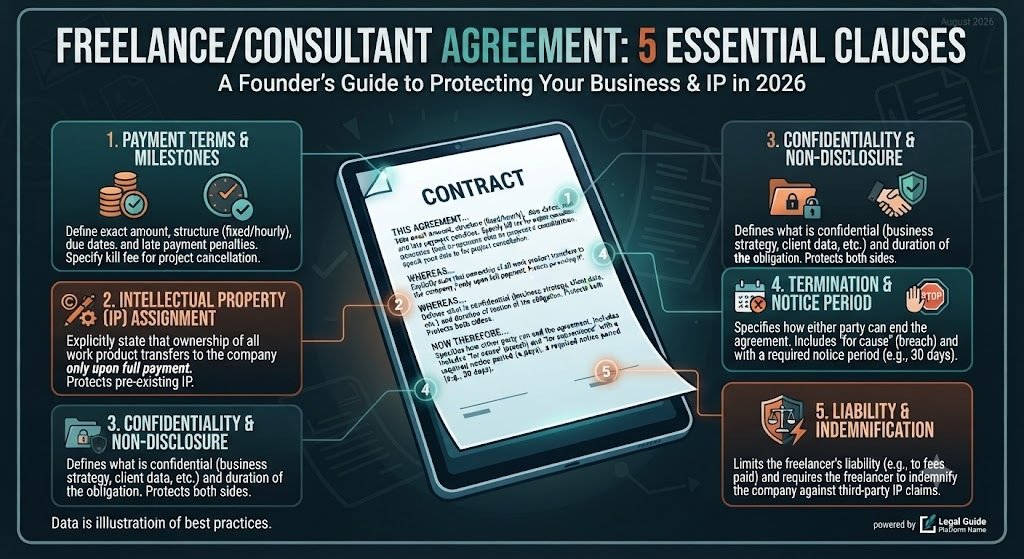
The freelance agreement clauses that matter most in 2026 are payment terms, IP ownership, confidentiality, termination, and liability — and in 17 years of drafting contracts, these five are the ones I see missing or badly worded far more often than anything else. A freelance or consultant agreement without clear language on these five areas isn’t really protecting anyone; it’s just a document that looks official until something goes wrong.
Why I’m Writing This
I’ve drafted and reviewed hundreds of freelance and consultant agreements over the years, and the pattern is almost always the same: the contract exists, both sides signed it, and it still didn’t prevent the dispute it was supposed to prevent. Not because the freelancer or the client acted in bad faith, but because the agreement never actually addressed the specific situation that came up later — a late payment, a disagreement over who owns the final work, a client sharing confidential information they shouldn’t have, or a messy exit when the relationship wasn’t working anymore.
If you’re a freelancer, consultant, or independent professional working with clients in 2026, this article walks through the five clauses I consider genuinely essential — not boilerplate, but the specific language that actually holds up when something goes sideways.
1. Payment Terms — More Than Just “How Much”
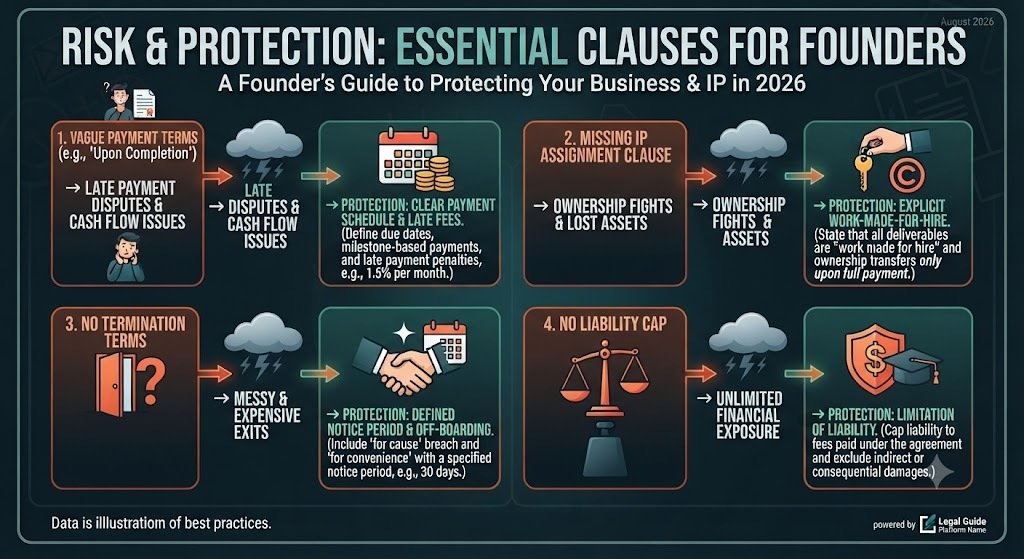
Payment disputes are, by a wide margin, the most common issue I see between freelancers and clients. And almost every time, the root cause isn’t a disagreement about the amount — it’s vague language about when, how, and what happens if payment is late.
What a solid payment clause should actually cover:
- Exact payment amount and structure — fixed fee, hourly rate, milestone-based, or retainer, spelled out precisely, not “as discussed.”
- Payment schedule — specific due dates, not vague terms like “upon completion” without defining what completion means.
- Late payment consequences — a defined late fee or interest rate for overdue payments, which gives you actual leverage rather than just an awkward follow-up email.
- Currency and payment method, especially relevant for freelancers working with international clients.
- Kill fee or partial payment terms — what you’re owed if a project is cancelled midway through.
I always tell freelancers: a payment clause without a late-payment consequence isn’t really a payment clause, it’s a suggestion. Clients generally respect deadlines more seriously when there’s an actual defined cost to missing them.
2. IP Ownership — Who Actually Owns What You Create
This is the clause I see cause the most confusion, largely because most people assume ownership works one way when the legal default is often different from what they expect. Under Indian copyright law, the default position without a clear contractual assignment can leave ownership ambiguous, which is exactly the kind of gap that leads to disputes later.
What needs to be explicit in an IP ownership clause:
- When ownership transfers — many agreements transfer IP only upon full payment, not upon delivery, which protects the freelancer if a client stops paying partway through.
- What’s actually being transferred — the final deliverable, or also underlying drafts, code, source files, and working materials.
- Pre-existing IP — if a freelancer uses their own tools, templates, code libraries, or frameworks built before the engagement, the agreement should clarify that ownership of those underlying assets stays with the freelancer, even if the final output incorporates them.
- Portfolio rights — whether the freelancer can showcase the completed work in their portfolio, which matters more to independent professionals than clients often realize until it’s negotiated after the fact.
I’ve written a more detailed breakdown of how contract language should actually protect you in our checklist on drafting a contract that actually protects you, which covers IP assignment language in more depth alongside other protective clauses.
3. Confidentiality — Protecting Both Sides, Not Just the Client
Most freelance agreements include a confidentiality clause protecting the client’s information, which makes sense — you’re often exposed to business strategy, client lists, financials, or unreleased products. But a well-drafted confidentiality clause should genuinely work both ways, and it’s worth checking whether yours actually does.
What a proper confidentiality clause covers:
- What counts as confidential information — defined clearly, rather than an overly broad “everything is confidential” clause that’s practically unenforceable and can also unfairly restrict you from ever discussing your own work.
- Duration of the obligation — confidentiality often needs to extend beyond the end of the engagement, and the clause should specify exactly how long.
- Carve-outs — information that’s already public, independently developed, or required to be disclosed by law shouldn’t be trapped under the confidentiality umbrella.
- Standalone NDA vs. embedded clause — for higher-stakes engagements, a separate, more detailed NDA signed before any sensitive information is even shared is often the safer approach rather than relying solely on a clause buried inside a broader agreement. If you’re regularly handling sensitive client information, it’s worth understanding what a strong NDA should actually include as context for how confidentiality obligations are typically structured.
4. Termination — How Either Side Can Actually Exit
I can’t count how many disputes I’ve seen arise not from the work itself, but from a messy, undefined exit. If your freelance agreement doesn’t specify how either party can end the engagement, you’re relying entirely on goodwill when the relationship sours — and goodwill tends to be in short supply exactly when you need clear terms most.
What a termination clause needs to address:
- Notice period — how much advance notice either party must give before ending the engagement, protecting both the freelancer’s income stability and the client’s project continuity.
- Termination for cause vs. convenience — cause typically covers breach of contract (non-payment, missed deliverables), while termination for convenience allows either side to exit without a specific reason, usually with a longer notice period.
- What happens to work in progress — whether partial payment is owed for incomplete work, and who owns what’s been completed so far.
- Post-termination obligations — return or deletion of confidential materials, final invoicing timelines, and any lingering confidentiality or IP terms that survive the end of the relationship.
A termination clause isn’t about expecting things to go wrong — it’s about making sure that if they do, neither side is left guessing about what happens next.
5. Liability — Limiting What You’re Actually On the Hook For
This is the clause freelancers most often skip entirely, usually because it feels overly formal or “not necessary for a small project.” I’d push back on that instinct hard. Liability clauses matter precisely because they define your exposure if something goes wrong — a missed deadline that costs the client money, an error in deliverables, or a dispute over how the work was used.
What a liability clause should include:
- Limitation of liability — capping your financial exposure, typically tied to the total fees paid under the agreement, rather than leaving your liability theoretically unlimited.
- Exclusion of indirect damages — protecting against claims for lost profits, business opportunities, or other indirect losses that go well beyond the value of the actual engagement.
- Indemnification terms — clarifying who’s responsible if a third party brings a claim related to the work, and under what circumstances.
- Insurance requirements, if relevant to your field — some client agreements specifically require freelancers to carry professional liability insurance, and it’s better to know that upfront than discover it mid-negotiation.
Without a liability clause, you could theoretically be exposed to damages far exceeding what you were ever paid for the work — which is a genuinely disproportionate risk for most freelance and consulting engagements.
A Quick Reality Check on Templates
I understand the appeal of a free template found online — it feels like a fast, low-cost way to get “something in writing.” But in my experience, generic templates are exactly where these five clauses tend to be weakest: payment terms too vague to enforce, IP language that doesn’t match your actual situation, confidentiality clauses copied from an unrelated industry, termination terms that don’t reflect how you actually work, and liability language that’s either missing entirely or too generic to hold up. A contract that looks complete on the surface but doesn’t reflect your actual working relationship isn’t much better than no contract at all.
Final Thoughts
If there’s one thing 17 years of drafting and reviewing contracts has taught me, it’s that disputes rarely start with someone acting in bad faith — they start with a contract that never clearly addressed the situation that eventually came up. Payment terms, IP ownership, confidentiality, termination, and liability aren’t just legal formalities; they’re the five areas where vague or missing language causes the most real-world damage to freelancers and consultants. If your current agreement is silent or vague on any of these, that’s worth fixing before your next engagement, not after a dispute forces the issue.
If you want a broader checklist for what a genuinely protective contract should include beyond just these five areas, my full guide on drafting a contract that actually protects you goes into more detail. And if you’re ready to get an agreement properly drafted or reviewed for your specific situation, you can reach out here — I’d rather help you get this right upfront than help you deal with the fallout later.
Frequently Asked Questions
What are the most important clauses in a freelance agreement? Payment terms, intellectual property ownership, confidentiality, termination conditions, and liability are the five clauses most likely to cause disputes if left vague or missing, making them the most important to get right in any freelance or consultant agreement.
Who owns the work in a freelance agreement if there’s no IP clause? Ownership can be genuinely ambiguous without a clear contractual assignment, which is exactly why an explicit IP ownership clause specifying when and what transfers is essential rather than assuming ownership works a certain way by default.
Do freelancers need a liability clause for small projects? Yes. Even smaller engagements can carry disproportionate financial exposure without a liability clause, since without one, your potential liability isn’t clearly limited to the value of the work itself.
Is a confidentiality clause inside a contract enough, or do I need a separate NDA? For lower-stakes engagements, a confidentiality clause within the main agreement is often sufficient. For higher-stakes work involving sensitive business information, a standalone NDA signed before any information is shared is generally the safer approach.
Can I use a free contract template instead of getting a custom agreement drafted? Templates can work for very low-stakes situations, but they frequently have weak or generic language around payment enforcement, IP assignment, and liability limits that don’t reflect your specific working relationship, which is where disputes tend to originate.
This article provides general information about common contract clauses and is not a substitute for personalized legal advice. Contract terms should be tailored to your specific situation, industry, and jurisdiction — consult a qualified lawyer before finalizing any agreement.