
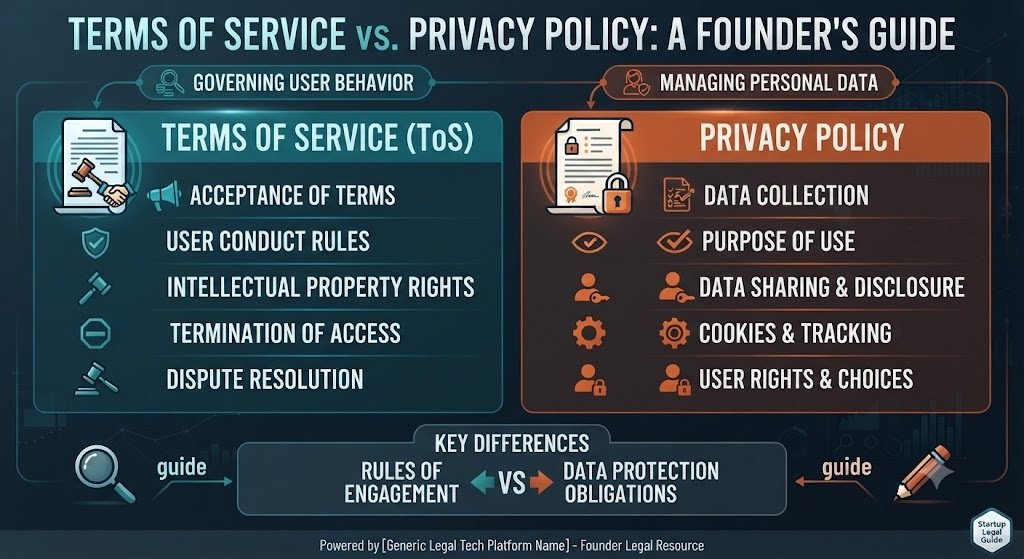
Almost every founder I talk to, whether they’re launching a SaaS product, an online store, or just a content site, asks me some version of the same question when it comes to Terms of Service vs Privacy Policy: “Don’t I just need one legal page covering everything?” The honest answer is no, and treating these as interchangeable is one of the most common legal gaps I see when reviewing a new business’s website. A Terms of Service and a Privacy Policy do two genuinely different jobs, protect you against two different kinds of risk, and skipping either one leaves a real gap in how your business is legally covered.
Let’s walk through exactly what separates them, why you need both regardless of what type of site you’re running, and what should actually go into each one for a SaaS product, an e-commerce store, or a content-driven website.
What a Terms of Service Actually Does
Your Terms of Service (sometimes called Terms of Use or a Terms and Conditions page) is essentially the rulebook governing the relationship between you and anyone using your website, app, or service. It sets the conditions under which people are allowed to use what you’ve built, and just as importantly, it protects you legally if something goes wrong.
A well-drafted Terms of Service typically covers:
- What users are and aren’t allowed to do on your platform
- Payment terms, refund policies, and subscription conditions (for paid products)
- Intellectual property ownership — yours and theirs
- Limitation of liability, protecting you from certain types of legal claims
- Account termination conditions
- Dispute resolution — how disagreements get handled if they escalate
This document is fundamentally about conduct and legal protection. It’s the same drafting discipline I cover in my checklist on drafting a contract that actually protects you — a Terms of Service is, functionally, a contract between you and every user, even though most people don’t think of it that way.
What a Privacy Policy Actually Does
A Privacy Policy is a completely different document with a completely different purpose. It exists specifically to disclose how you collect, use, store, and share personal data from anyone who interacts with your site or service. Unlike a Terms of Service, which is largely a matter of contractual choice, a Privacy Policy is a legal requirement in most jurisdictions the moment you collect any personal data — not an optional nicety.
A proper Privacy Policy typically covers:
- What personal data you collect (names, emails, payment details, browsing behavior, cookies, etc.)
- Why you collect it and how you use it
- Whether you share data with third parties, and under what circumstances
- User rights regarding their own data (access, correction, deletion)
- Data retention periods and security measures
- Compliance with applicable data protection laws
If you’re running a business with any Indian users, this is where laws like the DPDP Act come directly into play, requiring specific disclosures around consent, data retention, and grievance redressal that a generic template usually misses entirely.
Terms of Service vs Privacy Policy: The Core Difference
Here’s the simplest way I explain this distinction to clients: your Terms of Service governs behavior — what people can and can’t do, and what happens if there’s a dispute. Your Privacy Policy governs data — what you collect, why, and what rights people have over it.
| Aspect | Terms of Service | Privacy Policy |
|---|---|---|
| Primary purpose | Governs usage rules and legal protection | Discloses data collection and privacy practices |
| Legal requirement? | Recommended, largely contractual by choice | Legally mandated wherever personal data is collected |
| Covers | Conduct, IP, liability, payments, disputes | Data collection, storage, sharing, user rights |
| Who it protects | Primarily protects the business | Primarily protects the user (with compliance benefits for the business) |
| Governed by | General contract law principles | Data protection statutes (DPDP Act, GDPR, CCPA, etc.) |
| Changes trigger | Usually just require posting an update | Often require re-consent depending on the change |
Why You Genuinely Need Both — Not Just One
I’ve seen businesses try to combine these into a single “Legal” page, and it almost always creates problems. A Terms of Service without a Privacy Policy leaves you non-compliant with data protection law the moment you collect an email address for a newsletter signup. A Privacy Policy without a Terms of Service leaves you with no defined usage rules, no liability protection, and no clear framework for handling disputes or bad-faith users.
They’re not redundant — they’re complementary. Your Terms of Service protects your business operationally. Your Privacy Policy protects your users’ data rights while keeping you compliant with the law. Skipping either one leaves a real, identifiable gap that becomes obvious the moment something actually goes wrong — a payment dispute, a data breach, a user violating your platform’s rules in a way you have no documented right to act on.
Terms of Service and Privacy Policy for SaaS Products
SaaS businesses have some of the highest-stakes requirements here, since you’re typically handling recurring payments, user accounts, and often business-sensitive customer data.
Your Terms of Service should specifically address:
- Subscription billing cycles, auto-renewal terms, and cancellation policies
- Service Level Agreements (SLAs) or uptime commitments, if you’re making any
- API usage limits and acceptable use restrictions
- What happens to a user’s data if they cancel or their account is terminated
- Liability limitations specific to service outages or data loss
Your Privacy Policy should specifically address:
- Data processed on behalf of your customers versus data you control directly (this distinction matters enormously for B2B SaaS)
- Sub-processors and third-party tools you use (analytics, payment processors, hosting providers)
- Data residency — where customer data is actually stored
- Compliance commitments relevant to your customer base (DPDP Act for Indian users, GDPR for EU users, etc.)
Terms of Service and Privacy Policy for E-Commerce Sites
E-commerce brings its own specific legal exposure, mainly around payments, shipping, and returns.
Your Terms of Service should specifically address:
- Order acceptance and cancellation rights (yours and the customer’s)
- Return, refund, and exchange policies stated clearly and specifically
- Shipping timelines and liability for delayed or lost shipments
- Pricing error handling — what happens if a product is mistakly listed at the wrong price
- Product warranty disclaimers, where relevant
Your Privacy Policy should specifically address:
- Payment data handling, even when processed through a third-party gateway
- Shipping address and contact data usage
- Marketing communication opt-ins and opt-outs
- Cookie usage for cart abandonment tracking, retargeting ads, or personalization
Terms of Service and Privacy Policy for Content Sites and Blogs
Even a simple content site or blog needs both documents, though the scope is generally lighter than SaaS or e-commerce.
Your Terms of Service should specifically address:
- Content usage rights — can visitors republish or quote your material, and under what conditions
- Comment section rules and moderation policies, if applicable
- Disclaimers around any advice-style content (financial, legal, medical) to limit liability
- Affiliate link or sponsored content disclosures
Your Privacy Policy should specifically address:
- Newsletter or email list data collection
- Analytics and advertising cookies (Google Analytics, ad networks, etc.)
- Comment section data (names, emails left in comments)
- Any user account functionality, if your site has logins or memberships
A Practical Template Outline You Can Adapt
Regardless of which category your site falls into, here’s a structural outline that works as a starting point for both documents:
Terms of Service outline:
- Acceptance of terms
- Description of service
- User obligations and prohibited conduct
- Payment terms (if applicable)
- Intellectual property
- Limitation of liability
- Termination
- Dispute resolution and governing law
- Changes to terms
Privacy Policy outline:
- What data is collected
- How and why it’s used
- Legal basis for processing (especially relevant under DPDP Act or GDPR)
- Third-party sharing and sub-processors
- Data retention periods
- User rights and how to exercise them
- Cookie usage
- Grievance redressal / contact information
- Changes to the policy
This is a starting structure, not a finished document — the actual language needs to reflect your specific business, your specific data practices, and the specific laws that apply to your users. If you’re drafting a Privacy Policy specifically for Indian users, getting the DPDP Act’s consent, grievance redressal, and children’s data provisions right is where most generic templates fall short — this is the kind of gap I help clients close directly.
Common Mistakes I See Founders Make
Using one generic “Legal” page for both. This almost always under-serves one document or the other, and creates ambiguity about which rules actually apply to what.
Copying a competitor’s policy word-for-word. Beyond the obvious IP concerns, their data practices, business model, and legal exposure are rarely identical to yours, so their document won’t actually protect you correctly.
Never updating either document as the business evolves. Adding a new payment processor, a new data-sharing partnership, or a new feature often requires updates to both documents — most founders only remember this after something’s already gone wrong.
Treating these as a one-time task instead of ongoing maintenance. Just like the contract review principle I mentioned earlier — going back through a document again and again is what actually makes it hold up, not writing it once and forgetting about it.
I’ve spent enough time reviewing both contracts and compliance documents — including the shift from traditional legal practice into building VelaPDF and Malik Times myself — to know that most legal gaps aren’t dramatic. They’re just quiet, unaddressed risks sitting in a founder’s footer links until the day they actually matter.
Final Thoughts
Your Terms of Service and Privacy Policy aren’t interchangeable, and treating them as one combined afterthought is one of the most common gaps I see when reviewing a business’s legal setup. The Terms of Service protects your business and sets clear usage rules; the Privacy Policy protects your users’ data and keeps you compliant with the law. Whether you’re running a SaaS platform, an e-commerce store, or a simple content site, you need both — tailored specifically to how your business actually operates, not copied from a generic template. If you’d like a second set of eyes on either document, you can learn more about my practice and get in touch here.
Frequently Asked Questions
Can I combine my Terms of Service and Privacy Policy into one document? You can, but it’s generally not advisable. Combining them tends to make each section less specific, and it can create confusion about which provisions govern usage rules versus data handling, which matters if a dispute or compliance issue ever arises.
Is a Privacy Policy legally required even for a small blog? Yes, if your blog collects any personal data at all — email signups, comment forms, analytics cookies — you’re subject to disclosure requirements under most data protection laws, including the DPDP Act if you have users in India, regardless of how small your site is.
Do I need a lawyer to draft these, or can I use a template? Templates can be a reasonable starting point, but they rarely reflect your specific data practices, business model, or the exact laws applicable to your users. A lawyer’s review before publishing is worth the cost, especially for SaaS and e-commerce businesses handling payments or larger volumes of user data.
How often should I update my Terms of Service and Privacy Policy? Review both any time you add a new feature, payment processor, third-party tool, or data-sharing arrangement. Beyond that, a periodic review — at least annually — helps catch gaps before they become actual legal problems.
Parvez Ali is a Contract Lawyer based in Saharanpur, Uttar Pradesh, working with individuals and businesses on contract drafting, review, and data compliance. Learn more at ParvezAli.me.