
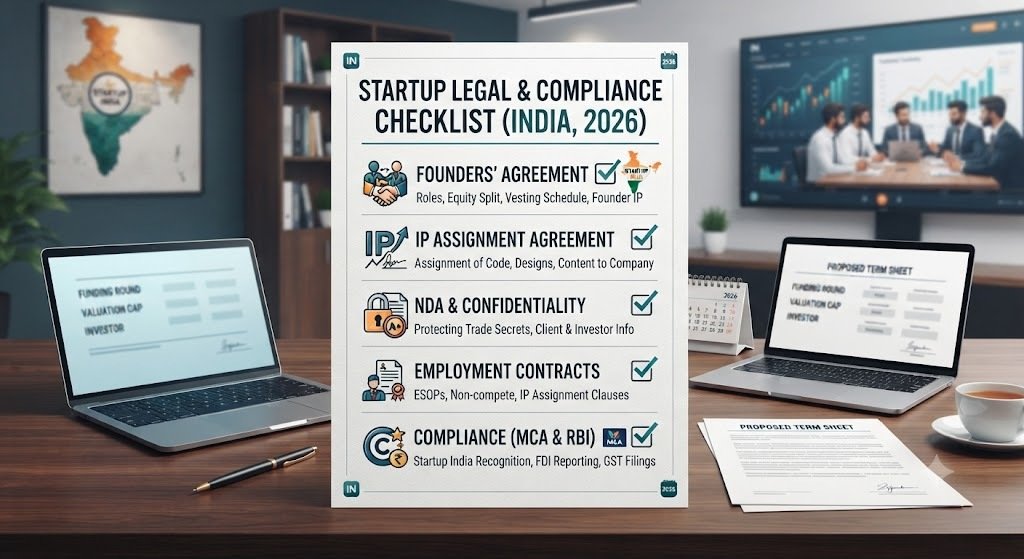
A solid legal checklist for Indian startups before raising their first round is the difference between walking into due diligence with confidence and scrambling to fix gaps an investor’s lawyer just flagged. I’ve spent 17 years drafting the exact documents this checklist covers, and the pattern is remarkably consistent: founders rarely lose deals over their product or their numbers. They lose time, leverage, and sometimes equity over legal basics that could have been sorted out months earlier — a missing founders’ agreement, IP that was never formally assigned to the company, or an NDA that wouldn’t actually hold up if tested.
This matters even more if you’re building outside India’s usual metro startup hubs. Founders in Tier 2 and Tier 3 cities often have less direct access to experienced startup counsel, which means legal readiness gets pushed down the priority list until an investor’s diligence checklist forces the issue — usually at the worst possible time, mid-negotiation. A proper legal checklist for startups in India before funding isn’t about hiring an army of lawyers before you’ve made a single sale. It’s about getting a handful of foundational documents right, early, so they never become a bottleneck when a term sheet finally lands on your desk.
This guide walks through exactly what that checklist looks like: your founders’ agreement, IP assignment, NDAs, employment contracts, and basic compliance — the five areas that come up again and again in early-stage due diligence. For broader context on what’s happening in India’s funding ecosystem right now, Malik Times covers ongoing funding rounds and startup news that’s worth following alongside this checklist.
1. Founders’ Agreement: Get Equity and Roles in Writing Before You Need To
A founders’ agreement India before seed round situation is one of the most common gaps I see — and one of the most dangerous, because it’s invisible until a disagreement forces it into the open. Verbal understandings between co-founders work fine right up until they don’t, and by the time a disagreement surfaces, there’s rarely a clean way to resolve it without a written agreement to fall back on.
A proper founders’ agreement should cover:
- Equity split — Who owns what percentage, and on what basis it was decided.
- Vesting schedule — Standard practice is a four-year vesting period with a one-year cliff, protecting the company if a co-founder leaves early.
- Roles and decision-making authority — Who has final say on what, and how disputes between founders get resolved.
- Exit clauses — What happens to a departing founder’s equity, and under what circumstances the company can buy it back.
Investors specifically look for this document during diligence because an unresolved founder dispute is one of the fastest ways a startup unravels post-funding. If you don’t have one in place yet, my guide on how to draft a contract that actually protects you covers the same principles that apply directly to founders’ agreements, and you can get your founders’ agreement drafted before you’re mid-negotiation and under time pressure.
2. IP Assignment: Make Sure the Company Actually Owns What It’s Selling
An IP assignment agreement for startups India situation catches more founders off guard than almost anything else on this list, because the assumption is usually “of course the company owns it — I built it.” Legally, that’s often not true unless it’s been formally assigned.
Here’s where this typically goes wrong:
- Code, designs, or content built before incorporation — If a founder built the core product before the company legally existed, that IP technically belongs to the individual unless it’s later assigned to the entity.
- Work done by freelancers or contractors — Without an explicit IP assignment clause in the contract, a freelancer may retain rights to what they built, even if you paid for it.
- Co-founder contributions — Each founder’s individual contributions need to be assigned to the company, not just assumed to belong to it by default.
Investors will ask for a clean IP chain of title during diligence, and gaps here can genuinely delay or derail a funding round. If your team includes contractors or freelancers, this connects directly to how your NDAs and contracts are worded — worth reviewing together with your founders’ and business agreements rather than treating IP assignment as a separate, standalone document.
3. NDAs: Protect What You Share With Investors, Hires, and Partners
An NDA for startup funding India conversation almost always comes up the moment you start pitching — but the quality of that NDA matters far more than simply having one. A copy-pasted template downloaded from Google often doesn’t hold up the way founders assume it will, particularly around enforceability and scope.
A strong NDA for a fundraising context should specify:
- What information is actually protected — Vague, catch-all language is weaker than a clearly defined scope of confidential information.
- Mutual vs one-way structure — Investor conversations often warrant a mutual NDA, while hiring or vendor conversations may only need one-way protection.
- Time-bound vs indefinite terms — How long the confidentiality obligation lasts matters, especially for information tied to a product roadmap that will eventually become public.
- Enforceability under Indian law — An NDA that isn’t properly structured for Indian jurisdiction offers far less real protection than founders assume.
Most investors won’t sign an overly broad or poorly worded NDA before a first meeting anyway, so it’s worth having a properly drafted version ready rather than improvising one under time pressure. I go deeper on the exact clauses that separate an enforceable NDA from a template on my NDA drafting and review service page.
4. Employment and Consultant Contracts: Formalize Your Early Team
Employment contracts for early stage startups India get deprioritized constantly, usually because early hires feel more like informal arrangements between people who already trust each other. That trust is exactly why formal contracts matter — they protect the relationship, not just the company.
At minimum, your early-stage contracts should cover:
- Role, compensation, and reporting structure — Written clearly enough that there’s no ambiguity later.
- IP assignment clauses — As covered above, every employee and consultant contract should explicitly assign work product to the company.
- Confidentiality obligations — Especially important for early hires who’ll have access to product details, financials, or strategy before any of it is public.
- Termination terms — Notice periods, severance (if any), and what happens to unvested equity or ESOPs on exit.
Consultant and freelance contracts need particular attention, since the legal relationship (and the IP ownership implications) differ meaningfully from full-time employment. Getting this right at the five- or ten-person stage is far easier than untangling it later once you’ve scaled. My guide on drafting contracts that actually protect you applies directly here, and it’s worth reading before you send out your next offer letter.
5. Basic Compliance Checklist: Incorporation, DPDP, and Core Registrations
A startup compliance checklist India Tier 2 cities founders can actually work through doesn’t need to be exhaustive at the seed stage — but a few basics are non-negotiable before you raise:
- Incorporation documents in order — MOA, AOA, and shareholding records should be complete, accurate, and consistent with what you’ve told investors verbally.
- DPDP Act readiness — If your product collects any user data, India’s Digital Personal Data Protection Act 2023 requires proper consent mechanisms and a compliant privacy policy. My detailed DPDP Act 2023 compliance checklist walks through exactly what this requires in practice, not just in theory.
- Terms of Service and Privacy Policy — If you run any website, app, or online product, these aren’t optional formalities. I’ve written specifically about the difference between Terms of Service and Privacy Policy and why most startups need both, not just one.
- Basic tax and statutory registrations — GST registration, PF/ESI if applicable, and any sector-specific licenses relevant to your business.
Founders outside major metro startup hubs sometimes assume compliance requirements are lighter for smaller or regional companies. They’re not — the DPDP Act, for example, applies uniformly regardless of where your company is incorporated or how large your user base currently is.
Conclusion: Your Next Steps Before You Start Fundraising Conversations
None of the five areas covered here require a large legal budget to get right — what they require is getting to them before an investor’s diligence checklist forces the issue. A founders’ agreement, proper IP assignment, enforceable NDAs, solid employment contracts, and basic DPDP compliance are the foundation that everything else in a funding round gets built on top of.
If you’re a founder — especially one building outside India’s traditional metro startup corridors — working through this checklist now, rather than during active fundraising, puts you in a materially stronger negotiating position when a term sheet does arrive.
A few practical next steps:
- Book a legal review of your current founders’ agreement, contracts, and compliance documents before you start investor conversations.
- Explore more startup legal guides covering contracts, NDAs, and compliance in more depth.
- Follow ongoing funding rounds and startup developments on Malik Times, a business and startup news platform.
- If you need to securely merge, convert, or manage your incorporation and compliance documents, VelaPDF offers free PDF tools built with the same document-handling care that goes into this checklist.
Getting your legal foundation right isn’t the exciting part of building a startup — but it’s the part that protects everything else you’re building. If you’d like a second pair of eyes on where your startup currently stands, get in touch and let’s go through it together.