
Partnership vs LLP vs Private Limited is the first real legal decision almost every founder in India has to make, and honestly, it’s one that quietly shapes everything that comes after — how much personal risk you’re carrying, how much paperwork you’ll be filing every year, how much tax you’ll pay, and whether an investor will even take your cap table seriously. I’ve sat across the table from enough founders to know that most people don’t get this wrong because they’re careless. They get it wrong because nobody explained it to them properly before they signed on the dotted line at the Registrar’s office. This guide is my attempt to fix that — a full, practical comparison of partnership firms, Limited Liability Partnerships (LLPs), and Private Limited Companies, built around the five things that actually matter: liability, compliance burden, taxation, fundraising ability, and ease of setup.
If you’ve landed here searching “LLP vs private limited company,” “partnership firm vs LLP,” or “which business structure is best in India,” you’re in the right place. Let’s go through this properly, the way I would with a client sitting in my office.
Why Your Choice of Business Structure Matters More Than You Think
Before we get into the comparison, it’s worth understanding why this decision isn’t just a formality. Your business structure decides:
- Who is legally liable if the business runs into debt or gets sued
- How much compliance work (and cost) you’re signing up for every year
- How your profits are taxed — and how much of that tax you can legally plan around
- Whether you can raise equity funding from angel investors or VCs
- How easy or hard it is to bring in new partners, transfer ownership, or exit later
A lot of founders pick a structure based on what their friend used, or what their CA suggested in five minutes, without really weighing the trade-offs. That’s fine when the business stays small. It becomes a real problem the moment you want to raise funding, hire aggressively, or protect personal assets from business risk. If you’ve already read my piece on company winding up in India, you’ll know that unwinding the wrong structure later is far more expensive — in time, money, and stress — than choosing correctly at the start.
What Is a Partnership Firm?
A partnership firm is the oldest and simplest form of doing business with more than one person, governed in India by the Indian Partnership Act, 1932. Two or more people agree — usually through a partnership deed — to run a business together and share profits and losses in an agreed ratio.
Key features of a partnership firm:
- No separate legal identity — the firm and the partners are legally the same
- Registration with the Registrar of Firms is optional (though strongly recommended)
- Governed almost entirely by the partnership deed the partners sign
- Minimum two partners, maximum limit generally capped at 50 partners
- Relatively informal and inexpensive to set up
This is where a well-drafted partnership deed becomes critical — I’ve written a detailed comparison in Partnership Deed vs LLP Agreement that walks through exactly what each document needs to cover and where founders typically leave dangerous gaps. If your partnership deed doesn’t spell out profit-sharing, exit terms, and dispute resolution clearly, you’re essentially running the business on trust alone — and trust is not a legal defence.
What Is an LLP (Limited Liability Partnership)?
An LLP, governed by the Limited Liability Partnership Act, 2008, is a hybrid structure — it gives you the operational flexibility of a partnership but wraps it in the limited liability protection of a company. This is exactly why LLPs have become so popular among consultants, service businesses, and professional firms (CAs, lawyers, architects) over the last decade.
Key features of an LLP:
- Separate legal entity, distinct from its partners
- Partners’ liability is limited to their agreed contribution — personal assets are protected
- Governed by an LLP Agreement, filed with the Ministry of Corporate Affairs (MCA)
- Minimum two designated partners; no upper limit on partners
- Mandatory registration with MCA, unlike a partnership firm
The LLP Agreement functions much like a founder agreement — it needs to be drafted with the same care you’d put into any commercial contract. If you’re comparing which document suits your situation, my earlier post on Partnership Deed vs LLP Agreement breaks this down clause by clause.
What Is a Private Limited Company?
A Private Limited Company, incorporated under the Companies Act, 2013, is the most formal and most “fundable” of the three structures. It’s a completely separate legal entity from its shareholders and directors, with perpetual succession — meaning the company continues to exist even if shareholders change.
Key features of a Private Limited Company:
- Fully separate legal entity with its own PAN, bank account, and legal standing
- Shareholders’ liability limited strictly to the value of their shares
- Minimum two directors and two shareholders (can be the same people)
- Maximum 200 shareholders
- Heaviest compliance load of the three, but also the most credible structure for investors, banks, and large clients
If you’re building anything that might raise external capital — angel money, VC funding, or even a structured founder-investor deal — this is usually the default choice. And once a term sheet is on the table, the legal complexity multiplies fast. I’ve covered what actually happens at that stage in An Investor Sent Me a Term Sheet. Do I Need a Lawyer? — worth reading before, not after, you sign anything.
Partnership vs LLP vs Private Limited – Key Differences at a Glance
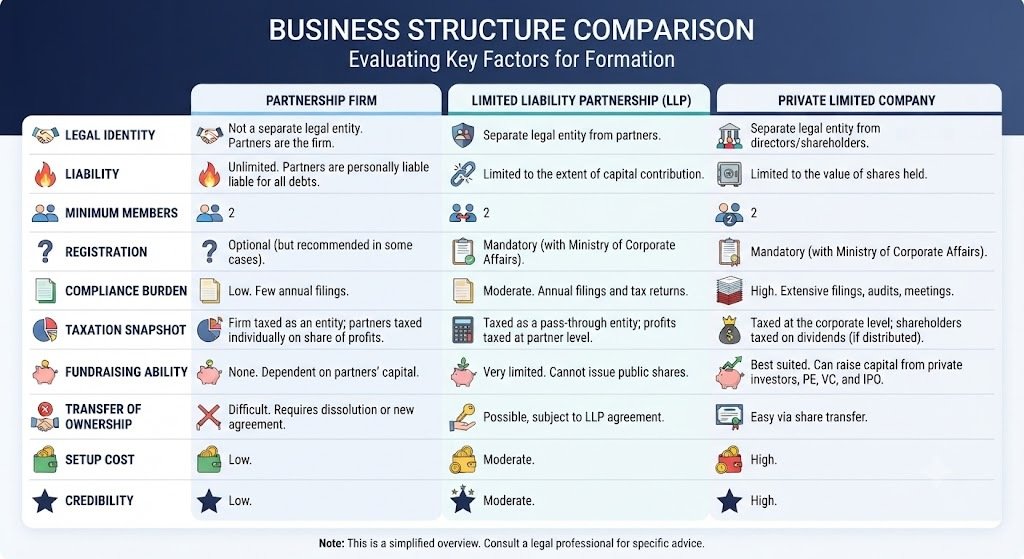
Here’s the side-by-side comparison founders ask me for most often:
| Parameter | Partnership Firm | LLP | Private Limited Company |
|---|---|---|---|
| Governing Law | Indian Partnership Act, 1932 | LLP Act, 2008 | Companies Act, 2013 |
| Legal Identity | No separate entity | Separate legal entity | Separate legal entity |
| Liability | Unlimited (personal assets at risk) | Limited to capital contribution | Limited to share value |
| Minimum Members | 2 partners | 2 designated partners | 2 directors + 2 shareholders |
| Registration | Optional (recommended) | Mandatory with MCA | Mandatory with MCA |
| Compliance Burden | Low | Moderate | High |
| Annual Filings | Income tax return only | Form 8, Form 11, ITR | AOC-4, MGT-7, ITR, board meetings |
| Taxation | 30% flat + surcharge | 30% flat + surcharge | 22-25% (concessional rates available) |
| Fundraising (Equity) | Not possible | Very limited | Best suited — VCs, angels prefer this |
| Transfer of Ownership | Difficult, needs partner consent | Moderate, per LLP agreement | Easiest — share transfer |
| Cost of Setup | Lowest | Moderate | Highest |
| Credibility with Banks/Clients | Lower | Moderate | Highest |
Liability Comparison: Where Your Personal Assets Stand
This is, in my experience, the single most underestimated factor when founders compare partnership vs LLP vs private limited structures.
In a partnership firm, liability is unlimited and joint. If the business can’t pay a debt, creditors can go after the partners’ personal assets — homes, savings, vehicles — not just what’s inside the business. Worse, each partner is jointly and severally liable, meaning you could be held responsible for a debt your co-partner incurred without your knowledge.
In an LLP, your liability is capped at whatever capital you contributed. Your personal assets stay protected unless there’s fraud or gross negligence involved.
In a Private Limited Company, the “corporate veil” gives shareholders the strongest protection — liability is limited strictly to the unpaid value of your shares. This is exactly why most professional advisors recommend LLP or Private Limited over a plain partnership the moment a business starts taking on real financial risk, vendor contracts, or loans.
Compliance Burden Comparison
Compliance is where the “which is easier to run” question actually gets answered.
- Partnership firms have the lightest compliance load — essentially just annual income tax filing. No mandatory audits unless turnover crosses prescribed thresholds.
- LLPs must file Form 11 (Annual Return) and Form 8 (Statement of Accounts) with the MCA every year, along with income tax returns. Audits are required only if turnover exceeds ₹40 lakh or capital contribution exceeds ₹25 lakh.
- Private Limited Companies carry the heaviest compliance burden: mandatory statutory audits regardless of turnover, board meetings, annual filings (AOC-4, MGT-7), maintenance of statutory registers, and ROC compliance. Missed deadlines attract steep penalties.
This compliance gap is exactly why so many small service businesses stick with an LLP — they get liability protection without the operational overhead of running a full-fledged company. It’s also worth remembering that if your business runs a website or collects user data — which most companies do today — compliance doesn’t stop at the MCA. You’ll also need a compliant Privacy Policy under India’s data protection framework; I’ve put together a full DPDP Act 2023 Privacy Policy compliance checklist that applies regardless of which structure you choose.
Taxation Comparison
Tax treatment is nearly identical for partnerships and LLPs, but Private Limited Companies have access to more favourable rates and planning options.
- Partnership firms and LLPs are taxed at a flat 30% on profits, plus applicable surcharge and cess. Partners’ remuneration and interest on capital are deductible within prescribed limits, which does offer some tax planning room.
- Private Limited Companies can opt for concessional tax regimes — 22% (plus surcharge and cess) under Section 115BAA for existing companies, or 15% for certain new manufacturing companies under Section 115BAB. Dividend distribution to shareholders is taxed in the hands of the recipient.
Neither structure is universally “better” on tax — it genuinely depends on how profits are extracted, reinvested, and how much you’re paying yourself as salary versus dividend. This is one area where I’d always recommend sitting down with a CA alongside your legal advisor before finalising the structure.
Fundraising Ability: The Deciding Factor for Startups
If there’s one factor that ends the “partnership vs LLP vs private limited” debate instantly for most startups, it’s this: you cannot raise equity funding in a partnership firm or LLP.
- Partnership firms have no concept of “shares” — there’s simply nothing to sell to an investor.
- LLPs can technically bring in new partners and their capital, but the structure is unfamiliar and unattractive to institutional investors, VCs, and angel networks. Very few funds will write a cheque into an LLP.
- Private Limited Companies are built for this. Shares can be issued, valued, and transferred. SAFE notes, convertible instruments, ESOPs, and structured cap tables all work cleanly within a Private Limited framework — which is precisely why almost every VC-backed startup in India is incorporated this way.
If fundraising is even a remote possibility in your roadmap — six months or three years from now — incorporate as a Private Limited Company from day one. Converting an LLP or partnership into a Private Limited Company later is possible, but it’s slower, costlier, and involves more paperwork than most founders expect.
Ease of Setup and Registration Process
- Partnership Firm: Draft a partnership deed, get it notarised, optionally register with the Registrar of Firms. Can be operational within days. Lowest cost of the three.
- LLP: Reserve a name via MCA’s RUN-LLP service, obtain Digital Signature Certificates (DSC) and Designated Partner Identification Numbers (DPIN), file incorporation documents, draft and file the LLP Agreement. Typically takes 10-15 working days.
- Private Limited Company: Reserve a name, obtain DSCs and DINs for all directors, file the SPICe+ form with MCA covering incorporation, PAN, TAN, EPFO, and ESIC registration together. Usually takes 10-20 working days depending on document readiness.
One thing founders often overlook at this stage: you’ll need a registered office address for both LLP and Private Limited incorporation, which usually means a proper lease or rent agreement in the company’s name. If you’re setting that up, it’s worth understanding the difference covered in Rent Agreement vs Lease Agreement in India — using the wrong document type here can actually delay your incorporation.
Decision Matrix – Which Structure Fits Your Business?
Use this quick decision matrix to narrow down your choice:
| Your Situation | Recommended Structure |
|---|---|
| Small family business, no external funding needed, low risk | Partnership Firm |
| Two friends running a consultancy or service business | LLP |
| Professional services firm (CA, legal, design, IT services) | LLP |
| Planning to raise angel/VC funding within 1-3 years | Private Limited Company |
| Tech startup with scaling ambitions | Private Limited Company |
| High-risk business (import/export, manufacturing, heavy contracts) | Private Limited Company or LLP |
| Solo founder testing an idea with minimal capital | Partnership Firm or Sole Proprietorship initially |
| Business plans to offer ESOPs to future employees | Private Limited Company |
| Low compliance appetite, want liability protection | LLP |
| Building something to eventually sell/exit | Private Limited Company |
When Founders Get This Wrong
In my seventeen years of drafting agreements for founders, the most common mistake I see isn’t picking the “wrong” structure outright — it’s picking a structure without documenting the relationship between the people involved properly. A partnership without a solid deed, or an LLP without a clear LLP Agreement, is a lawsuit waiting for a reason. Before you even finalise your structure, if you and your co-founder have discussed the business informally, it’s worth getting a basic understanding documented — I’ve explained when that document is legally binding in MOU vs Contract – Is a Memorandum of Understanding Legally Binding in India?. And if you’re bringing on freelancers or contractors early on, regardless of which structure you choose, get the basics right using the clauses I’ve listed in 5 Essential Clauses Every Freelance Agreement Needs.
Frequently Asked Questions
1. What is the main difference between partnership, LLP, and private limited company? The core difference is liability and legal identity. A partnership firm has unlimited liability and no separate legal identity from its partners. An LLP and a Private Limited Company are both separate legal entities offering limited liability, but a Private Limited Company has stricter compliance requirements and is better suited for raising equity funding.
2. Which is better for a startup — LLP or private limited company? For most startups planning to raise external funding, hire aggressively, or offer ESOPs, a Private Limited Company is the better choice. If you’re running a small service or consultancy business with no funding plans, an LLP offers similar liability protection with far less compliance work.
3. Can a partnership firm be converted into an LLP or private limited company later? Yes, both conversions are legally possible under the LLP Act and Companies Act respectively. However, conversion involves additional paperwork, potential tax implications, and time — so it’s usually more efficient to choose the right structure at incorporation if you can reasonably predict your growth path.
4. Is GST registration different for partnership, LLP, and private limited company? GST registration requirements are based on turnover and business activity, not the legal structure itself, so the process is broadly similar across all three. However, the documentation required (PAN, incorporation certificate, partnership deed or LLP agreement) differs based on which structure you’ve chosen.
5. Which business structure has the lowest compliance cost in India? A partnership firm has the lowest ongoing compliance cost since it only requires annual income tax filing and no mandatory MCA filings. An LLP has moderate compliance costs, while a Private Limited Company has the highest due to mandatory audits, board meetings, and ROC filings.
6. Can I raise funding from investors if I register as an LLP? Technically you can bring in new partners and their capital, but institutional investors, angel networks, and VCs overwhelmingly prefer investing in Private Limited Companies because of the familiar shareholding structure, ease of instruments like SAFE notes and CCPS, and clearer exit mechanisms.
7. What is the minimum number of people required to start each structure? A partnership firm needs a minimum of two partners. An LLP needs a minimum of two designated partners. A Private Limited Company needs a minimum of two directors and two shareholders — though one person can hold both roles.
8. Is a private limited company always taxed at a lower rate than a partnership or LLP? Not automatically — Private Limited Companies can opt into concessional tax regimes (22% or 15% under specific conditions), while partnerships and LLPs are taxed at a flat 30%. However, the effective tax outcome depends heavily on how profits are distributed and reinvested, so this should be evaluated with a tax professional based on your specific numbers.
9. Do I need a lawyer to choose between partnership, LLP, and private limited company? You don’t strictly need a lawyer to register any of these structures, but given how expensive it is to fix the wrong structure later — especially once investors, co-founders, or debt are involved — it’s worth getting the founding documents (partnership deed, LLP agreement, or founder agreement) properly reviewed before you sign.
10. Which structure is easiest to shut down if the business doesn’t work out? A partnership firm is generally the simplest and least expensive to dissolve, since it involves minimal regulatory formality. Closing an LLP or Private Limited Company requires formal procedures under the LLP Act or Companies Act, including regulatory filings and, in some cases, a longer winding-up process.
Final Thoughts
There’s no single “best” answer to partnership vs LLP vs private limited — there’s only the best answer for where your business actually is, and where you honestly intend to take it. If you’re testing an idea with a friend and don’t expect to raise outside money, a well-documented partnership or LLP will serve you fine. If you’re building something that could scale, attract investors, or bring on a team with ESOPs, incorporating as a Private Limited Company from day one will save you a painful and expensive conversion process later.
Whatever you choose, the structure only protects you as well as the documents behind it — the partnership deed, the LLP agreement, or the founder and shareholder agreements that govern how you and your co-founders actually work together. That’s the part most founders get wrong, and it’s the part I help fix. If you’d like a second opinion on which structure fits your specific situation, or need your founding documents drafted properly the first time, get in touch here.