
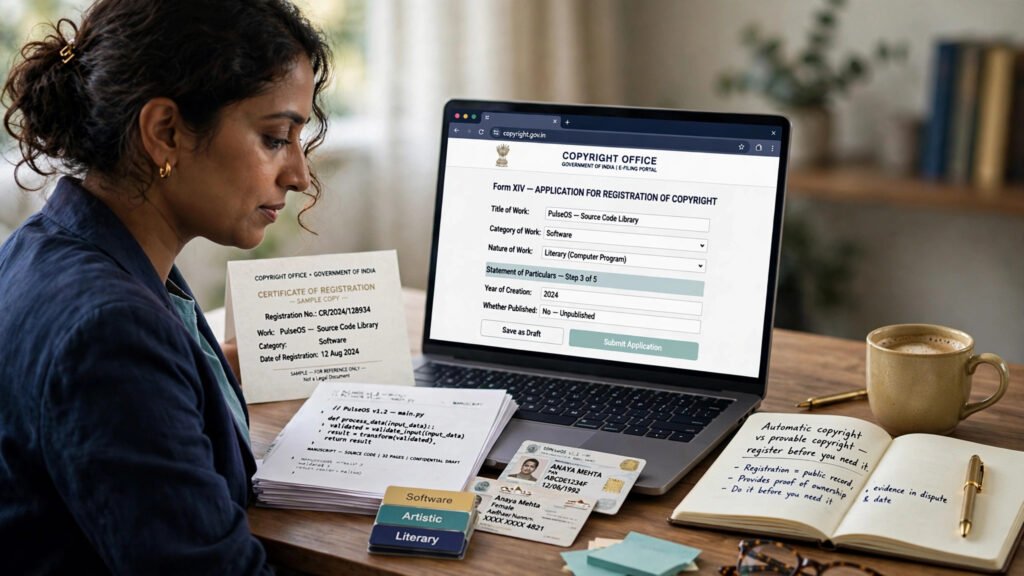
Copyright registration in India is something I get asked about almost as often as NDAs — usually right after a client has already been copied, and rarely before. A writer finds their blog post republished under someone else’s name. A software founder discovers a competitor’s app running suspiciously familiar code. A musician sees their track reused in an ad they never approved. In every one of these conversations, the first question is the same: “Could I have stopped this if I’d registered my copyright?” The honest answer is almost always yes — and this guide exists so you don’t have to find that out the hard way.
I’ve spent seventeen years drafting the kind of agreements that prevent disputes before they happen, and copyright sits right at the center of that work — especially now that I run an editorial platform and a document-tools product myself. This guide walks through exactly what copyright registration in India involves: what qualifies for protection, the step-by-step Form XIV process, the actual government fees, realistic timelines, and what to do when someone infringes your work online.
What Is Copyright Registration in India, and Do You Actually Need It?
Here’s something most guides bury halfway through, but you deserve to know upfront: under Section 13 of the Copyright Act, 1957, copyright in an original literary, dramatic, musical, or artistic work, a cinematograph film, or a sound recording arises automatically the moment you create it. You don’t need to register anything for copyright to exist.
So why register at all? Because automatic copyright and provable copyright are two very different things when you’re standing in front of a judge, a platform’s legal team, or an infringer’s lawyer. A registration certificate issued by the Copyright Office is prima facie evidence of ownership and the date of creation — something that’s genuinely difficult to establish after the fact if your only proof is a file on your laptop with an editable “created” timestamp. Registration under Section 45 is voluntary, but it’s the difference between saying “this is mine” and being able to prove it in minutes rather than months.
If you’re a content creator, author, musician, software developer, photographer, or business owner in India, registration is one of the most affordable legal protections available to you — often costing less than a single client dinner, for protection that can last decades.
What Can Actually Be Copyrighted in India?
The Copyright Act, 1957 protects several distinct categories of original work, and understanding which bucket your work falls into matters because it determines both the fee and the required documentation:
- Literary works — books, articles, blog posts, poems, and — importantly — computer software and source code, which are legally classified as literary works in India
- Dramatic works — scripts, screenplays, choreography
- Musical works — musical notations and compositions (separate from the recording itself)
- Artistic works — paintings, logos, illustrations, photographs, sculptures, and graphic designs
- Cinematograph films — movies, advertisements, promotional videos, and other visual recordings
- Sound recordings — the actual recorded audio, distinct from the underlying musical composition
One detail that trips up a lot of founders: if your startup has a website, you likely have four or five separately copyrightable works sitting on it right now — the written content (literary), the visual design and logo (artistic), any original background music (musical), and promotional videos (cinematograph film). Each one needs its own application and its own fee. You cannot bundle them into a single filing, and I’d genuinely encourage you to prioritize registering whichever of these represents your actual commercial value first — for most SaaS founders, that’s source code; for content platforms, it’s the written work itself.
What Cannot Be Copyrighted
Equally important is knowing the limits. Copyright protects the expression of an idea, not the idea itself. You cannot copyright a business idea, a method or process, a name, a title, a short phrase, or a factual event. This is precisely why founders often need an IP assignment agreement alongside copyright registration — copyright protects the finished creative work, but who legally owns that work when a freelancer, employee, or agency built it for you is a separate question entirely, and one I see founders get badly wrong more often than almost anything else.
Step-by-Step: The Copyright Registration Process in India
The entire process is conducted online through the official Copyright Office portal under the Department for Promotion of Industry and Internal Trade (DPIIT), and it generally follows these stages:
Step 1: Create a User Account
You’ll need to register on the Copyright Office’s online portal before you can file anything. This gives you a dashboard to submit applications and track their status.
Step 2: File Form XIV
This is the actual application form. You’ll select the category of work (literary, artistic, musical, and so on), and provide complete details of both the author and the owner of the work — these are sometimes the same person and sometimes not, which is exactly the situation an IP assignment agreement is meant to clarify when a business owns work created by someone else.
Step 3: Upload Supporting Documents
You’ll need to submit a copy of the original work itself (manuscript, source code, artwork file, music sheet, or recording), identity proof, and, where applicable, a No Objection Certificate from anyone else whose name might reasonably be associated with the work.
Step 4: Pay the Government Fee
Fees are paid online at the time of filing and vary by category (covered in detail below).
Step 5: The 30-Day Objection Window
Once filed, there is a mandatory waiting period — typically around 30 days — during which any third party can raise a formal objection to your application. If an objection is raised, both sides are given a hearing before the matter proceeds.
Step 6: Examination by a Scrutineer
Assuming no objection is raised, or once any objection is resolved in your favour, the application moves to a Scrutineer, who checks for discrepancies in the details provided, verifies the documentation is complete, confirms the work is correctly categorised, and checks that the correct fee was paid.
Step 7: Certificate Issuance
Once approved, an extract is sent to the Registrar of Copyrights for entry into the official Register of Copyrights, and a Registration Certificate bearing your entry number is issued. As of 2026, the Copyright Office has meaningfully sped up its processing, with certificates typically issued within roughly six months of filing, assuming no objections complicate the timeline.
Copyright Registration Fees in India (2026)
This is usually the first question I get, so let’s be direct about it. Government fees are prescribed under the Second Schedule to the Copyright Rules, 2013, and depend entirely on the category of work — not on whether you’re an individual, a startup, or a large company. There’s no company discount and no startup concession at the government-fee level:
| Category of Work | Government Fee (per work) |
|---|---|
| Literary, dramatic, musical, or artistic work | ₹500 |
| Software / source code (classified as literary work) | ₹500 |
| Sound recording | ₹2,000 |
| Artistic work used in relation to goods/services (e.g., a logo or label) | ₹2,000 |
| Cinematograph film | ₹5,000 |
A few important caveats worth knowing before you budget for this:
- Each application covers exactly one work. If you’re registering five blog posts, that’s five separate applications and five separate fees — not one bundled filing.
- Logos and labels cost more than standalone artwork. If your artistic work is going to appear on a product or service (think a logo on packaging or a website), it falls into the ₹2,000 category, not the ₹500 one, and carries an additional documentation requirement.
- These are government fees only. If you engage a lawyer or filing agent to prepare and manage the application — which I’d genuinely recommend if you’re filing something commercially significant, like proprietary software — professional fees apply on top of the government fee.
Documents Required for Copyright Registration
The exact document list varies slightly by category, but across most applications you’ll need:
- A copy of the work being registered — the manuscript, source code, design file, sheet music, or recording
- Identity and address proof of the applicant (Aadhaar, PAN, passport, or similar)
- A Power of Attorney, if a lawyer or agent is filing on your behalf
- A No Objection Certificate (NOC), where the work involves other contributors whose consent is relevant — for instance, a producer’s NOC for a film, or a publisher’s NOC for a literary work
- Details of the author and the owner of the work, which may differ — this is where a properly drafted IP assignment agreement becomes essential, since the Copyright Office will record whoever is legally the owner, not simply whoever created the work
If you’re a founder who’s had work created by a freelancer, agency, or employee, I’d stop right here and make sure you actually have signed assignment documentation before you file. I’ve had more than one client discover, mid-registration, that they didn’t legally own the very work they were trying to register — because nothing in writing ever transferred ownership from the freelancer to the business.
How Long Does Copyright Protection Last in India?
For most works — literary, dramatic, musical, and artistic works — copyright protection under Section 22 of the Copyright Act, 1957 lasts for the lifetime of the author plus 60 years. For cinematograph films, sound recordings, and works where the author isn’t a natural person (such as government works), the term is typically 60 years from the year of publication. Registration doesn’t extend or shorten this term — it simply gives you documented proof of ownership for as long as the underlying copyright exists.
What Is Fair Use Under Indian Copyright Law?
Section 52 of the Copyright Act, 1957 carves out specific exceptions where using someone else’s copyrighted work does not amount to infringement — commonly referred to as fair dealing (India’s equivalent of the American “fair use” doctrine, though narrower in scope). This generally covers uses like private study, criticism or review, reporting of current events, and certain educational or research purposes.
It’s worth being cautious here: fair dealing in India is assessed case by case, considering the purpose of the use, the amount used, and its effect on the market for the original work. It is not a blanket permission to reuse content just because you credited the source, and it’s one of the most commonly misunderstood areas of Indian copyright law — I’d treat any “fair use” argument as something to run past a lawyer before relying on it, not something to assume protects you by default.
How to Enforce Your Copyright Online
Registration gives you the paperwork; enforcement is where that paperwork actually earns its keep. If you discover your registered work has been copied or used without permission, here’s the realistic sequence of steps:
- Document the infringement immediately — screenshots, URLs, and timestamps, before the infringing party has a chance to take it down and destroy your evidence trail.
- Send a cease-and-desist notice. A formal legal notice, referencing your registration certificate, resolves a surprising number of infringement cases without ever going further — most infringers aren’t prepared to actually fight a documented ownership claim.
- File a takedown request with the platform. Most major platforms (Google, YouTube, Instagram, e-commerce marketplaces) have dedicated copyright infringement reporting mechanisms, and a registration certificate significantly strengthens these requests.
- Pursue civil remedies. Under the Copyright Act, you can seek an injunction, damages, and an account of profits through a civil suit — registration makes proving ownership in court considerably faster and cheaper.
- Consider criminal remedies where appropriate. Copyright infringement can also attract criminal penalties under the Act, including imprisonment and fines, in more serious or repeated cases.
If your business regularly publishes original content, it’s worth thinking about this proactively rather than reactively. A well-drafted Terms of Service for your website or platform, combined with clear contributor agreements, makes enforcement dramatically easier down the line — because ownership and usage rights are already documented before any dispute arises.
Moral Rights: The Protection Registration Doesn’t Cover (But Still Exists)
Separate from the economic rights that come with copyright, Section 57 of the Copyright Act, 1957 confers moral rights on authors — the right to be credited as the creator of a work, and the right to object to distortion or mutilation of it that could harm your reputation. These rights exist independently of registration and, notably, can’t be fully signed away even if you assign your economic copyright to someone else. If you’re a freelancer or contributor negotiating an agreement, this is a detail worth understanding before you sign anything.
International Protection: Does Indian Copyright Registration Work Abroad?
This comes up constantly with content creators and software developers who have an international audience. India is a signatory to the Berne Convention, which as of 2026 has 181 member countries. Under this framework, a work created and protected in India generally receives corresponding copyright protection in other Berne Convention member countries, without needing to separately register in each one — and the reverse is true for foreign works in India. It’s not absolute, unqualified protection in every jurisdiction, but for the vast majority of practical purposes, Indian copyright registration gives your work meaningful international standing.
Common Mistakes I See Founders and Creators Make
After years of handling this for clients, a few mistakes come up again and again — and they’re almost always avoidable:
- Registering the wrong owner. If a freelancer, agency, or employee created the work, the Copyright Office records legal ownership based on your documentation — not on who you assume owns it. Without a signed IP assignment agreement, you may not legally own what you’re trying to register.
- Treating software and its documentation as one work. Source code, a user manual, and a product’s visual branding are often three separate copyrightable works, each needing its own filing — not one combined application.
- Assuming a Privacy Policy or Terms page covers content ownership. These documents govern how you use visitor data and how visitors may use your platform — they don’t substitute for proper internal agreements about who owns the content your team or contributors create. If you haven’t looked at this yet, our guide on drafting a compliant Privacy Policy under the DPDP Act is worth reading alongside this one, since content ownership and data compliance are two different problems that founders often conflate.
- Waiting until after a dispute to register. Registration timelines run in months, not days. If you’re already mid-dispute, you’re negotiating from a weaker position than if the certificate already existed.
- Assuming registration alone prevents all disputes. Registration proves ownership; it doesn’t prevent someone from trying to copy your work. Pairing it with solid contributor NDAs and founder agreements closes the gap — this is where a properly scoped NDA earns its cost long before you ever need copyright enforcement.
Frequently Asked Questions
1. Is copyright registration mandatory in India? No. Copyright exists automatically under Section 13 of the Copyright Act, 1957, the moment you create an original work. Registration under Section 45 is voluntary, but it provides strong, easily produced legal evidence of your ownership and the date of creation — something that becomes critical in any dispute.
2. How much does copyright registration cost in India? Government fees range from ₹500 for literary, dramatic, musical, and standard artistic works, to ₹2,000 for sound recordings and artistic works used commercially (like logos), up to ₹5,000 for cinematograph films. Professional or legal filing assistance costs apply separately if you use one.
3. How long does copyright registration take in India? As of 2026, the Copyright Office has significantly expedited processing, with certificates typically issued within about six months of filing, assuming no objections are raised during the mandatory 30-day objection window.
4. Can software be copyrighted in India? Yes. Computer software and source code are legally classified as “literary works” under the Copyright Act, 1957, and register at the ₹500 government fee rate, the same as books or articles.
5. Who owns the copyright if I hire a freelancer to create my logo, website content, or software? By default, the creator (the freelancer) may retain certain rights unless ownership is expressly assigned to you in writing. This is exactly why a proper IP assignment agreement is essential any time you’re paying someone else to create work for your business.
6. What is fair dealing under Indian copyright law? Fair dealing (Section 52) permits limited use of copyrighted material without permission for specific purposes like private study, criticism, review, and news reporting. It’s assessed case by case based on purpose, extent of use, and market impact — it isn’t a blanket exception, and it’s often misapplied.
7. Can I register multiple works — like a website’s content, logo, and video — in one application? No. Each work requires its own separate application and its own fee. A website typically contains several separately copyrightable works (written content, visual design, video, music), and each must be filed individually.
8. What happens if someone objects to my copyright application? Applications go through a mandatory 30-day window during which any third party can file an objection. If one is raised, both parties get a hearing before the Copyright Office decides how to proceed, which can extend your overall timeline.
9. How do I stop someone from using my copyrighted content online without permission? Start by documenting the infringement, then send a formal cease-and-desist notice referencing your registration. Most platforms also have dedicated copyright takedown request systems. If that doesn’t resolve it, civil remedies — including injunctions and damages — and, in serious cases, criminal penalties, are available under the Act.
10. Does Indian copyright registration protect my work internationally? Largely, yes. India is a signatory to the Berne Convention (181 member countries as of 2026), which extends reciprocal copyright protection across member nations without requiring separate registration in each country — though enforcement mechanics still vary by jurisdiction.
Final Thoughts: Register Before You Need To
Every founder and creator I’ve worked with who skipped copyright registration had the same reasoning at the time: it felt like a formality they could deal with later, once the business or the creative project was further along. The ones who regretted that decision all learned the same lesson — by the time you actually need a registration certificate, you’re usually already in a dispute, and it’s too late to file your way out of it cleanly.
If you’re building something original — a platform, a body of written work, a piece of software, a brand — copyright registration is one of the cheapest, most durable protections available to you under Indian law. Pair it with the right supporting agreements — an IP assignment agreement if others are creating work for you, a solid NDA before you share anything sensitive, and a compliant Privacy Policy if you’re running a website or app — and you’ve closed most of the gaps that turn into expensive disputes later.
This article is for general informational purposes and reflects the law as understood as of 2026. It is not a substitute for personalized legal advice. If you’re planning to register a copyright or are dealing with a potential infringement, get in touch and I’ll walk you through your specific situation.