
Most contract disputes don’t start with someone breaking an agreement on purpose. They start with a contract that was never clear enough to begin with. Someone assumed a term meant one thing, the other side assumed something else, and by the time it matters, the document doesn’t actually settle anything.
I’ve spent years drafting and reviewing contracts, and the pattern is almost always the same: the contracts that cause problems later were rushed, copied from a generic template, or missing two or three clauses that would have prevented the whole mess. This checklist covers what I actually look for when I draft a contract that’s meant to hold up — not just look official.
What Makes a Contract Actually Protect You
A contract protects you when it does three things: it says exactly what each side is agreeing to, it accounts for what happens if something goes wrong, and it can be enforced if it ever needs to be. A document can look professional and still fail on all three counts. Length and formatting don’t make a contract strong — clarity and completeness do.
The Checklist: Clauses People Skip (And Regret Later)
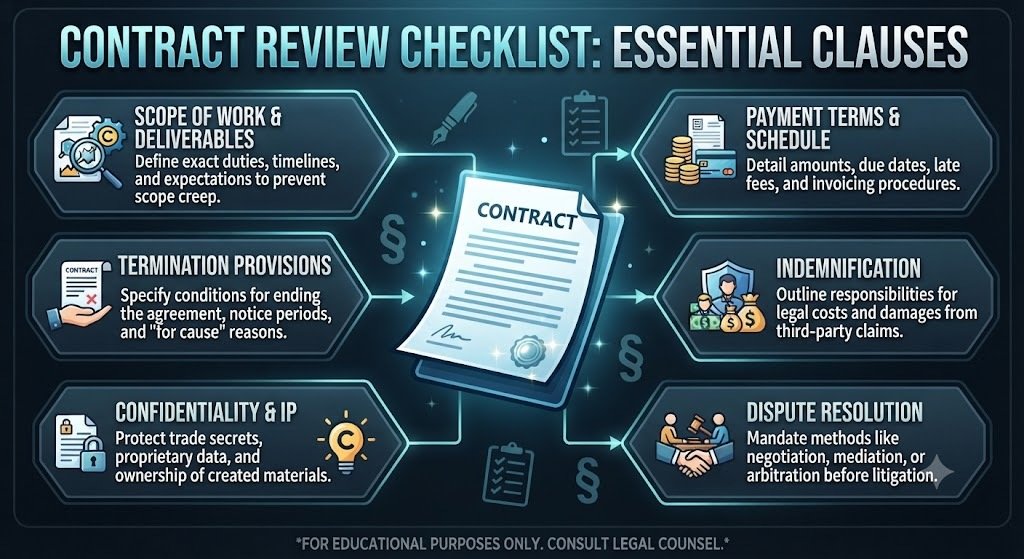
1. Clearly Defined Scope Vague language is where most disputes start. “Marketing services” means nothing specific. “Managing two social media accounts, posting three times per week, for six months” leaves no room for argument. Define exactly what’s included — and just as importantly, what isn’t.
2. Payment Terms, In Detail Don’t just state the amount. Include when payment is due, what happens if it’s late, whether there are penalties, and what currency and method apply if that’s relevant. Ambiguity here causes more disputes than almost anything else in a contract.
3. Termination Clause Every contract needs an exit. Specify how either party can end the agreement, how much notice is required, and what obligations survive after termination (like confidentiality or final payments). Without this, ending a bad agreement becomes its own legal problem.
4. Indemnity Clause This clause decides who’s financially responsible if something goes wrong because of one party’s actions. Skipping it doesn’t remove the risk — it just leaves it undefined, which usually means expensive arguments later.
5. Confidentiality Terms If any sensitive information is shared — client data, business processes, pricing, strategy — a confidentiality clause should say what counts as confidential, how long the obligation lasts, and what happens if it’s breached.
6. Dispute Resolution Clause Decide, in advance, how disagreements get resolved — negotiation, mediation, arbitration, or court — and where. This alone can save months of confusion if a dispute actually happens, since you’re not arguing about the process on top of the actual issue.
7. Force Majeure Clause This covers what happens if an unforeseen event (natural disaster, government action, and similar circumstances) makes the contract impossible to fulfill. It’s easy to skip until you actually need it.
8. Signatures, Dates, and Version Control It sounds basic, but unsigned or undated contracts, or unclear which version was actually agreed to, create real problems in disputes. Keep a clearly labeled, signed, dated final version — for both sides.
Read more :- From Courtroom to Code: Why a Contract Lawyer Started Building Digital Products
Common Contract Mistakes I See Repeatedly
- Using a generic template without adjusting it for the actual situation
- Leaving payment terms vague to “keep things simple”
- Assuming a verbal understanding will hold up without being written into the contract
- Not defining what counts as a breach, or what happens if one occurs
- Skipping legal review because a contract “looks standard”
None of these mistakes are dramatic on their own. They just tend to surface at the worst possible time — when there’s already a disagreement and no clear clause to fall back on.
When You Should Get a Contract Lawyer Involved
A contract lawyer isn’t just for large, complex deals. Getting one involved makes sense any time real money, ongoing obligations, or sensitive information are on the line — an employment agreement, a vendor relationship, a partnership, or a service contract with real stakes attached. A short review before signing is almost always cheaper than resolving a dispute after the fact.
Frequently Asked Questions
Q: What is the most important clause in a contract? There isn’t one single most important clause — but scope, payment terms, and termination together cover the majority of disputes. If those three are clear and specific, the contract is already stronger than most.
Q: Can I write a contract myself without a lawyer? You can draft a basic contract yourself, but a lawyer’s review helps catch missing clauses, vague language, and enforceability issues that aren’t obvious until there’s a dispute.
Q: What makes a contract legally enforceable? Generally, a contract needs a clear offer, acceptance, consideration (something of value exchanged), and the intent to create a legal relationship — along with clear, specific terms that a court could actually interpret if needed.
Q: How often should a contract be reviewed before signing? Every time — even for agreements that look similar to ones you’ve signed before. Small differences in wording can change what you’re actually agreeing to.
Parvez Ali is a Contract Lawyer based in Saharanpur, Uttar Pradesh, working with individuals and businesses on contract drafting and review. Learn more at ParvezAli.me.