
Introduction
Copyright registration in India sits in a strange spot for most creators — it’s simultaneously one of the most searched IP topics in the country and one of the most misunderstood. As someone who runs a media platform and a SaaS product alongside a law practice, I deal with this question constantly, from three different angles at once: as a publisher worried about content theft, as a software founder wondering what actually protects our source code, and as a lawyer who’s walked dozens of clients through the actual Form XIV process. This guide covers copyright registration in India end to end — what can be registered, the exact process and fees, realistic timelines, fair use, and critically, the two things most guides on this topic skip entirely: how copyright law is actually treating AI-generated content right now, and what to do once you’re registered and someone steals your work online.
What Can Actually Be Covered Under Copyright Registration in India?
Under Section 13 of the Copyright Act, 1957, copyright subsists in six categories of original work:
- Literary works — books, articles, blog content, and, importantly, computer software and source code, which qualify as literary works under Section 2(o).
- Dramatic works — scripts, screenplays, choreography.
- Musical works — musical notation and composition (separate from the sound recording itself).
- Artistic works — paintings, photographs, logos, illustrations, product designs.
- Cinematograph films — movies, video content, and increasingly, the kind of short-form video content that dominates platforms today.
- Sound recordings — the recorded performance itself, protected separately from the underlying musical composition and lyrics.
What copyright does not protect is worth stating clearly, since it’s a common point of confusion: ideas, facts, procedures, and methods of operation are never protected — only the original expression of those ideas is. This is exactly the reasoning the Delhi High Court leaned on in the 2026 ANI v. OpenAI ruling discussed below.
Do You Actually Need Copyright Registration in India? The Automatic Protection Myth
Here’s the single most important thing to understand before spending a rupee on copyright registration in India: copyright exists automatically the moment you create an original work. Registration is optional, not mandatory, and India is a signatory to the Berne Convention, which means your copyright is automatically recognised across more than 180 member countries without any separate international filing.
So why pursue copyright registration in India at all? Two concrete legal reasons:
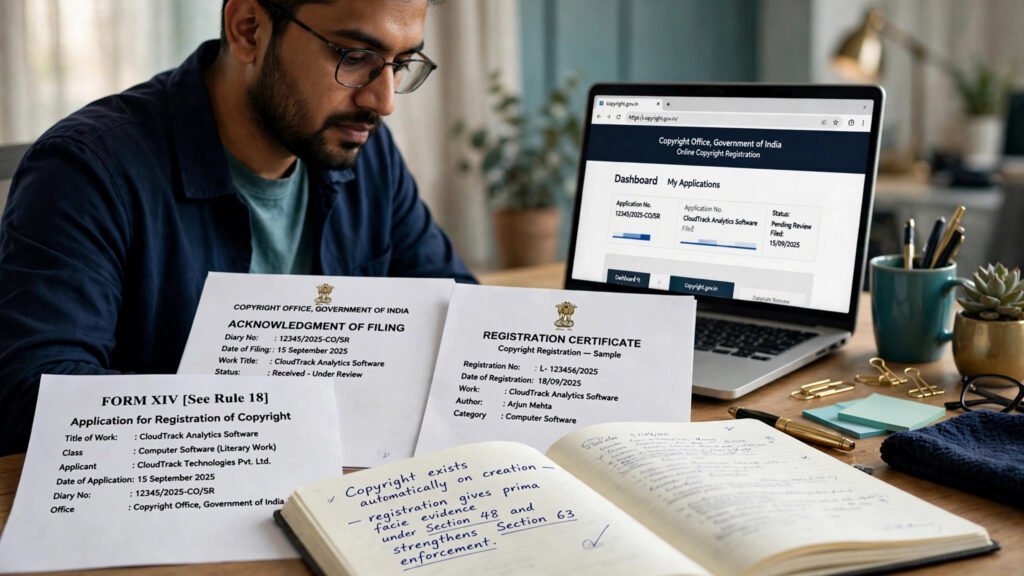
- Section 48 makes a registration certificate prima facie evidence of ownership in any legal proceeding — meaning the burden shifts to the other side to disprove your ownership, rather than you having to prove it from scratch.
- Section 63 criminal prosecution for infringement — carrying imprisonment from six months up to three years and fines between ₹50,000 and ₹2,00,000 — is significantly easier to pursue with a registered work establishing a clear paper trail of ownership and date of creation.
Registration also matters enormously the moment you try to license, sell, or transfer your work — which is exactly where copyright registration intersects with a completely different but frequently confused document. If you’re commissioning work from a freelancer or agency, registering the finished product doesn’t help you if you never secured a proper IP assignment agreement transferring ownership to you in the first place — under Section 17 of the same Act, the freelancer remains the legal owner regardless of payment unless that assignment exists in writing.
The Copyright Registration Process in India: Step by Step
The step-by-step process for copyright registration in India runs through the Copyright Office’s online portal, copyright.gov.in, and follows this sequence:
- Create an account and file Form XIV, along with the required “Statement of Particulars” and, where applicable, “Statement of Further Particulars,” specific to your work category.
- Upload copies of the work — for literary and software works, this typically means source code extracts or manuscript copies; for artistic works, image files; for films and sound recordings, the relevant media.
- Pay the government fee based on your work category (full breakdown below).
- Receive a Diary Number, issued the same day you file — this is your official proof of filing date, which matters for establishing priority.
- The mandatory 30-day waiting period begins. Your application is published in the Copyright Journal, during which anyone can file an objection claiming prior rights or disputing your application.
- Examination by the Copyright Office. If no objections are raised and the examiner finds no discrepancies, the application moves toward registration. If a discrepancy is flagged, you’ll receive a formal letter and a window to respond (more on this below).
- Entry in the Register of Copyrights and certificate issuance. Once cleared, the Registrar enters your work into the official register and issues a signed registration certificate.
Documents Required for Copyright Registration in India
- A completed Form XIV with the Statement of Particulars (and Statement of Further Particulars, where the work category requires it).
- Two copies of the work (or the relevant extract, for software and unpublished works).
- A No Objection Certificate (NOC) from co-authors or other rights holders, if the work has joint ownership.
- A Power of Attorney, if the application is being filed through a copyright agent or advocate rather than the applicant directly.
- Proof of identity of the applicant, and incorporation documents if the applicant is a company.
- Form TM-C (NOC from the Trademark Registry) — a requirement most guides on copyright registration in India skip entirely. If your artistic work (a logo, for instance) is already being used as a trademark on goods, you need this specific no-objection certificate before the Copyright Office will register it, to prevent overlapping IP claims between the two registries.
Copyright Registration in India: Government Fees
Government fees are charged per work, not per application batch — filing five separate works means five separate Form XIV applications and five separate fee payments.
| Category of Work | Government Fee (per work) |
|---|---|
| Literary, dramatic, musical, or artistic work (individual applicant) | ₹500 |
| Same categories (company/corporate applicant) | ₹2,000 |
| Software / computer program | ₹500 (as a literary work), though many agents apply the ₹2,000 corporate rate depending on the filing entity |
| Sound recording | ₹2,000 |
| Cinematograph film | ₹5,000 |
| Changes or corrections to an existing registration | ₹500 |
Beyond the government fee, most applicants also pay a professional fee if working through a copyright agent or advocate — typically ₹2,000 to ₹10,000 per work depending on complexity, particularly for software filings requiring careful source code compilation and redaction of proprietary sections before submission.
How Long Does Copyright Registration in India Actually Take?
Realistically, budget 2 to 8 months for copyright registration in India from filing to certificate. The mandatory 30-day objection period is a hard floor — nothing moves faster than that, regardless of how straightforward your application is. Beyond that floor, the timeline depends heavily on whether the examiner raises a discrepancy. A clean application with no objections and no discrepancy letter can clear in as little as 2 to 4 months; an application requiring a response to a discrepancy letter, or facing a genuine third-party objection, can stretch toward 8 months or, in disputed cases, longer.
What Happens If You Get a Discrepancy Letter
If the Copyright Office’s examiner finds an issue with your application — commonly a mismatch in the Statement of Particulars, an incomplete NOC, or a question about originality — you’ll receive a formal discrepancy letter rather than an outright rejection. You typically have a defined window to respond with clarification, corrected documents, or additional evidence of authorship. Ignoring this letter, rather than responding within the deadline, is one of the most common and entirely avoidable reasons a copyright registration in India application stalls indefinitely or gets treated as abandoned.
Copyright Registration in India for Software: What’s Different
Software occupies an unusual position for anyone pursuing copyright registration in India: it’s legally a “literary work” under Section 2(o), so it follows the same Form XIV process as a book or article, but the practical documentation is very different. Applicants typically submit either the complete source code or the first and last 25 pages (a common convention to protect trade secrets while still demonstrating originality), along with object code where relevant. If your software was built by a third-party developer or agency rather than in-house, registering it doesn’t establish who legally owns it — that ownership question is governed separately by whether a proper IP assignment agreement was signed before the code was written, not by who files the copyright application afterward.
After Copyright Registration in India: How Long Does Protection Actually Last?
- Literary, dramatic, musical, and artistic works: the author’s lifetime plus 60 years from the end of the calendar year of death.
- Cinematograph films and sound recordings: 60 years from the end of the calendar year of publication.
Unlike a trademark, copyright protection requires no renewal — once it exists, it simply runs for the statutory term and then enters the public domain.
Fair Use and Fair Dealing: The Exceptions to Copyright Registration in India
Section 52 of the Copyright Act carves out specific situations where using someone else’s copyrighted work doesn’t constitute infringement, commonly called “fair dealing” in Indian law (a narrower concept than the American “fair use” doctrine, though often used interchangeably in casual conversation):
- Private or personal use, including research.
- Criticism or review of a work, including a review of another work that quotes from it.
- Reporting of current events, including reporting via broadcast or in a newspaper.
- Use in judicial proceedings or reports of judicial proceedings.
- Reproduction for educational purposes, including by a teacher or student in the course of instruction.
- Incidental inclusion of a work in a cinematograph film or broadcast.
This exception has just become significantly more consequential in 2026. In a landmark ruling on 24 July 2026, the Delhi High Court in ANI Media Pvt Ltd v. Open AI OPCO LLC refused to grant ANI an interim injunction against OpenAI, holding that OpenAI’s storage of ANI’s news content for training ChatGPT fell within the private-use fair dealing exception under Section 52(1)(a), since the training data was held in a closed system inaccessible to the public. The Court also found that ANI failed to establish that ChatGPT’s outputs were substantially similar to its original articles. This is the first major judicial ruling anywhere in India on how fair dealing applies to AI training data, and while the underlying suit is still proceeding to trial, the interim finding significantly shapes how content creators, publishers, and AI companies alike should currently think about copyright registration in India as it intersects with generative AI.
Copyright Registration in India and AI-Generated Content: What the Law Says Right Now
This is the section most existing guides on copyright registration in India simply don’t cover, because the law is moving faster than most guides get updated. Two separate issues are in play:
- Can AI-generated output itself be copyrighted? Indian copyright law does not currently recognise non-human authorship. A work generated autonomously by an AI system, without meaningful human creative input, generally cannot be registered as a copyrighted work, since Section 13 protection has historically been understood to require a human author. If you’re using AI tools as part of your creative process, the safer practice is to ensure and document meaningful human authorship, editing, and creative decision-making in the final work.
- Can AI companies use copyrighted content to train models? As the ANI v. OpenAI ruling above shows, this remains genuinely unsettled at the trial level, even though the interim finding favored OpenAI’s private-use argument. Content creators and publishers should not assume this issue is fully resolved — the main suit is still pending, and the outcome could meaningfully affect how AI training on Indian copyrighted content is treated going forward.
After Copyright Registration in India: How to Enforce Your Copyright Online
Copyright registration in India is only half the job — enforcement is where most creators, especially digital publishers and content creators, actually struggle. Here’s what’s realistically available once your copyright registration in India is in place, or even while you rely on the automatic protection that exists before registration:
- Platform takedown requests. YouTube’s Content ID system, Instagram and Facebook’s reporting tools, and most hosting providers accept direct copyright infringement complaints, typically modeled loosely on the American DMCA process even though India doesn’t have an identical statutory framework. A registration certificate significantly strengthens these complaints by providing clear proof of ownership and priority date.
- Cease and desist notices. A formal legal notice, ideally sent through a lawyer, is often enough to resolve straightforward infringement without litigation, particularly against smaller infringers who weren’t acting with commercial intent.
- John Doe (Ashok Kumar) orders. For large-scale online piracy — unauthorized streaming of films, mass redistribution of copyrighted content — Indian courts have developed “John Doe” orders (referred to in Indian case law as “Ashok Kumar” orders), which allow rights holders to obtain injunctions against unknown, unidentified infringers in advance, particularly effective against piracy websites that spring up faster than they can be individually named in a lawsuit.
- Civil remedies under Section 55, including injunctions, damages, and accounts of profits.
- Criminal prosecution under Section 63, discussed above, which distinguishes copyright infringement in India from many jurisdictions where infringement is purely a civil matter.
For any business publishing content at scale — which, as someone running a media platform daily, I deal with directly — pairing registration with a documented process for issuing takedown notices and monitoring for unauthorized redistribution is far more practical than relying on litigation as the first response to every infringement.
Copyright Registration in India vs. Trademark vs. Patent Registration
| Copyright | Trademark | Patent | |
|---|---|---|---|
| Protects | Original expression — books, code, art, music, film | Brand names, logos, taglines | Novel inventions and processes |
| Registration required? | No — automatic on creation, registration is optional | Yes, for full statutory protection | Yes, mandatory |
| Duration | Lifetime + 60 years (60 years from publication for films/recordings) | 10 years, renewable indefinitely | 20 years, non-renewable |
| Approx. government fee | ₹500 – ₹5,000 per work | ₹4,500 – ₹9,000 per class | ₹1,600 – ₹8,000+ (filing and examination) |
| Typical timeline | 2 – 8 months | 12 – 18 months | 2 – 5 years |
Conclusion: Copyright Registration in India Is Optional, Being Deliberate Isn’t
Copyright registration in India isn’t a legal requirement, and understanding that clearly before you start the process saves a lot of unnecessary anxiety — your work is protected the moment you create it. What registration actually buys you is evidentiary strength: a clear, official record that makes both online enforcement and any future legal dispute significantly more straightforward. Where I see founders and creators actually get hurt isn’t from skipping registration — it’s from assuming registration alone solves problems that require a completely different document, like an IP assignment agreement, or from not knowing what enforcement options exist once infringement actually happens. If you’re weighing whether to register a specific work, need help responding to a discrepancy letter, or are dealing with online infringement right now, you can reach out here, or explore more IP and contract guidance on the blog.
Frequently Asked Questions (FAQ)
1. Is copyright registration mandatory in India? No. Copyright exists automatically the moment an original work is created. Registration is optional but provides prima facie evidence of ownership under Section 48, which is valuable in disputes and for criminal prosecution under Section 63.
2. How much does copyright registration in India actually cost? Government fees range from ₹500 per work for individual applicants registering literary, dramatic, musical, or artistic works, up to ₹5,000 for cinematograph films. Fees are charged per work, not per application batch.
3. How long does the full copyright registration in India process take? Realistically, 2 to 8 months, including a mandatory 30-day objection period that applies to every application regardless of complexity. Applications that receive a discrepancy letter or a third-party objection typically take longer.
4. Can software be copyrighted in India? Yes. Computer programs, including source code and object code, qualify as “literary works” under Section 2(o) of the Copyright Act, 1957, and follow the same Form XIV registration process as books or written content.
5. Does copyright registration protect my work outside India? Yes, indirectly. India is a signatory to the Berne Convention, meaning your copyright is automatically recognised in over 180 member countries without needing separate registration in each one.
6. What is the difference between copyright registration and an IP assignment agreement? Copyright registration creates an official record of a work’s ownership and creation date. An IP assignment agreement is a separate legal document that actually transfers ownership from a creator (such as a freelancer or employee) to another party. Registering a work doesn’t resolve an ownership dispute if a proper assignment was never signed.
7. Can AI-generated content be copyrighted in India? Generally not on its own. Indian copyright law does not currently recognise non-human authorship, so a work generated autonomously by AI without meaningful human creative input is unlikely to qualify for copyright protection.
8. Are AI companies allowed to train their models on copyrighted Indian content? This remains unsettled. In a 2026 interim ruling in ANI v. OpenAI, the Delhi High Court found that storing content for private AI training purposes fell within the fair dealing exception under Section 52, but the main case is still proceeding to trial, and the final outcome could change this position.
9. How can I enforce my copyright if someone steals my content online? Options include platform takedown requests (such as YouTube’s Content ID system), formal cease and desist notices, John Doe (Ashok Kumar) court orders against unidentified mass infringers, civil remedies under Section 55, and criminal prosecution under Section 63 for willful infringement.
10. Do I need a No Objection Certificate from the Trademark Registry to register a logo? Yes, if the artistic work is already being used as a trademark on goods. Form TM-C, a No Objection Certificate from the Trademark Registry, is required before the Copyright Office will process the registration, to prevent conflicting claims between the two registries.
11. What happens if my copyright application receives a discrepancy letter? You’ll be given a specific window to respond with clarifications or corrected documents. Failing to respond within the deadline is one of the most common reasons applications stall or are treated as abandoned, so timely response matters more than the discrepancy itself in most cases.
12. Who owns the copyright in work created by a freelancer I hired? By default, the freelancer does, even if you paid for the work — copyright registration doesn’t change this. Ownership only transfers to you through a valid, written IP assignment agreement signed under Section 19 of the Copyright Act.