
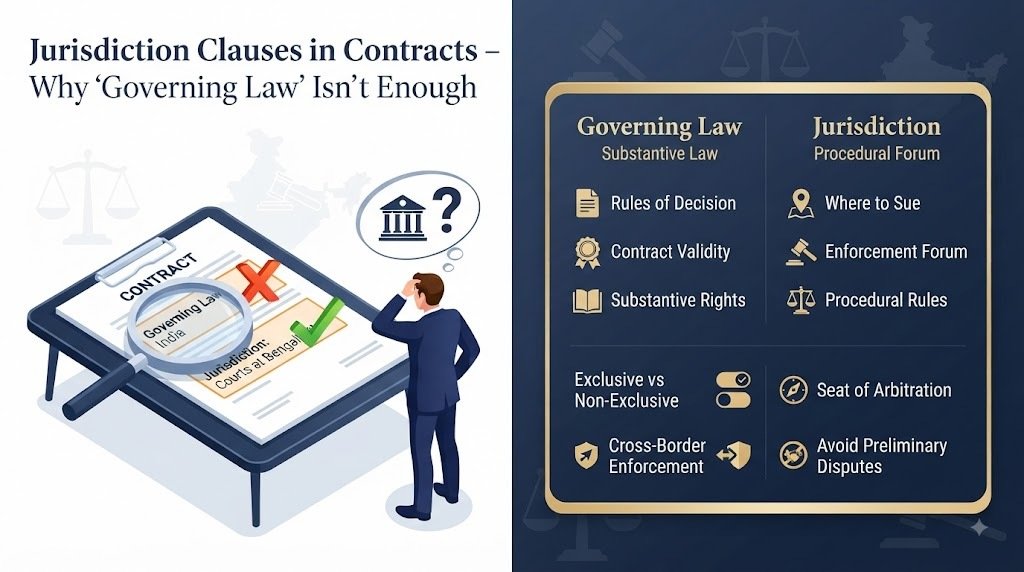
I can’t count how many contracts I’ve reviewed where a founder points to the “Governing Law: India” line and tells me confidently that they’ve already handled jurisdiction. They haven’t — not fully, anyway. A jurisdiction clause and a governing law clause are answering two completely different questions, and treating them as interchangeable is one of the most common, and most expensive, drafting gaps I see in commercial contracts. Governing law tells a court which country’s or state’s substantive law applies to interpret your contract. Jurisdiction tells you which specific courts actually have the authority to hear a dispute about it. A contract can specify Indian law perfectly and still leave you fighting over whether the case should be heard in Mumbai, Delhi, or somewhere else entirely — because nobody bothered to pin that down separately.
This article breaks down exactly what a jurisdiction clause does, why it’s a distinct provision from governing law, and how to draft one that actually prevents the fight it’s supposed to avoid.
What Is a Jurisdiction Clause?
A jurisdiction clause specifies which courts have the authority to hear and decide disputes arising from a contract. It answers a purely procedural question — where can this dispute actually be litigated — separate from the substantive question of which body of law a court applies once it’s hearing the case. In India, jurisdiction clauses commonly designate a specific city’s courts (“the courts at Bengaluru shall have jurisdiction”), which matters considerably more than founders initially assume, because litigating a dispute in an inconvenient city adds real cost and complexity regardless of how strong your underlying case is.
What Is a Governing Law Clause?
A governing law clause specifies which jurisdiction’s substantive law governs the interpretation, rights, and obligations under the contract — for most domestic Indian commercial agreements, this is simply Indian law, but for cross-border contracts, parties can and do choose a different governing law entirely, even where litigation might ultimately happen elsewhere. Governing law shapes how the contract’s terms are interpreted; it doesn’t, by itself, determine where a dispute gets physically litigated.
Governing Law vs Jurisdiction – Why They’re Not the Same Thing
This is the core confusion this entire article exists to clear up. A jurisdiction clause and a governing law clause can genuinely point in different directions within the same contract — you can have Indian law govern the agreement’s interpretation while designating courts in a completely different city, or even, in cross-border arrangements, a different country’s courts entirely. Treating “Governing Law: India” as though it answers the jurisdiction question too leaves a real gap: if a dispute arises and the contract is silent on which specific court has authority, you can end up litigating the jurisdiction question itself as a preliminary battle, in parallel with — or even before — the substantive dispute is addressed at all.
Types of Jurisdiction Clauses
Jurisdiction clauses generally fall into two categories, and the distinction matters more than the label suggests:
Exclusive Jurisdiction Clause
An exclusive jurisdiction clause designates one specific court (or set of courts) as the only forum where disputes can be litigated, expressly excluding all others — even courts that might otherwise have had jurisdiction under general legal principles. This is the stronger, more predictable option, and generally the one I’d recommend for most commercial contracts, because it eliminates ambiguity about where a dispute will actually be heard.
Non-Exclusive Jurisdiction Clause
A non-exclusive jurisdiction clause designates a specific court as one available forum, without ruling out others that might also have jurisdiction. This offers more flexibility — useful in some cross-border scenarios where a party wants the option to sue in multiple jurisdictions depending on where the counterparty or their assets are located — but it sacrifices the predictability that makes exclusive jurisdiction clauses valuable for most standard commercial relationships.
Why “Governing Law” Alone Isn’t Enough
Beyond the conceptual distinction, here’s the practical consequence founders actually run into: a contract that specifies governing law but stays silent on jurisdiction leaves the actual forum open to argument, based on where the defendant is located, where the contract was performed, or where the cause of action arose — all of which can point to different cities, and all of which can be contested. This isn’t a hypothetical risk; it’s a genuinely common source of preliminary litigation, where parties spend time and money arguing about where to fight before they ever get to what they’re fighting about. A properly drafted jurisdiction clause removes this entire layer of dispute before it can happen.
Jurisdiction Clauses and Arbitration – How They Interact
This is worth clarifying, because founders sometimes assume an arbitration clause makes a jurisdiction clause unnecessary — it doesn’t, not entirely. Even where a contract designates arbitration as the dispute resolution mechanism, a supervisory jurisdiction question still exists: which courts have the authority to support the arbitration process — appointing arbitrators, hearing interim relief applications, or handling a challenge to the award. I’ve covered this in more depth in the context of specifying the seat of arbitration in my article on Arbitration Clause Drafting, where the seat effectively performs a jurisdiction-like function for arbitration-specific matters, even while the main jurisdiction clause may separately govern any residual court proceedings outside the arbitration itself.
Common Jurisdiction Clause Mistakes
I see the same handful of drafting failures repeatedly:
- Treating governing law and jurisdiction as the same clause, when they need to be addressed as distinct provisions
- Leaving jurisdiction unspecified entirely, assuming “Governing Law: India” already covers it
- Vague or ambiguous city references that don’t clearly designate which specific court’s territorial jurisdiction applies
- Contradicting the arbitration clause’s seat, creating confusion between which forum governs arbitration-related matters versus general contractual disputes
- Copy-pasting a jurisdiction clause from an unrelated template, without adapting it to where the parties, performance, or assets are actually located
- Choosing an inconvenient jurisdiction without considering practical enforcement — a favourable clause on paper is far less useful if enforcing a judgment there is genuinely difficult
Cross-Border Contracts – Extra Care Needed
For contracts involving parties in different countries, jurisdiction clauses deserve considerably more careful drafting than a standard domestic agreement. Beyond specifying governing law and jurisdiction, cross-border contracts should also consider enforceability of judgments across borders, which varies significantly depending on the countries involved and whether reciprocal enforcement arrangements exist. This is precisely the kind of scenario where arbitration — with a clearly specified seat, as I’ve discussed in my piece on arbitration clause drafting — is often preferred over litigation, since arbitral awards generally enjoy broader cross-border enforceability under international conventions than court judgments do.
How to Draft a Jurisdiction Clause That Actually Works
A properly drafted jurisdiction clause should specify:
- The specific city or court with designated authority, not just a country or state
- Whether it’s exclusive or non-exclusive, stated explicitly rather than left to implication
- How it interacts with the arbitration clause, if one exists, to avoid overlapping or contradictory forum provisions
- The governing law, addressed as a separate, clearly stated provision — not assumed to cover jurisdiction by implication
- Practical enforceability considerations, particularly for cross-border agreements
This overlaps closely with the broader dispute resolution framework I’ve laid out across my Founder Agreement and Business Contracts content, where governing law, jurisdiction, and dispute resolution mechanism are treated as three distinct, deliberately drafted provisions — not one clause doing the job of three.
Frequently Asked Questions
Is a jurisdiction clause the same as a governing law clause? No — governing law determines which body of law applies to interpret the contract, while a jurisdiction clause determines which specific courts have authority to hear disputes about it. Both should be addressed separately.
What happens if a contract doesn’t include a jurisdiction clause? The forum becomes open to argument based on factors like where the defendant is located or where the contract was performed, which can create a preliminary dispute over jurisdiction before the actual dispute is even addressed.
What’s the difference between exclusive and non-exclusive jurisdiction? An exclusive jurisdiction clause designates one court as the only permitted forum; a non-exclusive clause allows that court as one option among others that might also have jurisdiction.
Do I need a jurisdiction clause if my contract already has an arbitration clause? Generally yes, in some form — even with arbitration, a supervisory jurisdiction question remains for court-supported aspects of the arbitration process, which is usually addressed through the seat of arbitration rather than a separate jurisdiction clause.
Why does jurisdiction matter for cross-border contracts specifically? Because enforcing a judgment across borders depends heavily on which countries are involved and whether reciprocal enforcement arrangements exist — a factor that doesn’t arise in purely domestic agreements.
Can parties choose any jurisdiction they want in a contract? Generally yes, within reasonable limits, though courts retain some discretion in specific circumstances, and practical enforceability should factor into the choice as much as legal permissibility.
Final Takeaway
A jurisdiction clause isn’t a footnote to your governing law clause — it’s answering a genuinely different question, and leaving it unaddressed creates exactly the kind of preliminary dispute that delays and complicates resolving the issue you actually care about. Specify the court, state whether it’s exclusive, and make sure it doesn’t quietly contradict your arbitration clause’s seat. Getting this right costs a few extra sentences at drafting time; getting it wrong can cost months arguing about where to even start.
Reviewing a contract and not sure whether your jurisdiction and governing law clauses actually work together? Get in touch and let’s make sure they do.
This article is for general informational purposes and does not constitute legal advice. Jurisdiction and governing law provisions should be tailored to your specific contract and reviewed by a qualified lawyer.