
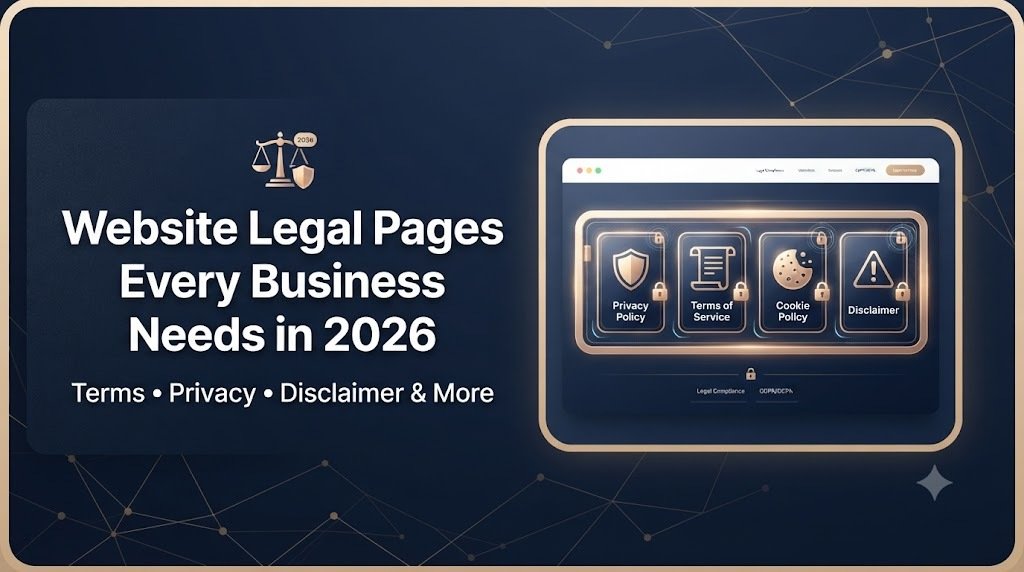
Website legal pages every business needs is a question I get from founders almost exclusively after their website is already live, their first hundred users have already signed up, and someone — usually a potential investor, a payment processor, or an app store reviewer — has just asked to see a Privacy Policy that doesn’t exist yet. The honest, slightly frustrating truth: most of these pages take a few hours to get right when done properly, and they should exist before launch, not after.
I’m Parvez Ali, a contract lawyer, and this is the complete checklist I actually walk clients through — every legal page a website realistically needs in 2026, in the order you should tackle them if you’re starting from zero, plus the mistakes I see repeated constantly across otherwise well-built websites.
Why Website Legal Pages Matter (This Isn’t Optional Anymore)
A few years ago, a bare-bones website with no legal pages was common and mostly low-risk. That’s genuinely no longer true:
- Data protection law now applies to most websites collecting any user information, regardless of business size — this isn’t limited to large companies anymore
- Payment processors, ad networks, and app stores routinely require specific legal pages before approving your account, meaning missing pages can block revenue entirely, not just create legal exposure
- Website compliance gaps are one of the first things investors’ due diligence teams flag during funding rounds — our pillar guide on types of contracts every business should know covers the broader agreement landscape this checklist sits inside
- A missing or generic Disclaimer or Terms page removes legal protections you’d otherwise have if a customer dispute or liability claim arises
None of this requires an enormous legal budget — it requires knowing which pages actually matter, and doing them properly once rather than patching gaps under pressure later.
The Complete Checklist: Website Legal Pages in Priority Order
Here’s the full list, ordered by how urgently each one typically matters for a new website:
- Privacy Policy — highest priority, often legally required the moment you collect any user data
- Terms and Conditions (Terms of Service) — sets the rules of using your site or app
- Disclaimer — limits liability for advice, content, or outcomes
- Cookie Policy — required if your site uses cookies or tracking technology, which most do
- Refund/Return Policy — mandatory for e-commerce, strongly recommended for any paid service
- Shipping Policy — for any business shipping physical products
- Copyright/DMCA Notice — protects your content and gives a process for handling infringement claims
- Affiliate Disclosure — legally required if you earn commission through affiliate links
- Accessibility Statement — increasingly expected, and legally required in some jurisdictions for certain business types
Not every website needs all nine — an informational blog doesn’t need a Shipping Policy, and a service business without affiliate links doesn’t need that disclosure. The list above is comprehensive; the priority section below tells you which ones actually apply to your specific situation. It also sits alongside your broader contract obligations — our pillar guide on types of contracts every business should know covers what else your business likely needs beyond just website pages.
Priority Order: What to Publish First If You’re Starting From Zero
If you’re building a new website and need to sequence this realistically, here’s the order that actually matters:
Must have before launch, no exceptions:
- Privacy Policy
- Terms and Conditions
Should have before launch, if applicable to your business:
- Cookie Policy (if you use any analytics, ads, or tracking — which almost every site does)
- Refund/Return Policy (if you sell anything, physical or digital)
- Disclaimer (if you give advice, information, or recommendations users might rely on)
Add as your business grows into needing them:
- Shipping Policy (once you sell physical products)
- Affiliate Disclosure (once you add affiliate links)
- Copyright/DMCA Notice (once you’re publishing meaningful original content worth protecting)
- Accessibility Statement (worth prioritizing earlier if you serve enterprise or government clients, who often require it contractually)
If you’re sequencing this alongside other early-stage legal priorities, our checklist on protecting a startup idea before incorporation covers what typically comes even before your website legal pages, at the idea and pre-formation stage.
Privacy Policy — What It Must Actually Include
Your privacy policy is the single most important page on this entire list, and it needs to cover specific ground, not just generic boilerplate:
- What personal data you collect (names, emails, payment details, usage data, cookies)
- How you collect it (forms, account creation, tracking technology, third-party integrations)
- Why you collect it and how you use it
- Whether you share data with third parties, and which ones
- User rights over their own data — access, correction, deletion requests
- How long you retain data
- Contact information for privacy-related requests
For businesses operating in or serving customers in India specifically, our DPDP Act 2023 and Privacy Policy compliance checklist walks through the exact statutory requirements your Privacy Policy needs to satisfy under current Indian law — generic templates frequently miss these specific obligations entirely.
Terms and Conditions — What It Must Actually Include
Terms and conditions (sometimes called Terms of Service) govern the relationship between your business and anyone using your website or app:
- User responsibilities and acceptable use
- Account creation and termination terms, if applicable
- Payment terms, for any paid service
- Intellectual property ownership over your site’s content
- Limitation of liability
- Governing law and jurisdiction for any disputes
A Privacy Policy and Terms and Conditions are frequently confused as interchangeable, but they serve genuinely different legal functions — one governs data handling, the other governs site usage and legal relationships. Our detailed breakdown of Terms of Service vs Privacy Policy: what’s the difference clarifies exactly where each one’s obligations begin and end, which is worth reading before you draft either.
Disclaimer — When You Need One and What It Covers
A disclaimer limits your legal liability for advice, information, or content on your site that users might act on:
- Who needs it most: blogs and sites offering financial, legal, medical, or professional advice; affiliate marketers; any business whose content could be misread as a guarantee of results
- What it typically covers: that content is for informational purposes only, isn’t professional advice, and results or outcomes aren’t guaranteed
- A well-drafted disclaimer doesn’t eliminate liability entirely, but it meaningfully strengthens your legal position if a dispute ever arises from someone acting on your content — the same liability-limiting logic behind well-drafted confidentiality and service agreement clauses more broadly
Cookie Policy and Consent Banners
If your website uses cookies, analytics, or any tracking technology — and nearly every modern website does — a cookie policy and appropriate consent mechanism matter:
- Disclose what cookies you use and why (essential functionality, analytics, advertising)
- Explain how users can control or opt out of non-essential cookies
- Implement an actual consent banner where legally required, not just a policy page nobody sees — increasingly, disclosure alone isn’t sufficient; active consent before non-essential tracking begins is the emerging global standard
- This ties directly into your broader data protection obligations — see the Privacy Policy section above and our DPDP Act compliance checklist for the Indian-specific requirements here
E-Commerce Specific Pages: Refund and Shipping Policies
If your business sells anything — physical products, digital downloads, or subscriptions — two additional pages become essential rather than optional:
- Refund/Return Policy: clearly state your return window, conditions, refund method, and any non-refundable items. Vague or missing refund terms are a common source of payment disputes and chargebacks, which can affect your standing with payment processors over time
- Shipping Policy: delivery timeframes, shipping costs, applicable regions, and what happens with delayed or lost shipments
Both pages reduce customer service disputes considerably just by existing and being genuinely clear, rather than being treated as legal formalities nobody reads. If your e-commerce business also involves selling to or through partners, this is worth reading alongside our broader contract types guide, which covers Sales and Distribution Agreements in more depth.
Data Protection Law Considerations Beyond Your Own Country
If your website serves users outside your home country — genuinely common for most online businesses today — you may need to account for multiple data protection frameworks simultaneously:
- DPDP Act 2023 governs data protection for Indian users specifically — covered in full in our compliance checklist
- GDPR applies if you have users in the EU, regardless of where your business is based, and carries some of the strictest consent and data-handling requirements globally
- Other jurisdictions (California’s CCPA, and a growing list of others) impose their own specific requirements
A single, well-drafted Privacy Policy can address multiple frameworks if it’s built to cover the strictest applicable requirements rather than the minimum for just one jurisdiction — worth discussing with a lawyer if you’re serving a genuinely international user base rather than assuming one country’s rules cover you everywhere.
Practical Data Handling: Beyond Just Having the Right Pages
Legal pages describe your practices — but the practices themselves matter just as much as the policy describing them. If your site or tools handle user-uploaded files or documents, what actually happens to those files matters independently of what your Privacy Policy says:
- Uploaded files sitting indefinitely on third-party servers, contrary to a Privacy Policy’s stated retention terms, is a genuine compliance gap, not just a technical detail
- Our piece on why online PDF tools should never store your files covers exactly this risk, and it’s the same principle behind why VelaPDF was built to never retain uploaded documents in the first place — the policy and the actual technical practice need to match
Common Mistakes Businesses Make With Website Legal Pages
- Copying a competitor’s or a generic template’s pages wholesale, including references to jurisdictions, data practices, or business models that don’t match your own
- Publishing pages once and never updating them, even as your business, data practices, or applicable law changes materially
- Treating Privacy Policy and Terms as interchangeable, when they serve genuinely distinct legal functions
- Skipping the Disclaimer on content-heavy or advice-driven sites, leaving unnecessary liability exposure
- Ignoring cookie consent requirements, relying on disclosure alone when active consent is increasingly the legal standard
- Forgetting e-commerce-specific pages (Refund, Shipping) until a customer dispute forces the issue
- Assuming one country’s rules cover a genuinely international user base, missing GDPR, DPDP, or other applicable frameworks entirely
If any of these sound familiar, it’s worth getting your existing pages reviewed rather than waiting for a dispute, app store rejection, or investor due diligence call to surface the gap.
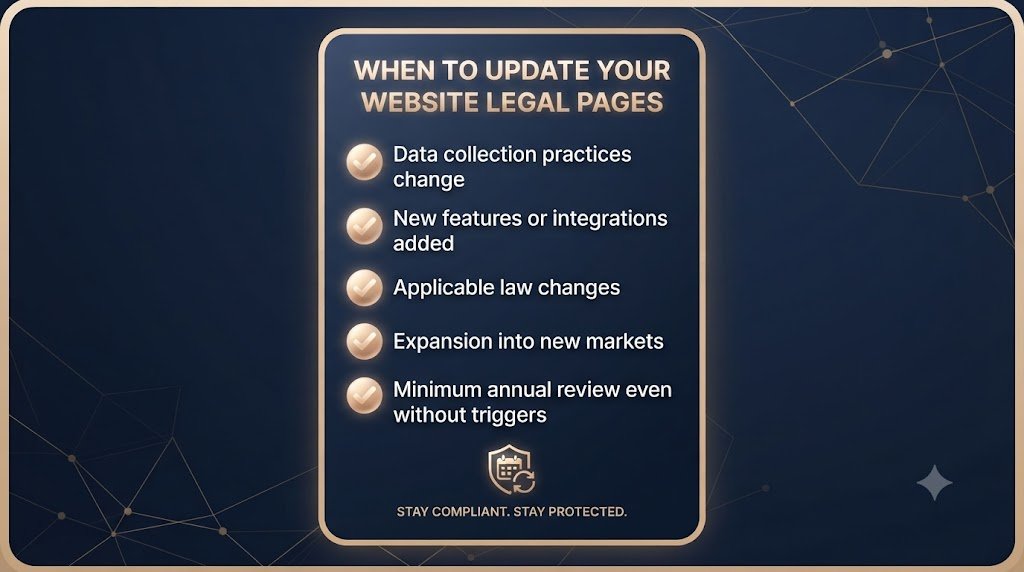
How Often Should You Update These Pages?
Website legal pages aren’t a one-time task. Review and update them whenever:
- Your data collection or handling practices change in any meaningful way
- You add new features, payment methods, or third-party integrations
- Applicable law changes — data protection regulations specifically have been evolving rapidly across most major markets
- You expand into new geographic markets with different legal requirements
- At minimum, even without a specific trigger, a periodic annual review is worth building into your business’s routine, similar to the ongoing review discipline we recommend for broader business contracts as your company evolves
Frequently Asked Questions
Do small websites and blogs need legal pages too? Yes, particularly a Privacy Policy if you collect any data at all (even just email signups or analytics cookies) and a Disclaimer if you publish advice or recommendations. Legal page requirements aren’t limited to large businesses.
Can I use a free online generator for these pages? Generators can work for genuinely simple, low-risk sites, but they typically produce generic language that doesn’t reflect your actual data practices or specific jurisdictional requirements — a meaningful risk if your business handles any sensitive data or operates across multiple countries.
Is a Cookie Policy legally required, or just a Privacy Policy section? It can be either, depending on your jurisdiction, but a standalone Cookie Policy paired with an active consent banner is increasingly the safer, more thorough approach as data protection enforcement has tightened globally.
What’s the difference between a Disclaimer and Terms and Conditions? Terms and Conditions govern the overall rules of using your site. A Disclaimer specifically limits liability for the content, advice, or information you publish. Many sites need both, addressing different risks.
Do I need separate legal pages for different countries I serve? Not necessarily separate pages, but your Privacy Policy specifically may need to address multiple frameworks (like DPDP and GDPR) within a single, comprehensive document if you serve users across those regions.
How do app store or payment processor requirements factor into this? Most major app stores and payment processors require a live, accessible Privacy Policy — and sometimes Terms and Conditions — before approving your listing or account, making these pages a practical business requirement independent of general legal risk.
What happens if I don’t have these pages at all? Beyond legal exposure, missing pages can block app store approval, payment processor onboarding, ad network approval, and investor due diligence — the practical business consequences often surface before any legal dispute does. Our DPDP Act compliance checklist covers the specific Indian regulatory angle on this if that’s a relevant concern for your business.
Final Thoughts
The website legal pages every business needs in 2026 come down to a manageable, prioritized list once you know what actually applies to your specific business — not every site needs all nine pages covered here, but every site needs the core two (Privacy Policy and Terms and Conditions) at minimum, done properly rather than copy-pasted from a competitor. Treat these as living documents that get reviewed as your business and applicable law evolve, not a one-time launch-day checkbox.
If you’re building out these pages properly — matched to your actual data practices and business model rather than a generic template — I draft and review these directly for founders and businesses, the same practical approach covered throughout this checklist.
This article provides general legal information and does not constitute personalized legal advice. Data protection and website compliance requirements vary by jurisdiction and business type — consult a qualified lawyer regarding your specific situation before relying on any guidance here.