
How to legally protect a startup idea before incorporation is a question I get almost exclusively from founders who’ve already made the mistake they’re calling about — they pitched an idea to a potential co-founder, a freelance developer, or an investor, got a vague “let me think about it,” and then watched something suspiciously similar show up somewhere else a few months later. By the time that call happens, the honest answer is usually: there wasn’t much I could have done, because there wasn’t anything in writing.
I’m Parvez Ali, a contract lawyer, and this guide covers exactly what you can do — starting today, before you’ve incorporated anything — to protect a startup idea properly. This isn’t jurisdiction-locked advice; the core principles here apply whether you’re building in Bangalore, Berlin, or Austin, since intellectual property fundamentals are broadly consistent across most legal systems. Where a specific country’s rules genuinely diverge, I’ll flag it clearly rather than pretending one set of rules applies everywhere.
Understand What’s Actually Protectable (Most Founders Get This Wrong)
Before anything else: ideas themselves are almost never legally protectable, anywhere in the world. This surprises most first-time founders, so it’s worth stating plainly.
- What’s protectable is the expression of an idea — the specific code, written business plan, design, brand name, or invention you’ve actually created — not the underlying concept
- This “idea vs execution” distinction is a foundational principle across US, UK, EU, Indian, and most other legal systems’ IP law
- Telling someone “I have an idea for an app that does X” generally creates no legal protection at all, no matter how novel the idea feels to you
- The moment you write code, draft a business plan, design a logo, or file a patent application, you’ve created something protectable — the shift from unprotected idea to protectable asset happens at the point of creation or filing, not at the point of conception
This is exactly why the practical steps below focus on getting your idea into a protectable form — and documented — as early as possible, rather than trying to protect the concept itself. It’s the same underlying principle behind why confidentiality protection matters so much once you start bringing outside collaborators in — covered in more depth in protecting confidential information when working with freelancers and contractors.
Step 1: Get an NDA Signed Before Any Substantive Conversation
If you’re about to discuss your idea with a potential co-founder, freelance developer, advisor, or early investor, a non-disclosure agreement should exist before the conversation — not after.
- A one-way NDA protects your disclosure specifically, appropriate when you’re the only party sharing sensitive information
- Cover what actually needs protecting: the specific business plan details, technical architecture, unreleased product features, or market strategy — vague “everything we discuss is confidential” language is weaker than a precise list
- This becomes especially important with freelancers and contractors, since they’re outside your company and often working with multiple clients simultaneously — I’ve written a full breakdown of exactly how to structure this in how to protect confidential information when working with freelancers and contractors, which covers the NDA and service agreement mechanics this step relies on in more depth
Realistically, some conversations — particularly early investor pitches — happen without an NDA, since many investors decline to sign one before a first meeting. That’s a genuine limitation worth understanding, not a reason to skip the NDA everywhere else it’s actually obtainable.
Step 2: Document Everything, With Timestamps
If a dispute ever arises over who came up with what and when, documentation is what actually resolves it — not memory, and not who talks more convincingly.
- Keep dated records of your idea’s development: emails, design files, code commits, meeting notes, and written business plans
- Copyright protection in most jurisdictions — including the US, UK, EU, and India — attaches automatically the moment an original work is fixed in a tangible form (written, coded, recorded), without requiring formal registration, though registration strengthens your position considerably if you ever need to enforce it
- Version-controlled code repositories (like Git) create a naturally timestamped record of exactly when specific features or architecture decisions were made — a genuinely useful, often-overlooked form of documentation
- If you’re working with a co-founder or early team, document individual contributions clearly, since this becomes directly relevant to equity discussions and IP assignment later — the same documentation discipline that matters once you’re working with freelancers or contractors too, as covered in our freelance/consultant agreement clauses guide
Step 3: Search and Reserve Your Trademark Early
Your business name and brand identity are separate protectable assets from your core idea, and they’re worth securing early:
- Conduct a trademark search in your target market(s) before committing meaningfully to a brand name — discovering a conflict after you’ve built a website, ordered signage, and printed business cards is a genuinely expensive mistake
- Trademark protection is generally territorial, meaning registering in one country doesn’t automatically protect you elsewhere — founders building for a global market from day one should factor this into which markets to prioritize for registration
- Reserve your domain name and key social media handles alongside the trademark search, since brand squatting on unregistered names is common enough to be worth the modest upfront cost of securing them early. Once you’ve settled on a name, this is also a natural point to think about your public-facing legal pages — our comparison of Terms of Service vs Privacy Policy covers what you’ll need before launching a website or app under that brand
Step 4: Understand When a Patent Actually Makes Sense
Patents protect genuine inventions — new, non-obvious, useful processes or products — not business models or app ideas in the abstract.
- If your startup involves a genuinely novel technical invention, a provisional patent application (available in the US and several other jurisdictions, with equivalent early-filing mechanisms elsewhere) can establish a filing date while you continue development, buying roughly 12 months before a full application is required
- Filing systems differ meaningfully by country — the US and most jurisdictions now operate on a first-to-file basis, meaning the first person to file an application generally has priority, not necessarily the first person to have the idea, which makes early filing genuinely time-sensitive once you decide to pursue patent protection
- Prior art — anything publicly disclosed before your filing date, including your own public pitches or demos — can undermine patentability, which connects directly to the public disclosure risks covered further below
- Most software-driven startups don’t end up pursuing patents at all, relying instead on trade secret protection, copyright over the actual code, and simply moving fast — patents make the most sense for genuinely novel technical or hardware innovations, not for “an app that connects X with Y.” Whichever route you take, if you’re preparing for a first funding round, our legal checklist for Indian startups before raising their first round covers what investors will actually expect to see regardless of IP strategy
Step 5: Decide What Stays a Trade Secret
Not everything needs to be disclosed, patented, or even written into a pitch deck. A trade secret strategy is often the most practical protection for early-stage startups:
- Information that provides competitive advantage specifically because it’s kept confidential — a proprietary algorithm, a specific customer acquisition process, a pricing model — can be protected simply by not disclosing it, with no filing or registration required
- This protection only holds as long as reasonable confidentiality measures are actually maintained — NDAs, restricted access, and documented confidentiality policies matter directly here, the same practical measures covered in our freelancer confidentiality guide once you start bringing in outside help
- Decide deliberately what genuinely needs to be public-facing (enough to pitch investors and attract users) versus what stays internal — oversharing technical specifics in pitch decks or public demos is one of the most common ways founders undermine their own trade secret protection
Step 6: Put IP Ownership in Writing Before You Incorporate
This is arguably the single most consequential step on this list, and it’s the one founders skip most often because it feels premature before the company technically exists.
- If you’re building with a co-founder, technical collaborator, or early contractor before formal incorporation, get an IP assignment clause or a pre-incorporation founders’ agreement in writing, specifying that all IP created will transfer to the company once it’s formed
- Without this, work created before incorporation can legally remain owned by the individual who created it — a genuinely serious problem that surfaces during due diligence when you eventually raise a funding round, since investors specifically check for exactly this gap
- This overlaps with, but is distinct from, the confidentiality protections covered in Step 1 — an NDA stops disclosure, while an IP assignment clause establishes ownership; you need both, not one or the other, a distinction covered in more depth in protecting confidential information when working with freelancers and contractors
- If multiple co-founders are involved, this is also the natural moment to start the broader founders’ agreement conversation — equity split, vesting, and roles — even before the company is legally formed
Step 7: Choose Your Incorporation Structure and Jurisdiction Deliberately
Where and how you incorporate affects IP ownership, liability, and fundraising flexibility going forward:
- Different jurisdictions offer different default IP treatment, tax implications, and investor familiarity — a structure well-suited to raising from Indian investors may look different from one optimized for US venture capital, for instance
- For India-based founders specifically, choosing between structures like a private limited company, an LLP, or a partnership has real implications for IP ownership clarity and investor readiness — our comparison of partnership deed vs LLP agreement is a useful starting point if you’re still deciding on structure
- Once incorporated, execute the actual IP assignment from founders to the newly formed company promptly — a pre-incorporation agreement that promises future assignment still needs a formal, executed transfer once the entity legally exists
- If you’re preparing for your first funding round, a broader look at what investors expect to see in place is worth reviewing — our legal checklist for Indian startups before raising their first round covers this ground comprehensively, and IP assignment clarity is consistently one of the first things due diligence surfaces
The Public Disclosure Trap Most Founders Walk Into
A genuinely common mistake: founders eager for validation post detailed product descriptions publicly, pitch at open demo days without any confidentiality protection, or discuss specifics in public forums — then wonder why their “unique” idea shows up elsewhere, or find their eventual patent application undermined by their own prior disclosure. This is precisely the kind of oversharing an NDA, discussed in Step 1 above and covered fully in our freelancer confidentiality guide, is designed to prevent when the audience is a specific person rather than the general public.
- Public disclosure before filing can bar patent protection entirely in many jurisdictions, or start a limited grace-period clock (commonly 12 months in the US, but not universally available — many jurisdictions offer no such grace period at all) after which the option closes permanently
- Sharing enough to validate demand and attract interest doesn’t require disclosing your specific technical implementation, algorithm, or proprietary process — there’s a meaningful middle ground between total secrecy and full disclosure
- If you’re building in public as a growth strategy (a genuinely valid approach for many startups), decide deliberately what stays confidential regardless of that broader openness, rather than defaulting to full transparency without thinking it through
Common Mistakes Founders Make
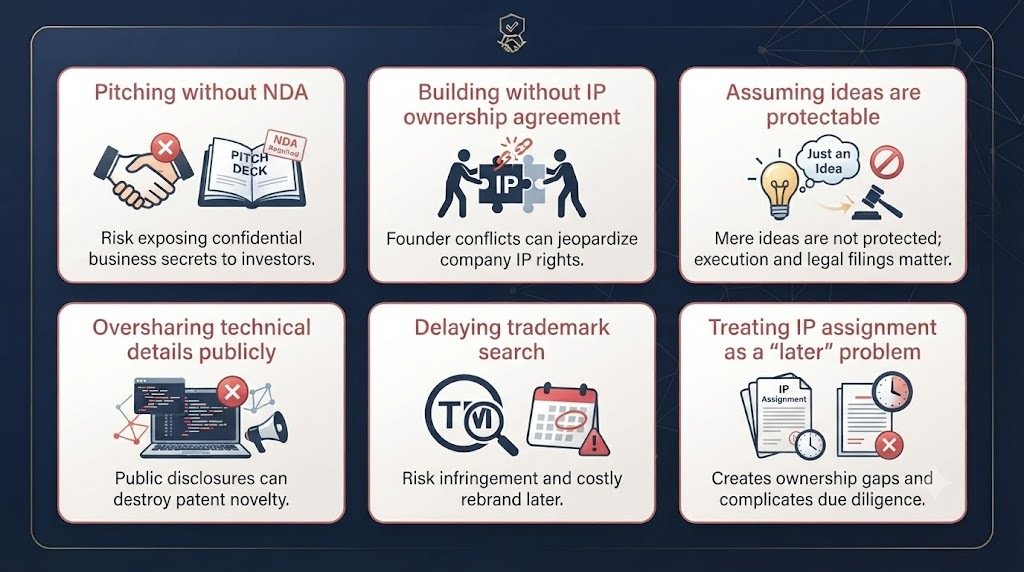
- Pitching an idea before any NDA exists, assuming a handshake or a “trust me” conversation offers real protection
- Building with a co-founder or contractor for months before addressing IP ownership, creating exactly the ambiguity investors flag during due diligence
- Assuming an idea alone is protectable, when what actually needs protecting is its documented expression
- Oversharing technical specifics publicly while still hoping to pursue patent protection later
- Delaying trademark searches until after significant brand investment has already happened
- Treating pre-incorporation IP assignment as a “later” problem, when it should be resolved before serious collaborative work begins
Most of these mistakes share a common thread: treating informal trust as a substitute for a written agreement — the exact pattern we unpack in more detail in protecting confidential information when working with freelancers and contractors.
Frequently Asked Questions
Can I legally protect a startup idea without incorporating a company first? Yes, to a meaningful extent. NDAs, documentation, copyright (which attaches automatically), trademark filings, and even provisional patent applications can all happen before incorporation. What typically needs to wait until incorporation is the formal IP assignment transferring ownership into the company entity itself.
Does an NDA guarantee my idea won’t be stolen? No. An NDA creates a legal remedy if confidentiality is breached, but it doesn’t prevent someone from disclosing information — it gives you legal recourse afterward. Combined with careful decisions about what you actually disclose, it’s the strongest practical protection available before formal IP rights exist.
Is a business idea copyrightable? No. Copyright protects the specific expression of an idea — your written business plan, your code, your designs — not the underlying concept itself. Two founders can pursue similar business concepts without either infringing the other’s copyright, as long as the actual execution differs.
Should I file a patent for my startup idea? Only if it involves a genuinely novel technical invention, not a business model or app concept in the abstract. Most software startups protect their work through copyright, trade secrets, and NDAs rather than patents, since patenting is expensive, slow, and often doesn’t fit typical software innovation.
What happens to IP created before my company is incorporated? By default, it generally belongs to whoever created it individually, not to a company that doesn’t legally exist yet. This is exactly why a written pre-incorporation agreement specifying future assignment to the company, followed by a formal executed transfer once incorporation happens, matters so much.
How do I protect my idea when pitching to investors globally? Understand that many investors, especially in the US and increasingly elsewhere, won’t sign an NDA before a first meeting, viewing it as a red flag for investment-readiness. Focus instead on what you disclose — enough to demonstrate value without giving away your specific technical implementation or proprietary details — and rely on documentation and timing (particularly for patents) as your practical protection.
Does registering a trademark in my home country protect me internationally? Generally no. Trademark protection is territorial. If you’re building for a global market, you’ll need to consider registration in each significant market separately, prioritized by where you expect meaningful business activity. If you’re incorporating in India specifically and weighing entity structures, our partnership deed vs LLP agreement comparison is a useful next read.
Final Thoughts
Protecting a startup idea before incorporation isn’t about one silver-bullet document — it’s a sequence of deliberate steps: understanding what’s actually protectable, getting NDAs signed before sensitive conversations, documenting everything with timestamps, making early trademark and patent decisions where relevant, and — critically — putting IP ownership in writing before serious collaborative work begins, not after a dispute forces the question. Founders who treat this as a “we’ll formalize it once we’re bigger” problem are almost always the ones calling a lawyer after something’s already gone wrong, when the available remedies are far more limited than they would have been with the right paperwork in place from day one.
If you’re at this pre-incorporation stage and want the NDA, founders’ agreement, or IP assignment terms built around what you’re actually protecting rather than a generic template, I draft these directly for founders, whether you’re incorporating in India or building for a global market from the start.
This article provides general legal information for founders across multiple jurisdictions and does not constitute personalized legal advice. IP and incorporation laws vary meaningfully by country — consult a qualified lawyer in your specific jurisdiction before relying on any guidance here.