
Protecting confidential information when you work with freelancers and contractors is a different problem than protecting it inside your own company, and most founders don’t realize that until something’s already gone wrong. I’m Parvez Ali, and in 17 years of drafting NDAs and service agreements, the single most common call I get isn’t “how do I write a contract” — it’s “a freelancer I hired has my client list, my pricing, or my product roadmap, and I don’t actually know what I can do about it.” Usually, the honest answer depends entirely on what was in writing before the work started.
This guide walks through exactly how to protect confidential business information when you’re bringing outside freelancers and contractors into your business — the right kind of NDA, what your service agreement actually needs to say, and the specific complications that come with remote and global teams, where the freelancer drafting your pitch deck might be sitting in a country whose courts have never heard of your business.
Why Confidentiality Risk Is Different With Freelancers and Contractors
Employees typically sign broad confidentiality obligations as part of onboarding, often reinforced by company culture, ongoing employment relationships, and internal systems access controls. Freelancers and contractors sit outside almost all of that:
- They’re engaged for a defined project, often with no ongoing relationship afterward — meaning less incentive to protect your information once the project ends
- They frequently work with multiple clients simultaneously, sometimes in the same industry, raising genuine questions about information crossover
- Access controls are often looser in practice — a freelancer designing your app might get your entire user database export “just to test with,” when a scoped sample would have worked
- Cross-border contract enforceability becomes a live issue the moment your contractor isn’t in the same country as your business, which is increasingly the default rather than the exception for remote teams
None of this means you shouldn’t hire freelancers — it means the paperwork needs to work harder than it does with employees, precisely because the informal safety nets aren’t there. If you’re building out a broader freelance or consultant relationship rather than a single sensitive task, our guide on 5 essential clauses every freelance/consultant agreement must have in 2026 covers the full contract structure this confidentiality piece fits inside.
Start With an NDA — But the Right Kind
A non-disclosure agreement is your first line of defense, and it should exist before any sensitive conversation happens, not after you’ve already shared your business plan hoping the freelancer seems trustworthy.
Mutual NDA vs One-Way NDA
- A one-way NDA protects only your information — the standard choice when you’re the party disclosing sensitive material (client data, product plans, financials) to a freelancer who isn’t sharing anything confidential of their own in return
- A mutual NDA protects both parties’ confidential information — worth using if the freelancer is also disclosing something sensitive to you, such as proprietary methodology or their own client relationships
Most freelancer engagements call for a one-way NDA, but I’ve seen founders default to mutual NDAs out of habit, which sometimes creates confidentiality obligations on your side you didn’t actually need to accept.
What a Freelancer Confidentiality Agreement Should Actually Cover
A freelancer NDA that’s actually enforceable — not just a downloaded template — needs to specify:
- A precise definition of confidential information — vague language like “all business information” is harder to enforce than a specific list: client data, financial figures, source code, pricing strategy, product roadmaps, and so on
- Duration of the confidentiality obligation, which should typically extend well beyond the end of the project — some information (trade secrets, unreleased product details) may warrant indefinite protection rather than a fixed term
- Permitted use restrictions, spelling out that the information can only be used for the specific project, not applied to the freelancer’s other clients or future work
- Return or destruction of materials at the end of the engagement, including any local copies, backups, or notes
- Remedies for breach, including the right to seek injunctive relief — the ability to get a court order stopping further disclosure quickly, which matters more than damages in a lot of confidentiality breach scenarios, since the harm from leaked information often can’t be undone with money alone
If this is your first time drafting one, our companion piece on 5 essential clauses every freelance/consultant agreement must have in 2026 covers the broader agreement structure this NDA typically sits alongside.
Confidentiality Clauses Inside the Service Agreement Itself
An NDA and a service agreement aren’t the same document, and relying on an NDA alone is a common gap. Your actual contractor agreement should also carry its own confidentiality obligations, reinforcing and extending what the NDA covers:
- Confidentiality obligations that survive termination of the agreement, not just the working relationship
- Clear scope of what systems, files, or data the contractor is authorized to access — and a statement that access is limited to what’s necessary for the project
- Data handling requirements, particularly if the contractor will handle any personal data belonging to your customers or employees, which brings in obligations under applicable data protection law
For Indian businesses specifically, this is where confidentiality obligations start overlapping with statutory compliance — our DPDP Act 2023 and Privacy Policy compliance checklist walks through what’s legally required if any personal data is involved in what your freelancer is accessing, separate from your own confidentiality contract terms.
IP Ownership vs Confidentiality — Why They’re Not the Same Thing
This is one of the most common misunderstandings I see, so it’s worth stating plainly: an NDA stops someone from disclosing your information. It does nothing to establish who actually owns the work product a freelancer creates for you.
- Intellectual property ownership needs its own clause — typically a work-for-hire clause or explicit IP assignment clause stating that all deliverables, code, designs, or content created under the engagement belong to your business, not the freelancer, upon payment
- Without this, a freelancer may retain default ownership rights over what they created, depending on your jurisdiction — meaning you could be barred from certain uses of work you paid for
- A confidentiality clause and an IP assignment clause should both appear in your service agreement — one protects the information, the other protects ownership of what gets built with it. If your startup is early-stage and hasn’t nailed either down yet, our broader legal checklist for Indian startups before raising their first round covers where this fits alongside everything else investors will expect to see in place.
Protecting Confidential Information With Remote and Global Teams
Remote and international freelance arrangements introduce complications a same-country, in-office arrangement simply doesn’t have.
Cross-border enforceability: An NDA that’s airtight under Indian law may be considerably harder to enforce against a freelancer based in a country with different confidentiality standards or weaker IP protections. Where possible, specify governing law and jurisdiction clearly in the contract, and understand realistically what recourse actually exists if the freelancer is in a country where local enforcement is difficult or expensive to pursue.
Jurisdiction clause specificity: Rather than a generic “governed by the laws of India” line, a stronger contract specifies which courts have authority to hear disputes, and ideally includes an arbitration clause as a faster, less jurisdiction-dependent alternative to litigation for a global freelance team arrangement.
Secure file-sharing practices: Confidentiality on paper means little if the practical file-sharing setup undermines it — sending sensitive documents through unsecured channels, using tools that store files indefinitely on third-party servers, or granting broader folder access than the project actually requires. If you’re sharing sensitive PDFs or documents with freelancers, it’s worth understanding what actually happens to those files on the platforms you use — our piece on why online PDF tools should never store your files breaks down exactly this risk, and it’s the same principle behind why we built VelaPDF to never retain uploaded documents.
Practical Steps Before You Share Anything Sensitive
A short, practical checklist worth running through before any freelancer or contractor gets access to sensitive material:
- Sign the NDA before the first substantive conversation, not after you’ve already described your product roadmap in a discovery call
- Scope access precisely — share only what’s needed for the specific task, not broad folder or database access “to be safe later”
- Put confidentiality terms in the service agreement too, not just the standalone NDA
- Confirm IP ownership separately, since this is a distinct issue from confidentiality
- Use secure, access-controlled file sharing rather than open links or tools with unclear data retention practices
- Document what was shared and when, so you have a clear record if a dispute arises later
This same discipline applies whether you’re handling confidential business documents directly or personal data belonging to customers — our DPDP Act 2023 compliance checklist is worth reviewing if any of what your freelancer accesses includes personal data covered by Indian data protection law.
What to Do If a Freelancer Breaches Confidentiality
If you discover a freelancer has disclosed or misused confidential information:
- Review the NDA and service agreement first — your available remedies depend entirely on what was actually written, which is precisely why the drafting stage matters so much
- Document the breach, gathering evidence of what was disclosed, when, and how you discovered it
- Send a formal cease-and-desist communication as an initial step, which often resolves the issue without litigation
- Assess whether injunctive relief is appropriate — where ongoing or imminent disclosure poses serious harm, a court order stopping further disclosure may be more urgent than pursuing damages
- Consult a contract lawyer promptly — the specific remedies available, and how quickly you need to act, depend heavily on your contract’s exact language and your jurisdiction. This is also a good moment to double-check your website or app’s own Terms of Service and Privacy Policy stay consistent with whatever commitments you’ve made to customers, since a breach involving customer data can trigger obligations beyond just your contract with the freelancer
Common Mistakes Businesses Make
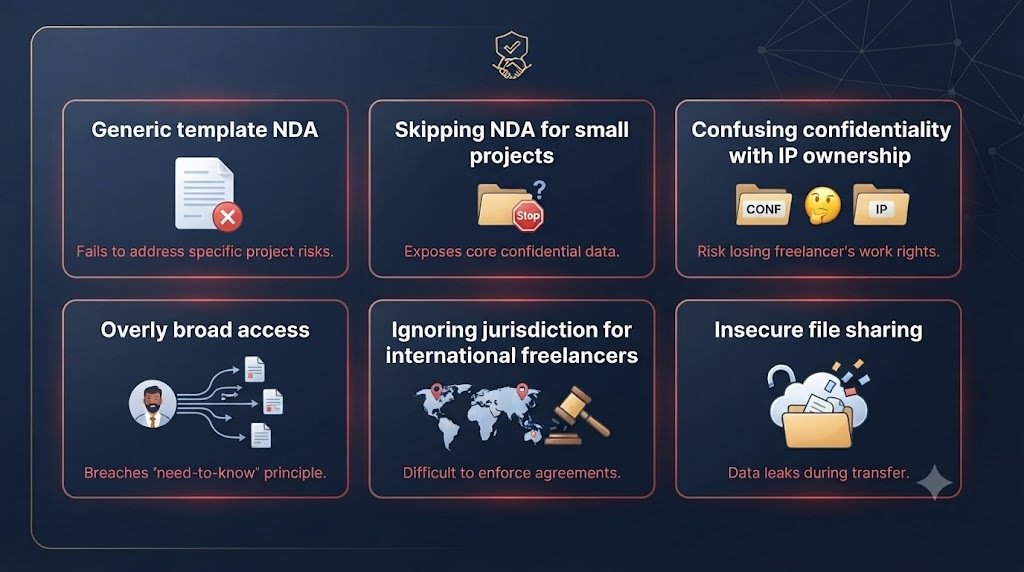
- Relying on a generic downloaded NDA template without adapting it to the specific information actually being shared
- Skipping the NDA for “small” projects, assuming brief engagements don’t carry meaningful risk
- Confusing confidentiality protection with IP ownership, leaving a genuine gap in the contract
- Granting broader system or data access than the project requires, out of convenience rather than necessity
- Ignoring jurisdiction and enforceability questions for international freelancers until a dispute forces the issue
- Sharing sensitive files through insecure or data-retaining platforms, undermining paper protections with practical exposure — the same risk we cover in more depth in why online PDF tools should never store your files
Frequently Asked Questions
Do I need an NDA for every freelancer, even for small projects? Generally, yes, if the freelancer will be exposed to any genuinely sensitive information — client data, pricing, product plans. The size of the project matters less than the sensitivity of what they’ll see.
Is a verbal agreement about confidentiality enforceable? It’s considerably harder to enforce than a written NDA, since proving the exact terms of a verbal agreement in a dispute is difficult. A written, signed NDA should always be the standard for anything genuinely sensitive.
What’s the difference between an NDA and a confidentiality clause in a service agreement? An NDA is typically a standalone document, sometimes signed before the main engagement even begins. A confidentiality clause is part of the broader service agreement. Using both together, with consistent terms, gives stronger protection than relying on either alone.
Can I stop a freelancer from working with a competitor after our project ends? That requires a separate non-compete clause, which is distinct from confidentiality protection and carries its own enforceability considerations depending on jurisdiction — confidentiality alone doesn’t prevent someone from working elsewhere, only from disclosing your specific protected information.
How do I protect confidential information with an international freelancer? Specify governing law and jurisdiction clearly in the contract, consider an arbitration clause as an alternative to litigation, and realistically assess enforcement feasibility in the freelancer’s actual country before assuming the same protections apply as they would domestically.
Does an NDA also cover ownership of the work a freelancer creates? No. An NDA protects information from disclosure; it doesn’t establish IP ownership. You need a separate IP assignment or work-for-hire clause in your service agreement to secure ownership of deliverables — our freelance/consultant agreement clauses guide covers exactly where this clause belongs.
What should I do immediately if I suspect a confidentiality breach? Document everything you know about the disclosure, review your existing NDA and agreement terms, and consult a contract lawyer promptly, since available remedies and time-sensitivity depend heavily on your specific contract language.
Final Thoughts
Protecting confidential information when working with freelancers and contractors comes down to doing the paperwork before you need it, not after — the NDA before the sensitive conversation, the IP assignment clause before the deliverable gets built, and clear jurisdiction terms before a dispute forces the question. None of this is complicated once it’s in place; the risk almost entirely comes from skipping it because the relationship feels informal or the project feels small.
If you’re bringing freelancers or contractors into sensitive parts of your business — especially across borders — and want an NDA or service agreement actually built around what you’re protecting rather than a generic template, I draft these directly for founders and businesses across India, informed by the same practical, get-it-right-the-first-time approach I bring to running Malik Times and VelaPDF myself.
This article provides general legal information and does not constitute personalized legal advice. Consult a qualified contract lawyer regarding your specific situation before relying on any guidance here.