
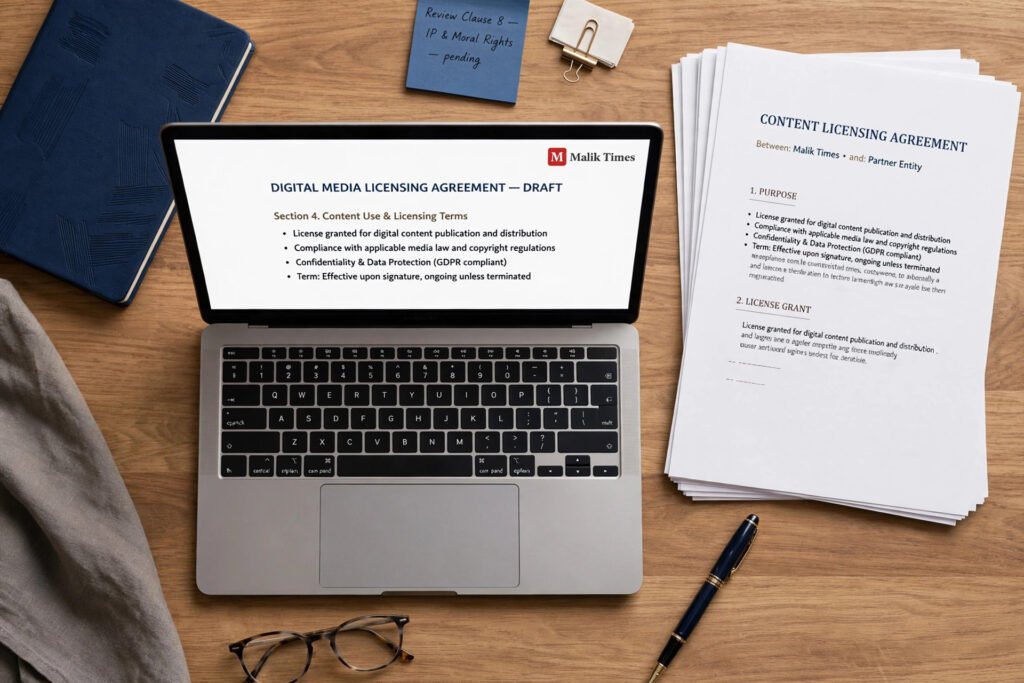
Legal lessons from running Malik Times aren’t the kind I learned in a classroom, or the kind I usually hand clients across a desk. I’m Parvez Ali — a contract lawyer by training, and the founder of Malik Times, a news and markets platform I built and still run myself. For years, I gave founders advice about content ownership, contributor agreements, and platform liability from the outside, as the lawyer reviewing someone else’s mess after the fact. Running my own platform forced me to actually live inside that advice, and a few things looked genuinely different from the inside than they ever did across a consultation table.
Most founders treat content and contributor arrangements casually — a verbal “just write for us,” a handshake understanding about who owns what — right up until something goes wrong, and by then the options are considerably more limited than they would have been with the right paperwork from day one. This isn’t a generic legal checklist. These are three practical lessons from actually operating a content platform, not just advising on one.
1. Content Ownership — Who Actually Owns What You Publish?
The most common assumption I hear from first-time platform founders is some version of “if it’s on my website, I own it.” That’s not how content ownership actually works, and getting this wrong is one of the more expensive mistakes I’ve watched founders make.
Under Indian copyright law — specifically the Copyright Act, 1957 — ownership generally starts with the person who created the work, not the platform that published it. A few distinctions matter enormously here:
- Content written by you or your direct employees in the course of their employment is generally treated as work created for the employer, with ownership sitting with the business — this is the one scenario where the “I own what’s on my site” instinct holds up
- Content written by freelancers or guest contributors is a completely different situation. By default, the freelancer typically retains copyright ownership unless there’s a specific, written transfer — publishing their piece on your site doesn’t automatically transfer anything
This is where I see the most confusion, including from founders who’ve been running content platforms for years. There’s a real, meaningful difference between an assignment of copyright — a full transfer of ownership to your platform — and a simple license, which only grants permission to publish, not ownership. A license, especially a non-exclusive one, can leave the original writer free to republish the same piece elsewhere, sell it to a competitor, or demand its removal from your site entirely.
The practical rule I now follow at Malik Times, without exception: never publish external content without a clear written assignment or exclusive license in place first. Not after publication. Before.
What happens if you don’t have this in writing: takedown demands from contributors who’ve had a falling out with your platform, copyright claims that can genuinely disrupt your business, and — the one that surprises founders most — an inability to reuse, syndicate, or monetize content you’ve been treating as your own for years, because you never actually owned it in the first place. This is exactly the kind of gap I now insist on closing before a single guest piece runs, and it’s the same principle behind protecting confidential information when working with freelancers and contractors more broadly — ownership and confidentiality both need to be settled in writing before the relationship begins, not after.
2. Contributor Agreements — The Document Most Platforms Skip
Verbal “just write for us” arrangements feel efficient in the early days of a platform. They create long-term problems that only surface once a contributor relationship sours, a piece gets challenged, or your platform grows enough that the informal approach stops scaling.
A proper contributor agreement doesn’t need to be a fifteen-page document — mine at Malik Times genuinely isn’t — but it needs to cover specific ground:
- Ownership/assignment of copyright — spelled out plainly, not implied
- Moral rights waiver, where legally possible — moral rights (like the right to be credited or to object to modifications) can persist even after copyright is assigned, depending on jurisdiction, and need to be addressed separately
- Payment terms and kill fees — what happens, and what’s owed, if a commissioned piece doesn’t ultimately get published
- Representations — the contributor confirming their work is original, isn’t plagiarized, and doesn’t contain defamatory content, which shifts meaningful risk back onto the person who actually wrote the piece
- Right to edit and final decision on publication — your platform’s editorial discretion, stated explicitly rather than assumed
- Indemnity — protection if the contributor’s claims about originality turn out to be false and your platform faces a resulting claim
- Termination terms, and specifically what happens to already-published pieces if the relationship ends — this is the clause most templates skip entirely, and the one that causes the most confusion later
Some of these obligations run one-way (representations and indemnity typically flow from contributor to platform), while others — payment terms, editorial process — genuinely work both ways. I go into the full clause-by-clause breakdown, with more detail than fits here, in 5 essential clauses every freelance/consultant agreement must have in 2026, which covers this exact document structure in depth.
The approach I actually use for Malik Times is a short, plain-language agreement rather than dense legal boilerplate — contributors read it, understand it, and sign it the same day, which matters more in practice than a longer document nobody actually reads before signing.
3. Platform Liability — What You Can Be Held Responsible For
This is the lesson that changed how I think about running a platform day to day, not just how I draft documents for one. There are three main risk areas that genuinely matter for any content platform:
Defamation and reputation harm. If a contributor publishes something defamatory on your platform, your platform can face exposure alongside the writer, depending on the specific circumstances and how much editorial control and awareness you exercised.
Copyright infringement by contributors. If a contributor submits plagiarized or improperly sourced content and you publish it, your platform can be pulled into that dispute even though you didn’t create the infringing material yourself.
Regulatory and intermediary issues. Under India’s IT Act and related safe harbour provisions, platforms can receive some protection from liability for user-generated content — but this protection isn’t automatic or unconditional. It depends on following specific compliance obligations, including responding appropriately to takedown requests and maintaining certain grievance and content-moderation processes.
The genuinely important lesson here: being a “platform” does not automatically give you full legal protection. I’ve seen founders assume the label itself does the protective work. It doesn’t. Documentation and process matter considerably more than the label you apply to your business.
Practical steps that actually reduce this risk:
- Clear Terms of Use and disclaimers, distinct from a generic template — our breakdown of Terms of Service vs Privacy Policy covers the foundational difference between these documents if you’re building this out for your own platform
- An editorial review process, even a light one — genuine review, not just a publish button, meaningfully strengthens your position if content is later challenged
- A real ability to take down content quickly once a legitimate concern is raised, rather than a slow or unclear removal process
- A proper Privacy Policy and clear data handling practices, particularly if you’re collecting reader emails, newsletter signups, or any user data at all — our full checklist on website legal pages every business needs walks through exactly which pages a content platform specifically needs, and our DPDP Act 2023 compliance checklist covers what Indian data protection law specifically requires if you’re collecting any reader data
Key Takeaways
- Content ownership must be settled in writing before publication — not assumed because a piece appears on your site
- Every regular contributor should have a simple, signed agreement, even a short one, covering ownership, representations, and termination
- Platform liability is managed through process and clear legal pages, not hope — the “platform” label alone offers considerably less protection than most founders assume
- These issues are far cheaper to fix early than after a dispute, takedown demand, or contributor conflict has already started — the same pattern I see across almost every category of business contract, covered more broadly in types of contracts every business should know
Running Malik Times Taught Me to Practice My Own Advice
Running Malik Times forced me to actually practice the same advice I’ve spent years giving clients across a desk — content ownership, contributor agreements, and platform liability aren’t abstract legal categories once they’re your own business’s exposure, not someone else’s hypothetical. Every clause I now insist on for a contributor agreement, I insist on because I’ve felt the gap where that clause was missing, not because a textbook said to include it.
If you’re building a content site, newsletter, or platform of your own and want the legal foundation done properly — contributor agreements, ownership clauses, Terms and Privacy Policy — built around how your platform actually operates rather than a generic template, feel free to reach out. I’m happy to help you get this right from day one, the same way I eventually got it right for my own.
This article reflects general legal principles and personal experience, and does not constitute personalized legal advice. Copyright, contributor, and platform liability rules vary by jurisdiction — consult a qualified lawyer regarding your specific platform and situation before relying on any guidance here.