
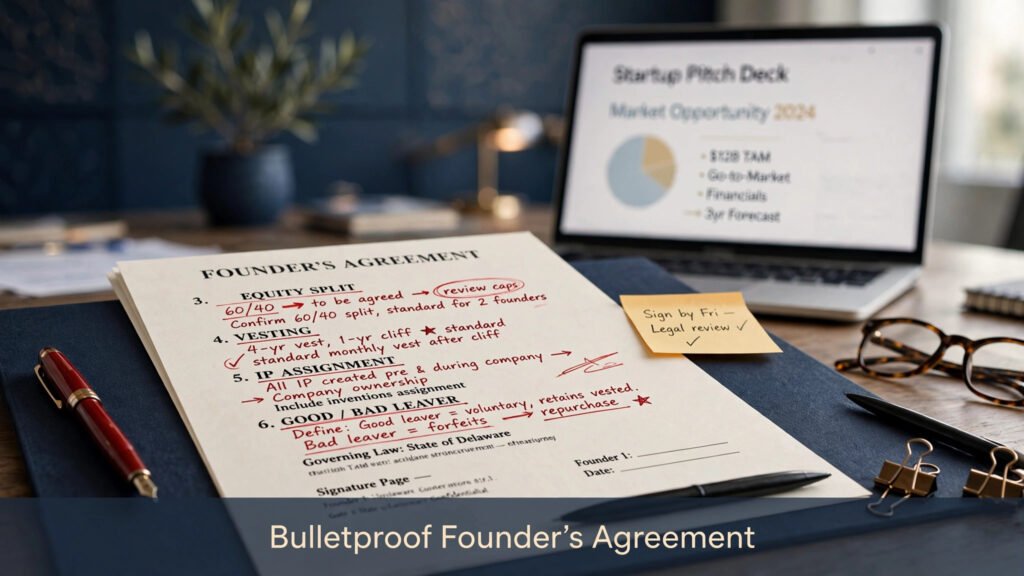
Introduction
A founder’s agreement is, statistically, one of the highest-leverage documents you will ever sign — and one of the most commonly skipped. Most founding teams treat it as paperwork to get to “later,” something you’ll formalize once the idea proves itself. That instinct is exactly backwards. Harvard Business School’s Noam Wasserman studied 10,000 founders and found co-founder conflict was a contributing factor in roughly 65% of startup failures, and a 2023 CB Insights post-mortem analysis ranked co-founder conflict as the third most common cause of startup death, trailing only running out of money and building something nobody wanted. A founder’s agreement is the one document specifically designed to prevent that outcome — if it’s actually built to hold weight, not just filled with boilerplate. This guide breaks down every clause a genuinely bulletproof founder’s agreement needs, why each one matters, and includes a free downloadable template you can adapt to your own startup and jurisdiction.
What a Founder’s Agreement Actually Is (And What It Isn’t)
A founder’s agreement is a legally binding contract between the co-founders of a company that defines ownership, roles, responsibilities, and what happens if things go wrong — before they go wrong. It is not the same thing as a shareholders’ agreement, though the two are frequently confused. I’ve broken down the difference between a founder agreement and a shareholders’ agreement in detail here; in short, a founder’s agreement typically governs the relationship between the founding team from day one, often before the company is even formally incorporated, while a shareholders’ agreement governs shareholder rights once the entity exists and may include investors.
Handshake deals and “we trust each other” arrangements feel efficient in the excitement of starting something new. They’re also exactly how founder disputes turn into founder lawsuits. A founder’s agreement doesn’t exist because you distrust your co-founders — it exists because trust alone doesn’t survive a disagreement about equity, workload, or direction two years in, when the stakes are dramatically higher than they are on day one.
The Data: Why This Document Predicts Startup Survival
The research on this is more specific than most founders realize. Carta’s 2025 data on VC-backed companies found that 94% use a four-year vesting schedule with a one-year cliff for founder equity — a structure that exists almost entirely to prevent one specific disaster: a co-founder leaving early while still walking away with a large, permanent stake in the company. First Round Capital’s 2024 survey of over 300 portfolio companies found that 22% experienced a co-founder departure within the first 36 months, and of those, 61% left after the one-year cliff but before full vesting — typically retaining between 25% and 50% of their original equity grant. Without a vesting clause in the founder’s agreement, that equity simply sits there permanently, un-earned and undiluted, doing nothing for the company that’s still doing all the work.
Equity split data tells a related story. Roughly 55% of two-founder startups start with a simple 50/50 equity split — often chosen precisely to avoid an uncomfortable conversation about who’s contributing more. Research on founder dynamics consistently shows that equal splits made to sidestep conflict, rather than reflect actual roles and risk, tend to resurface as resentment later, at exactly the moment a founder’s agreement should already have addressed it directly.
The Anatomy: Every Clause a Bulletproof Founder’s Agreement Needs
1. Equity Split and Ownership Percentages
This is the clause everyone thinks about first, and the one most founders resolve too casually. The agreement should state each founder’s exact equity percentage and, critically, the reasoning behind the split — capital contributed, IP brought in, time commitment, and role. A 50/50 split isn’t wrong, but it should be a deliberate choice, not a default used to avoid the conversation.
2. Vesting Schedule and Cliff
Every founder, including you, should vest their equity — not just future employees. The market standard, per Carta’s 2025 data, is four years with a one-year cliff: 0% vests in the first 12 months, 25% vests at the one-year mark, and the remaining 75% vests monthly over the following 36 months. This single clause is the strongest protection against the “dead equity” problem — a co-founder who leaves after a few months but keeps a permanent, disproportionate slice of the company.
3. Roles, Responsibilities, and Decision-Making Authority
Vague titles (“we’re all co-founders”) create real operational conflict the moment two founders disagree on direction. A bulletproof agreement specifies who has final say on what — product, finance, hiring, fundraising — and what requires unanimous or majority founder consent. This isn’t about hierarchy for its own sake; it’s about having an answer ready before a disagreement becomes a deadlock.
4. Capital Contributions and Reimbursement
If founders are contributing personal funds, equipment, or unpaid time at different levels, the agreement should document exactly what was contributed, by whom, and how (or whether) it will be reimbursed or converted into additional equity. Undocumented informal contributions are one of the most common sources of “but I put in more” disputes later.
5. Intellectual Property (IP) Assignment
Every founder must formally assign any IP relevant to the business — code, designs, trade secrets, content — to the company itself, not to themselves individually. Without this clause, a departing founder could legally argue they retain personal ownership of work central to the product, which can freeze fundraising and even force a costly buyout of IP the company assumed it already owned.
6. Dead Equity and Leaver Provisions (Good Leaver vs. Bad Leaver)
This is arguably the single most important clause in the entire document, and the one most amateur templates get wrong. A strong agreement distinguishes between a “good leaver” (someone who departs for legitimate reasons — illness, mutual agreement, role elimination) and a “bad leaver” (someone who quits abruptly, is terminated for cause, or breaches the agreement). Good leavers typically retain vested equity; bad leavers may forfeit unvested equity entirely and sometimes face a buyback of vested shares at a discount. Defining this distinction now, while everyone is still on good terms, prevents an ugly and expensive argument about it later — the exact scenario that produces most of the breach-of-contract disputes I’ve had to help founders untangle, the kind I’ve written about in more detail in what remedies are actually available for breach of contract.
7. Dispute Resolution Mechanism
Even the best-run founding teams disagree. A bulletproof agreement specifies exactly how disputes get resolved — internal mediation first, then arbitration, and only then litigation as a last resort — along with which jurisdiction and governing law applies. Skipping this clause doesn’t prevent disputes; it just guarantees they’ll be resolved in the most expensive, adversarial way possible.
8. Non-Compete and Non-Solicit Clauses
These clauses restrict a departing founder from immediately starting a competing business or poaching employees and clients. Enforceability varies significantly by jurisdiction — non-competes are heavily restricted in places like California, while more broadly enforceable elsewhere — so this section needs to be written with your specific jurisdiction’s law in mind rather than copied from a generic US template.
9. Exit, Buyout, and Right of First Refusal
The agreement should define what happens if a founder wants to sell their shares: does the company or the other founders get a right of first refusal? At what valuation? Over what timeline? Without this clause, a departing founder could sell their stake to an outside party the remaining founders never agreed to work with.
10. Amendment and Governance Clause
Startups evolve fast, and an agreement that can’t be updated becomes obsolete within a year. A bulletproof founder’s agreement specifies how it can be amended — typically requiring unanimous or supermajority founder consent — so it stays a living document rather than a fossil from week one.
A Note on Jurisdiction: This Is Not One-Size-Fits-All
Founder’s agreements are heavily shaped by local law, and this is precisely where generic templates — including AI-generated ones — tend to fail founders quietly. I’ve written previously about why AI-drafted contracts often miss jurisdiction-specific requirements entirely, and a founder’s agreement is a textbook example: a US-style template may assume Delaware corporate norms and at-will employment concepts that simply don’t exist under Indian company law, while an Indian-drafted agreement needs to account for proper stamping and, where applicable, registration requirements that a US or UK template won’t mention at all. If you’re incorporating in India specifically, pair this guide with a review of founder agreements versus shareholders’ agreements under Indian company law before finalizing anything. Wherever you’re incorporating, treat the template below as a strong starting structure — not a substitute for a lawyer licensed in your specific jurisdiction reviewing the final version.
Common Mistakes Founders Make With This Document
- Treating it as a formality instead of a strategic asset. A founder’s agreement, like any well-built contract, is also a trust-building document between co-founders — a theme I explore more broadly in Contracts Are Marketing Tools, Not Just Legal Paperwork.
- Skipping vesting because “we trust each other.” Trust is exactly why you need it in writing — vesting protects the relationship, not just the cap table.
- Copying a template from a different country without adapting it. Governing law, stamping, and enforceability of non-competes vary enormously by jurisdiction.
- Never revisiting it after signing. Roles and contributions shift fast in early-stage startups; an agreement that can’t be amended becomes irrelevant within a year.
- Confusing it with a shareholders’ agreement and assuming one document covers both purposes.
How to Use the Free Founder’s Agreement Template
Below, you can download a fully editable .docx founder’s agreement template covering every clause outlined above — equity split, vesting, IP assignment, leaver provisions, dispute resolution, and more — structured so you can fill it in directly or hand it to a lawyer in your jurisdiction for final review. It’s built as a genuine starting framework, not a substitute for jurisdiction-specific legal advice, but it will get your founding team 90% of the way to a document worth signing.
[Download the Free Founder’s Agreement Template →] (Editorial note for site setup: gate this download behind an email opt-in form — e.g., a WPForms or ConvertKit form that delivers the .docx file via automated email after signup — so the download itself builds your mailing list rather than sitting as a public link.)
Conclusion: The Document That Protects the Relationship, Not Just the Cap Table
A founder’s agreement isn’t paperwork you tolerate on the way to building something real — it is part of building something real. It’s the clearest, earliest signal a founding team can send each other that they’ve thought through what happens when things get hard, not just when things go well. Given that co-founder conflict contributes to roughly two-thirds of startup failures, a properly drafted founder’s agreement is one of the highest-return hours you’ll spend before writing a single line of code. If you’d like your specific agreement reviewed for your jurisdiction rather than relying on a template alone, you can reach out here, or explore more startup legal guides on the blog.
Frequently Asked Questions (FAQ)
1. What is the difference between a founder’s agreement and a shareholders’ agreement? A founder’s agreement governs the relationship, roles, and equity among the founding team, often signed before formal incorporation. A shareholders’ agreement governs shareholder rights across the company’s full investor base once the entity exists, and often comes later, especially after a funding round.
2. Do solo founders need a founder’s agreement? Not in the traditional multi-founder sense, but solo founders should still set up a personal vesting schedule for their own equity, since investors typically require it as a sign of long-term commitment and it protects the company if a solo founder later brings on a co-founder or key executive.
3. What is a “good leaver” versus a “bad leaver” clause? A good leaver clause typically allows a departing founder to retain their vested equity if they leave for legitimate reasons like illness or mutual agreement. A bad leaver clause allows the company to claw back unvested (and sometimes vested) equity if a founder quits abruptly, is terminated for cause, or breaches the agreement.
4. Why is vesting important if founders already trust each other? Vesting doesn’t exist because of distrust — it exists because circumstances change even between founders who trust each other completely. It ensures equity is earned through ongoing contribution, protecting the company (and the remaining founders) if someone has to leave early for any reason.
5. What percentage of startups actually use founder vesting? Industry data from Carta shows that roughly 92-94% of venture-backed startups implement a founder vesting schedule, typically four years with a one-year cliff, making it close to a universal standard rather than an optional protection.
6. Can a founder’s agreement be changed after it’s signed? Yes, provided the agreement itself includes an amendment clause specifying how changes can be made — usually requiring unanimous or supermajority consent from the founders. Agreements without this clause become difficult to update as the company evolves.
7. Is a 50/50 equity split a good idea for two co-founders? It can be, but it should be a deliberate decision based on comparable contribution, risk, and commitment — not a default chosen to avoid an uncomfortable conversation. Research shows equal splits made purely to sidestep conflict often resurface as resentment later.
8. What happens if a co-founder leaves without a founder’s agreement in place? Without a documented agreement, disputes over equity, IP ownership, and contributions typically have to be resolved informally, through negotiation, or ultimately through costly litigation — with no pre-agreed framework to guide the outcome.
9. Should a founder’s agreement be reviewed by a lawyer even if a template is used? Yes. Templates, including detailed ones, provide a strong starting structure, but enforceability of specific clauses — particularly non-competes, dispute resolution mechanisms, and IP assignment — varies by jurisdiction and should be reviewed by a lawyer licensed where the company is incorporated.
10. What is the most commonly missing clause in founder agreements? The leaver provision (good leaver/bad leaver) and vesting schedule are the two most frequently missing or weakly drafted clauses, and they’re also the two most directly responsible for the equity disputes that arise when a co-founder departs unexpectedly.