
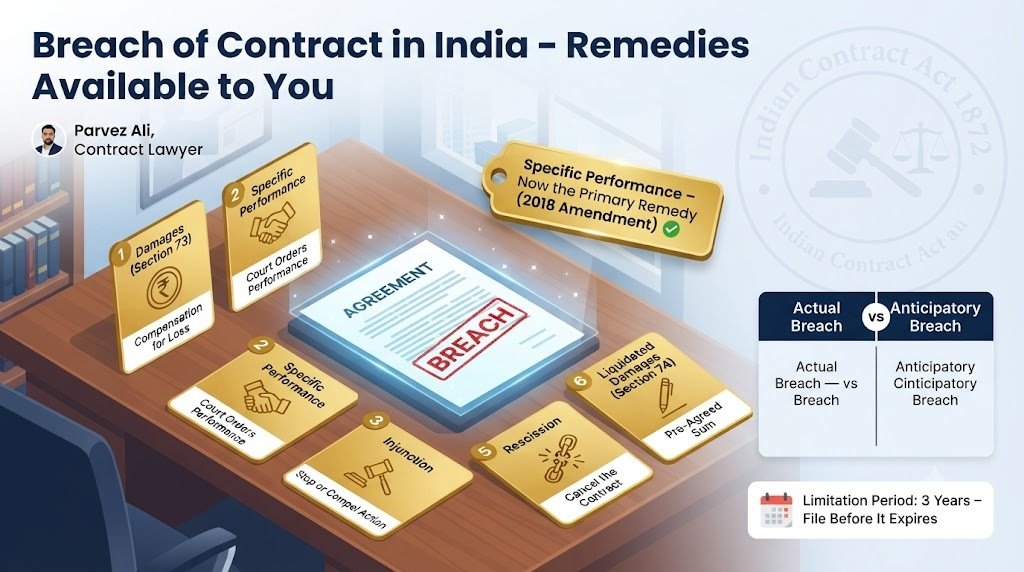
A breach of contract doesn’t automatically mean you’re entitled to whatever compensation feels fair — Indian law is considerably more specific than that, and the remedy that’s actually available to you depends heavily on what kind of breach occurred, what the contract itself says, and how quickly you act. I get this question from homebuyers whose builder missed a possession date, freelancers who never got paid for delivered work, and founders whose vendor simply stopped performing mid-contract — and in almost every case, the person assumes damages are their only option, when specific performance, an injunction, or even quantum meruit might actually serve them better.
This article covers every remedy Indian law makes available for a breach of contract — what each one actually does, when courts will grant it, and the practical steps that protect your claim from the moment a breach happens, not after you’ve already lost the ability to act on it. This ties directly into the broader documentation discipline covered in my Business Contracts checklist for founders, since every agreement is only as protective as the remedies actually available if it’s ever breached.
What Constitutes a Breach of Contract?
A breach of contract occurs when a party fails to perform their obligations under a valid agreement, without lawful excuse — I’ve covered what makes an agreement a valid contract in the first place, and hence capable of being breached, in Essential Elements of a Valid Contract Under Indian Law. A breach can be total (a complete failure to perform any part of the obligation) or partial (performance that falls short of what was promised), and understanding which type applies shapes both which remedy fits and how much compensation you can realistically claim.
Types of Breach – Actual vs Anticipatory
Indian law recognises two distinct timings of breach, and this distinction genuinely changes your legal position:
- Actual breach occurs when a party fails to perform on the due date, or performs defectively during performance.
- Anticipatory breach occurs when a party clearly indicates — through words or conduct — that they won’t perform their obligations, before the performance date actually arrives. Indian law allows the aggrieved party to treat the contract as breached immediately, sue for damages right away, or wait until the actual performance date to see if the other party changes course. This choice matters, because the limitation period for filing a claim can run from either the anticipatory repudiation or the actual due date, depending on which option you choose.
Remedy 1: Damages Under Section 73
Section 73 of the Indian Contract Act, 1872 is the foundation of most breach of contract claims — it entitles the aggrieved party to compensation for loss or damage that naturally arose in the usual course of things from the breach, or that both parties knew, at the time of contracting, was likely to result from it. This codifies the English principle from Hadley v. Baxendale (1854), and it means you generally can’t recover losses that were too remote or unforeseeable when the contract was made — a claim for lost profits from an unrelated downstream deal the other party never knew about, for instance, is unlikely to succeed.
Damages under Section 73 come in a few recognised forms:
- General (ordinary) damages — compensation for loss naturally arising from the breach, foreseeable at the time of contracting
- Special damages — compensation for unusual losses, recoverable only if the specific circumstances were actually communicated to the other party when the contract was formed
- Nominal damages — a token amount awarded where a breach is proven but no actual financial loss resulted, simply acknowledging the legal wrong
- Exemplary or punitive damages — rarely awarded in ordinary commercial breach of contract cases, since Indian contract law’s core aim is compensation, not punishment
Crucially, Explanation to Section 73 requires the aggrieved party to take reasonable steps to mitigate their loss — failing to do so can reduce or eliminate the compensation otherwise available, a point worth understanding well before you consider simply waiting and stacking up damages.
Remedy 2: Liquidated Damages and Penalty Under Section 74
Many contracts include a clause specifying a pre-agreed sum payable on breach. Section 74 governs how these clauses actually work in India, and the position here differs meaningfully from English law, which draws a sharp distinction between “liquidated damages” (a genuine pre-estimate of loss, enforceable) and a “penalty” (designed to punish, generally unenforceable). Indian law does not make this same distinction — regardless of how the clause is labelled, courts will award only reasonable compensation not exceeding the stipulated amount, and the party claiming under Section 74 still needs to demonstrate that some genuine loss actually occurred, even if not to the precise degree stipulated. If the stipulated sum is wildly excessive compared to any conceivable loss, courts will scale it down to what’s actually reasonable, regardless of what both parties originally agreed to in writing.
Remedy 3: Specific Performance – Now the Primary Remedy
This is one of the most significant, and most under-appreciated, shifts in Indian contract remedies over the past decade. Following the 2018 amendment to the Specific Relief Act, 1963, specific performance — a court order compelling the breaching party to actually perform their contractual obligations, rather than simply pay damages — is now treated as the primary remedy for breach of contract in most circumstances, rather than the narrow, discretionary exception it used to be under the pre-2018 framework. This is a genuinely important shift for anyone negotiating a contract today: courts are now considerably more willing to order actual performance — delivering the property, transferring the shares, completing the agreed work — rather than simply awarding compensation and allowing the breaching party to walk away. Specific performance remains most readily available where the subject matter is unique (immovable property being the classic example), and the party seeking it must show they were ready and willing to perform their own obligations throughout.
Remedy 4: Injunction
An injunction is a court order either restraining a party from doing something (a prohibitory injunction) or compelling them to do something (a mandatory injunction), also governed by the Specific Relief Act. This remedy is particularly relevant where a breach of contract involves an ongoing or threatened violation — for instance, restraining a party from breaching a confidentiality obligation I’ve covered in Confidentiality Agreement vs NDA, or preventing someone from disposing of a specific asset that’s the subject of a dispute while litigation is pending.
Remedy 5: Quantum Meruit
Quantum meruit — literally “as much as he has earned” — allows a party who has partially performed a contract to recover reasonable compensation for the work actually completed before the breach occurred, even where the contract itself doesn’t specify a price for partial performance, or where the contract is later found unenforceable for reasons unrelated to that party’s own conduct. This remedy matters considerably for freelancers, contractors, and vendors who’ve delivered part of an agreed scope before a counterparty walked away — it prevents someone from simply cutting off a project midway and refusing to pay for what was genuinely delivered.
Remedy 6: Rescission
Rescission cancels the contract entirely and aims to restore both parties to their original position before the agreement was made — returning any benefits already exchanged. This is typically pursued where continuing the contractual relationship no longer makes sense, and the aggrieved party would rather walk away cleanly than seek damages or force continued performance from a counterparty who’s already shown they won’t honour the deal.
Limitation Period – You Have 3 Years, Not Forever
This is one of the most consequential — and most commonly missed — practical points in any breach of contract matter. Under Article 55 of the First Schedule to the Limitation Act, 1963, a suit for breach of contract must generally be filed within three years from the date of the breach. For an anticipatory breach, this period can run from either the date of repudiation or the date performance was actually due, depending on which option the aggrieved party elected. This limitation period is treated as effectively absolute — courts have very limited discretion to condone delay beyond it, which makes it genuinely dangerous to sit on a valid claim while trying to informally resolve the dispute, only to find the limitation window has quietly closed.
Mitigation of Loss – Why You Can’t Just Sit Back
Indian courts expect the aggrieved party to take reasonable steps to minimise their own loss once a breach occurs — continuing to incur avoidable costs, or deliberately allowing damages to accumulate, can reduce what a court is ultimately willing to award. Practically, this means documenting your mitigation efforts from the earliest stage of the dispute — alternative arrangements sought, costs genuinely incurred to limit the damage — since this evidence directly supports the compensation you eventually claim.
Breach of Contract and Arbitration – Check Your Clause First
Before filing any court case over a breach of contract, check whether the underlying agreement contains an arbitration clause — if it does, that clause generally needs to be honoured, routing the dispute to arbitration rather than court litigation, subject to the specific terms and any limited exceptions. I’ve covered exactly what a properly drafted arbitration clause should specify in Arbitration Clause Drafting, and separately, which courts would have supervisory or residual jurisdiction in Jurisdiction Clauses in Contracts — both are worth confirming before you spend time and money filing in the wrong forum.
What Should You Do If a Contract Is Breached?
Practically, once you identify a genuine breach:
- Review the contract itself carefully for the specific obligations breached, any cure period, and the dispute resolution mechanism specified — the same discipline I’ve laid out in How to Read a Contract Before You Sign It
- Document the breach and your losses as they occur, including any mitigation steps taken
- Send a formal notice to the breaching party, specifying the breach and requesting a remedy within a reasonable timeframe — often a prerequisite before further legal action
- Check for a valid arbitration clause and confirm whether the underlying agreement is properly stamped, since an unstamped agreement can complicate admissibility in a dispute
- Consider settlement before committing to full litigation or arbitration — I’ve covered exactly how a properly structured exit works in Settlement Agreements – How Founders Exit Disputes Without Litigation
- File within the limitation period, ideally with legal advice well before the three-year window narrows
Common Mistakes When Pursuing a Breach of Contract Claim
I see the same handful of issues repeatedly:
- Waiting too long to act, and discovering the three-year limitation period has already run out
- Not mitigating losses, which courts can treat as a reason to reduce the compensation ultimately awarded
- Assuming damages are the only available remedy, when specific performance, injunction, or quantum meruit might genuinely serve the situation better
- Ignoring an existing arbitration clause and filing directly in court, only to have the matter referred back to arbitration anyway, wasting time and cost
- Treating a liquidated damages clause as automatically enforceable at face value, without realising courts will still scale it down to reasonable compensation if it’s excessive
- Not properly documenting the breach and resulting loss, leaving a claim that’s legally sound but practically difficult to prove
Frequently Asked Questions
What are the main remedies available for breach of contract in India? For any breach of contract, Indian law provides damages under Sections 73-75, specific performance and injunctions under the Specific Relief Act, quantum meruit for partial performance, and rescission of the contract, depending on the nature of the breach and the circumstances.
What is the difference between actual and anticipatory breach? Actual breach occurs when a party fails to perform on the due date; anticipatory breach occurs when a party indicates, before the due date, that they won’t perform — allowing the aggrieved party to act immediately rather than wait.
How long do I have to file a breach of contract claim in India? Generally three years from the date of breach, under Article 55 of the Limitation Act, 1963 — a limit treated as effectively absolute, with very limited scope for courts to condone delay.
Is specific performance easier to get now than it used to be? Yes — following the 2018 amendment to the Specific Relief Act, specific performance is now the primary remedy for most breaches, rather than a narrow, discretionary exception as it was previously.
Does a liquidated damages clause guarantee you’ll receive that exact amount? Not necessarily — under Section 74, Indian courts award reasonable compensation not exceeding the stipulated amount, and can reduce it further if the stipulated sum is excessive relative to any genuine, provable loss.
What is quantum meruit and when does it apply? It allows a party who has partially performed a contract to recover reasonable compensation for the work actually completed, even without a specified price for partial performance — commonly relevant for freelancers and contractors whose work is cut short by the other party’s breach.
Do I need to prove actual financial loss to claim damages? Generally yes, for damages beyond a nominal amount — Section 73 compensation is tied to loss naturally arising from the breach or reasonably foreseeable at the time of contracting.
What happens if my contract has an arbitration clause and I file in court instead? The court will typically refer the matter to arbitration in accordance with the clause, subject to the specific terms and limited exceptions — making it worth confirming the correct forum before filing.
Can I claim damages and still ask the court to cancel the contract? Generally, a party must choose a consistent remedy — pursuing damages while performing under the contract differs from rescinding it — though the appropriate combination depends on the specific facts and should be assessed carefully.
Does an unstamped agreement affect a breach of contract claim? It can affect admissibility as evidence in court until the deficient stamp duty and any penalty are paid, though this is generally a curable defect rather than one that invalidates the underlying claim.
Final Takeaway
A breach of contract rarely has just one obvious remedy — damages, specific performance, injunction, quantum meruit, and rescission each fit different situations, and choosing the right one (or combination) shapes how much you actually recover and how quickly. What matters most practically is speed: document the breach early, mitigate your losses, check your dispute resolution clause before filing anywhere, and never let the three-year limitation window creep up on you while you’re still deciding what to do.
Dealing with a breach of contract and need help deciding the right remedy? Get in touch and let’s map out your options before the clock runs further. For the broader groundwork on what makes an agreement enforceable in the first place, see my Essential Elements of a Valid Contract and Contract Law Glossary.
This article is for general informational purposes and does not constitute legal advice. Breach of contract remedies depend on your specific facts and should be reviewed by a qualified lawyer.
Written by Parvez Ali.