
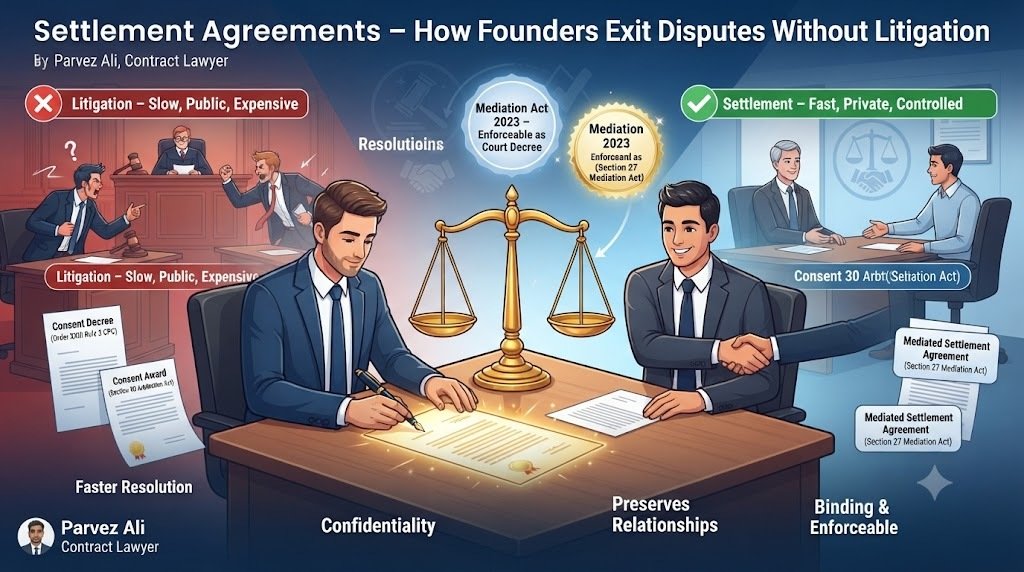
A well-structured settlement agreement is usually the fastest, least damaging way out of a dispute a founder never wanted to be in — a co-founder split that turned adversarial, a vendor relationship that broke down, an investor disagreement that’s threatening to derail a funding round. Litigation is slow, public, and expensive in ways that go well beyond legal fees — it can consume months of founder attention that should be going into the business, and it can permanently damage relationships and reputations that mattered before the dispute started. A properly drafted settlement agreement lets both sides close the chapter on their own terms, rather than handing that decision to a court.
This article covers what a settlement agreement actually is under Indian law, how it differs from a consent decree, what the Mediation Act, 2023 changed about enforceability, and what founders need to include to make sure a settlement actually sticks.
What Is a Settlement Agreement?
A settlement agreement is a contract between disputing parties that resolves some or all of their disagreement on mutually agreed terms, without requiring a court or arbitrator to decide the matter on the merits. It typically involves one or both parties giving up certain claims or rights in exchange for payment, specific actions, or other agreed consideration, and it’s governed by the same fundamental principles as any other contract under the Indian Contract Act, 1872 — offer, acceptance, consideration, and lawful object. Whether a specific settlement is genuinely binding depends on its actual drafted terms, not its title — the same substance-over-form principle I’ve discussed in MOU vs Contract.
Why Founders Choose Settlement Over Litigation
Settlement is generally preferred over full litigation or even arbitration for a few consistent reasons: it’s typically faster, both parties retain control over the outcome rather than handing it to a judge or arbitrator, the terms and existence of the dispute can often remain confidential, and it preserves at least the possibility of an ongoing business relationship — genuinely valuable when the dispute involves a co-founder, investor, or long-term commercial partner you might still need to work alongside. I’ve covered the broader dispute resolution framework — including when arbitration itself is the right first choice — in my article on Arbitration Clause Drafting, and a settlement agreement often becomes the actual exit mechanism even when a matter starts down the arbitration or litigation path.
Settlement Agreement vs Consent Decree – Order XXIII Rule 3 CPC
If a dispute has already reached a civil court, a settlement agreement can be formalised as a consent decree under Order XXIII Rule 3 of the Code of Civil Procedure, 1908. This provision allows parties to a pending suit to settle on agreed terms, in writing and signed by the parties, which the court then records and converts into a binding decree. A consent decree carries the same enforceability as any other court decree, and importantly, courts have consistently held that a consent decree operates as an estoppel — it’s valid and binding unless specifically set aside by the same court, and generally can’t be independently challenged through a separate suit or appeal. This is precisely why a settlement agreement destined to become a consent decree needs to be drafted with the same rigor as any binding contract — once the court records it, unwinding it becomes genuinely difficult.
Mediated Settlement Agreements Under the Mediation Act, 2023
This is one of the more significant recent developments in how a settlement agreement gets enforced in India. Under the Mediation Act, 2023, which came into force in October 2023, a settlement agreement reached through mediation and properly authenticated by the mediator is now enforceable in the same manner as a judgment or decree of a court, under Section 27 of the Act. This is a genuinely important shift from the pre-2023 position, where a mediated settlement was typically enforceable only as an ordinary contract, requiring separate proceedings to actually enforce if one side breached it.
The Act also sets a statutory timeline — mediation is meant to be completed within 120 days of the first appearance before the mediator, extendable by a further 60 days with the parties’ consent — and codifies confidentiality, meaning communications made during the mediation process are generally inadmissible in any later proceedings. A mediated settlement agreement can only be challenged on narrow grounds, such as fraud, corruption, impersonation, or where the underlying dispute wasn’t actually suitable for mediation in the first place, with a challenge required within 90 days of receiving the authenticated agreement.
Settlement in Arbitration – Section 30 of the Arbitration Act
Where a dispute is already proceeding through arbitration rather than court litigation, parties can still settle — and under Section 30 of the Arbitration and Conciliation Act, 1996, an arbitral tribunal can record that settlement as a consent award, which then carries the same status and enforceability as any other arbitral award. This overlaps directly with the arbitration clause drafting considerations I’ve written about separately, since a well-structured arbitration clause should generally accommodate — rather than complicate — this kind of negotiated exit if the parties reach one before the tribunal issues a final award.
What a Founder’s Settlement Agreement Should Include
A properly drafted settlement agreement should clearly address the same core elements I’ve emphasised across the broader documentation checklist in Business Contracts for founders:
- Recitals describing the dispute, establishing exactly what’s being settled and providing context if the agreement is ever challenged
- The specific terms of settlement — payment amount, timeline, actions to be taken, or equity or asset transfers, spelled out precisely
- A release and discharge clause, confirming that both parties waive further claims related to the settled matter
- Confidentiality obligations, covering both the existence and terms of the settlement itself
- Non-disparagement terms, if relevant, restricting either party from making negative public statements about the other going forward — drafted with the same enforceability care I’ve discussed around restrictive covenants in What Makes a Non-Compete Clause Enforceable in India?
- Governing law and dispute resolution for the settlement agreement itself, in case a dispute arises over the settlement’s own terms — a point I’ve covered in more depth in Jurisdiction Clauses in Contracts
- Consequences of breach, including whether the settlement can be converted into a consent decree or enforced as an arbitral award if either side fails to honour it
Confidentiality in Settlement Agreements
Confidentiality is one of the most valuable, and most commonly under-drafted, aspects of a settlement agreement. Founders settling a co-founder or investor dispute often want the underlying disagreement to stay private — for the sake of the company’s reputation with employees, customers, and future investors. This needs to be explicitly built into the settlement itself, covering both the terms of the settlement and, ideally, the fact that a dispute occurred at all, with clearly defined consequences if either party breaches that confidentiality. I’ve discussed the broader principles behind drafting enforceable confidentiality terms in Confidentiality Agreement vs NDA, and the same discipline applies directly here.
Is a Settlement Agreement Legally Binding?
Generally, yes — a properly drafted settlement agreement is a binding contract in its own right, enforceable under ordinary contract law principles. Its enforceability is meaningfully strengthened, though, depending on how it’s formalised: as a consent decree under Order XXIII Rule 3 CPC if reached during litigation, as a consent award under Section 30 of the Arbitration Act if reached during arbitration, or as a mediated settlement agreement under the Mediation Act, 2023 if reached through formal mediation — each of these routes gives the settlement stronger, more direct enforceability than relying on it as an ordinary, standalone contract that would need a fresh breach-of-contract suit to enforce.
Common Mistakes Founders Make When Settling Disputes
I see the same handful of issues repeatedly:
- Settling verbally or over email, without a properly drafted written agreement — courts have consistently held that a written, signed document is essential for a compromise to be legally binding
- Vague release language, leaving ambiguity about exactly which claims are actually being waived
- No confidentiality clause, allowing details of the dispute to become public despite both sides wanting privacy
- Not addressing what happens on breach, leaving the settling party without a clear, fast enforcement path if the other side doesn’t honour the agreement
- Rushing the settlement to end an uncomfortable dispute, without properly valuing what’s actually being given up in exchange
- Not formalising the settlement through the appropriate mechanism — a consent decree, consent award, or mediated settlement agreement — when litigation, arbitration, or mediation is already underway, missing the stronger enforceability those routes provide
When Should You Consider Settlement Over Litigation or Arbitration?
Settlement is generally worth pursuing seriously when the relationship has some ongoing value worth preserving, when both sides want to avoid the cost and publicity of a prolonged dispute, when the outcome of litigation or arbitration is genuinely uncertain, or when a faster resolution matters more than pursuing every possible claim to its fullest extent. This overlaps closely with the broader dispute resolution planning I’ve covered in Founder Agreement / Co-Founder Agreement in India, where a well-drafted deadlock resolution clause often points toward settlement or mediation as the first step, precisely to avoid an adversarial dispute in the first place.
Frequently Asked Questions
What is the difference between a settlement agreement and a consent decree? A settlement agreement is the underlying contract resolving a dispute; a consent decree is what that agreement becomes once a court records and formalises it under Order XXIII Rule 3 CPC during pending litigation, giving it the enforceability of a court judgment.
Is a mediated settlement agreement legally binding in India? Yes — under the Mediation Act, 2023, a properly authenticated mediated settlement agreement is enforceable in the same manner as a court judgment or decree, a significant strengthening from the pre-2023 position.
Can a settlement agreement be challenged after it’s signed? Generally only on narrow grounds — for a mediated settlement, this includes fraud, corruption, impersonation, or unsuitability for mediation, within a limited window after receiving the agreement.
Does a settlement agreement need to be in writing to be enforceable? Yes — courts have consistently held that a written, signed agreement is essential for a compromise or settlement to be legally binding under Indian procedural law.
Can arbitration disputes be settled before the tribunal issues a final award? Yes — under Section 30 of the Arbitration and Conciliation Act, 1996, the tribunal can record a settlement as a consent award, carrying the same enforceability as any other arbitral award.
Should a settlement agreement include a confidentiality clause? Generally yes, particularly for founder, investor, or employment disputes — without an explicit confidentiality clause, details of the dispute and settlement can become public even when both parties wanted privacy.
What happens if one party breaches a settlement agreement? The consequences depend on how the settlement was formalised — a consent decree or consent award can typically be enforced directly through execution proceedings, while an ordinary settlement contract may require a fresh breach-of-contract claim.
How long does mediation take under the Mediation Act, 2023? Mediation is meant to be completed within 120 days of the first appearance before the mediator, extendable by a further 60 days with the consent of the parties.
Final Takeaway
A well-drafted settlement agreement can resolve a dispute faster, more privately, and with considerably more control over the outcome than litigation or a fully contested arbitration — but only if it’s actually drafted properly, with clear release terms, confidentiality, and a defined enforcement path if either side doesn’t honour it. Whether you formalise it as a consent decree, a consent award, or a mediated settlement agreement under the 2023 Act, the strength of that enforcement mechanism is worth understanding before you sign, not after a breach forces the question.
Working through a dispute and considering settlement instead of litigation? Get in touch and let’s make sure the agreement actually protects you once it’s signed. For the broader contract fundamentals worth understanding before any negotiation, see my Contract Law Glossary and How to Read a Contract Before You Sign It.
This article is for general informational purposes and does not constitute legal advice. Settlement agreements should be tailored to your specific dispute and reviewed by a qualified lawyer.