
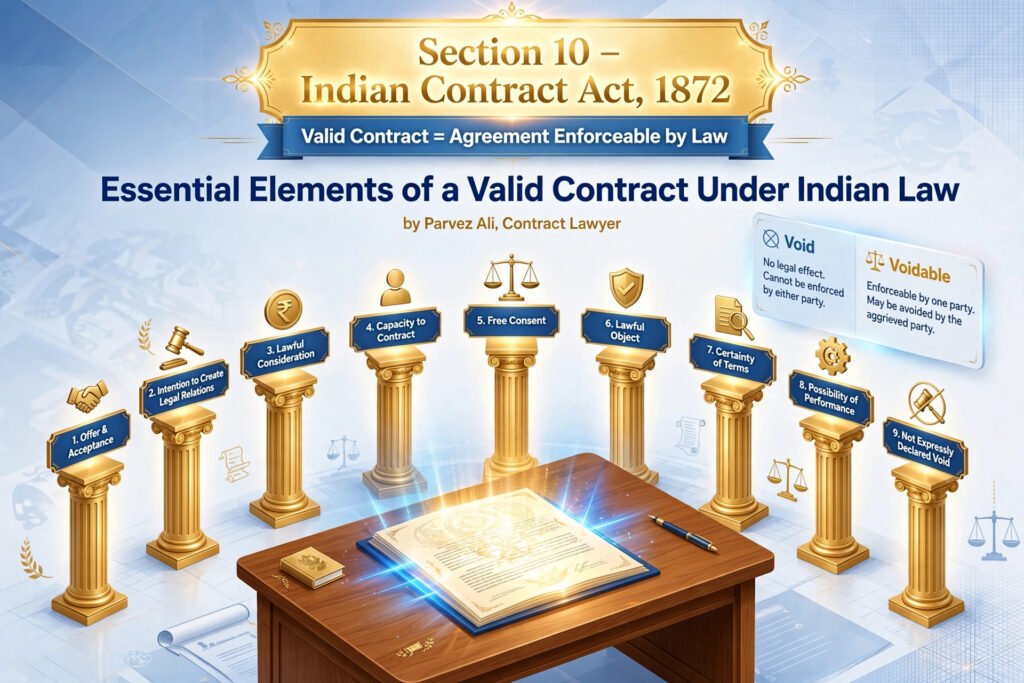
Understanding the essential elements of a valid contract is the one piece of legal literacy I’d want every founder to actually have, because it’s the foundation underneath every other article on this site — every founder agreement, NDA, employment contract, and vendor agreement I’ve written about ultimately has to satisfy the same basic requirements before it’s worth anything at all. Founders often assume a signed document is automatically a binding contract simply because both parties put their name to it. It isn’t, necessarily — a signature doesn’t override a missing element, and an agreement that looks perfectly professional can still be void, voidable, or simply unenforceable if it fails to satisfy what Indian law actually requires.
This article breaks down exactly what makes an agreement a valid contract under the Indian Contract Act, 1872 — the elements Section 10 requires, what happens when one is missing, and why this matters well beyond a law school exam question.
What Is a Contract? Agreement vs Contract
Under Section 2(h) of the Indian Contract Act, 1872, a contract is defined simply as “an agreement enforceable by law.” This distinction matters more than it sounds: Section 2(e) defines an agreement as “every promise and every set of promises forming the consideration for each other” — meaning every contract is an agreement, but not every agreement rises to the level of a legally enforceable contract. A promise between friends to meet for dinner is an agreement; it’s not a contract, because neither party intended it to carry legal consequences. What separates the two is exactly what this article covers.
Section 10 – The Legal Foundation for a Valid Contract
Section 10 of the Act is the single most important provision underlying every valid contract in India. It states: “All agreements are contracts if they are made by the free consent of parties competent to contract, for a lawful consideration and with a lawful object, and are not hereby expressly declared to be void.” Every element discussed below flows directly from this one sentence, and missing even one of them can mean the difference between a valid contract and an agreement with no legal teeth at all.
1. Offer and Acceptance
Every valid contract begins with a lawful offer (or proposal) by one party, and an unqualified acceptance of that exact offer by the other. Under Section 2(a), an offer is a clear expression of willingness to do or not do something, made to obtain the other party’s assent. Acceptance must mirror the offer precisely — a modified response is legally treated as a counter-offer, not an acceptance, and doesn’t form a contract until the original offeror accepts those new terms in turn. Both parties must also be talking about the same thing in the same sense — a principle courts describe as consensus ad idem, or a genuine “meeting of minds.” Without it, even a document both parties signed may not actually be a valid contract.
2. Intention to Create Legal Relations
Beyond offer and acceptance, both parties must intend for their agreement to carry legal consequences. Purely social or domestic arrangements — a parent promising a child a gift for good exam results, for instance — generally lack this intention and aren’t treated as valid contracts, even if one side later feels let down. This is precisely the kind of question that comes up in the MOU vs Contract context too — whether a document was genuinely intended to create binding obligations, or merely record an understanding, depends heavily on its actual language and the parties’ evident intent.
3. Lawful Consideration
Consideration, defined under Section 2(d), is something of value — a promise, payment, goods, or services — exchanged between the parties. The long-standing principle is “no consideration, no contract”: an agreement to do something without receiving anything in return generally isn’t enforceable as a valid contract, subject to specific statutory exceptions under Section 25 (such as agreements made out of natural love and affection, in writing and registered, between close relatives). Consideration doesn’t need to be adequate — courts don’t typically second-guess whether the exchange was a good deal — but it does need to be real, lawful, and not illusory.
4. Capacity to Contract
Under Section 11, the parties to a valid contract must be competent to contract — meaning they’ve reached the age of majority (18 years in India), are of sound mind, and aren’t otherwise disqualified from contracting by any law they’re subject to. An agreement with a minor is treated as void from the outset, not merely voidable — a principle established in the landmark case Mohori Bibee v. Dharmodas Ghose, where the Privy Council held that a mortgage entered into by a minor couldn’t be enforced against him, precisely because he lacked the legal capacity to contract in the first place.
5. Free Consent
Under Sections 13 and 14, consent must be free — meaning it wasn’t caused by coercion, undue influence, fraud, misrepresentation, or mistake. If consent is compromised by any of these factors, the resulting agreement is generally voidable at the option of the party whose consent wasn’t genuinely free, rather than automatically void. This is one of the elements courts scrutinise most closely in a dispute, because it goes directly to whether the agreement genuinely reflects what both parties actually intended to agree to.
6. Lawful Object
The object — the purpose — of the agreement must be lawful. Under Section 23, an object is unlawful if it’s forbidden by law, would defeat the provisions of another law, is fraudulent, involves injury to another person or their property, or is considered immoral or opposed to public policy by the courts. An agreement to do something illegal simply isn’t a valid contract, regardless of how carefully the rest of the document is drafted, and this is exactly the same underlying principle behind why Section 27’s restraint-of-trade provisions render most non-compete clauses void — I’ve covered this specific application in detail in What Makes a Non-Compete Clause Enforceable in India?
7. Certainty of Terms
A valid contract’s terms must be certain and unambiguous, not vague or uncertain to the point that a court can’t determine what the parties actually agreed to. An agreement to sell “some of my land” without specifying which portion, for instance, would generally fail this requirement. This principle underlies much of what I’ve written about contract drafting generally — vague scope language, undefined terms, and ambiguous obligations don’t just create commercial friction, they can genuinely undermine a contract’s enforceability, a point I’ve expanded on in How to Read a Contract Before You Sign It.
8. Possibility of Performance
An agreement to do something impossible isn’t a valid contract — this connects directly to Section 56 of the Act, the doctrine of frustration, which I’ve covered in more depth in the context of Force Majeure Clauses. If performance was impossible from the very outset — not due to a later event, but genuinely impossible when the agreement was made — the agreement is void from the start, distinct from a contract that becomes impossible to perform later due to a supervening event.
9. Not Expressly Declared Void
Finally, the agreement must not fall into a category the Act itself expressly declares void — including agreements in restraint of trade (Section 27), agreements in restraint of marriage (Section 26), wagering agreements (Section 30), and agreements to do impossible acts (Section 56), among others. Even where every other element is satisfied, an agreement falling into one of these categories still won’t constitute a valid contract.
What Happens If an Element Is Missing? Void vs Voidable
Understanding the difference between void and voidable matters here. A void agreement has no legal effect from the outset — it was never enforceable, as with a minor’s agreement or one with an unlawful object. A voidable contract, by contrast, is enforceable until and unless the aggrieved party chooses to cancel it — typically applicable where consent was obtained through coercion, fraud, undue influence, or misrepresentation, meaning the affected party has a choice, not an automatic nullity. This distinction has real practical consequences — a voidable contract can still be enforced if the aggrieved party chooses not to challenge it, while a void agreement generally can’t be revived by either party’s later consent.
Why This Matters for Founders
Every specific contract type I’ve written about on this site is, underneath its specific commercial terms, simply an application of these same nine elements — the same underlying discipline behind the Business Contracts checklist I’ve put together for founders drafting agreements for the first time. A Founder Agreement needs genuine consideration and free consent between co-founders just as much as any commercial deal. A Settlement Agreement resolving a dispute is only as strong as the free consent and lawful object underlying it. Even something as procedural as Stamp Duty on Agreements only becomes relevant once you already have a valid contract to stamp in the first place — stamping doesn’t cure a fundamentally void agreement. Understanding these foundational requirements is what lets you spot a genuinely defective agreement before you sign it, rather than discovering the defect only once a dispute forces the question, which is exactly the discipline I’ve tried to build into How to Read a Contract Before You Sign It and my broader Contract Law Glossary.
Frequently Asked Questions
What are the essential elements of a valid contract under Indian law? Under Section 10 of the Indian Contract Act, 1872, a valid contract requires offer and acceptance, intention to create legal relations, lawful consideration, capacity to contract, free consent, a lawful object, certainty of terms, possibility of performance, and must not be expressly declared void.
What is the difference between an agreement and a contract? Every agreement is a promise or set of promises; a contract is specifically an agreement that’s enforceable by law under Section 2(h). Not every agreement satisfies the requirements to become a valid contract.
Can a minor enter into a valid contract in India? No — under Section 11, a minor lacks the capacity to contract, and any agreement with a minor is void from the outset, as established in Mohori Bibee v. Dharmodas Ghose.
What is the difference between a void and a voidable contract? A void agreement has no legal effect from the beginning; a voidable contract remains enforceable until the aggrieved party — typically one whose consent wasn’t free — chooses to cancel it.
Does a contract need to be in writing to be valid in India? Generally no — Indian law recognises oral contracts as valid in most cases, though certain categories (such as agreements required to be registered) need to be in writing, and written contracts are always considerably easier to prove and enforce.
What happens if consideration is missing from an agreement? Generally, “no consideration, no contract” — an agreement without lawful consideration typically isn’t enforceable, except under specific statutory exceptions like agreements made out of natural love and affection between close relatives.
Is an agreement with an unlawful object enforceable? No — under Section 23, an agreement with an object that’s illegal, fraudulent, injurious, or opposed to public policy is void, regardless of how the rest of the contract is drafted.
What does “free consent” mean under Indian contract law? Consent is free when it isn’t caused by coercion, undue influence, fraud, misrepresentation, or mistake, as defined under Sections 14 to 22 of the Act. If consent isn’t free, the resulting contract is generally voidable.
Can a contract be valid if its terms are vague or uncertain? No — Indian courts require reasonable certainty in a contract’s terms. An agreement so vague that a court can’t determine what was actually agreed generally fails this requirement.
Why does understanding these elements matter for founders specifically? Because every specific agreement a founder signs — a founder agreement, NDA, employment contract, or settlement — is only as enforceable as its compliance with these same foundational requirements, regardless of how detailed its specific commercial terms are.
Final Takeaway
The essential elements of a valid contract aren’t abstract law-school theory — they’re the actual test any agreement you sign has to pass before it’s worth the paper (or PDF) it’s written on. Offer, acceptance, consideration, capacity, free consent, lawful object, certainty, possibility of performance, and not being expressly void — every one of these matters, and missing even one can quietly undermine an agreement you assumed was airtight. Understanding this foundation is what makes every other contract-specific article on this site actually useful, rather than a collection of clauses without the legal grounding underneath them.
Not sure whether an agreement you’re about to sign actually holds up as a valid contract? Get in touch and let’s make sure it does before you rely on it.
This article is for general informational purposes and does not constitute legal advice. Contract validity depends on your specific facts and should be reviewed by a qualified lawyer.