
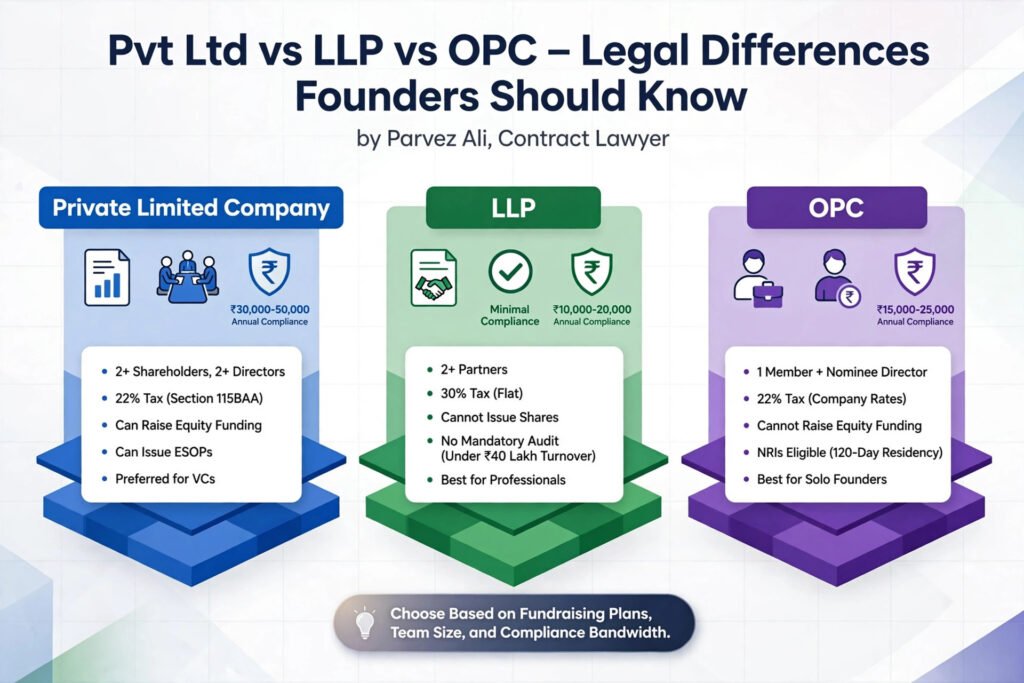
The Pvt Ltd vs LLP vs OPC decision is usually the very first legal choice a founder makes, often before they’ve even settled on a product — and it’s a decision that quietly shapes almost everything that follows: how much tax you pay, whether investors will even consider funding you, how much compliance paperwork you’re signing up for every year, and how personally exposed you are if things go wrong. I’ve seen founders pick a structure based on what a friend used, or whatever a CA suggested in a five-minute phone call, and then spend real time and money converting to something else eighteen months later once the mismatch became obvious.
This article breaks down exactly how a Private Limited Company, an LLP, and an OPC differ under Indian law in the Pvt Ltd vs LLP vs OPC comparison — ownership, liability, taxation, compliance, and fundraising — with the specific numbers and provisions that actually matter for the decision, not just generic descriptions.
What Is a Private Limited Company (Pvt Ltd)?
A Private Limited Company is registered under the Companies Act, 2013, and regulated by the Ministry of Corporate Affairs (MCA). It requires a minimum of two directors and two shareholders, and can have up to 200 shareholders and up to 15 directors without seeking special approval to expand further. Since the Companies (Amendment) Act, 2015, there’s no statutory minimum paid-up capital requirement — you can incorporate with a nominal amount, though most founders still set a reasonable authorised capital for operational purposes.
A Pvt Ltd company is generally the preferred structure for founders planning to raise external funding, because it can issue shares to investors cleanly, supports employee stock option plans (ESOPs), and is the entity structure investors and venture capital funds are most comfortable investing into. Whatever structure you choose, remember that the entity itself doesn’t make an agreement enforceable — every contract you sign on its behalf still needs to satisfy the essential elements of a valid contract under Indian law.
What Is a Limited Liability Partnership (LLP)?
An LLP is governed by the Limited Liability Partnership Act, 2008, and combines features of a traditional partnership with the limited liability protection of a company. It requires a minimum of two partners, with no upper limit, and — like a Pvt Ltd company — has no mandatory minimum capital contribution. At least one designated partner must be an Indian resident, though NRIs and foreign nationals can otherwise be partners, subject to applicable FDI conditions.
LLPs are generally favoured by professional service businesses — consulting firms, law firms, chartered accountants, agencies — and by founders who want a company-like liability shield without the heavier compliance burden a Pvt Ltd company carries.
What Is a One Person Company (OPC)?
An OPC, introduced under the Companies Act, 2013 specifically to give solo entrepreneurs corporate structure and limited liability without needing a second shareholder, is formed by a single member, who must also appoint a nominee director in addition to acting as director themselves. Since the Companies (Incorporation) Second Amendment Rules, 2021, NRIs can now incorporate an OPC in India, provided they meet a reduced 120-day residency requirement — a meaningful relaxation from the earlier rule that restricted OPCs to Indian citizens and residents only.
OPCs are genuinely useful for a solo founder who wants a formal structure before deciding whether to bring on employees, contractors, or a co-founder — a decision that eventually raises the same classification questions I’ve covered in Employment Contract vs Freelance Agreement.
Pvt Ltd vs LLP vs OPC: Side-by-Side Comparison
| Factor | Private Limited Company | LLP | OPC |
|---|---|---|---|
| Governing law | Companies Act, 2013 | LLP Act, 2008 | Companies Act, 2013 |
| Minimum members | 2 shareholders, 2 directors | 2 partners | 1 member + nominee director |
| Maximum members | 200 shareholders | No upper limit | 1 (converts if scaled — see below) |
| Minimum capital | None (since 2015) | None | None |
| Liability protection | Limited to shareholding | Limited to contribution | Limited to unpaid share amount |
| Can raise equity funding | Yes — preferred by investors | No — cannot issue shares | No |
| Can issue ESOPs | Yes | No | No |
| Corporate tax rate | 22% under Section 115BAA (concessional regime), else standard slab | 30% flat, but no dividend distribution tax | Taxed as a company, similar to Pvt Ltd |
| Mandatory audit | Yes, regardless of turnover | Only if turnover exceeds ₹40 lakh or capital contribution exceeds ₹25 lakh | Yes, regardless of turnover |
| Board/general meetings | Mandatory | Not required — governed by LLP agreement | One meeting per half-year if more than one director; none required for sole director |
| Foreign ownership | Automatic route in most sectors | Permitted, subject to FDI conditions | Not permitted for foreign nationals (NRIs eligible since 2021) |
| Typical annual compliance cost | ₹30,000–₹50,000 | ₹10,000–₹20,000 | ₹15,000–₹25,000 |
| Registration timeline | 2–10 working days (MCA V3) | 7–15 working days (FiLLiP) | 2–10 working days (MCA V3) |
Taxation Differences Explained
Taxation is one of the areas founders most consistently get wrong when comparing Pvt Ltd vs LLP vs OPC, because the headline numbers don’t tell the full story. A Pvt Ltd company can access the concessional 22% corporate tax rate under Section 115BAA (plus applicable surcharge and cess), provided it forgoes certain exemptions and incentives — a rate that’s become the default choice for most new companies given how competitive it is. An OPC, taxed under the same company taxation framework, generally accesses the same concessional rates.
An LLP, by contrast, is taxed at a flat 30% on its profits, with no equivalent concessional regime — but LLPs avoid the dividend distribution complications that come with a company structure, since profit distributed to partners isn’t taxed again the way a company’s post-tax dividend distribution can create additional tax exposure for shareholders. Depending on how profits are actually used — reinvested versus distributed — this can make the effective tax comparison closer than the headline 22% versus 30% numbers suggest, which is exactly why this is worth modelling against your specific business’s expected profit and distribution pattern rather than assuming one rate is simply “better.”
Compliance and Annual Filing Requirements
This is where the three structures diverge most sharply in day-to-day founder experience, and it’s usually the deciding factor once founders actually sit down to weigh Pvt Ltd vs LLP vs OPC seriously. A Private Limited Company carries the heaviest compliance load: mandatory board meetings, an annual general meeting, statutory audit regardless of turnover, and annual filings including the financial statements (Form AOC-4) and annual return (Form MGT-7/MGT-7A) with the Registrar of Companies.
An LLP has meaningfully lighter compliance — no mandatory board or general meetings at all, since the LLP is governed primarily by its LLP agreement rather than statutory meeting requirements, and audit is only mandatory if annual turnover exceeds ₹40 lakh or partner capital contribution exceeds ₹25 lakh under Rule 24(8) of the LLP Rules. Many small LLPs simply never trigger a mandatory audit requirement at all.
An OPC sits in between — it requires annual filings and a statutory audit similar to a Pvt Ltd company, but with relaxed meeting requirements: only one board meeting every six months if there’s more than one director, and no board meeting requirement at all if the OPC has a sole director, which is genuinely useful for solo founders who don’t want the formality overhead.
Fundraising – Which Structure Can Actually Raise Capital?
If raising external capital is anywhere in your plans, this comparison largely settles itself. A Private Limited Company can issue shares to investors cleanly, structure equity rounds, and issue ESOPs to attract talent — which is exactly why venture capital funds and angel investors overwhelmingly prefer this structure, a point I’ve covered from the investor side in Angel Investment Agreements in India and SAFE Notes vs Convertible Notes, both of which assume a Pvt Ltd company structure as the norm.
An LLP cannot issue shares at all — it has no equity instrument for investors to actually acquire, which means external equity fundraising through an LLP is essentially unavailable in the conventional sense. An OPC similarly cannot raise equity funding from outside investors — bringing in an investor would require converting the entity structure first. If you’re planning to raise institutional capital at any point, starting directly with a Pvt Ltd company generally saves you a conversion process later, rather than starting lean with an LLP or OPC and converting once funding conversations begin. Whichever structure you choose, registering your brand separately is worth prioritising early too — I’ve covered exactly how in Trademark Registration in India, since company registration and trademark protection are genuinely separate processes.
Foreign Ownership and NRI Eligibility
Foreign investment rules differ meaningfully across the three structures. A Private Limited Company generally permits foreign investment under the Automatic Approval route in most sectors, making it the most straightforward structure for foreign founders or foreign investors. An LLP permits foreign ownership too, but subject to specific FDI conditions and sector eligibility, historically requiring more careful structuring than a straightforward Pvt Ltd investment. An OPC remains the most restrictive here — only an Indian citizen and resident can be the sole member (or, since the 2021 relaxation, an eligible NRI meeting the 120-day residency requirement), and foreign nationals generally cannot incorporate an OPC at all.
Can You Convert Between Structures Later?
This is genuinely important to understand before you choose, because conversion later is rarely as simple as founders assume. An OPC can convert to a Private Limited Company voluntarily — a mandatory conversion threshold based on turnover or paid-up capital used to apply, but this requirement has since been removed, meaning an OPC can now scale indefinitely without being forced to convert. Converting from an LLP to a Private Limited Company, by contrast, is a more involved, costlier process, and something worth planning for in advance rather than treating as a simple administrative switch if you expect to eventually need equity fundraising capability.
Which Structure Should You Choose in the Pvt Ltd vs LLP vs OPC Decision?
A reasonably reliable shortcut for resolving Pvt Ltd vs LLP vs OPC in practice:
- Choose a Private Limited Company if you plan to raise venture capital or angel funding, want to issue ESOPs to attract talent, or expect to scale with multiple co-founders and eventual institutional investment — this is the structure I’d generally recommend pairing with a properly drafted Founder Agreement from day one, given how directly equity and vesting terms depend on having a share-issuing entity in place.
- Choose an LLP if you’re running a bootstrapped consulting, professional services, or agency business with two or more partners, don’t need external equity funding, and want meaningfully lower compliance overhead.
- Choose an OPC if you’re a solo founder who wants a formal corporate structure and limited liability protection without bringing in a co-founder purely to satisfy a minimum-member requirement, and you’re not planning to raise external equity funding in the near term.
Common Mistakes Founders Make When Choosing a Structure
I see the same handful of issues repeatedly:
- Choosing based on lowest compliance cost alone, without considering whether that structure can actually support future fundraising plans
- Starting as an LLP with fundraising plans already in mind, then facing a costly, time-consuming conversion once investor conversations begin
- Adding a “nominal” second shareholder just to satisfy a Pvt Ltd minimum, without a proper Founder Agreement governing that person’s actual rights and equity — a gap that can create real disputes later
- Underestimating Pvt Ltd compliance costs, only budgeting for registration and not the ongoing audit, board meeting, and ROC filing obligations
- Assuming OPC status is permanent, without understanding that voluntary conversion to a Pvt Ltd remains available (and often necessary) once you want to bring in a co-founder or investor
- Not factoring taxation into the decision holistically — comparing headline tax rates alone without modelling how profit distribution actually works under each structure
- Signing incorporation and founding documents without reading them carefully, the same discipline I’ve laid out generally in How to Read a Contract Before You Sign It
Not sure whether a term in this comparison — audit, dividend distribution, designated partner — needs further unpacking? My Contract Law Glossary covers many of the underlying legal terms founders run into during incorporation and beyond.
Frequently Asked Questions
What is the main difference between Pvt Ltd, LLP, and OPC? The Pvt Ltd vs LLP vs OPC distinction comes down to ownership and fundraising capability: a Pvt Ltd company needs at least two shareholders and can raise equity funding; an LLP needs at least two partners and cannot issue shares; an OPC is for a single founder and also cannot raise external equity funding without converting first.
Which structure is best for raising venture capital in India? A Private Limited Company — it’s the structure investors overwhelmingly prefer, since it can issue shares, structure equity rounds, and support ESOPs.
Can an LLP raise funding from investors? Generally no, in the conventional equity sense — LLPs cannot issue shares, making external equity fundraising essentially unavailable without converting to a company structure first.
Is there a minimum capital requirement to register a Pvt Ltd, LLP, or OPC in India? No — since the Companies (Amendment) Act, 2015, there’s no statutory minimum paid-up capital for a Pvt Ltd company or OPC, and the LLP Act doesn’t prescribe a minimum capital contribution either.
Can a single person start a Private Limited Company? No — a Pvt Ltd company requires a minimum of two shareholders and two directors. A solo founder wanting a company structure should consider an OPC instead.
Can an OPC be converted to a Private Limited Company later? Yes, voluntarily — the earlier mandatory conversion threshold based on turnover or paid-up capital has been removed, so conversion is now available whenever the founder chooses, typically when bringing in a co-founder or investor.
Which structure has the lowest compliance burden? Generally an LLP — no mandatory board or general meetings, and audit is only required above specific turnover or capital contribution thresholds, unlike a Pvt Ltd company or OPC, both of which require annual statutory audits regardless of size.
Can NRIs incorporate an OPC in India? Yes, since the Companies (Incorporation) Second Amendment Rules, 2021, provided they meet a reduced 120-day residency requirement — a relaxation from the earlier citizen-and-resident-only restriction.
Are LLP profits taxed differently from a Pvt Ltd company’s? Yes — LLPs are taxed at a flat 30%, while a Pvt Ltd company can generally access a concessional 22% rate under Section 115BAA, though LLPs avoid the additional tax exposure that can arise from a company’s dividend distribution to shareholders.
Can an OPC or LLP issue ESOPs to employees? No — ESOPs require a share-issuing entity, meaning only a Private Limited Company can grant employee stock options in the conventional sense.
Final Takeaway
The Pvt Ltd vs LLP vs OPC decision isn’t really about which structure is “best” in the abstract — it’s about matching the entity to your actual plans for fundraising, team size, and compliance bandwidth, ideally before you’ve built enough on top of the wrong structure to make switching genuinely painful. If institutional funding and ESOPs are anywhere in your roadmap, a Private Limited Company is almost always the right starting point. If you’re bootstrapped and lean, an LLP or OPC can meaningfully reduce your compliance overhead — provided you’re honest with yourself about whether that’s likely to stay true.
Not sure which structure fits your specific plans, or need your founding documents drafted around the right entity? Get in touch and let’s make sure the foundation is right before you build on top of it. For the broader legal groundwork every founder needs, see my Business Contracts checklist and Contract Law Glossary.
This article is for general informational purposes and does not constitute legal, tax, or financial advice. Business structure selection should be reviewed against your specific circumstances by a qualified professional.