
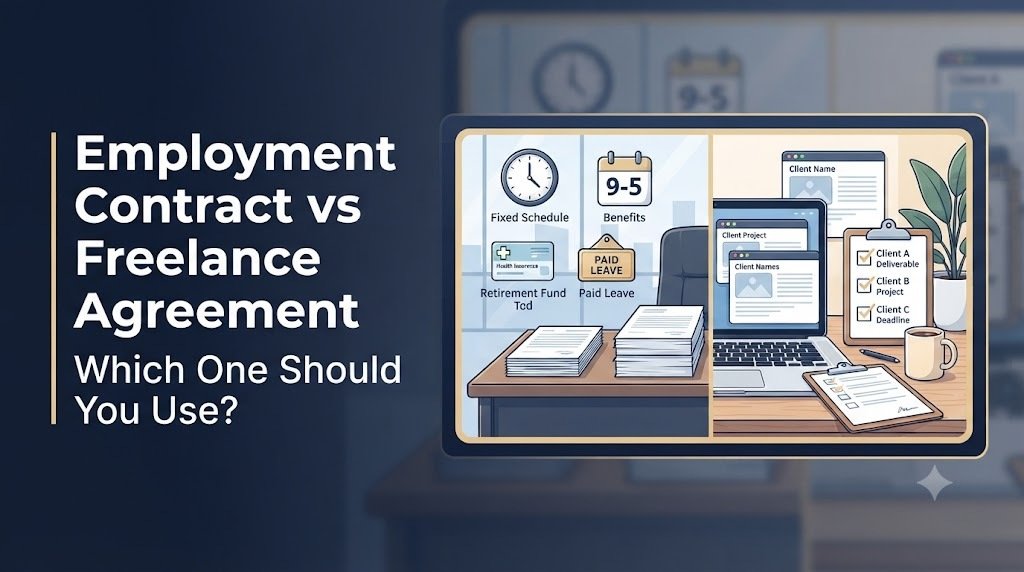
I get some version of this question almost every week, usually from a founder who’s about to bring someone onto the team and isn’t sure what paperwork actually fits: should this be an employment contract, or a freelance agreement? It sounds like a small drafting choice. It isn’t. The Employment Contract vs Freelance Agreement decision determines how much statutory protection the person gets, how much tax and compliance burden falls on you, who owns the work product, and — if you get it wrong — whether a labour authority later decides your “freelancer” was actually an employee the whole time, with all the back-dated liability that comes with it.
This is one of those decisions people make quickly because it feels administrative, when it’s actually foundational. So let’s go through it properly — what each document actually is, how Indian law tells them apart, and how to decide which one fits the relationship you’re actually building.
What Is an Employment Contract?
An employment contract is an agreement that establishes an employer-employee relationship — the person works under your direction, on your schedule (largely), using your tools and processes, and in exchange, receives salary along with statutory protections: provident fund, gratuity, leave entitlements, and the various protections available under applicable labour legislation.
The defining feature isn’t the job title or how the person is paid — it’s control. If you dictate how, when, and where the work gets done, and the person is integrated into your organisation the way any staff member would be, you’re almost certainly looking at an employment relationship, whatever the document is titled.
What Is a Freelance Agreement?
A freelance agreement (also called an independent contractor agreement) governs a relationship where someone delivers a defined scope of work or output, on their own schedule, using their own methods, without being integrated into your organisation as staff. Freelancers typically work with multiple clients, invoice for services rather than draw a salary, handle their own tax filings, and don’t receive employee benefits.
The key distinguishing feature here is autonomy over how the work gets done — you can specify what you need delivered and by when, but not how the freelancer organises their day to produce it.
Employment Contract vs Freelance Agreement: Key Differences
Here’s the comparison I usually walk clients through directly:
| Factor | Employment Contract | Freelance Agreement |
|---|---|---|
| Relationship | Employer–employee | Client–independent contractor |
| Control | Employer directs how work is done | Contractor decides how work is done |
| Statutory benefits | PF, ESI, gratuity, leave, etc. | None — no statutory employee benefits |
| Tax handling | TDS on salary, employer compliance | Contractor manages own tax (TDS under Section 194J typically) |
| Exclusivity | Usually exclusive to one employer | Often works with multiple clients |
| Termination | Notice period, statutory protections | Governed purely by contract terms |
| IP ownership | Typically employer-owned by default | Must be expressly assigned in the agreement |
| Equipment/tools | Usually employer-provided | Usually contractor’s own |
Contract of Service vs Contract for Service
Indian courts and labour authorities don’t decide this question by looking at what you called the document — they look at substance over form, using a distinction lawyers refer to as “contract of service” vs “contract for service.”
A contract of service is what an employment relationship actually is — the person serves under you, subject to your control and supervision. A contract for service is what a freelance or independent contractor relationship is — the person provides services to you as an independent party, without being under your direct control.
Courts typically apply a combination of tests to figure out which one actually exists: the degree of control exercised, whether the person is integrated into the organisation, whether they work exclusively for one party, who bears the financial risk, and who supplies the tools and equipment. This is exactly why simply labelling someone a “freelancer” in a document doesn’t protect you if the underlying relationship functions like employment — a point I’ll come back to.
When Should You Use an Employment Contract?
An employment contract is the right instrument when:
- The person will work fixed or substantial hours under your direction
- You need exclusivity — they shouldn’t be working for competitors simultaneously
- The role is core, ongoing, and integrated into daily operations
- You’re providing equipment, workspace, or specific tools for the role
- You intend to offer statutory benefits and long-term retention incentives
- The relationship is meant to be indefinite, not tied to a specific project
When Should You Use a Freelance Agreement?
A freelance agreement fits better when:
- You need a specific, defined deliverable or project completed
- The person will set their own working hours and methods
- The engagement is short-term, seasonal, or project-based
- You don’t want (or need) an ongoing employer-style relationship
- The person already works with other clients and isn’t exclusive to you
- You want flexibility to end the engagement once the project concludes
If your honest answer to most of these leans toward “I need someone integrated into my team long-term,” you’re describing employment, regardless of what you’d prefer to call it for cost reasons.
Key Clauses in an Employment Contract
A properly drafted employment contract should cover:
- Designation and role — title, reporting structure, and core responsibilities
- Compensation and benefits — salary structure, PF, gratuity, other statutory entitlements
- Working hours and leave policy
- Probation period, if applicable
- Confidentiality obligations, both during and after employment
- Notice period and termination conditions
- Non-compete and non-solicitation, drafted carefully given Section 27 of the Indian Contract Act, which I’ve written about in more depth in my piece on Founder Agreement / Co-Founder Agreement in India — Key Clauses, since the same enforceability limits apply here
- Grievance and dispute resolution mechanism
Key Clauses in a Freelance Agreement
A well-drafted freelance agreement, by contrast, should include:
- Scope of work — a precise definition of deliverables, not a vague description of “services”
- Payment terms — rate, invoicing schedule, and payment timelines
- Timeline and milestones for the project
- Independent contractor status — an explicit statement that no employer-employee relationship is created
- Intellectual property assignment — critical, because unlike employment, IP created by a freelancer doesn’t automatically belong to you unless the agreement says so
- Confidentiality and non-disclosure terms
- Termination clause — how either party can end the engagement, and on what notice
- Indemnity and liability provisions
Misclassification Risks – Treating an Employee as a Freelancer
This is the section I’d genuinely want every founder and small business owner to read carefully, because it’s where I see the most expensive mistakes.
Calling someone a “freelancer” while treating them like staff — fixed hours, exclusive engagement, ongoing supervision, integration into your team, no real autonomy over how the work gets done — doesn’t actually make them a freelancer in the eyes of the law. If a labour authority, tax authority, or court later examines the actual relationship and finds it functions as employment, you can face retroactive liability for unpaid statutory benefits, PF contributions, and penalties — sometimes going back years, and applying to more than one person if the pattern is consistent across your team.
The fix isn’t complicated: match the document to the reality of the relationship, not to whichever option is cheaper on paper. If the relationship looks like employment, document it as employment.
Tax and Statutory Compliance Differences
The tax treatment diverges significantly between the two:
- Employees are subject to TDS on salary under the applicable slab rates, and employers must handle PF and ESI contributions where applicable, along with other statutory filings.
- Freelancers typically invoice for their services, and clients deduct TDS under Section 194J (professional/technical services) rather than salary TDS. Freelancers are responsible for their own income tax filings, GST registration and compliance where applicable, and don’t receive PF or ESI contributions from the client at all.
Getting this wrong doesn’t just create employment-law exposure — it can create tax compliance issues on both sides, which is often the first place misclassification actually surfaces during an audit.
Intellectual Property and Confidentiality Considerations
Under most employment relationships, work created by an employee within the scope of their role is presumed to belong to the employer by default, though a well-drafted contract should still confirm this explicitly rather than relying on presumption. With freelancers, the presumption often runs the other way — many jurisdictions treat the creator as the default IP owner unless the agreement expressly assigns rights to the client. This is precisely why a freelance agreement’s IP assignment clause is non-negotiable, not an afterthought — the same principle I’ve stressed in the founder context, where unclear IP ownership routinely derails fundraising and acquisitions.
Confidentiality matters in both relationships, but freelancers working across multiple clients — sometimes including your competitors — often warrant a more explicit, carefully scoped confidentiality clause than a full-time employee bound by a broader employment contract. If you want a sense of how I approach confidentiality drafting more generally, my site’s own Legal & Policy page walks through the same underlying principles applied to a website context.
Termination and Notice Period Differences
Employment termination in India is shaped by statutory protections, applicable state Shops and Establishments Acts, and the terms of the contract itself — typically involving defined notice periods, severance considerations, and procedural requirements depending on the reason for termination.
Freelance agreements are far more flexible, because the relationship isn’t governed by employment law protections — termination is whatever the contract says it is. This is exactly why the termination clause in a freelance agreement needs to be precise: without statutory backstops, the contract is the entire framework governing how the relationship ends.
Which One Should You Use? A Simple Decision Framework
If you’re still unsure, ask yourself three questions:
- Do I control how, when, and where the work gets done, or just what gets delivered? Control points toward employment; deliverables-only points toward freelance.
- Is this role ongoing and core to my business, or tied to a specific project with a natural end point? Ongoing and core leans employment; project-based leans freelance.
- Am I comfortable with this person working for other clients simultaneously? If not, that exclusivity itself is a strong signal you’re describing an employment relationship.
Answer honestly, and the right document usually becomes obvious — the mistake most businesses make is choosing based on cost rather than the actual shape of the relationship, which is exactly what creates misclassification exposure down the line.
Frequently Asked Questions
What is the main difference between an employment contract and a freelance agreement? An employment contract creates an employer-employee relationship with statutory benefits and employer control over how work is performed. A freelance agreement creates a client-contractor relationship for a defined scope of work, without statutory employee benefits.
Can a freelancer be treated as an employee under Indian law? Yes — if the actual relationship functions like employment (control, exclusivity, integration into the team), authorities can treat it as employment regardless of what the contract is titled, exposing the business to back-dated liability.
Does a freelancer own the IP they create? Often yes, by default, unless the freelance agreement expressly assigns intellectual property rights to the client — which is why this clause is essential in any freelance agreement.
Is TDS applicable on freelance payments? Yes, typically under Section 194J for professional or technical services, which differs from salary TDS applicable to employees.
Which is cheaper — hiring an employee or engaging a freelancer? Freelance engagements often carry lower immediate compliance costs, but this shouldn’t be the deciding factor — misclassifying an employee as a freelancer to save costs creates significantly larger liability if discovered later.
Final Takeaway
The Employment Contract vs Freelance Agreement decision isn’t about which document is cheaper or faster to sign — it’s about which one accurately reflects the relationship you’re actually building. Get the classification right, draft the specific clauses that relationship needs, and you avoid the two most common — and most expensive — mistakes I see: statutory non-compliance on one side, and unassigned IP or unenforceable terms on the other.
If you’re bringing someone onto your team or engaging a contractor and want the paperwork to actually hold up, it’s worth getting the document — and the classification — right from the start. For related reading on structuring agreements properly, see my earlier pieces on Founder Agreement / Co-Founder Agreement in India and 50/50 Co-Founder Splits, or browse the blog for more on startup and employment legal documents.
Need an employment contract or freelance agreement drafted or reviewed? Get in touch and let’s make sure the paperwork matches the relationship you’re actually building.
This article is for general informational purposes and does not constitute legal advice. Employment and freelance arrangements should be reviewed against your specific facts by a qualified lawyer before signing.