
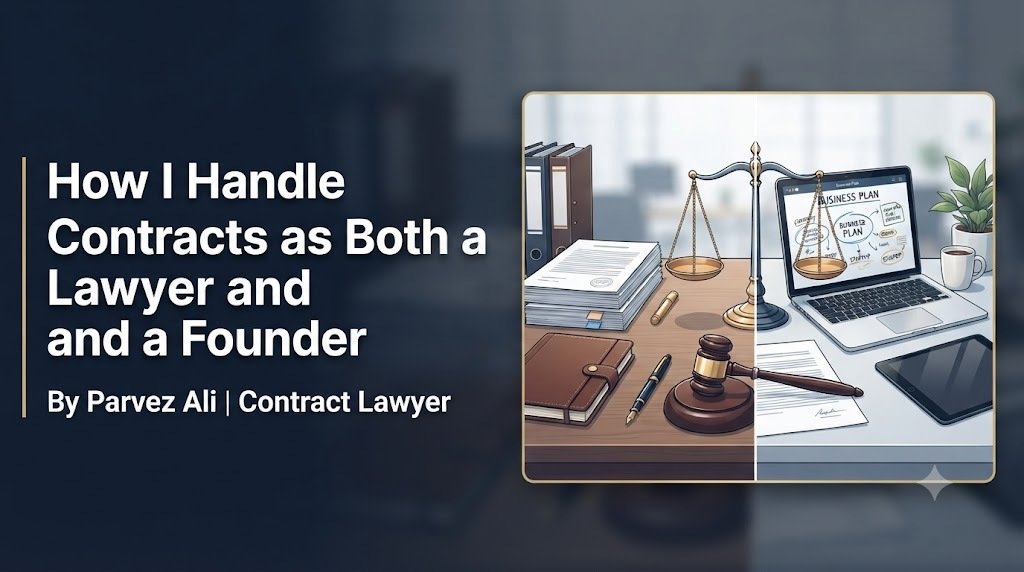
People assume that handling contracts as a lawyer and a founder means I approach every agreement the same way twice — once with a legal hat on, once with a business hat on — and pick whichever version feels safer. In practice, it’s the opposite. The two roles don’t take turns; they argue with each other, in real time, over every clause. And that argument is, honestly, the most useful thing about how I draft.
Most lawyers have never had to live with the consequences of their own contracts past the signing table. Most founders have never had to explain, in front of a judge or an arbitrator, why a clause they thought was “just formality” doesn’t say what they assumed it says. I’ve sat on both sides of that gap, and it’s changed how I think about what a contract is actually for.
Why This Dual Perspective Changes How I Draft
A contract written purely by a lawyer often optimises for legal defensibility — airtight language, exhaustive coverage, every risk fenced off — sometimes at the cost of being something two founders will actually read, understand, and use day to day. A contract written purely by a founder, on the other hand, tends to optimise for speed and trust — “we’re friends, we’ll figure it out” — which is exactly the mindset that leaves gaps a dispute later crawls through.
Handling contracts from both sides means I’m constantly checking a clause against two questions at once: does this hold up legally, and will a founder actually understand and follow this without a lawyer standing over their shoulder? If the answer to either is no, the clause isn’t finished yet.
The Founder’s Instinct: Move Fast, Worry Later
I understand the founder instinct to defer legal work, because I’ve had it myself. When you’re trying to close a deal, hire your first employee, or get a co-founder relationship off the ground, sitting down to negotiate indemnity language feels like the least urgent thing on your list. Momentum matters, and paperwork feels like friction.
The problem isn’t the instinct — it’s that “worry later” almost always means “worry after something’s already gone wrong,” at which point you’re negotiating from a position of damage control instead of foresight. I’ve seen this play out most often with exactly the documents I write about regularly: two co-founders who never formalised their Founder Agreement until a disagreement forced the conversation, or a business that treated a full-time contributor as a freelancer without ever working through the Employment Contract vs Freelance Agreement question properly.
The Lawyer’s Instinct: Cover Every Risk, Even the Unlikely Ones
The professional training pulls the opposite direction — toward comprehensiveness. A traditionally trained lawyer’s draft often tries to anticipate every conceivable scenario, which produces documents that are legally thorough but practically unreadable to the people who actually have to live under them.
I still think comprehensiveness matters — deadlock clauses, vesting schedules, and IP assignment terms exist precisely because founders don’t anticipate the scenarios they cover until it’s too late, as I’ve written about in the context of a 50/50 co-founder split. But comprehensiveness without clarity just shifts the risk from “we didn’t think of this” to “we signed something we didn’t understand,” which is its own kind of liability.
How I Handle Contracts as a Lawyer and a Founder, In Practice
In practice, this shows up as a few consistent habits in how I draft and review contracts:
- I write for the person who has to use the document, not just the lawyer who might litigate it later. Plain language wherever legal precision allows it, defined terms where it doesn’t.
- I prioritise the clauses that actually get disputed, not the ones that look impressive. Deadlock resolution, exit terms, and IP assignment cause far more real-world damage than the boilerplate most templates spend the most words on.
- I treat every agreement as something that has to survive a relationship changing, not just describe it as it is today. Founders change roles, freelancers become core team members, priorities shift — the contract should already account for that.
- I push back on “we’ll trust each other” as a substitute for documentation, because trust is exactly what a good contract protects, not what makes it unnecessary.
- I test my own drafting the way a founder would read it — would I actually understand this clause at 11pm, three weeks before a fundraise, without a lawyer next to me? If not, I rewrite it.
Where This Shows Up in My Own Work
This isn’t just a philosophy I apply to client work — it’s how I’ve approached the legal documents on this site too. My Legal & Policy page and Cookie Policy were written the same way: plain enough that a visitor actually reads them, precise enough that they hold up as real legal documents rather than decorative footer links nobody opens.
The same discipline applies to the founder-facing content on the blog — whether that’s breaking down founder agreement clauses, walking through the risks of a 50/50 equity split, or explaining when a freelance agreement is the wrong tool for the relationship you’re actually building. The goal in every case is the same: a founder should finish reading and understand why a clause exists, not just that it exists.
Mistakes I’ve Learned From — On Both Sides
I’ll be direct about this, because I think it’s more useful than pretending either role gets it right by default. Early in my practice, I drafted agreements that were legally sound but that clients quietly ignored in practice, because the language didn’t match how they actually operated — which meant the contract wasn’t actually protecting anyone, just sitting in a drawer. On the founder side, I’ve also seen — and occasionally made — the opposite mistake: assuming a handshake and a shared understanding would hold up under pressure, only to find out that “we both know what we meant” means something different to each person once real money or equity is on the line.
Both mistakes come from the same root cause: treating the contract as a formality instead of as the actual record of what happens when things get hard. That’s the lesson that shapes almost everything I draft now.
What This Means for You as a Founder
If you’re building something and wondering how seriously to take the paperwork underneath it, here’s the honest answer from someone who’s been on both sides of that question: the contract isn’t the boring part of building a company — it’s the part that decides how painful the hard moments turn out to be. A well-drafted founder agreement, freelance contract, or employment agreement doesn’t slow you down; it’s what lets you move fast later, because you’re not renegotiating trust in the middle of a crisis.
That’s really the whole philosophy behind how I handle contracts as a lawyer and a founder: draft for the version of your business that’s under pressure, not just the version that’s easy to agree on today.
Frequently Asked Questions
Why does it matter if a lawyer has also been a founder? A founder-lawyer has lived with the practical consequences of contract terms — negotiating with a co-founder, managing a freelancer, structuring equity — not just drafted them theoretically. That experience shapes which clauses actually get prioritised and how clearly they’re written.
Do founder-friendly contracts sacrifice legal protection? No — clarity and legal robustness aren’t opposites. A contract can be both plain enough to actually be read and legally precise enough to hold up if it’s ever tested.
What’s the biggest contract mistake founders make? Treating documentation as optional between people who trust each other, rather than recognising that trust is exactly what clear terms are meant to protect once real stakes are involved.
Should early-stage founders use templates or hire a lawyer? Templates can help you understand the shape of a document, but the clauses that matter most — vesting, IP assignment, exit terms, deadlock resolution — usually need to be tailored to your specific situation, not copy-pasted.
Final Takeaway
Handling contracts as both a lawyer and a founder has taught me that the best agreements aren’t the ones with the most clauses — they’re the ones the people signing them actually understand, trust, and would still stand behind six months into a real disagreement. That’s the standard I hold every document I draft to, whether it’s a founder agreement, a freelance contract, or the legal pages on my own site.
If you’re building something and want your contracts to hold up the way you’d want them to if things ever got difficult, that’s exactly the kind of work I do. Get in touch and let’s make sure your paperwork is built for the business you’re actually running — not just the one on paper today.
This article reflects general perspectives on contract drafting and does not constitute legal advice. Your specific agreements should be reviewed against your own facts by a qualified lawyer.