
Founders ask me about SAFE notes vs convertible notes almost every time they start reading US startup content and notice the fundraising instruments described there don’t quite match what their own investors or advisors are proposing. It’s a reasonable thing to be confused about — SAFE notes are everywhere in Silicon Valley content, YC’s own documents, and startup Twitter, and founders naturally assume the same instrument applies here. It mostly doesn’t, and the gap between the two isn’t just terminology — it’s a genuine regulatory difference that can create real compliance problems if you structure a raise around the wrong assumption.
This article walks through the SAFE notes vs convertible notes comparison properly — what each instrument actually is, why Indian law treats them so differently, and what Indian startups actually use instead when they want SAFE-like flexibility.
What Is a Convertible Note?
A convertible note is a debt instrument that converts into equity at a future date — typically the startup’s next priced funding round — rather than requiring the company and investor to agree on a valuation immediately. The investor lends money now; instead of being repaid in cash, that debt converts into shares later, usually at a discount to the new round’s price or subject to a valuation cap, whichever benefits the investor more under the agreed terms.
In India, convertible notes are a formally recognised instrument under the Companies (Acceptance of Deposits) Rules and the Foreign Exchange Management (Non-Debt Instruments) Rules — but only for startups that hold DPIIT recognition under the Startup India programme. This is already the first meaningful gap in the SAFE notes vs convertible notes comparison: one side of it has clear statutory backing, the other doesn’t. Until conversion, the note sits on the company’s books as debt, not equity, and typically carries a defined tenure — up to ten years from issuance — within which it must either convert or be repaid.
What Is a SAFE Note?
A SAFE (Simple Agreement for Future Equity) is a US-originated instrument, popularised by Y Combinator, that gives an investor the right to receive equity at a future triggering event — usually a priced round — without creating debt, interest, or a maturity date. The core idea was to simplify early-stage fundraising by stripping out the debt-like mechanics of a convertible note entirely: no interest accruing, no repayment obligation, no ticking clock forcing a conversion event within a fixed period.
That simplicity is exactly why SAFE notes became the default instrument for early-stage US fundraising — and exactly why founders in India are drawn to the idea once they encounter it, even before understanding what the SAFE notes vs convertible notes distinction actually means for a company incorporated in India.
SAFE Notes vs Convertible Notes: Key Differences
| Factor | Convertible Note | SAFE Note |
|---|---|---|
| Legal status in India | Formally recognised under Companies Act & FEMA | Not recognised under Indian company law or FEMA |
| Classified as | Debt until conversion | Not debt — a contractual right to future equity |
| Interest | Typically carries interest (often 6–8% p.a., sometimes zero) | No interest |
| Maturity date | Yes — must convert or be repaid within a defined period | No maturity date |
| Eligibility | Only DPIIT-recognised startups | N/A — not a recognised category under Indian law |
| Minimum investment | ₹25 lakh per investor per tranche | Not applicable under Indian regulation |
| Foreign investment | Permitted under FEMA reporting requirements | Regulatory ambiguity; generally avoided for foreign investors |
Laid out side by side like this, the SAFE notes vs convertible notes gap isn’t subtle — it’s the difference between a regulated instrument and an unregulated one.
Are SAFE Notes Legally Recognised in India?
No — this is the single most important point in the entire SAFE notes vs convertible notes discussion. A standard US-form SAFE has no statutory footing under either the Companies Act, 2013, or the Foreign Exchange Management Act, 1999. Indian regulators haven’t formally recognised SAFE notes as a distinct financial instrument, which creates real regulatory ambiguity — particularly around whether the funds received could be characterised as an unauthorised “deposit,” and around FEMA compliance if the investor is a non-resident. Founders who sign a plain SAFE agreement, especially with a foreign investor, risk arriving at their next priced round with an instrument that has to be unwound or restructured before institutional investors will proceed — exactly the kind of avoidable complication that slows down a raise at the worst possible time.
How Convertible Notes Work Under Indian Company Law
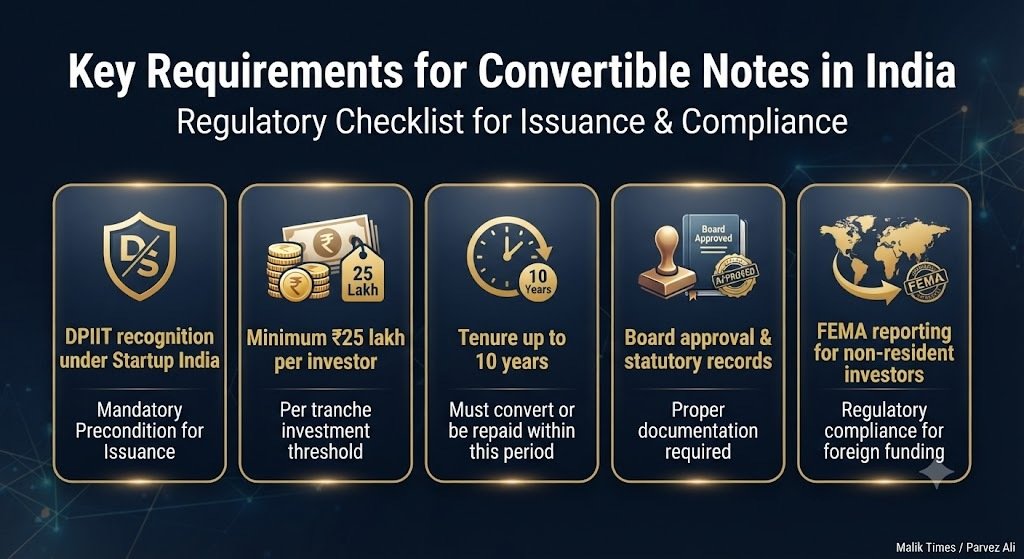
To issue a convertible note in India, a startup generally needs:
- DPIIT recognition under the Startup India scheme — a hard precondition, without which convertible notes can’t be issued at all
- A minimum investment of ₹25 lakh per investor, in a single tranche
- A defined tenure of up to ten years, within which the note must convert into equity or be repaid
- Proper board approval and documentation, recorded in the company’s statutory registers
- FEMA reporting compliance where the investor is a non-resident, including the relevant filings within prescribed timelines
Because convertible notes are treated as debt until conversion, they also typically carry a nominal interest rate — commonly in the 6–8% per annum range, though some notes are structured at zero interest depending on what’s negotiated.
Valuation Cap and Discount Rate Explained
Both convertible notes and SAFE-style instruments typically use two mechanisms to reward early investors for taking on risk before the company’s valuation is established — and both sides of the SAFE notes vs convertible notes comparison rely on them in largely the same way:
- Valuation cap — a ceiling on the valuation at which the investor’s investment converts into equity, ensuring the early investor doesn’t get diluted as heavily as new investors even if the company’s valuation rises sharply by the priced round
- Discount rate — a percentage discount applied to the price per share in the priced round, giving the early investor a better effective price than new investors paying the round’s full valuation
Most agreements specify both, with conversion happening at whichever mechanism is more favourable to the investor at the time of the triggering event — this needs to be spelled out precisely in the agreement, because ambiguity here is one of the more common sources of dispute at the priced round.
Interest and Maturity Date – Why Convertible Notes Have Them (and SAFEs Don’t)
This is the structural heart of the difference. A convertible note is legally debt until it converts, which is exactly why it carries interest and a maturity date — those are standard features of any debt instrument, and Indian regulation treats convertible notes as falling within that category. A SAFE was deliberately designed to avoid this altogether — it’s not debt, so it doesn’t need an interest rate or a repayment deadline forcing a resolution.
The absence of a maturity date is genuinely useful for founders, because it means there’s no ticking clock forcing a priced round before the company is ready. It’s also precisely the feature that makes SAFE notes difficult to fit within Indian regulatory categories, since Indian law doesn’t currently have a comparable framework for a non-debt instrument that simply waits indefinitely for a future equity event.
Which Is Better for Indian Startups?
Given that SAFE notes carry real regulatory risk in India, the practical SAFE notes vs convertible notes question for most founders isn’t really “SAFE or convertible note” — it’s “convertible note, or the Indian workaround that replicates what a SAFE is trying to achieve.” That workaround is generally structured through Compulsorily Convertible Preference Shares (CCPS), sometimes referred to informally as an “iSAFE,” which is engineered to mandatorily convert into equity upon a triggering event while remaining compliant with the Companies Act and FEMA pricing norms.
In practice: if you’re raising primarily from Indian resident investors and the round is straightforward, a convertible note is usually the cleaner, better-understood path. If you specifically want SAFE-like features — no interest, no maturity date — a CCPS-based structure is the compliant way to get there, rather than adopting a plain US SAFE template and hoping it survives scrutiny at your next round.
Key Clauses to Include in a Convertible Note Agreement
Whether you’re using a standard convertible note or a CCPS-based structure, the agreement should clearly address:
- Principal amount and interest rate, if applicable
- Valuation cap and discount rate, and how they interact at conversion
- Qualifying financing threshold — the minimum size of a future round that triggers conversion
- Maturity date and treatment on maturity — conversion, repayment, or extension terms
- Conversion mechanics — exactly how the principal (and any accrued interest) translates into shares
- Investor rights — information rights, pro-rata rights, and any other protections negotiated into the instrument
This overlaps closely with the broader founder-facing documentation I’ve written about in my Business Contracts checklist, and eventually feeds directly into your company’s Shareholders’ Agreement once these instruments convert into actual equity ownership.
Common Mistakes Founders Make with SAFE and Convertible Notes
I see the same handful of issues repeatedly among early-stage founders navigating the SAFE notes vs convertible notes decision:
- Adopting a plain US SAFE template because it’s freely available online, without checking whether it’s compliant under Indian law
- Raising from foreign investors using a SAFE, creating FEMA exposure that has to be untangled before the next round
- Not confirming DPIIT recognition is valid and current before issuing a convertible note
- Missing the ₹25 lakh minimum investment threshold, which can invalidate the intended structure
- Leaving conversion mechanics vague, creating disputes over cap table math at the priced round
- Not tracking the maturity date on outstanding convertible notes, arriving at a deadline without a plan to convert, repay, or renegotiate
Frequently Asked Questions
Are SAFE notes legal in India? Not as a formally recognised instrument — a standard US-form SAFE has no statutory footing under the Companies Act or FEMA, and carries real regulatory ambiguity, particularly with foreign investors. This is the crux of the entire SAFE notes vs convertible notes question for Indian founders.
What is the Indian equivalent of a SAFE note? Indian startups typically use a CCPS-based structure (sometimes called an “iSAFE”) that replicates SAFE-like features — deferred valuation, no fixed interest — while remaining compliant with Indian company law.
Who can issue a convertible note in India? Only startups holding valid DPIIT recognition under the Startup India programme, subject to a minimum investment of ₹25 lakh per investor and a maximum tenure of ten years.
Do convertible notes carry interest in India? Typically yes, since they’re classified as debt until conversion — commonly in the 6–8% per annum range, though zero-interest structures are also used depending on the negotiated terms.
Can foreign investors invest in Indian startups through convertible notes? Yes, subject to FEMA reporting requirements and sectoral FDI eligibility — this is generally more straightforward and better regulated than attempting to use a SAFE with a foreign investor.
What happens if a convertible note reaches its maturity date without conversion? The specific consequence depends on what the agreement provides — options typically include conversion at agreed terms, repayment, or a negotiated extension, which is why maturity handling should be addressed clearly when the note is drafted.
Final Takeaway
The SAFE notes vs convertible notes comparison isn’t really a matter of preference for Indian founders the way it might be elsewhere — Indian law recognises convertible notes, subject to DPIIT eligibility and specific conditions, while a plain SAFE carries genuine regulatory risk that tends to surface at exactly the wrong moment, during your next priced round. If you want SAFE-like flexibility, the compliant path is a properly structured CCPS-based instrument, not a template pulled from a US startup’s data room.
Raising a round and need your convertible note or SAFE-equivalent structured correctly? Get in touch and let’s make sure the instrument you’re using actually holds up under Indian law.
This article is for general informational purposes and does not constitute legal, tax, or investment advice. Fundraising instruments should be structured and reviewed by a qualified lawyer based on your specific circumstances.umstances.