
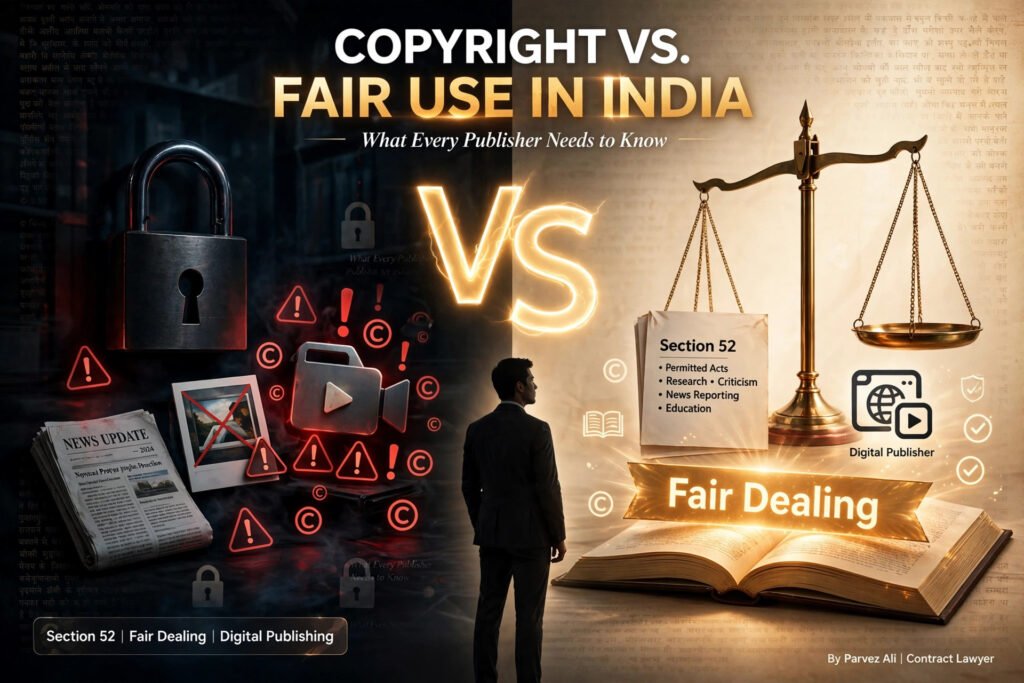
Running Malik Times has taught me something most legal explainers about fair use in India never quite capture: the gap between what publishers assume the law allows and what Section 52 of the Copyright Act, 1957 actually says is genuinely wide, and it’s a gap I’ve had to navigate myself — deciding how much of a source article I can quote in a news brief, whether I can run a screenshot of someone else’s tweet, whether crediting a photographer is enough to use their image. Every digital publication runs into these questions eventually, and most get the answer wrong at least once before they get it right.
This is the first piece in a short series I’m writing on media and publishing law, drawn directly from decisions I’ve had to make running this site — not just theoretical legal writing, but the actual boundaries I check before we publish. This one covers copyright and fair use in India specifically: what the term actually means, how it differs from the American doctrine everyone assumes applies here, and where journalists and content creators most commonly cross a line they didn’t realise existed.
There’s No “Fair Use” in India — There’s “Fair Dealing”
Here’s the correction I’d make first, because it shapes everything else: India does not have a “fair use” doctrine. What India has is “fair dealing,” under Section 52 of the Copyright Act, 1957 — a related but meaningfully narrower concept that gets casually (and incorrectly) called “fair use in India” constantly, including by publishers who should know better. The American fair use doctrine is open-ended, weighed against four flexible factors by courts case by case. Indian fair dealing is purpose-specific and enumerated — your use has to fall within one of the specific categories Section 52 actually lists, or the exception simply doesn’t apply, no matter how “fair” the use might feel.
For media and content creators, the two categories that matter most are:
- Section 52(1)(a)(ii) — fair dealing for criticism or review, of the work itself or of any other work
- Section 52(1)(a)(iii) — fair dealing for reporting of current events and current affairs, including reporting a lecture delivered in public
If what you’re doing doesn’t genuinely fit one of these purposes (or the Act’s other enumerated categories — private study, judicial proceedings, incidental inclusion, and a handful of others), you’re not protected by fair dealing, however reasonable your use might otherwise seem.
The Purpose Test — Why Indian Law Is Narrower Than the US
This distinction isn’t academic pedantry — it changes what’s actually defensible when you’re relying on fair use in India, which is a meaningfully narrower shield than its American namesake suggests. Under the American model, a transformative, non-commercial-feeling use might survive a fair use challenge even without fitting a specific named category. Under Indian law, purpose comes first: courts ask whether your use genuinely serves criticism, review, or news reporting, and only then move to questions of fairness. A publisher who reproduces large chunks of a competitor’s investigative piece under the banner of “commentary,” without genuinely adding critical or reviewing content, is unlikely to be protected — the purpose has to be real, not a label applied after the fact to justify copying.
Even where a use does fit one of these purposes, Indian courts still evaluate fairness itself using a set of factors developed through case law — most notably the three-factor test from Civic Chandran v. Ammini Amma (Kerala High Court): the quantum and value of the material used, the purpose for which it’s used, and the likelihood of the use competing with or substituting for the original work in the market. A use that reproduces the “heart” of a source article — its key findings, its distinctive analysis — rather than genuinely limited excerpts, risks failing this test even if it’s nominally framed as “reporting.”
Quoting News Sources — What’s Actually Allowed
This is the question I navigate most often running Malik Times. When we cover a funding round or a court ruling, we’re almost always drawing on someone else’s original reporting — and the honest position is: you can report on the same underlying facts freely (facts themselves aren’t copyrightable), but you cannot substantially reproduce another publication’s specific wording, structure, or original analysis without it constituting infringement, fair dealing protection notwithstanding beyond genuinely limited quotation.
In practice, this means:
- Facts and events are free to report — if a competitor breaks a story about a funding round, you can report the same facts independently, in your own words, without needing their permission
- Direct quotation should be genuinely minimal — short, specific quotes attributed clearly, not paragraph-length lifts
- Paraphrasing still needs to be genuine rewriting, not a close mirror of the original’s sentence structure and phrasing with a few words swapped
- Source acknowledgment is expected but isn’t itself a defence — crediting a source doesn’t automatically make substantial reproduction lawful; attribution and fair dealing are separate questions entirely
Using Third-Party Images — The Riskiest Gap in Digital Publishing
If there’s one area where I see media sites, including well-established ones, most consistently get this wrong, it’s images. Photographs, unlike short textual quotes, are typically treated as a complete work in themselves — there’s no equivalent to “quoting a sentence” when it comes to a photograph; using it at all generally means using the whole thing. Fair dealing’s news-reporting exception can cover use of an image in a genuine news context, but this protection is narrower than most publishers assume, and it doesn’t extend to using a professional photographer’s or wire service’s image simply because it illustrates your story well, particularly for stock, editorial wire (Getty, AP, Reuters-licensed), or another publication’s original photography.
The practically safer approach for a publication like Malik Times:
- License images properly through stock services or wire subscriptions where budget allows
- Use officially released press images — company logos, official product shots, press-kit photography — which are typically released precisely for media use, subject to any stated conditions
- Create original graphics rather than lifting a competitor’s chart or infographic
- Consider a proper licence where an image is genuinely essential and unavailable elsewhere — the same principle underlying Brand Licensing Agreements, where usage rights have to be expressly granted rather than assumed
- Screenshot with genuine restraint — a screenshot of a public social media post used to report on that post’s content sits differently under fair dealing than screenshotting a paywalled article’s exclusive photography to illustrate an unrelated story
Embedding vs Hosting — Social Media Posts, Screenshots, and Syndicated Content
Embedding a tweet, Instagram post, or YouTube video using the platform’s own official embed code is generally treated differently from hosting a downloaded copy of that same content on your own server — embedding pulls the content live from the platform under that platform’s own terms of service, rather than reproducing a copy yourself, which meaningfully changes the legal analysis. This is worth understanding clearly: embedding a public figure’s tweet to report on what they said is standard, low-risk journalistic practice; downloading that same tweet’s image and re-uploading it as your own site’s asset is a different, higher-risk act entirely.
Attribution Isn’t a Shield — A Common Misconception
I’d flag this because it’s the single most common misunderstanding I encounter among content creators: crediting the original source does not, by itself, make an otherwise infringing use lawful. Attribution is good practice, and it’s expected under Section 52(1)(a)(iii) for news reporting specifically, but it operates alongside the fair dealing analysis, not as a replacement for it. “I credited them” is not a defence if the underlying use — the amount copied, the purpose, the market effect — fails the actual fair dealing test.
What Happens If You Get This Wrong
Copyright infringement in India carries both civil and criminal exposure — courts can award damages, order an injunction preventing further use, and in some circumstances, infringement carries criminal penalties too, since the Copyright Act empowers relatively direct police action compared to some other IP regimes. For a media business specifically, the more immediate practical risk is often a takedown notice or a direct legal notice from the original rights holder, which can disrupt publishing schedules and create real cost even before a matter reaches formal litigation. I’ve discussed the broader distinctions between copyright, trademark, and patent protection — including how automatic copyright protection actually works — in Copyright vs Trademark vs Patent, which is worth reading alongside this piece if you’re building out a publication’s IP policy more broadly. This ties directly into the contributor agreement piece I’ll be writing next in this series, since IP assignment from freelancers and guest writers is exactly where a publication’s copyright exposure most often actually originates.
A Practical Fair Dealing Checklist for Media Founders
Before publishing content that draws on someone else’s original work, I run through this internally:
- Does this genuinely serve criticism, review, or reporting of current events — not just repackaging someone else’s work under a thin editorial wrapper?
- Am I quoting minimally, with the substance of the piece coming from my own reporting, analysis, or writing?
- Have I paraphrased genuinely, rewriting structure and phrasing, not just swapping synonyms?
- Is the image properly licensed, officially released, or embedded through the platform’s own mechanism, rather than downloaded and re-hosted?
- Would a reasonable observer see this as substituting for the original, or as something genuinely additive — analysis, commentary, independent reporting?
- Have I acknowledged the source clearly, even though I know this alone doesn’t resolve the fair dealing question?
If the honest answer to more than one of these is “not really,” that’s the content that needs rework before it goes live, not after a legal notice arrives.
This is exactly the kind of judgment call that benefits from having a written internal policy — the same plain-language discipline I’ve applied to my own site’s Legal & Policy and Cookie Policy pages, rather than relying on ad hoc decisions made under publishing deadline pressure. Freelancers and guest writers contributing content to a publication also raise their own classification questions, similar to those I’ve covered in Independent Contractor Misclassification in India.
Frequently Asked Questions
Is “fair use” a legal term in India? No — there’s no fair use in India as a distinct legal doctrine; what exists is “fair dealing” under Section 52 of the Copyright Act, 1957, which is narrower and purpose-specific, unlike the broader, open-ended American “fair use” doctrine.
Can I quote a news article if I credit the source? Attribution is expected but isn’t itself a legal defence — the quotation still needs to be genuinely minimal and fall within a fair dealing purpose like reporting or review, not simply be credited.
Can I use a photo from another news site if I link back to them? Generally no — linking or crediting doesn’t resolve the underlying copyright question. Images are typically treated as complete works, and using one without a license or fair dealing justification carries real infringement risk.
Is embedding a tweet or Instagram post the same as copying it? No — embedding through the platform’s official code pulls content live under that platform’s own terms, which is treated differently from downloading and re-hosting a copy on your own site.
Does reporting on the same facts as another publication count as copyright infringement? No — facts and events themselves aren’t copyrightable. What’s protected is the specific expression, wording, and original analysis a publication used to report those facts.
What’s the difference between Section 52(1)(a)(ii) and (a)(iii)? Clause (ii) covers fair dealing for criticism or review of a work; clause (iii) covers fair dealing for reporting current events and current affairs, including public lectures.
Can I be sued for copyright infringement even if I didn’t intend to infringe? Yes — copyright infringement doesn’t generally require intent to infringe; using protected material outside a valid exception can create liability regardless of good faith belief that the use was permitted.
What test do Indian courts use to decide if a use is genuinely “fair dealing”? Courts commonly apply factors from cases like Civic Chandran v. Ammini Amma — looking at the quantum and value of material used, the purpose of the use, and whether it competes with or substitutes for the original in the market.
Are official press kit images safe to use without separate permission? Generally yes, since they’re typically released specifically for media use, though it’s worth checking any stated conditions attached to that release before publishing.
What should a media site do if it receives a copyright infringement notice? Take it seriously and review the specific use against the fair dealing framework promptly — removing genuinely infringing content quickly is usually far less costly than contesting a clearly weak position, though a proper legal review can also confirm where a fair dealing defence genuinely applies.
Final Takeaway
Running a digital publication means making dozens of small copyright judgment calls every week, and fair use in India — as most people understand the term — simply isn’t the standard that governs those calls. Fair dealing is narrower, purpose-specific, and judged on quantum, purpose, and market effect, not on a general sense that a use feels reasonable. Understanding this distinction properly is exactly what separates a publication that occasionally gets a takedown notice from one that’s built its editorial practice around genuinely defensible ground from the start.
This is the first piece in my media and publishing law series — next up, I’ll cover why every media site needs a proper contributor agreement for freelancers and guest writers, and how to draft a disclaimer that actually protects you against defamation and reliance claims arising from your reporting.
Building out your publication’s legal foundation and want it reviewed properly? Get in touch — this is exactly the kind of groundwork I help media founders and content businesses get right. For the broader documentation discipline every growing business needs, see my Business Contracts checklist, Contract Law Glossary, and Essential Elements of a Valid Contract.
This article is for general informational purposes and does not constitute legal advice. Copyright and fair dealing questions depend on your specific facts and should be reviewed by a qualified lawyer.
Written by Parvez Ali.