
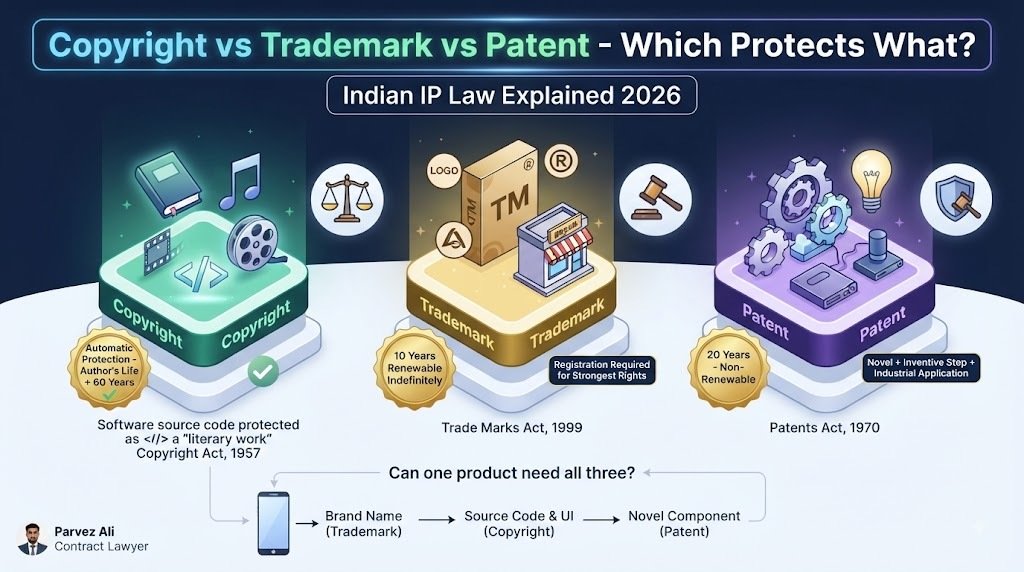
The copyright vs trademark vs patent question comes up constantly from founders who know they need “IP protection” but aren’t sure which specific right actually covers what they’ve built. It’s an understandable mix-up — all three fall under the broad umbrella of intellectual property, all three are covered by separate central legislation in India, and a single product can genuinely involve all three at once without a founder realising it. Get the wrong one, or miss one entirely, and you can end up with a beautifully protected brand name sitting on top of source code and product design that nobody legally owns in any enforceable way.
This article breaks down exactly what each of these three rights protects, how they’re registered and enforced differently under Indian law, and which one your specific startup actually needs first.
What Does Copyright Protect?
Copyright, governed by the Copyright Act, 1957, protects original literary, dramatic, musical, and artistic works — including, importantly for founders, software source code, which is protected as a “literary work” under the Act, along with cinematograph films and sound recordings. Copyright protects the original expression of an idea, not the idea itself — meaning two people can independently build similar functionality, but each one’s actual code, written content, or design work is separately protected as long as it’s original.
Copyright arises automatically the moment an original work is created in a fixed, tangible form — you don’t need to register it for the right to exist. Registration is still genuinely useful, though: under Section 48, an entry in the Register of Copyrights serves as prima facie evidence of ownership if a dispute arises, which matters considerably when you’re trying to prove you created something first.
What Does a Trademark Protect?
A trademark, governed by the Trade Marks Act, 1999, protects brand identifiers — names, logos, taglines, and other distinctive signs that identify your goods or services and distinguish them from competitors in the marketplace. I’ve covered the full registration process in detail in my article on Trademark Registration in India, including fees, classes, and realistic timelines for 2026.
Unlike copyright, a trademark generally needs to be registered to give you the strongest, most enforceable statutory rights — though unregistered marks can still be protected to some extent through the common law remedy of “passing off,” which is considerably harder and more expensive to establish than simply pointing to a registration certificate.
What Does a Patent Protect?
A patent, governed by the Patents Act, 1970, protects new inventions — a novel product or process that involves an inventive step and is capable of industrial application, as defined under Section 2(1)(j) of the Act. Patents cover functional, technical solutions: a new manufacturing process, a piece of hardware, a pharmaceutical compound, or a specific technical mechanism — not brand identity, and not creative expression.
Patents must be formally applied for and granted to create enforceable rights, and India’s patent examination process is considerably more rigorous and time-consuming than trademark or copyright registration, given the technical novelty and inventive-step requirements involved. It’s also worth knowing that Section 3 of the Patents Act specifically excludes certain categories from patentability — including mere discoveries, abstract theories, and, notably for tech founders, most standalone software algorithms unless integrated with a genuine technical application or hardware component.
Copyright vs Trademark vs Patent: Side-by-Side Comparison
| Factor | Copyright | Trademark | Patent |
|---|---|---|---|
| Protects | Original creative expression — writing, code, art, music | Brand identity — names, logos, taglines | Inventions — new, useful, non-obvious technical solutions |
| Governing law | Copyright Act, 1957 | Trade Marks Act, 1999 | Patents Act, 1970 |
| Registration required? | No — arises automatically; registration strengthens enforcement | Effectively yes, for strongest statutory rights | Yes — must be examined and granted |
| Duration | Author’s life + 60 years (60 years from publication for films/sound recordings) | 10 years, renewable indefinitely | 20 years from filing, non-renewable |
| Enforcement | Civil and criminal remedies; police can act directly | Civil remedies via Registrar and courts | Primarily civil litigation |
Do You Need to Register to Get Protection?
This is one of the more common points of confusion in the copyright vs trademark vs patent comparison, because the answer genuinely differs across all three, and it’s worth pausing on the copyright vs trademark vs patent registration question specifically before moving on. Copyright exists automatically upon creation — no filing required, though registration strengthens your evidentiary position. A trademark can technically rely on passing-off protection unregistered, but registration under the Trade Marks Act gives you dramatically stronger, easier-to-enforce statutory rights. A patent, by contrast, simply doesn’t exist as an enforceable right until it’s been examined and formally granted — there’s no automatic or informal equivalent for inventions the way there is for creative works.
How Long Does Each Protection Last?
Duration is another area where copyright vs trademark vs patent diverges significantly. Copyright in authored works generally lasts for the author’s lifetime plus 60 years (with films and sound recordings protected for 60 years from publication instead). A trademark lasts 10 years initially but can be renewed indefinitely in further 10-year blocks, provided the mark remains genuinely in use. A patent, by contrast, lasts a fixed 20 years from the filing date and cannot be renewed — once that term ends, the invention enters the public domain permanently, available for anyone to use, make, or sell.
Can One Product Need All Three?
Frequently, yes — and this is exactly why the copyright vs trademark vs patent question shouldn’t be treated as “pick one.” Consider a hardware product: the brand name and logo are protected by trademark; the user interface design, source code, and marketing materials are protected by copyright; and a genuinely novel technical component — say, a unique battery optimisation mechanism — could be protected by patent. A comprehensive IP protection strategy usually involves coordinating all three where relevant, rather than assuming one form of registration covers everything your business has built.
Is Software Protected by Copyright or Patent?
This deserves its own section because it trips up nearly every tech founder at some point. Software source code is protected as a literary work under copyright, automatically, from the moment it’s written. Software is generally not independently patentable in India — Section 3 of the Patents Act excludes computer programs “as such.” However, software that’s genuinely integrated with a novel technical or hardware application — not just a standalone algorithm — can, in narrower circumstances, qualify for patent protection where it demonstrates a real technical effect beyond the code itself. For most SaaS and software businesses, copyright is the primary, automatic protection for your codebase, with patent protection remaining a narrower, more technical exception rather than the default expectation.
Enforcement – What Happens If Someone Infringes?
Enforcement mechanisms also differ meaningfully across the three. Copyright infringement can lead to both civil remedies and criminal prosecution, with police empowered to act relatively directly under the Copyright Act — making it, in practice, one of the more law-enforcement-friendly IP regimes in India. Trademark infringement similarly carries both civil and, in certain circumstances, criminal consequences, generally involving the Registrar and courts. Patent infringement, by contrast, is enforced almost exclusively through civil litigation — reflecting its technical, commercial nature rather than the kind of counterfeiting concerns criminal enforcement is typically built around.
Which One Does Your Startup Actually Need First?
For most early-stage founders, the practical priority order looks like this: copyright protection for your code, content, and creative assets already exists automatically, so registration here is optional but useful for evidentiary strength; trademark registration for your brand name and logo deserves genuine priority once you’ve settled on a name you intend to build long-term value around, exactly as I’ve covered in my Trademark Registration in India guide; and patent protection is worth pursuing specifically where you’ve developed a genuinely novel, technical invention — not as a default step every startup needs to take. This same prioritisation discipline overlaps with the broader IP assignment clauses I’ve discussed in the context of Founder Agreements and Business Contracts, where making sure the company actually owns what’s been created matters just as much as which specific IP right applies to it.
Frequently Asked Questions
What is the main difference between copyright, trademark, and patent? Copyright protects original creative expression like writing and code; trademark protects brand identity like names and logos; patent protects new, useful inventions and technical processes. Each is governed by separate Indian legislation.
Do I need to register my copyright in India? No — copyright arises automatically upon creation. Registration isn’t mandatory, but it strengthens your position as prima facie evidence of ownership under Section 48 if a dispute arises.
Is software protected by copyright or patent in India? Primarily copyright, as a literary work, arising automatically. Software is generally not independently patentable under Section 3 of the Patents Act, except in narrower cases involving genuine technical or hardware integration.
How long does trademark protection last compared to a patent? A trademark lasts 10 years and can be renewed indefinitely as long as it’s in use. A patent lasts a fixed 20 years from filing and cannot be renewed.
Can a single product be protected by copyright, trademark, and patent at the same time? Yes — a product’s brand name (trademark), its code and design (copyright), and a genuinely novel technical component (patent) can each be separately protected, and often should be for comprehensive protection.
Which should a startup register first — copyright, trademark, or patent? Trademark registration is usually the most urgent priority, since copyright already exists automatically and patents are only relevant for genuinely novel inventions, not every product feature.
Final Takeaway
The copyright vs trademark vs patent question isn’t really about choosing one — it’s about understanding that each protects a genuinely different part of what you’ve built, under separate legislation, with different registration requirements, durations, and enforcement mechanisms. Most startups will lean most heavily on trademark and copyright early on, with patent protection reserved for genuine technical inventions. Getting the right protection on the right asset, rather than assuming one filing covers everything, is what actually keeps your IP defensible as the business grows.
Not sure which IP protection your business actually needs? Get in touch and let’s map out what should be registered, and in what order.
This article is for general informational purposes and does not constitute legal advice. IP protection strategy should be reviewed against your specific assets by a qualified lawyer.