
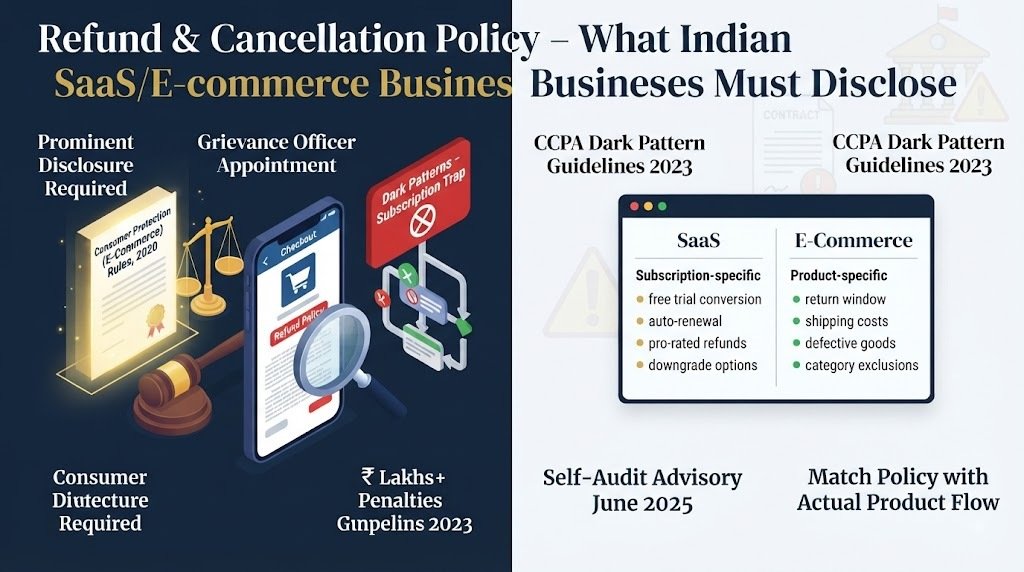
Most founders treat their refund and cancellation policy as a formality copied from a competitor’s website the night before launch, without realising it’s one of the few legal pages actually backed by direct regulatory enforcement in India — not just theoretical contract law. Indian e-commerce and SaaS businesses aren’t just free to write whatever refund terms feel convenient; the Consumer Protection (E-Commerce) Rules, 2020 impose specific disclosure requirements, and the government’s more recent dark patterns guidelines have started penalising businesses whose refund and cancellation policy design misleads consumers, even where the written policy technically says the right things.
This article covers what a compliant refund and cancellation policy actually needs to include, how the rules differ for SaaS subscriptions versus physical e-commerce, and where founders most commonly get this wrong.
What Is a Refund & Cancellation Policy?
A refund and cancellation policy is the document — usually a standalone page linked from checkout, footer, or terms of service — that explains under what circumstances a customer can cancel an order or subscription, request a refund, and what process and timeline applies. For SaaS businesses, this typically covers subscription cancellation and pro-rated or non-refundable billing terms; for e-commerce businesses, it typically covers return windows, product condition requirements, and refund processing timelines.
Is a Refund & Cancellation Policy Legally Required in India?
Yes, for e-commerce entities specifically — this isn’t just good practice, it’s a regulatory requirement. Under the Consumer Protection (E-Commerce) Rules, 2020, notified under the Consumer Protection Act, 2019, e-commerce entities must prominently display clear information covering return, refund, exchange, and cancellation terms, among other mandatory disclosures. This applies to e-commerce entities operating in India or specifically targeting Indian consumers, regardless of where the business itself is incorporated.
For SaaS businesses specifically, the position is slightly different — SaaS often falls within the broader definition of e-commerce (given services are being sold online), meaning the same disclosure principles generally apply, though the specific terms of a subscription refund and cancellation policy will naturally differ from a physical product return policy.
Consumer Protection (E-Commerce) Rules, 2020 – What They Actually Mandate
Beyond simply requiring a refund and cancellation policy to exist, the E-Commerce Rules impose several specific obligations worth understanding:
- Prominent disclosure of return, refund, exchange, warranty, delivery, and payment terms — not buried in fine print or requiring multiple clicks to locate
- No refusal of return, refund, or replacement for defective, deficient, spurious, or misrepresented goods or services, except in narrow, legitimate circumstances
- Grievance officer appointment, with name, contact details, and designation displayed prominently, to handle consumer complaints including refund disputes
- Accurate advertising — advertisements must accurately reflect the actual nature, usage, and characteristics of goods or services, which extends to how refund and cancellation terms are represented in marketing
- Secure payment options with clearly disclosed cancellation procedures, fees, and chargeback information
Non-compliance can attract real penalties under the Consumer Protection Act, 2019, not just reputational risk — this is enforced regulation, not aspirational guidance.
Dark Patterns – Why Your Refund & Cancellation Policy Could Get You Penalised
This is the section I’d want every SaaS founder to read carefully, because it’s a genuinely evolving area of enforcement. The Guidelines for Prevention and Regulation of Dark Patterns, 2023, issued by the Central Consumer Protection Authority (CCPA), specifically identify manipulative design practices — including “subscription trap” patterns that make it easy to sign up but deliberately difficult to cancel, and “forced action” patterns that pressure consumers into unintended purchases or renewals. These guidelines apply regardless of what your written refund and cancellation policy technically states — a policy that says cancellation is available, paired with a cancellation flow buried behind multiple confusing steps, can still be flagged as a dark pattern.
The CCPA has taken this seriously in practice — it has already imposed real penalties on platforms found engaging in dark patterns, and in June 2025 issued a further advisory directing e-commerce platforms to conduct self-audits specifically to identify and correct these practices. For SaaS businesses in particular, this means your refund and cancellation policy needs to match your actual product experience — if cancellation is genuinely available in two clicks, the policy should reflect that, and the product should actually deliver it.
What Every Refund & Cancellation Policy Should Disclose
A properly drafted refund and cancellation policy should clearly cover:
- Eligibility for refunds — what circumstances qualify (defective product, service not delivered, subscription cancelled within a trial period) and which don’t
- Cancellation process — the specific, actual steps a customer needs to take, matching the real product or checkout flow
- Timelines — how long refund processing actually takes, and any relevant cooling-off or return windows
- Refund method — original payment method, store credit, or another mechanism, stated clearly
- Non-refundable items or charges — clearly flagged upfront, not discovered only at the point of a refund request
- Contact details for disputes, including the grievance officer where applicable under the E-Commerce Rules
- Any deductions — processing fees, restocking charges, or partial refund calculations for subscription proration
Refund & Cancellation Policy for SaaS – Subscription-Specific Considerations
SaaS businesses face a distinct set of considerations beyond standard e-commerce returns:
- Free trial to paid conversion — clearly disclosing when a free trial converts to a paid subscription, and how to cancel before that conversion happens
- Auto-renewal disclosure — clearly stating that a subscription renews automatically, and by when a customer needs to cancel to avoid the next charge
- Pro-rated refunds vs no refunds — many SaaS businesses operate on a no-refund-after-billing basis for the current cycle; this needs to be stated explicitly, not implied
- Downgrade and pause options, if offered, as alternatives to full cancellation
- Recurring payment authorisation — aligning your cancellation and refund terms with how recurring payments are actually authorised and processed under applicable RBI-regulated payment mechanisms
Given how much scrutiny “subscription trap” patterns are now receiving specifically, SaaS founders should treat the actual in-product cancellation flow as part of their compliance obligation, not just the written policy page — regulators and courts increasingly look at the two together.
Refund & Cancellation Policy for E-Commerce – Product-Specific Considerations
For physical product e-commerce, the policy should additionally address:
- Return window duration and what condition the product must be in to qualify
- Who bears return shipping costs, stated clearly rather than left ambiguous
- Defective or damaged product handling, which the E-Commerce Rules specifically protect — you generally cannot refuse a refund or replacement for genuinely defective, deficient, or misrepresented goods
- Exchange versus refund options, if both are offered
- Category-specific exclusions — certain product categories (perishables, customised items, intimate goods) are commonly non-returnable, but this needs explicit disclosure, not assumption
Common Mistakes That Make a Refund & Cancellation Policy Non-Compliant
I see the same handful of issues repeatedly:
- Copying a generic template refund and cancellation policy without adapting it to the actual product, checkout flow, or subscription model
- Burying cancellation instructions or requiring excessive steps, creating a functional “subscription trap” even where the written policy claims cancellation is easy
- Not disclosing auto-renewal terms clearly before the first charge occurs
- Failing to appoint or display grievance officer contact details as required under the E-Commerce Rules
- Refusing refunds for genuinely defective products, in violation of the E-Commerce Rules’ specific protections
- Treating the refund and cancellation policy as a static legal page, disconnected from actual product and checkout design — exactly the gap dark patterns enforcement now targets directly
Where This Policy Fits Alongside Your Other Legal Pages
A refund and cancellation policy doesn’t replace your other legal pages — it works alongside them. Your Terms of Service should reference it, your Privacy Policy governs how you handle the data involved in processing refunds, and your Cookie Policy, similar to how I’ve approached my own site’s Cookie Policy and Legal & Policy pages, should stay consistent with the plain-language, actually-readable approach the rest of your legal documentation takes. This overlaps with the broader documentation checklist I’ve covered in Business Contracts for founders building out their legal foundation for the first time.
Frequently Asked Questions
Is a refund and cancellation policy legally required for e-commerce businesses in India? Yes — the Consumer Protection (E-Commerce) Rules, 2020 mandate prominent disclosure of return, refund, exchange, and cancellation terms for e-commerce entities operating in or targeting India.
Do SaaS companies need a refund and cancellation policy too? Generally yes — SaaS services typically fall within the broader e-commerce framework, and the same disclosure and fair-practice principles apply, adapted to subscription-specific terms like auto-renewal and pro-ration.
What are dark patterns and how do they relate to refund policies? Dark patterns are manipulative design practices — like making cancellation deliberately difficult (a “subscription trap”) — regulated under the CCPA’s 2023 Dark Pattern Guidelines. A written refund policy that promises easy cancellation but pairs it with a confusing cancellation flow can still be flagged as non-compliant.
Can an e-commerce business refuse to refund a defective product? Generally no — the E-Commerce Rules specifically prohibit refusing return, refund, or replacement for defective, deficient, spurious, or misrepresented goods or services, except in narrow circumstances.
What happens if a business doesn’t comply with refund disclosure requirements? It can attract penalties under the Consumer Protection Act, 2019, including action from the CCPA, which has already penalised platforms for related dark pattern violations.
Should the refund and cancellation policy match the actual product experience? Yes — increasingly, regulators assess both the written policy and the actual user experience together, particularly for subscription cancellation flows, so the policy needs to reflect what the product genuinely does.
Final Takeaway
A refund and cancellation policy in India isn’t just a defensive legal page — it’s an actively enforced compliance requirement under the Consumer Protection (E-Commerce) Rules, 2020, and increasingly scrutinised alongside your actual product design under the CCPA’s dark patterns enforcement. Write it to reflect what your cancellation flow genuinely does, disclose auto-renewal and refund eligibility clearly, and treat it as a living document tied to your product experience, not a one-time template exercise.
Need your refund and cancellation policy drafted or reviewed for compliance? Get in touch and let’s make sure it actually holds up — both on paper and in your product.
This article is for general informational purposes and does not constitute legal advice. Refund and cancellation policy requirements should be reviewed against your specific business model by a qualified lawyer.