
A well-drafted brand licensing agreement is what lets you earn revenue from your name without giving it away — a franchise partner using your brand in a new city, a manufacturer producing goods under your label, or a distributor selling under your trademark in a market you haven’t entered directly. I’ve seen founders treat this as a simple handshake deal because the other party feels trustworthy, and I’ve also seen founders lose meaningful control over their own brand’s reputation because the agreement never specified how the licensee was actually required to maintain quality. Licensing your brand is genuinely one of the more powerful ways to scale without capital-intensive expansion — but only if the agreement is doing the specific legal work it needs to.
This article covers what a brand licensing agreement actually is under Indian trademark law, the registered user framework that gives it statutory teeth, and the terms that matter most whether you’re the one licensing out your name or taking on someone else’s.
What Is a Brand Licensing Agreement?
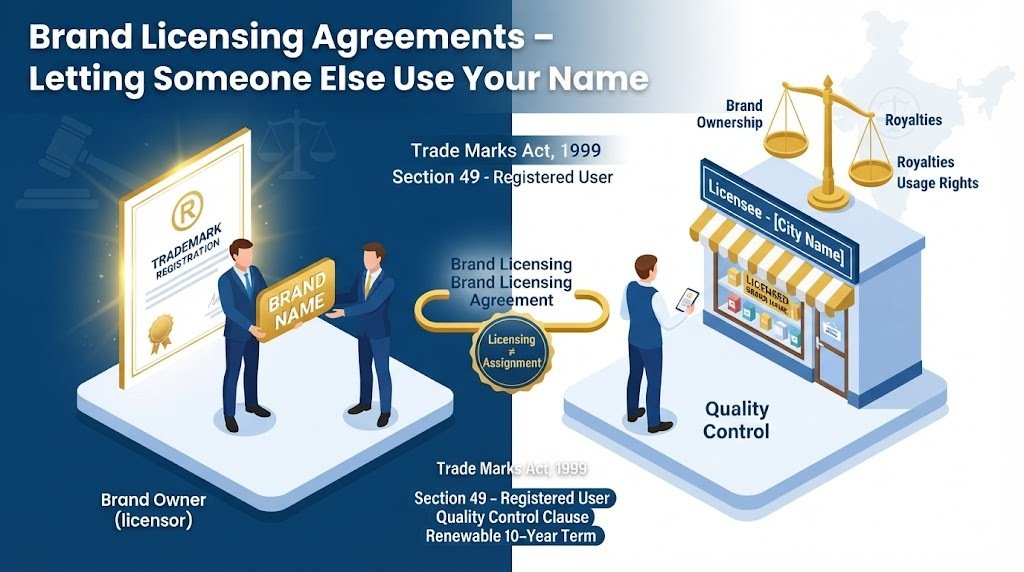
A brand licensing agreement is a contract under which the owner of a trademark (the licensor) grants another party (the licensee) the right to use that trademark, on agreed terms, without transferring ownership of the mark itself. The licensee gets permission to use your name, logo, or brand identity — typically in exchange for royalties or other consideration — while you retain full ownership and, critically, the underlying responsibility for what that brand continues to represent in the market.
Licensing vs Assignment – You’re Not Selling Your Brand
This distinction matters enormously, and founders sometimes conflate the two. An assignment transfers ownership of a trademark entirely — the assignee becomes the new owner. A brand licensing agreement, by contrast, keeps ownership with the licensor and simply grants usage rights, which can be limited by territory, duration, goods or services, and can be revoked or allowed to expire according to the agreement’s terms. If you’re looking to earn ongoing revenue from your brand while retaining control over it long-term, licensing — not assignment — is almost always the right structure.
Legal Framework for Trademark Licensing in India
Interestingly, the Trade Marks Act, 1999 doesn’t actually use the word “license” anywhere in its text. Instead, the Act approaches this through the concept of “permitted use,” defined under Section 2(1)(r), which covers use of a registered trademark by someone other than the proprietor — either as a formally registered user, or simply with the proprietor’s consent. A brand licensing agreement is the underlying contract that establishes this permitted use, and while the Act is silent on licensing of unregistered trademarks, such arrangements remain valid under common law licensing principles, following the same underlying logic. This sits alongside the broader IP landscape I’ve covered in Copyright vs Trademark vs Patent – Which Protects What?, since a brand’s protectable assets often extend well beyond the trademark itself.
Under Section 48(1), the use of the word “may” makes clear that formally registering the license isn’t mandatory for it to be legally valid — but as I’ll cover shortly, registering it gives you meaningfully stronger protection than relying on an unregistered agreement alone.
Registered User vs Permitted User – What’s the Difference?
The Act creates two categories of authorised trademark use, and understanding which one applies to your brand licensing agreement matters for how enforceable and how public your arrangement actually is:
- Registered users are licensees formally recorded with the Trade Marks Registry under Section 49, through a joint application by both licensor and licensee, filed via Form TM-U within six months of the agreement’s date, along with a supporting affidavit detailing the relationship, control measures, and licence terms.
- Permitted users are licensees who have the proprietor’s written consent to use the mark, but haven’t gone through the formal registered-user recordal process.
Registering as a registered user isn’t legally mandatory, but it’s genuinely worth doing — it creates a public record of authorised use on the Trademark Register, which strengthens enforcement and gives third parties clarity about who’s legitimately using your mark and under what conditions.
Why Quality Control Is the Most Important Clause
This is the clause I’d tell any founder not to treat as boilerplate. A trademark exists to signal consistent origin and quality to consumers — if a licensor grants use of their mark without exercising genuine control over what the licensee actually produces or delivers under that name, the mark stops reliably signalling anything at all, and both the brand’s reputation and its legal defensibility can suffer. Indian law builds this expectation directly into the registered-user framework — the licensor’s affidavit supporting a Section 49 application specifically needs to demonstrate the degree of control being exercised over the licensee’s use of the mark. A brand licensing agreement without meaningful, enforceable quality control provisions isn’t just commercially risky; it can undermine the legal basis for the license itself.
Key Terms Every Brand Licensing Agreement Should Include
A properly drafted brand licensing agreement should clearly address:
- The specific mark(s) being licensed, matched precisely to your existing trademark registration
- Goods or services covered, aligned with the classes your trademark is actually registered under
- Territory — where the licensee is permitted to use the mark, which can be nationwide, regional, or market-specific
- Duration and renewal terms, ideally aligned with your trademark’s own 10-year renewal cycle so coverage never lapses mid-term
- Exclusivity — whether the licensee is the sole authorised user in that territory, or one of several
- Royalty and payment terms, including calculation method and payment schedule
- Quality control obligations and inspection rights, giving the licensor genuine oversight, not just theoretical approval rights
- Termination provisions, specifying how and when the license can be ended, including for quality or brand-reputation breaches — drafted with the same care I’ve discussed around exit and termination clauses in Founder Agreement / Co-Founder Agreement in India
- Dispute resolution mechanism, ideally arbitration for the same privacy and speed reasons I’ve covered in Arbitration Clause Drafting, particularly for licensing relationships spanning multiple territories
Royalty Structuring and Tax/FEMA Considerations
Royalties under a brand licensing agreement are generally taxable as business income for the licensor, and GST typically applies to the licensing service being provided. For cross-border arrangements, royalty payments to or from a foreign trademark proprietor are also subject to FEMA compliance requirements, and the licensing agreement needs to structure the royalty rate, calculation method, and payment mechanism in line with applicable Reserve Bank of India regulations. This is exactly the kind of detail worth getting reviewed properly before signing, particularly for founders licensing a brand internationally for the first time — the same cross-border regulatory diligence I’ve discussed in the context of foreign investment in my Angel Investment Agreements in India piece applies just as much here.
Exclusive vs Non-Exclusive Licensing
A brand licensing agreement can grant either exclusive rights — where only one licensee (sometimes excluding even the licensor themselves) can use the mark within the specified territory — or non-exclusive rights, where multiple licensees can operate under the same brand simultaneously, often in different territories or product categories. Exclusive arrangements typically command higher royalties given the limited competition they create for the licensee, while non-exclusive structures allow the licensor to scale usage more broadly across multiple partners at once.
What Happens If You Don’t Register the License?
An unregistered brand licensing agreement — one relying purely on the licensor’s written consent rather than formal Section 49 recordal — remains legally valid, and the licensee’s rights aren’t inherently different in principle. In practice, though, an unregistered arrangement offers weaker evidentiary standing if a dispute arises, and doesn’t create the public record that helps deter third-party confusion or unauthorised use. For any brand licensing agreement involving meaningful royalty value or a long-term commercial relationship, I’d generally recommend pursuing registered user status rather than relying solely on an unregistered, consent-based arrangement.
Common Mistakes in Brand Licensing Agreements
I see the same handful of issues repeatedly:
- Treating the agreement as a revenue mechanism only, without building in meaningful quality control and inspection rights
- Licensing a mark before it’s actually registered, creating downstream complications once registration is eventually pursued — a step I’ve covered in detail in my Trademark Registration in India guide
- Leaving territory or goods/services scope vague, creating ambiguity about what the licensee is actually authorised to do
- Not aligning the license term with the trademark’s own renewal cycle, risking a licence outliving — or a licence expiring mid-way through — the underlying registration
- Skipping FEMA and tax structuring for cross-border royalty arrangements, creating compliance gaps discovered only during an audit
- Not including confidentiality obligations covering business information the licensee gains access to, along the same lines I’ve discussed in Confidentiality Agreement vs NDA
- Confusing licensing with assignment, inadvertently structuring what should be a revocable, controlled arrangement as a permanent transfer of ownership
Frequently Asked Questions
What is a brand licensing agreement? It’s a contract where a trademark owner grants another party permission to use their brand name or logo, typically for royalties, without transferring ownership of the underlying trademark.
Is trademark licensing legally recognised in India? Yes — through the concept of “permitted use” under Section 2(1)(r) of the Trade Marks Act, 1999, covering both formally registered users and licensees with the proprietor’s written consent.
Do I need to register a trademark license in India? Not mandatorily — Section 48(1) makes registration optional — but registering as a registered user under Section 49 creates a public record that strengthens enforcement and evidentiary standing.
Why is quality control important in a brand licensing agreement? Because a trademark signals consistent origin and quality to consumers — without genuine control over the licensee’s use, the mark’s reliability and legal defensibility can both be undermined.
What’s the difference between licensing and assigning a trademark? Licensing grants usage rights while the licensor retains ownership; assignment transfers ownership entirely to the assignee.
Are royalty payments under a brand licensing agreement taxable? Yes — royalties are generally taxable as business income, GST typically applies to the licensing service, and cross-border payments are also subject to FEMA compliance requirements.
Final Takeaway
A brand licensing agreement can be one of the most effective ways to scale a business’s revenue and reach without proportional capital investment — but only when it’s built around genuine quality control, clear scope, and proper structuring, not just a royalty number both sides agreed to quickly. Whether you’re licensing your own name out or taking on someone else’s, treat this agreement with the same rigor you’d apply to any contract governing your brand’s actual reputation, because that’s exactly what it’s doing.
Structuring a brand licensing deal, or need an existing one reviewed? Get in touch and let’s make sure it protects your brand as much as it grows your revenue. For the full picture of which agreements your business needs as it scales, see my Business Contracts checklist for founders.
This article is for general informational purposes and does not constitute legal advice. Brand licensing agreements should be tailored to your specific trademark and business circumstances and reviewed by a qualified lawyer.