
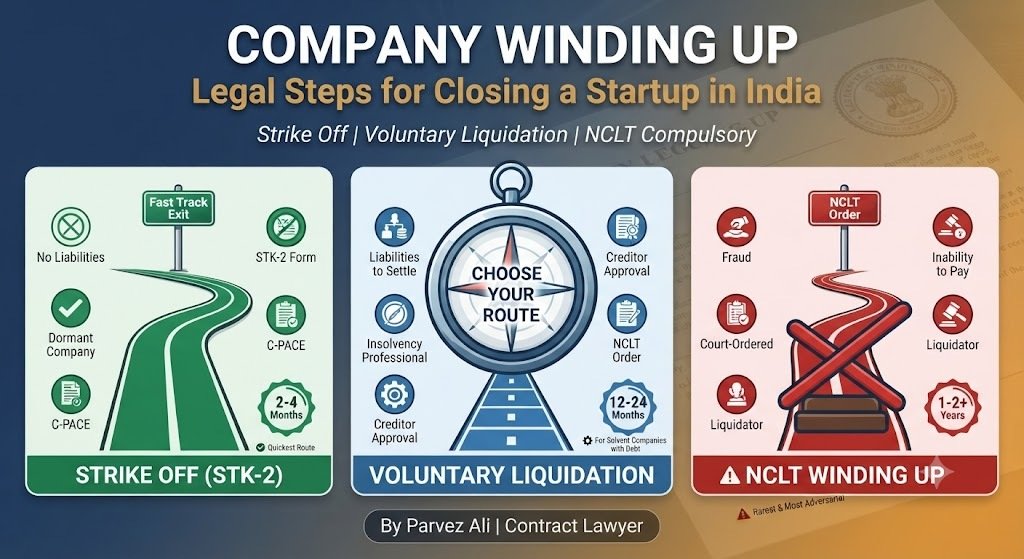
Company winding up is the step most founders postpone for as long as possible, right up until the moment postponing it becomes the actual problem. I understand the instinct — closing a company feels like admitting defeat, and once the founders have mentally moved on to the next thing, formal dissolution paperwork feels like the least urgent task on the list. The numbers tell the real story, though: the Ministry of Corporate Affairs estimates roughly 870,000 defunct companies are still sitting on India’s registrar records in 2026, simply because their founders walked away instead of closing them properly — and every one of those companies is quietly accumulating penalties and director disqualification risk in the background.
This article walks through exactly how to wind up a company in India — the strike-off route, voluntary liquidation, and the rarer NCLT-ordered process — with the current 2026 fees, timelines, and eligibility criteria, so you can actually close your startup cleanly instead of just letting it go quiet. Whichever structure you originally chose — a factor I’ve covered in Pvt Ltd vs LLP vs OPC — the closure process differs slightly, so it’s worth confirming which route applies to your specific entity type before you begin.
Why Proper Company Winding Up Matters
Before the mechanics, it’s worth being direct about the cost of getting this wrong. Simply stopping operations and ignoring your company’s compliance obligations doesn’t make the company disappear — annual filing obligations continue accruing, penalties compound, and under Section 164 of the Companies Act, 2013, directors of a company that fails to file financial statements or annual returns for three consecutive years can face disqualification from serving as a director of any company for five years, alongside penalties that can reach ₹1 lakh. Proper company winding up is what actually closes this exposure — an informal shutdown doesn’t.
Route 1: Strike Off Under Section 248 (Fast Track Exit / STK-2)
For most startups with no ongoing liabilities, strike-off under Section 248 of the Companies Act, 2013 — commonly called Fast Track Exit — is the fastest and cheapest route to company winding up. It’s an administrative removal from the Registrar of Companies’ register, filed through Form STK-2, and processed by C-PACE (Centre for Processing Accelerated Corporate Exit), MCA’s centralised authority operational since May 2023, which has dramatically cut processing time from what used to take over two years down to a matter of months.
Eligibility Criteria for Strike Off
Your company needs to satisfy specific conditions before STK-2 is even an option:
- No business operations for at least two consecutive financial years, or the company never commenced business within one year of incorporation
- Nil outstanding liabilities
- No active or open bank accounts — an active account will cause the application to be auto-rejected
- All statutory filings cleared — pending MCA, income tax, and GST filings must be up to date
- No pending legal proceedings against the company
- Not a listed company, and no disposal of assets in the three months preceding the application
If your company has fallen behind on ROC filings, those need to be cleared first — historically through amnesty schemes like the Company Fresh Start Scheme, which periodically waive late-filing penalties to bring companies current before strike-off becomes available. Worth noting: a similar 2026 relief window (the CCFS-2026 scheme, offering reduced filing fees) ran from 15 April 2026 to 15 July 2026 and has since closed — if you’re reading this after that date, check the MCA portal for whichever amnesty or compliance-clearance scheme is currently active, since these windows tend to reopen periodically rather than being permanent.
Documents Required for STK-2 Filing
- Indemnity Bond (Form STK-3) from all directors
- Affidavit (Form STK-4) from all directors
- Statement of Accounts (Form STK-8), dated no more than 30 days before filing
- Special resolution or consent of 75% of shareholders, evidencing shareholder approval for the closure — the same diligence in reading and understanding what you’re signing off on that I’ve covered generally in How to Read a Contract Before You Sign It
The Strike-Off Process Step by Step
- Clear all pending compliance — GST returns, income tax filings, and ROC forms — before filing, since the ROC and GST portals aren’t integrated, meaning the tax department can still object during the public notice period even if your ROC filings look clean
- Close all company bank accounts, obtaining closure confirmation
- Pass the special resolution approving the strike-off, with at least 75% shareholder consent
- File Form STK-2 with C-PACE via the MCA V3 portal, along with the government fee, indemnity bond, affidavit, and statement of accounts
- Public notice period — a 30-day window during which the Registrar publishes the application, allowing objections from creditors or other stakeholders
- Final order (Form STK-7) — if no objections are received, or all objections are resolved, the Registrar issues the strike-off order, the company’s name is removed from the Register of Companies, and the order is published in the Official Gazette
- Dissolution — from the date of Gazette publication, the company is legally dissolved
With clean documentation, this entire company winding up process now typically completes in roughly two to four months, a dramatic improvement from the multi-year timelines that predated C-PACE. As of mid-2025, C-PACE had already processed and dissolved over 38,600 companies under this streamlined system.
Route 2: Voluntary Liquidation Under Section 59 of the IBC
If your company has liabilities to settle — outstanding loans, unpaid vendor invoices, or investor preference rights that need to be honoured — strike-off isn’t available, and you need voluntary liquidation instead, governed by Section 59 of the Insolvency and Bankruptcy Code, 2016 and the IBBI (Voluntary Liquidation Process) Regulations, 2017. This route is specifically for solvent companies — meaning the company can pay all its debts in full — that are choosing to close rather than being forced to by insolvency. Where creditor negotiations get complicated during this process, the same principles I’ve covered in Settlement Agreements for resolving disputes without full litigation often apply directly to reaching final terms with individual creditors.
The process runs through several distinct stages:
- Declaration of solvency by a majority of directors, confirming the company can pay its debts in full within a specified period, supported by an audited statement of assets and liabilities
- Special resolution passed by shareholders (75% approval) to liquidate the company and appoint a registered Insolvency Professional as liquidator
- Creditor approval — where the company owes creditors, they must approve the liquidation by at least two-thirds in value, generally within seven days of the special resolution
- Asset realisation and creditor settlement — the Insolvency Professional takes over management, realises company assets, settles all creditor claims, and distributes any remaining surplus to shareholders
- NCLT dissolution order — once the liquidation process is complete, the National Company Law Tribunal issues the final dissolution order
Since this route shifted from court-managed liquidation under the pre-2017 Companies Act framework to an Insolvency-Professional-managed process under the IBC, it’s become considerably faster and more commercially oriented than it used to be — though it remains meaningfully more involved and expensive than a straightforward strike-off, given the liabilities genuinely being settled along the way.
Route 3: Compulsory Winding Up by the NCLT
The rarest and most adversarial route, compulsory winding up under Sections 271-272 of the Companies Act, 2013, is court-ordered rather than voluntarily initiated — typically triggered by fraud, an inability to pay debts, or a petition from creditors, regulators, or other stakeholders. This isn’t a route founders choose; it’s one imposed when a company’s situation has deteriorated to the point that a tribunal steps in. Given the litigation-heavy nature of this process, it’s genuinely the most expensive and time-consuming of the three, often extending well beyond a year — and it’s precisely the kind of dispute where a properly drafted arbitration clause or jurisdiction clause in your original commercial agreements could have kept related creditor disputes out of this same overloaded forum.
Strike Off vs Voluntary Liquidation vs NCLT Winding Up
Laid out side by side, the right company winding up route for your situation usually becomes clear once you know which category your company actually falls into:
| Factor | Strike Off (STK-2) | Voluntary Liquidation (IBC S.59) | NCLT Compulsory Winding Up |
|---|---|---|---|
| Best suited for | Dormant companies, no liabilities | Solvent companies with liabilities to settle | Insolvent or fraud-affected companies |
| Who manages it | Directors, filed via C-PACE | Registered Insolvency Professional | NCLT-appointed liquidator |
| Shareholder approval | 75% special resolution | 75% special resolution + 2/3 creditor value approval | Court-driven, limited shareholder control |
| Typical timeline | 2–4 months | 12–24 months | Often 1–2+ years |
| Typical total cost | ₹25,000–₹60,000 | ₹1.5 lakh–₹3 lakh+ | Significantly higher, litigation-dependent |
| Government fee | ₹10,000 (STK-2) | Varies with IP and NCLT filing costs | Court and litigation costs |
Closing an LLP or OPC — Does the Process Differ?
If your business is structured as an LLP rather than a Private Limited Company, the closure process runs through a separate mechanism — LLPs use Form 24 to apply for striking their name off the register under the LLP Rules, with broadly similar eligibility conditions around dormancy and nil liabilities, though the specific forms and provisions differ from the Companies Act framework. An OPC, being incorporated under the Companies Act, follows the same STK-2 strike-off or Section 59 voluntary liquidation routes as a Private Limited Company, since it’s fundamentally the same statutory framework applying to a single-shareholder structure.
What Happens If You Just Stop Filing Instead of Closing Properly?
This is the scenario responsible for a meaningful share of that 870,000-company backlog. Simply abandoning a company — no filings, no bank account activity, no formal closure — doesn’t end its legal existence or your obligations as a director. Penalties for late or missed annual filings accumulate over time, and once non-filing crosses the three-consecutive-year threshold, director disqualification under Section 164 becomes a real risk, preventing you from being appointed as a director of any company, including your next venture, for five years. Proper company winding up isn’t just about closing the current entity cleanly — it protects your ability to start something new without carrying this liability into it, including negotiating a clean exit among co-founders themselves, a scenario the deadlock and exit provisions I’ve discussed in Founder Agreement / Co-Founder Agreement in India should ideally have anticipated well before closure became the only option.
Common Mistakes During Company Winding Up
I see the same handful of issues repeatedly:
- Filing STK-2 without clearing GST returns first — since the ROC and GST systems aren’t integrated, the tax department can still raise an objection during the 30-day public notice period, stalling the entire process
- Assuming investor or shareholder approval isn’t needed, when a valid special resolution with the required threshold is a hard prerequisite
- Submitting an outdated Statement of Accounts, when STK-8 must be dated within 30 days of filing
- Leaving a bank account open, which causes automatic rejection of the strike-off application
- Choosing strike-off when liabilities actually exist, rather than the appropriate voluntary liquidation route — a mismatch that typically surfaces as a creditor objection during the public notice period
- Waiting too long to start the process, accumulating additional years of late-filing penalties and disqualification risk while deciding whether to formally close
Frequently Asked Questions
What is the fastest way to close a company in India? For company winding up specifically, strike-off under Section 248, filed via Form STK-2 through C-PACE, is the fastest route for dormant companies with no liabilities — typically completing in two to four months with clean documentation.
Can I close my company if it still owes money to creditors? No, not through strike-off — a company with outstanding liabilities needs to go through voluntary liquidation under Section 59 of the IBC, which settles creditor claims before dissolution.
How much does it cost to wind up a company in India? Strike-off typically costs ₹25,000 to ₹60,000 total (including the ₹10,000 government fee and professional fees), while voluntary liquidation for a company with liabilities can run ₹1.5 lakh to ₹3 lakh or more, depending on complexity.
What happens if I just stop filing annual returns instead of formally closing my company? Penalties accumulate over time, and after three consecutive years of non-filing, directors can face disqualification under Section 164 of the Companies Act, preventing them from serving as a director of any company for five years.
Do I need a special resolution to strike off my company? Yes — Form STK-2 requires evidence of shareholder approval, typically through a special resolution or consent representing at least 75% of shareholders.
Can an LLP be closed the same way as a Private Limited Company? Not exactly — LLPs use Form 24 under the LLP Rules for a broadly similar strike-off process, while a Private Limited Company or OPC uses Form STK-2 under the Companies Act.
How long does voluntary liquidation take compared to strike-off? Voluntary liquidation typically takes 12 to 24 months, considerably longer than the two-to-four-month timeline for a straightforward strike-off, given the additional steps involved in settling creditor claims.
What is C-PACE and how has it changed company closures in India? C-PACE (Centre for Processing Accelerated Corporate Exit) is MCA’s centralised authority for processing strike-off applications, operational since May 2023, which has reduced typical processing time from over two years to a matter of months.
Can a company with pending legal proceedings be struck off? No — one of the core eligibility conditions for strike-off is that the company has no pending legal proceedings against it.
Is NCLT approval required for every company closure? No — strike-off under Section 248 is handled entirely through C-PACE and the Registrar of Companies, without NCLT involvement. NCLT approval is required specifically for voluntary liquidation’s final dissolution order and for compulsory winding-up proceedings.
Final Takeaway
Company winding up in India isn’t a single process — it’s a choice between three genuinely different routes depending on whether your company is dormant and debt-free, solvent but carrying liabilities to settle, or facing insolvency or fraud-related complications requiring court intervention. Choosing the wrong route costs real time and money, and simply avoiding the decision altogether carries its own compounding risk through late-filing penalties and director disqualification. If your startup has reached the end of its runway, closing it properly — not just letting it go quiet — is what actually protects you for whatever comes next.
Need help deciding the right closure route for your company, or want the process managed properly? Get in touch and let’s make sure your exit is clean, not another entry in the defunct-company backlog. For the broader legal groundwork every founder needs, see my Business Contracts checklist, Contract Law Glossary, and Essential Elements of a Valid Contract.
This article is for general informational purposes and does not constitute legal advice. Company winding up procedures, fees, and eligibility should be confirmed with a qualified professional based on your company’s current circumstances.
Written by Parvez Ali.