
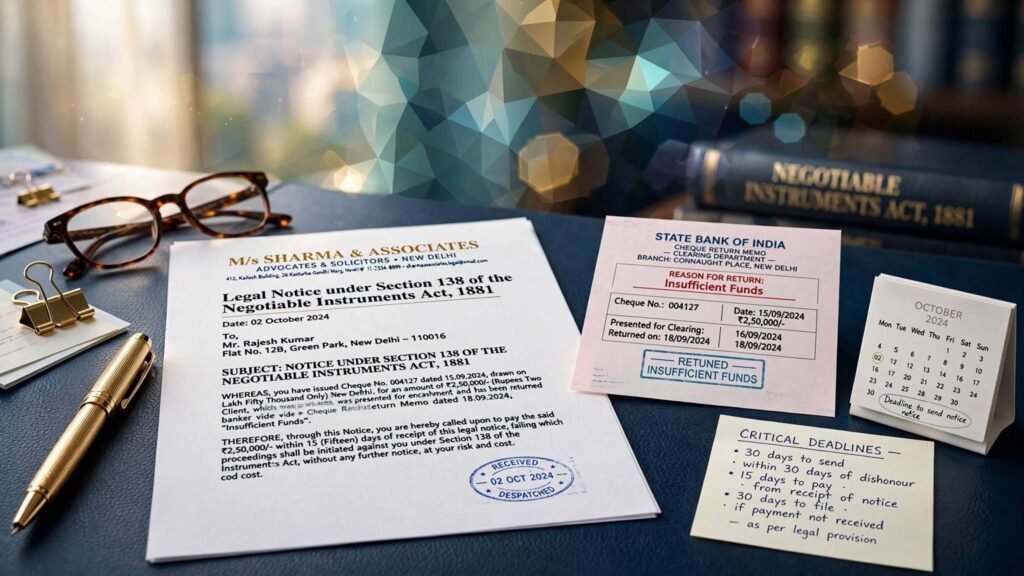
A cheque bounce notice is the first and most important legal step you must take when someone’s cheque to you gets dishonoured by the bank. If you skip this step, or get the format wrong, you lose your right to file a criminal case — no matter how strong your claim is. In this guide, I’ll walk you through exactly what a cheque bounce notice is, the legal notice format used under Section 138 of the Negotiable Instruments Act, 1881, the deadlines you cannot miss, what happens if the other party ignores your notice, and how to reply if you’re the one who received it. This is written from real drafting experience, not copied boilerplate — so you’ll actually know what to do next.
What Is a Cheque Bounce Notice?
A cheque bounce notice — also called a demand notice or legal notice for dishonour of cheque — is a formal written communication sent by the payee (the person who was supposed to receive the money) to the drawer (the person who issued the cheque), informing them that their cheque has been dishonoured and demanding payment within a fixed period.
This notice isn’t just a formality. Under Indian law, sending a valid cheque bounce notice is a mandatory precondition before you can file a criminal complaint for cheque dishonour. Courts have repeatedly held that without proof of a properly served notice, a Section 138 complaint is not maintainable.
Legal Basis: Section 138 of the Negotiable Instruments Act, 1881
Cheque bounce cases in India are governed by Section 138 of the Negotiable Instruments Act, 1881 (NI Act). This provision makes dishonour of a cheque a criminal offence when:
- The cheque was issued to discharge a legally enforceable debt or liability (not a gift or unrelated payment)
- The cheque is returned unpaid due to insufficient funds, or because the amount exceeds the arrangement made with the bank
- The payee presents the cheque within its validity period (3 months from the date on the cheque, as per RBI rules)
Section 138 works alongside Section 141 (which fixes liability on directors and partners when the drawer is a company or firm) and Section 142 (which governs how and where the complaint is filed). Together, these sections form the backbone of what most people simply call a “cheque bounce case.”
When Does a Cheque Bounce? Common Reasons
Before drafting a notice, it helps to know the standard reasons banks give on the cheque return memo:
- Insufficient funds in the account
- Signature mismatch
- Account closed or frozen
- Payment stopped by the drawer
- Post-dated cheque presented before its date
- Overwriting or alteration on the cheque
- Amount in words and figures not matching
Only some of these reasons — mainly insufficient funds or exceeding the arrangement — attract criminal liability under Section 138. Others, like signature mismatch, may still allow you to pursue civil recovery but not necessarily a criminal complaint, so it’s worth checking the exact wording on your return memo before proceeding.
Step-by-Step Process to Send a Cheque Bounce Notice
- Get the cheque return memo from your bank confirming dishonour and the reason.
- Draft the legal notice within 30 days of receiving the return memo — this is a strict deadline.
- Send it by Registered Post with Acknowledgement Due (RPAD) or Speed Post, and ideally also by email/courier as backup proof of service.
- Wait 15 days from the date the drawer receives the notice, for them to make payment.
- If no payment is made, file a criminal complaint under Section 138 in the appropriate court within 30 days of the expiry of the 15-day period.
Missing any of these timelines can permanently bar you from criminal recourse, though a civil suit for recovery of money may still be available separately.
Cheque Bounce Notice Format (Sample)
While the NI Act doesn’t prescribe a rigid template, a legally sound cheque bounce notice must contain these elements:
- Name and address of the drawer (cheque issuer)
- Name and address of the payee
- Cheque number, date, amount, and bank/branch details
- Date of presentation and date of return
- Reason for dishonour as stated in the bank memo
- The underlying transaction/debt (loan, sale of goods, services, etc.)
- Clear demand for payment within 15 days
- Explicit reference to Section 138 of the Negotiable Instruments Act, 1881
- Warning of criminal prosecution if payment is not made
Sample format:
[Sender's Name / Advocate's Letterhead]
By Registered Post A/D & Email

Date: [DD/MM/YYYY]

To,
[Full Name of Drawer]
[Complete Address]

Subject: Legal Notice under Section 138 of the Negotiable Instruments Act, 1881
for dishonour of Cheque No. [XXXXXX] dated [DD/MM/YYYY] for Rs. [Amount]

Sir/Madam,

Under instructions from my client, [Client Name], I serve upon you the
following notice:

1. That in discharge of a legally enforceable debt of Rs. [Amount] arising
   from [nature of transaction], you issued Cheque No. [XXXXXX] dated
   [DD/MM/YYYY] drawn on [Bank Name, Branch] in favour of my client.

2. That the said cheque, on presentation, was returned unpaid vide return
   memo dated [DD/MM/YYYY] with the remark "[Insufficient Funds / etc.]".

3. That this dishonour constitutes an offence under Section 138 of the
   Negotiable Instruments Act, 1881.

You are hereby called upon to pay the said sum of Rs. [Amount] within
fifteen (15) days of receipt of this notice, failing which my client shall
initiate criminal proceedings against you under Section 138 of the
Negotiable Instruments Act, 1881, at your entire cost, risk and consequence.

Yours faithfully,
[Name / Advocate]
If you’d rather not draft this yourself, you can get a customised, court-ready legal notice drafted for your specific case instead of relying on a generic template — small wording errors in the transaction description or timeline are one of the most common reasons courts reject Section 138 complaints later.
Cheque Bounce Notice Time Limits — A Quick Reference
| Stage | Time Limit |
|---|---|
| Sending notice after return memo | Within 30 days |
| Drawer’s window to pay after receiving notice | 15 days |
| Filing criminal complaint after 15-day window expires | Within 30 days |
Miss the 30-day notice deadline, and you may still be able to seek condonation of delay from the court, but it’s not guaranteed — so acting quickly is always safer than relying on exceptions.
What Happens If the Drawer Doesn’t Pay or Reply?
If the 15-day period lapses without payment, the payee can file a criminal complaint under Section 138 before the Magistrate having jurisdiction (usually where the cheque was presented for collection or where the payee’s bank branch is situated, per the 2015 amendment to Section 142). The court can:
- Take cognizance of the offence
- Issue summons to the accused
- Proceed to trial, where the accused must rebut the statutory presumption under Section 139 that the cheque was issued for a legally enforceable debt
Since the 2018 amendment to the NI Act, courts can also direct the drawer to pay interim compensation (up to 20% of the cheque amount) to the complainant during the pendency of the trial — a significant tool most older articles on this topic don’t mention.
Punishment for Cheque Bounce Under Section 138
If convicted, the drawer can face:
- Imprisonment for up to 2 years, or
- A fine up to twice the cheque amount, or
- Both
Importantly, cheque bounce is a compoundable offence — meaning the parties can settle at any stage, even after conviction, and the case can be closed once the drawer pays the agreed amount.
Liability of Companies and Directors (Section 141)
If the cheque was issued by a company or partnership firm, Section 141 makes every person who was in charge of and responsible for the conduct of business at the time of the offence — typically directors or partners — personally liable, unless they can prove the offence occurred without their knowledge. This is a critical point businesses issuing cheques on behalf of a company often overlook.
Cost of Sending a Cheque Bounce Notice
Most competitor guides skip this, but it’s one of the first things people actually want to know. Costs generally include:
- Advocate’s drafting and consultation fee — varies by complexity and jurisdiction (roughly ₹1,500–₹5,000 for individuals; more for high-value commercial disputes)
- Registered Post/Speed Post charges — nominal, usually under ₹100
- Notarisation, if required — a small additional fee
You can recover reasonable notice and legal costs from the drawer later, since courts often factor this into the final compensation ordered under Section 138.
Cheque Bounce Notice vs. Legal Notice for Recovery of Money
People often confuse these two, but they serve different purposes:
| Cheque Bounce Notice | Recovery Notice | |
|---|---|---|
| Legal basis | Section 138, NI Act | Contract law / Civil Procedure Code |
| Nature | Criminal + civil remedy | Purely civil remedy |
| Outcome if ignored | Criminal complaint + possible jail term | Civil recovery suit only |
| Time limit | Strict 30-day/15-day/30-day cycle | Governed by Limitation Act (usually 3 years) |
If your case doesn’t strictly meet Section 138’s conditions (for example, the cheque was a gift, or the debt wasn’t legally enforceable), a general legal notice for recovery of money may be the more appropriate route.
Common Mistakes People Make While Sending a Cheque Bounce Notice
- Sending the notice after the 30-day window has closed
- Not mentioning the underlying debt/transaction clearly
- Vague or incorrect cheque details (number, date, amount)
- Sending only by email without proof of delivery
- Forgetting to keep the postal receipt and tracking proof — this is your evidence in court
- Assuming a phone call or WhatsApp message counts as a “notice” — it does not satisfy Section 138’s requirement of a notice “in writing”
How to Reply to a Cheque Bounce Notice (If You Received One)
If you’ve received a Section 138 notice, don’t ignore it — that’s the single worst response. Instead:
- Read it carefully and verify the cheque details, dates, and amount claimed
- Check whether the debt is genuine and legally enforceable
- Pay within the 15-day window if the claim is valid, to avoid criminal proceedings entirely
- Send a written reply disputing the claim if you have valid grounds (e.g., the cheque was given as security, not in discharge of debt, or the debt was already settled)
- Consult a lawyer immediately — a poorly worded reply can weaken your defence later in court
A well-drafted reply preserves your legal position and can sometimes resolve the dispute without litigation.
Frequently Asked Questions About Cheque Bounce Notice
1. Who can send a cheque bounce notice?
Only the payee or the holder in due course of the cheque can send the notice, either personally or through an advocate.
2. What is the time limit to send a cheque bounce notice?
You must send it within 30 days from the date you receive the cheque return memo from your bank.
3. Can I send a cheque bounce notice myself, without a lawyer?
Yes, legally you can. However, since the exact wording around the “legally enforceable debt” and transaction details heavily influences whether the later complaint survives in court, most people prefer a lawyer-drafted notice.
4. What happens if the drawer doesn’t respond to the cheque bounce notice?
You can file a criminal complaint under Section 138 in the appropriate Magistrate’s court within 30 days after the 15-day payment window expires.
5. Is cheque bounce a criminal or civil offence?
It is primarily a criminal offence under Section 138 of the NI Act, but it also carries civil liability, since courts can order compensation up to twice the cheque amount.
6. Can a cheque bounce case be settled out of court?
Yes. Cheque bounce is a compoundable offence, meaning the parties can settle at any stage — even during trial or appeal — and the case is then closed.
7. What is the punishment for cheque bounce in India?
Imprisonment of up to 2 years, a fine of up to twice the cheque amount, or both.
8. Does a post-dated cheque bounce notice work the same way?
Yes, provided the cheque is presented within its validity period (currently 3 months from the date on the cheque) and then dishonoured, the same Section 138 process applies.
9. Where should the cheque bounce complaint be filed?
As per the 2015 amendment to Section 142, the complaint must be filed in the court within whose jurisdiction the payee’s bank branch (where the cheque was presented for collection) is situated.
10. Can directors of a company be held personally liable for a cheque bounce?
Yes. Under Section 141 of the NI Act, directors and officers responsible for the company’s day-to-day affairs at the time of the offence can be held personally liable, unless they prove they had no knowledge of or connection with the transaction.
11. Is there interim compensation available before the case is fully decided?
Yes. Since the 2018 NI Act amendment, courts can order the drawer to pay interim compensation of up to 20% of the cheque amount while the trial is ongoing.
Conclusion
A cheque bounce notice isn’t just paperwork — it’s the legal trigger that decides whether you can pursue criminal action under Section 138 at all. Getting the timeline right (30 days to send, 15 days for the drawer to pay, 30 days to file if unpaid) and the drafting right (correct cheque details, clear reference to the underlying debt, explicit mention of Section 138) makes the difference between a case that succeeds and one that gets dismissed on a technicality.
If you’re dealing with a bounced cheque — whether you need to send a notice or have just received one — it’s worth getting it professionally drafted or reviewed before any deadline passes, since these timelines don’t pause for mistakes.