
A commercial lease agreement is the single most important document in any business tenancy — it determines what you’ll pay, what you’re responsible for, and how much flexibility you have if your business needs change. Unlike a residential lease, a commercial lease agreement is heavily negotiable, often runs 20–40 pages, and can quietly shift thousands of dollars in costs onto a tenant through a single poorly worded clause. In this guide, I’ll break down every clause you actually need to understand, the different types of commercial leases, what landlords and tenants each tend to overlook, and a practical negotiation checklist — written from real drafting and review experience, not a recycled template.
What Is a Commercial Lease Agreement?
A commercial lease agreement is a legally binding contract between a landlord (lessor) and a business tenant (lessee) that grants the tenant the right to occupy and use a property — office, retail, industrial, or warehouse space — for business purposes, in exchange for rent. Unlike residential leases, commercial lease agreements are not standardized by consumer-protection law in most jurisdictions, which means almost every clause is open to negotiation, and the party with less negotiating leverage often ends up bearing more risk.
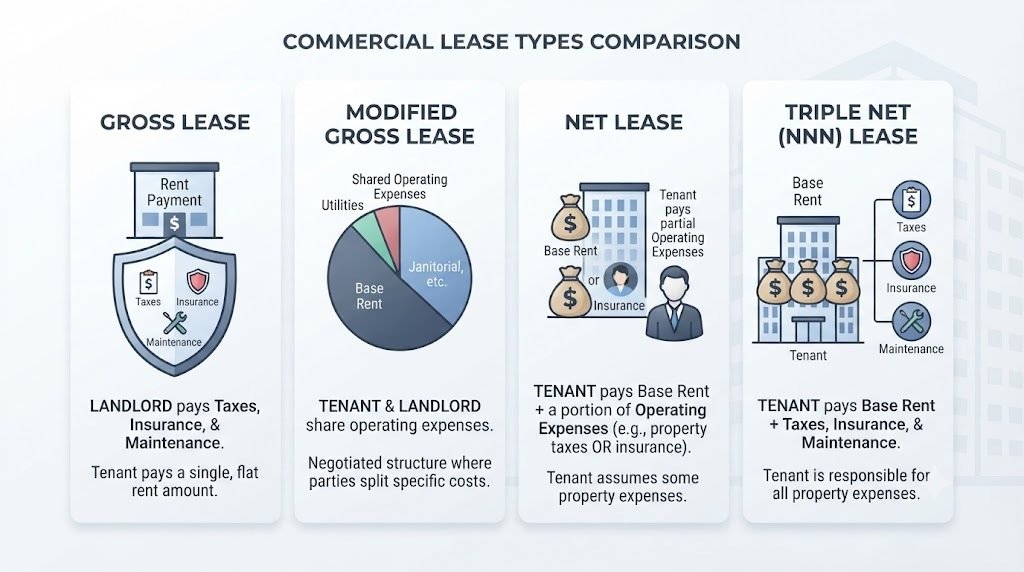
Types of Commercial Leases: Gross vs. Net vs. Triple Net (NNN)
Before reviewing individual clauses, it’s essential to understand which type of lease you’re signing, since this single classification affects nearly every cost clause in the agreement.
| Lease Type | Who Pays Operating Costs | Best For |
|---|---|---|
| Gross Lease | Landlord pays taxes, insurance, and maintenance; tenant pays flat rent | Tenants wanting predictable monthly costs |
| Modified Gross Lease | Costs split between landlord and tenant by agreement | Mid-size offices, shared buildings |
| Net Lease (Single/Double Net) | Tenant pays some combination of property tax, insurance, and/or maintenance | Retail and standalone buildings |
| Triple Net Lease (NNN) | Tenant pays taxes, insurance, AND maintenance, on top of base rent | Landlords seeking stable, low-management income |
Most commercial lease disputes actually trace back not to the rent figure itself, but to a tenant not realising which lease type they signed and being surprised by CAM (Common Area Maintenance) charges months later.
Key Clauses Every Commercial Lease Agreement Must Have
1. Parties and Premises
The lease must clearly name the legal entities involved (not just “the business” but the exact registered company name), and precisely describe the leased premises — including square footage, floor/suite number, and any shared common areas.
2. Rent, Escalation, and CAM Charges
This clause defines the base rent, payment frequency, and how rent will increase over the lease term — typically through a fixed percentage, a Consumer Price Index (CPI) linkage, or periodic market review. If it’s a net or triple-net lease, this section should also itemise CAM charges (maintenance, security, landscaping, shared utilities) so there are no surprise pass-through costs later.
3. Security Deposit and Refund Terms
Specifies the deposit amount, permissible deductions, and the timeline for refund after lease termination. Always confirm whether the deposit accrues interest and under what conditions it can be forfeited.
4. Lease Term, Renewal, and Holdover
The term clause fixes the start and end dates of the tenancy. The renewal clause should specify whether the tenant has a right of first refusal, how renewal rent is calculated (often “fair market value”), and the required notice period to exercise it. Don’t overlook the holdover clause — this governs what happens (and what penalty rent applies) if the tenant stays past the lease end date without a signed renewal.
5. Use Clause and Exclusivity
Defines exactly what business activities are permitted on the premises. Landlords in shared retail spaces often add an exclusivity clause preventing a competing business from leasing another unit in the same building — this matters enormously if you’re a retail or F&B tenant.
6. Maintenance and Repair Responsibilities
Clarifies who repairs what: structural repairs (usually the landlord) versus interior fixtures and day-to-day upkeep (usually the tenant). Ambiguity here is one of the most common sources of commercial lease disputes.
7. Subletting and Assignment Rights
States whether the tenant can sublease part or all of the premises, or assign the lease to another business, and whether landlord consent is required. If you expect your business to scale, downsize, or eventually be sold, this clause protects your exit flexibility.
8. Termination and Default Clause
Outlines the conditions under which either party can terminate early, what constitutes a default (late rent, breach of use clause, etc.), and the cure period given before eviction or lease termination proceedings begin.
9. Insurance Obligations
Specifies the type and minimum coverage of insurance each party must carry — general liability, property insurance, and sometimes business interruption insurance — and whether the landlord must be named as an additional insured.
10. Personal Guarantee Clause
Especially relevant for small businesses and startups: landlords often require the business owner to personally guarantee lease payments if the company defaults. This clause deserves careful negotiation — a capped or time-limited personal guarantee (e.g., “burns off” after 2 years of on-time payment) is far less risky than an unlimited, full-term guarantee.
11. Force Majeure Clause
This clause has become significantly more important since 2020. A well-drafted force majeure clause should broadly define covered events (pandemics, government-mandated shutdowns, supply chain disruptions), clarify whether rent is abated or suspended during the event, and specify a termination right if the disruption continues beyond a defined period (commonly 90–120 days). A lease silent on this point typically still obligates the tenant to pay full rent even if the premises becomes unusable — a gap many tenants only discover after signing.
12. Dispute Resolution and Governing Law
Specifies the jurisdiction, applicable law, and preferred method of resolving disputes — litigation, arbitration, or mediation. For cross-border or multi-location businesses, this clause prevents costly jurisdictional disputes later.
13. Estoppel Certificate Clause
Often missing from generic templates: this clause obligates the tenant to sign an estoppel certificate (confirming lease terms are accurate and unmodified) when requested — usually required if the landlord is refinancing or selling the property. Refusing or delaying this can itself constitute a lease default in many jurisdictions.
Common Pitfalls Tenants and Landlords Overlook
- Not distinguishing lease types — signing a triple-net lease without budgeting for CAM charges
- Vague maintenance language — “tenant to maintain premises” without defining structural vs. cosmetic repairs
- No cap on rent escalation — CPI-linked rent with no ceiling can spiral in high-inflation years
- Unlimited personal guarantees — especially risky for small business owners and first-time tenants
- Silent force majeure clauses — leaving no protection during shutdowns or disruptions
- No exit or early termination option — locking a growing (or shrinking) business into a rigid multi-year term
- Ignoring the fine print on renewal rent — “fair market value” renewal rent is often determined solely by the landlord unless the clause specifies an independent appraisal mechanism
Negotiation Checklist Before You Sign
- Confirm the lease type (gross, net, or triple net) and get an itemised CAM cost estimate
- Negotiate a cap on annual rent escalation
- Request a defined, capped personal guarantee (if applicable)
- Insist on a clear force majeure and rent-abatement clause
- Clarify maintenance responsibilities in writing, line by line
- Confirm subletting/assignment rights in case your business needs change
- Ask for a right of first refusal on renewal, with a transparent renewal-rent formula
- Review the default and cure-period clause carefully
If any of these clauses feel one-sided or unclear, it’s worth having the lease agreement professionally reviewed or drafted before signing — a single ambiguous clause can cost far more than a review fee once a dispute arises.
Commercial Lease Agreement vs. Residential Lease: Key Differences
| Commercial Lease | Residential Lease | |
|---|---|---|
| Regulation | Minimal statutory protection; highly negotiable | Heavily regulated by tenant-protection laws |
| Standard terms | Rare — nearly every clause is customised | Often follows a standard government/state template |
| Lease length | Typically 3–10+ years | Typically 6–12 months |
| Maintenance | Often shifted to tenant (net/NNN leases) | Almost always landlord’s responsibility |
| Exit flexibility | Limited unless specifically negotiated | Governed by statutory notice periods |
How a Commercial Lease Agreement Differs Across Jurisdictions
While the core clauses above are near-universal, enforceability and mandatory disclosures vary — for instance, some jurisdictions require registration or stamping of long-term commercial leases, while others cap security deposits or mandate minimum notice periods for termination. If you’re leasing across India, Bangladesh, the UK, or the US, it’s worth confirming local requirements separately, since a clause that’s standard in one jurisdiction may be unenforceable or require additional formalities in another. A jurisdiction-specific legal review before signing avoids this blind spot entirely.
Frequently Asked Questions About Commercial Lease Agreements
1. What is the difference between a gross lease and a triple net (NNN) lease?
In a gross lease, the landlord covers property taxes, insurance, and maintenance, and the tenant pays a flat rent. In a triple net lease, the tenant pays base rent plus taxes, insurance, and maintenance directly, which usually means a lower quoted rent but higher total occupancy cost.
2. Can I negotiate a commercial lease agreement, or is it fixed?
Yes — unlike residential leases, almost every clause in a commercial lease is negotiable, including rent escalation, maintenance responsibilities, renewal terms, and personal guarantees, especially if you have some negotiating leverage or are signing a long-term lease.
3. What is a personal guarantee in a commercial lease, and can it be limited?
A personal guarantee makes the business owner personally liable for lease payments if the company defaults. It can often be negotiated to a “capped” or “burning off” guarantee — for example, limited to 12 months’ rent or expiring after two years of consistent, on-time payment.
4. What happens if I need to break a commercial lease early?
This depends entirely on the termination clause. Some leases include an early termination option with a penalty fee; others require you to continue paying rent for the remainder of the term unless you can sublease or assign the lease with landlord consent.
5. Who is responsible for repairs in a commercial lease?
This varies by lease type and by the specific maintenance clause, but generally the landlord handles structural repairs (roof, foundation, major systems), while the tenant is responsible for interior fixtures, day-to-day upkeep, and any damage caused by their business operations.
6. What is a CAM charge in a commercial lease?
CAM (Common Area Maintenance) charges are costs for shared spaces and services — lobbies, parking lots, landscaping, security — that are passed on to tenants, typically in net and triple-net leases, calculated proportionally based on the tenant’s leased square footage.
7. Does a commercial lease need to be registered or notarized?
This depends on jurisdiction and lease duration. Many regions require registration or stamping for long-term commercial leases (commonly leases exceeding 1–3 years), so it’s important to check local property law requirements before finalising the agreement.
8. What is a holdover clause in a commercial lease?
A holdover clause specifies what happens if a tenant remains in the premises after the lease term ends without signing a renewal — typically triggering a higher “penalty” rent (often 150%–200% of the previous rent) until the tenant vacates or a new lease is signed.
9. Can a landlord increase rent during the lease term?
Only if the lease contains a rent escalation clause allowing for it — typically through a fixed annual percentage or a CPI-linked formula. Without such a clause, rent generally cannot be increased mid-term.
10. What should a small business check before signing a commercial lease?
At minimum: the lease type (gross/net/NNN) and total occupancy cost, personal guarantee terms, maintenance responsibilities, subletting/assignment rights, renewal and escalation terms, and whether a force majeure clause protects against disruptions like shutdowns or supply chain issues.
11. Is a verbal commercial lease agreement legally valid?
In most jurisdictions, commercial leases beyond a short duration (often one year) must be in writing to be enforceable under the Statute of Frauds or equivalent local law, so relying on a verbal agreement is legally risky for both landlord and tenant.
Conclusion
A commercial lease agreement is far more than a rent contract — it’s a long-term risk-allocation document, and the details you negotiate before signing determine whether your business has flexibility or gets locked into hidden costs and rigid terms. Whether you’re a landlord drafting a lease or a tenant reviewing one, understanding lease types, escalation formulas, maintenance responsibilities, and exit clauses upfront prevents disputes that are far more expensive to fix later than to negotiate now.
If you’re about to sign, renew, or draft a commercial lease agreement, it’s worth getting the document reviewed by someone who drafts these regularly — a 30-minute review can catch clauses that would otherwise cost months of negotiation or litigation down the line.