
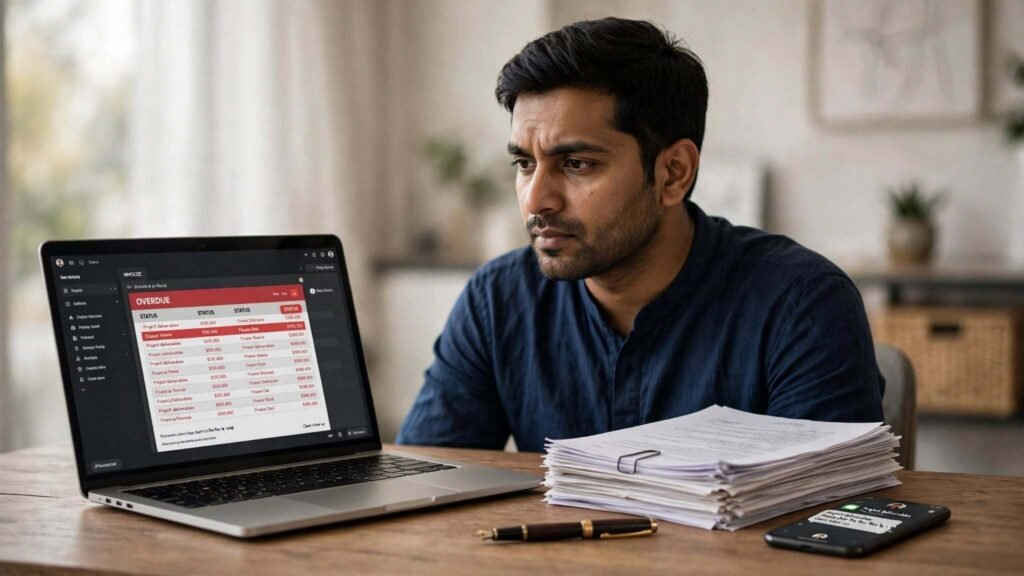
Client refuses to pay is one of the most searched phrases among Indian freelancers, and for good reason — it’s the moment every freelancer dreads but almost nobody prepares for. In March 2026, a 3D/motion designer’s public dispute with the natural honey brand HoneyVeda went viral, with the freelancer alleging an agreed 50% advance, 50% on completion arrangement fell apart after the client disputed that the work was complete. HoneyVeda, in turn, publicly stated it had paid the full invoiced amount and disputed that any such 50/50 structure was ever documented. Whatever actually happened between those two parties, the case exposed something every freelancer needs to hear: when a client refuses to pay and there’s no clear paper trail, you have far fewer options than you think, and the options you do have are frequently misunderstood. In this guide, I’ll walk through exactly what to do, in order, when a client won’t pay — from a reminder email to a legal notice to small-value civil recovery — including real costs, realistic timelines, and the legal routes most freelancer guides never mention.
Why the HoneyVeda Case Is a Lesson in Documentation, Not Just Bad Luck
Before getting into remedies, it’s worth sitting with what actually went wrong in that viral dispute, regardless of which side’s account is accurate. The freelancer described a 50/50 payment structure as “standard” and verbally agreed. The client said no such structure existed in any documented arrangement. That gap, between what was understood and what was written down, is where almost every freelancer payment dispute in India actually lives. Public callouts and viral posts might generate sympathy, but they don’t create legal proof, and they can expose the freelancer to a defamation counterclaim if the accusations turn out to be inaccurate or impossible to substantiate. Legal recourse starts and ends with documentation — which is exactly why a proper freelance service agreement matters long before any payment dispute arises, not after.
Step 1: Document Everything Before You Do Anything Else
Before sending a single demand, gather:
- The signed contract or, if informal, the written quote/proposal the client agreed to (email or chat counts)
- All invoices, with dates and amounts
- Proof of delivery — files sent, links shared, delivery confirmation emails or messages
- Any written acknowledgment of acceptance, even an informal “looks good, thanks” message
- The complete payment history, including any advance received
If your engagement was entirely verbal with no written trail at all, you’re not without options, but your case becomes significantly harder to prove, which is precisely the position the HoneyVeda dispute illustrates. Courts and even informal grievance portals weigh documented evidence far more heavily than screenshots of a public social media thread.
Step 2: Send a Formal Payment Reminder
Start professional, not aggressive. A clear, written reminder referencing the specific invoice number, amount, due date, and agreed payment terms often resolves genuine oversights or cash-flow delays without escalation. Keep it unemotional and factual — this communication becomes evidence later if the matter escalates, so avoid language that could later be read as harassment or threats.
Step 3: Send a Legal Notice for Recovery of Payment
If a reminder doesn’t work within a reasonable period (commonly 7–15 days), the next step is a formal legal notice for recovery of money, sent by an advocate. This isn’t just a formality, it’s often the single most effective step in the entire process, because it signals that you’re serious and prepared to escalate, and many clients settle immediately after receiving one rather than face a potential suit.
A properly drafted notice should include:
- The complete transaction history and agreed payment terms
- The exact amount due, with a breakdown of any advance already paid
- A clear demand for payment within a specified period (typically 15 days)
- A statement of intent to pursue civil or other legal remedies if payment isn’t made
If the client paid you via a post-dated cheque that subsequently bounced, this becomes a different and stronger situation entirely, triggering remedies under Section 138 of the Negotiable Instruments Act. We’ve covered the complete cheque bounce notice process and format separately, since that route carries criminal consequences a civil-only claim doesn’t.
Step 4: Check If You Qualify for the MSME Samadhaan Portal (Most Freelancers Miss This)
This is the step almost every freelancer-payment guide skips entirely, and it can be the fastest, cheapest route available if you qualify.
If you are registered as a Micro, Small, or Medium Enterprise under Udyam registration (yes, individual freelancers and sole proprietors can register), and your client is a company, LLP, or other registered business entity, you are protected under Sections 15 and 16 of the MSMED Act, 2006. The buyer must pay within the agreed period or 45 days if unspecified, and delayed payment attracts compound interest at three times the RBI’s notified bank rate.
Better still, you don’t need to file a civil suit to enforce this. The MSME Samadhaan portal, run by the Ministry of MSME, lets registered MSMEs file an online delayed-payment complaint directly against the buyer, which gets referred to the Micro and Small Enterprises Facilitation Council (MSEFC) for conciliation and, if needed, arbitration, without the cost and delay of ordinary civil litigation. If you haven’t registered as an MSME yet, our complete MSME/Udyam registration guide walks through the free, same-day process, and it’s worth doing proactively, before you need this protection, not after.
Step 5: File a Civil Suit for Recovery of Money
If the legal notice is ignored and MSME Samadhaan doesn’t apply to your situation, the next route is a civil suit for recovery of money before the appropriate court, based on breach of contract.
For claims backed by a written agreement or invoice, you can often use a summary suit under Order XXXVII of the Civil Procedure Code (CPC). This is significantly faster than an ordinary civil suit because the defendant cannot simply deny the claim and drag out proceedings, they must apply for “leave to defend” and show the court they have a genuine defence, failing which judgment can be passed quickly.
For higher-value commercial claims (the exact threshold varies by state, often ₹3 lakh and above), your case may qualify as a commercial dispute under the Commercial Courts Act, 2015, which requires mandatory pre-institution mediation under Section 12A before you can even file suit, unless you’re seeking urgent interim relief. This mediation step is often resolved faster than people expect, and skipping straight to litigation when mediation was available can actually delay your own recovery.
Is Non-Payment a Criminal Offence? (A Common Misconception)
This is worth addressing directly, because it’s one of the most common misunderstandings I see. Simple non-payment or a breach of contract is not, by itself, a criminal offence in India. For a client’s conduct to amount to cheating under Section 318 of the Bharatiya Nyaya Sanhita, 2023 (the provision that replaced Section 420 of the erstwhile IPC), there must be evidence of dishonest intention from the very outset of the engagement, meaning the client never intended to pay even at the time they engaged you.
A client genuinely disputing whether work met agreed standards, or facing real cash-flow issues, is a civil dispute, not a criminal one. Filing a police complaint in a straightforward payment dispute, without evidence of fraudulent intent from the start, is unlikely to succeed and can backfire by weakening your credibility in a civil proceeding. Reserve the criminal route for cases with real evidence of deliberate deception, not frustration over a slow-paying client.
The Legal Risk of “Naming and Shaming” on Social Media
The HoneyVeda dispute went viral precisely because the freelancer took to social media. It’s an understandable impulse, public pressure sometimes does work, and several viral freelancer-payment disputes globally have resulted in faster settlements purely because of reputational pressure on the client. But it carries real legal risk that most freelancers don’t weigh before posting:
- If your claims turn out to be inaccurate, exaggerated, or unprovable, the client can pursue a civil or criminal defamation claim against you, and in India, truth alone is not always a complete defence unless it’s also shown to be for the public good.
- A public dispute can complicate, not help, a later legal claim, since the other side may use your own public statements against you if the specifics don’t match what you can actually document.
- It rarely replaces formal recourse. Even a successful viral post pressuring a client into paying doesn’t give you the same enforceable outcome that a legal notice, MSME Samadhaan order, or court decree provides, particularly for future, similar disputes with other clients.
If you choose to go public, be scrupulously factual, avoid characterising disputed facts as settled truth, and ideally do so only after you’ve already sent a formal legal notice, not as a substitute for one.
Costs and Timelines: What to Actually Expect
| Route | Typical Cost | Typical Timeline |
|---|---|---|
| Formal payment reminder | Free to minimal | Immediate; response in days |
| Legal notice via advocate | ₹1,500–₹5,000 (varies by complexity) | 15–30 days for response window |
| MSME Samadhaan portal complaint | Free to file | Weeks to a few months, depending on Council workload |
| Summary suit (Order XXXVII CPC) | Court fees (percentage of claim) + advocate fees | Several months, faster than ordinary suits |
| Full civil suit for recovery | Court fees + advocate fees, higher for larger claims | Can run into years without summary procedure |
The practical insight here: a legal notice combined with MSME Samadhaan (if eligible) resolves the overwhelming majority of genuine freelancer payment disputes without ever reaching a courtroom, both because of the direct financial pressure and because most non-paying clients would rather settle than have an official delayed-payment finding on record.
How to Prevent This Before It Happens
The real lesson from cases like this isn’t about recovery, it’s about never needing to recover in the first place. A strong freelance engagement should include:
- A written contract or signed proposal for every engagement, however small, specifying exact payment milestones and what “completion” means
- Clear, specific deliverable definitions, so there’s no ambiguity about what counts as “done”
- Milestone-based invoicing tied to specific, documented deliverables rather than vague project phases
- A late-payment interest clause, explicitly stating the interest rate applicable on overdue amounts
- Udyam/MSME registration, so you’re protected under the MSMED Act’s delayed-payment provisions from day one
If you’re setting up recurring freelance or consulting engagements, it’s worth having a standard freelance agreement template professionally drafted or reviewed once, rather than negotiating terms informally on every new project, which is exactly the gap that turns a simple payment delay into a viral dispute.
Frequently Asked Questions About Client Non-Payment
1. What should I do first if a client refuses to pay me?
Start by gathering all documentation — the contract, invoices, proof of work delivery, and any written acceptance — then send a clear, professional payment reminder before escalating to a legal notice.
2. Can I sue a client for non-payment without a written contract?
Yes, but it’s significantly harder to prove. Courts give far more weight to written agreements, invoices, and documented communication than to verbal understandings, so gather whatever written evidence exists, including emails and chat messages confirming the engagement terms.
3. Is refusing to pay a freelancer a criminal offence in India?
Generally no. Simple non-payment is a civil breach of contract. It only becomes a criminal matter (cheating, under Section 318 of the Bharatiya Nyaya Sanhita, 2023) if there’s evidence the client never intended to pay from the very start of the engagement.
4. What is the MSME Samadhaan portal and can freelancers use it?
It’s an online portal allowing Udyam-registered Micro, Small, and Medium Enterprises to file delayed-payment complaints directly against buyers. Individual freelancers and sole proprietors can register as MSMEs, and once registered, they can use this portal to seek recovery with statutory interest under the MSMED Act, often faster than a civil suit.
5. How much can I claim in interest if a client delays payment?
If you’re MSME-registered and the client is a business buyer, the MSMED Act entitles you to compound interest at three times the RBI’s notified bank rate on the overdue amount, calculated monthly, without needing a separate contractual interest clause.
6. Should I post about a non-paying client on social media?
It carries real legal risk, including potential defamation claims if your statements are inaccurate or can’t be substantiated. If you choose to go public, stick strictly to verifiable facts, and treat it as a last resort, not a substitute for a formal legal notice.
7. What is a summary suit and why is it faster than a normal lawsuit?
A summary suit under Order XXXVII of the CPC is a faster civil procedure for claims based on a written contract or invoice, where the defendant must seek the court’s permission to defend the case and show a genuine defence exists, rather than being able to automatically contest and delay the matter.
8. Does the Consumer Protection Act apply if a business client doesn’t pay me?
Generally no. The Consumer Protection Act is designed to protect consumers purchasing goods or services, not service providers like freelancers seeking payment from business clients, so this route typically isn’t available for payment recovery.
9. How long do I have to legally recover unpaid freelance payments?
Under the Limitation Act, 1963, a suit for recovery of money based on a contract generally must be filed within three years from the date the payment became due, so don’t assume indefinite time to act.
10. What if the client paid me through a cheque that later bounced?
That triggers a separate and stronger legal remedy under Section 138 of the Negotiable Instruments Act, which carries criminal liability for the issuer in addition to the civil recovery claim, provided you follow the specific notice and timeline requirements under that law.
Conclusion
A client refusing to pay is frustrating precisely because it feels personal, but the legal system treats it as a documentation problem first and a dispute second. The freelancers who recover fastest aren’t the ones who go viral, they’re the ones who had a clear contract, a documented delivery trail, and the discipline to follow the escalation ladder: reminder, legal notice, MSME Samadhaan if eligible, then formal recovery proceedings if needed. The HoneyVeda dispute, whatever its actual facts turn out to be, is a reminder that “everyone knows the standard terms” is not a legal position, a signed agreement is.
If you’re dealing with an unpaid invoice right now, or want to put a proper contract in place before your next project so you never need this guide again, it’s worth getting your specific situation reviewed — a short consultation at this stage is far cheaper than months of chasing a payment with no paper trail to stand on.
This article discusses a publicly reported dispute for illustrative purposes only. The underlying facts of that specific case remain disputed between the parties and are not resolved by a court. Nothing in this article should be read as a finding regarding that dispute.