

Trade secret protection is the one area of employment law that Indian founders consistently underinvest in, right up until a senior employee walks out and starts competing with the exact playbook they built internally. The Zetwerk-Ayr Energy dispute, which ran across a Bengaluru court, a Texas court, and the US International Trade Commission before settling in September 2026, is the clearest recent illustration of what happens when a company’s confidential information, customer relationships, and technical know-how leave with a departing executive. I advise founders on exactly this kind of exit risk, and this case is worth studying closely, not because of who won (nobody’s allegations were ever proven in court), but because of how fast a single departure escalated into a year-long, three-jurisdiction legal battle. In this guide, I’ll walk through what actually happened, how trade secret law differs between India and the US, why non-compete clauses are far weaker in India than founders assume, and the specific exit controls that would have made this dispute far less likely.
What Happened in the Zetwerk-Ayr Energy Dispute
Zetwerk, a Bengaluru-based manufacturing platform that has raised over $700 million from investors including Peak XV Partners, Lightspeed, Accel, Khosla Ventures, and Baillie Gifford, was preparing for a public listing when this dispute became public. Here’s the timeline, based on court filings and reporting:
- 2024: Anirudh Reddy Edla, a former senior Zetwerk executive, incorporated Ayr Energy, a California-based maker of custom power transformers.
- October 2025: Zetwerk and its US subsidiary sued Ayr Energy and Reddy in a Texas court, alleging trade secret misappropriation, breach of fiduciary duty, and unfair competition. Zetwerk’s core allegation was that Reddy incorporated Ayr while still employed at Zetwerk, recruited former Zetwerk and affiliate staff, and used confidential information to win contracts that would otherwise have gone to Zetwerk’s own sales pipeline.
- May 2026: The Texas Business Court allowed Zetwerk’s claims to proceed, rejecting Ayr Energy’s motion to dismiss.
- July 2026: Ayr Energy countered hard, filing counterclaims in the same Texas court and a formal complaint with the US International Trade Commission (USITC), accusing Zetwerk and three affiliated entities of stealing Ayr’s own proprietary transformer technology. Ayr sought at least $1 billion in damages and asked the USITC for an import ban on certain transformers. The USITC instituted a formal Section 337 investigation based on this complaint.
- A parallel case ran in India, with Zetwerk Manufacturing Businesses suing Anirudh Reddy directly before a Bengaluru civil court.
- September 2026: Both sides reached a global settlement, agreeing to dismiss all pending claims in the Texas Business Court and the Bengaluru case, and jointly asked the USITC to terminate its Section 337 investigation.
The important caveat: none of the substantive allegations from either side were ever tested or proven in court. What makes this case instructive isn’t a verdict, it’s the sheer procedural scale that a single disputed exit generated: two countries, three legal forums, and a $1 billion counterclaim, all stemming from a dispute about what an employee took with them when they left.
Why This Case Matters Even If You’ll Never Face a USITC Investigation
Most founders reading this aren’t preparing for an IPO or running a cross-border manufacturing operation. But the underlying fact pattern, a trusted employee leaving to start a competing venture using knowledge, contacts, or documents from their old employer, is one of the most common disputes I see in early and growth-stage Indian companies. The scale of the Zetwerk-Ayr fight is unusual. The trigger is not.
What Actually Counts as a “Trade Secret” Under Indian Law
Here’s a fact that surprises many founders: India has no standalone trade secrets statute. Unlike the US, UK, or EU, trade secret protection in India is built entirely on a patchwork of common law and contract principles, primarily:
- Breach of confidence, a common law action derived from equity, protecting information that was shared in circumstances importing an obligation of confidence
- Contract law, under the Indian Contract Act, 1872, through confidentiality clauses, NDAs, and employment agreement terms
- Limited statutory support, such as provisions under the Copyright Act (for source code or documentation) or the Information Technology Act (for unauthorised access to computer systems)
For information to qualify as a protectable trade secret in Indian courts, it generally needs to satisfy three conditions courts have consistently applied: it must be secret (not generally known or readily accessible), it must have commercial value because of that secrecy, and the holder must have taken reasonable steps to keep it confidential. A customer list scribbled on a whiteboard that anyone in the office can photograph is a weak claim. A password-protected CRM with access logs and signed confidentiality undertakings is a strong one.
There has been ongoing discussion in India about a dedicated Trade Secrets Protection Bill, but as of now, founders are working entirely with contract-based protection, which makes the drafting of your confidentiality and IP assignment clauses far more important than most companies treat it.
Trade Secret Law in the US: The Legal Tool Ayr and Zetwerk Both Used
The US, by contrast, has the Defend Trade Secrets Act (DTSA), a federal statute that lets companies bring trade secret misappropriation claims directly in federal court, alongside individual state laws (most modelled on the Uniform Trade Secrets Act). This is what allowed Zetwerk’s US subsidiary to sue Ayr Energy in a Texas federal court in the first place, and it’s the same statutory basis Ayr Energy leaned on in its own counterclaims.
The USITC angle adds another layer entirely specific to the US: under Section 337 of the Tariff Act of 1930, a company can ask the USITC to investigate whether imported goods into the US were made using misappropriated trade secrets, and if the Commission finds a violation, it can issue an exclusion order blocking those goods from entering the US market altogether. This is a powerful, import-specific remedy that doesn’t require going through a full federal court trial, which is exactly why Ayr Energy used it as leverage alongside its Texas counterclaims.
For any Indian company selling into the US, this is worth understanding well before a dispute arises: a trade secret fight isn’t just about damages, it can directly threaten your ability to ship products into the US market at all.
Why Non-Compete Clauses Won’t Save You in India
This is the single biggest misconception I encounter with founders. Under Section 27 of the Indian Contract Act, 1872, any agreement that restrains a person from exercising a lawful profession, trade, or business is void, with very narrow exceptions (primarily around the sale of goodwill in a business sale). This means a standard post-employment non-compete clause, the kind common in US employment contracts, is generally unenforceable in India once the employment relationship ends.
What Indian courts have upheld, and what founders should actually rely on, are narrower protections:
- Non-solicitation clauses, restraining a departing employee from actively soliciting the company’s clients or poaching its employees for a defined period, are more likely to be enforced than a blanket non-compete
- Confidentiality and non-disclosure obligations survive employment termination and are enforceable independently of the non-compete question, since they don’t restrain a person’s right to work, only their right to use or disclose specific confidential information
- Garden leave clauses, keeping an employee on payroll but away from active duties during a notice period, are enforceable during the employment relationship itself, even though restrictions can’t extend meaningfully beyond it
- IP assignment clauses, ensuring that anything created during employment (code, designs, processes) belongs to the company, not the individual, regardless of when a dispute surfaces
If your current employment agreements rely primarily on a non-compete clause to protect your business, you likely have a much weaker position than you think. It’s worth having your employment and founder agreements reviewed specifically for confidentiality and non-solicitation strength, since that’s where actual enforceability in India lives.
What Constitutes “Misappropriation” — India and US Compared
| Indian Approach | US Approach (DTSA) | |
|---|---|---|
| Governing framework | Common law (breach of confidence) + contract | Federal statute (Defend Trade Secrets Act) + state law |
| Core test | Information was confidential, had commercial value, and confidence was breached | Improper acquisition, use, or disclosure of a trade secret |
| Typical remedy | Injunction, damages via civil suit | Injunction, damages, and in import cases, USITC exclusion orders |
| Criminal angle | Very limited (mainly under IT Act for unauthorised computer access) | Possible criminal prosecution under the Economic Espionage Act in serious cases |
| Enforcement speed | Civil courts, can be slow | Federal courts and USITC can move faster, especially for injunctive relief |
The practical takeaway for cross-border teams: if your company has any US nexus, whether a subsidiary, US customers, or products imported into the US, a departing employee dispute could realistically be litigated under US law even if the employee themselves is based in India, exactly as happened here.
An Exit-Proofing Checklist for Founders
- Separate your confidentiality clause from your non-compete clause. Don’t let a single unenforceable non-compete provision undermine an otherwise strong confidentiality obligation, draft them as independent, severable clauses.
- Make non-solicitation specific and time-bound. A vague “shall not solicit any client” clause is weaker than one naming categories of protected relationships and a defined restriction period (commonly 12–24 months).
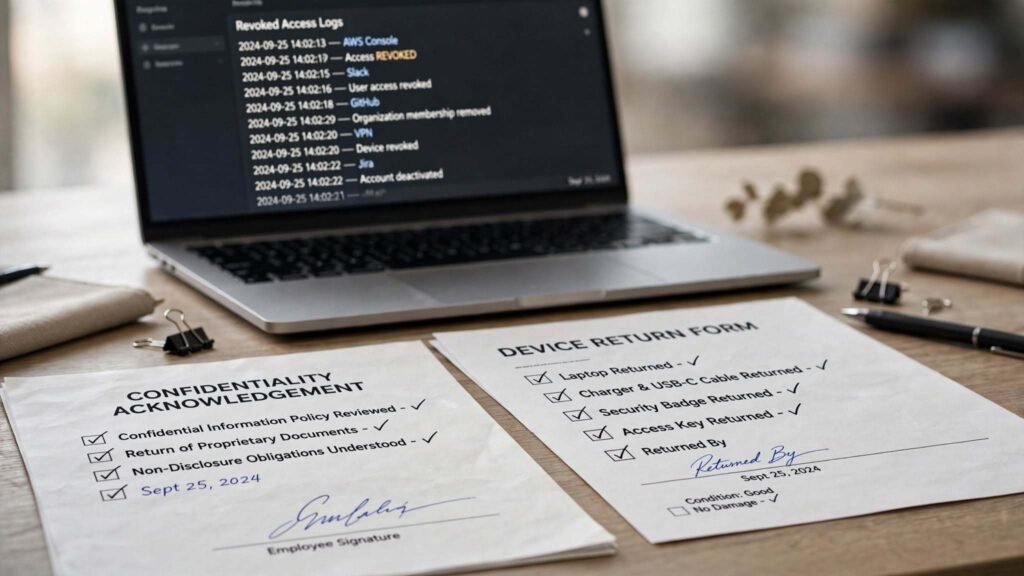
- Tie access to role, not tenure. Audit who actually has access to your customer pipeline, pricing models, and technical documentation, and revoke access immediately upon resignation, not on the last working day.
- Run a structured offboarding process. Document return of company devices, revoke cloud and CRM access same-day, and conduct an exit interview that specifically reminds the departing employee of surviving confidentiality obligations.
- Watch for incorporation red flags during employment. If you learn a senior employee has incorporated a competing entity while still on your payroll, as was alleged in the Zetwerk case, treat this as an immediate legal escalation point, not something to address informally.
- Build an evidence trail before you need it. Access logs, signed confidentiality acknowledgements, and IP assignment records are the evidence that actually wins these disputes, and they’re far cheaper to build proactively than to reconstruct after the fact.
- Map your cross-border exposure now. If you have a US subsidiary, sell into the US, or have any employees based there, understand upfront which forum, Indian courts, US federal courts, or potentially the USITC, would actually have jurisdiction if a dispute arose.
If you’re bringing on senior hires or restructuring your cap table ahead of a funding round, it’s worth reviewing these protections alongside your broader governance documents, since weak trade secret controls tend to surface as a red flag in VC due diligence just like data privacy gaps do — investors increasingly check both.
Common Mistakes That Turn a Bad Exit Into a Legal Crisis
- Relying entirely on a boilerplate non-compete clause copied from a US template, without realising it’s largely unenforceable in India
- Delayed access revocation, giving a resigning employee days or weeks of continued system access after they’ve announced their departure
- No documented IP assignment, leaving ambiguity over who owns work product created during employment
- Treating the exit interview as a formality rather than a legal checkpoint to reaffirm surviving obligations
- Ignoring early warning signs, such as a senior employee incorporating a new entity, until the departure has already happened and evidence has scattered
- Assuming a dispute will stay in one jurisdiction, when a US customer base, subsidiary, or supply chain can pull the fight into a completely different legal system
Frequently Asked Questions About Trade Secret Protection
1. Is a non-compete clause enforceable in India?
Generally no. Under Section 27 of the Indian Contract Act, 1872, agreements restraining a person from exercising a lawful profession or trade after employment ends are void, with narrow exceptions mainly around the sale of business goodwill. Non-solicitation and confidentiality clauses are far more likely to be enforced.
2. What did the Zetwerk-Ayr Energy dispute actually involve?
Zetwerk alleged that a former executive incorporated Ayr Energy, a competing transformer manufacturer, while still employed, and used confidential Zetwerk documents and contacts to win business. Ayr Energy counterclaimed that Zetwerk had stolen its own proprietary transformer technology. Both sides disputed the other’s allegations, and the matter settled globally in September 2026 without any claims being proven in court.
3. Does India have a dedicated trade secrets law?
No. India currently relies on common law principles (breach of confidence) combined with contract law, rather than a standalone trade secrets statute, unlike the United States, which has the federal Defend Trade Secrets Act.
4. What is a USITC Section 337 investigation?
It’s a proceeding under Section 337 of the Tariff Act of 1930 that allows the US International Trade Commission to investigate whether goods imported into the US were made using misappropriated trade secrets, with the power to issue an exclusion order blocking those imports if a violation is found.
5. Can an Indian company be sued for trade secret misappropriation in the US?
Yes, particularly if the company has a US subsidiary, sells products into the US market, or its actions otherwise have sufficient connection to the US, as seen in the Zetwerk case where the dispute was litigated in both Texas courts and before the USITC.
6. What should a confidentiality clause include to actually be enforceable?
It should clearly define what counts as confidential information, survive termination of employment independently of any non-compete provision, specify the duration of the obligation, and be supported by actual internal practices, like access controls, that show the information was genuinely treated as confidential.
7. What is the difference between a non-compete and a non-solicitation clause?
A non-compete restricts a person from working in a competing business or industry altogether, and is largely unenforceable in India post-employment. A non-solicitation clause only restricts approaching specific clients or employees of the former employer, and Indian courts have shown more willingness to enforce reasonably scoped versions of this.
8. What immediate steps should a company take if it suspects an employee is misappropriating trade secrets?
Preserve evidence immediately (access logs, emails, document transfer records), revoke system access, avoid tipping off the employee before evidence is secured, and consult legal counsel promptly to assess whether an injunction or urgent civil action is appropriate before more damage occurs.
9. Can a trade secret dispute affect a company’s IPO or fundraising plans?
Yes. As seen with Zetwerk, an active, high-profile cross-border trade secret dispute can surface during IPO preparation or investor due diligence, potentially affecting valuation, disclosure obligations, and investor confidence even before any court reaches a final decision.
10. How long should a non-solicitation restriction last to be reasonable?
Indian courts generally look more favourably on restrictions that are reasonable in scope and duration, commonly in the range of 12 to 24 months, rather than indefinite or overly broad restraints, which are more likely to be struck down as unreasonable.
Conclusion
The Zetwerk-Ayr Energy dispute didn’t become a three-jurisdiction legal battle because either company lacked lawyers. It became one because the underlying question, what exactly did a departing executive take, and was the company’s confidential information properly protected in the first place, is genuinely hard to resolve once a relationship has already broken down and evidence has scattered across two countries. The lesson for founders isn’t to fear every senior hire’s eventual departure. It’s to build the contractual and operational controls, confidentiality clauses that survive employment, tight access management, and a real offboarding process, before you need them, because by the time a dispute like this becomes public, the cost of fixing weak protections has already been paid.
If you’re structuring employment agreements, bringing on senior hires, or preparing for a funding round where these gaps could surface in diligence, it’s worth having your confidentiality, IP assignment, and non-solicitation clauses reviewed now, well before a departure forces the question.
This article discusses publicly reported litigation for educational purposes. All allegations referenced were disputed by the parties involved and were resolved by settlement without a judicial finding of liability on either side.