
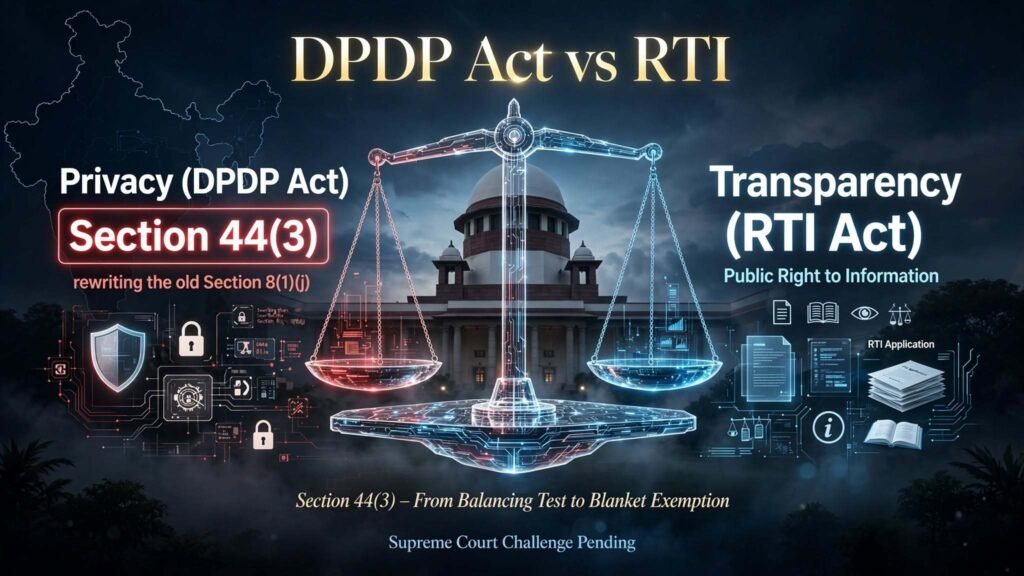
The DPDP Act vs RTI question sounds like something only constitutional lawyers should lose sleep over, but it is already changing how government offices answer applications, how journalists dig for records, and how businesses run due diligence. The trigger is a single provision, Section 44(3) of the Digital Personal Data Protection Act, 2023, which rewrote Section 8(1)(j) of the Right to Information Act, 2005. For twenty years that clause let an officer withhold personal information, but only if it had nothing to do with public activity, or would be an unwarranted invasion of privacy, and it came with a built-in public interest override. The amended text is much shorter and much blunter. In this guide I’ll explain what changed, what you can still get through RTI, how public authorities should respond now, what the Supreme Court is examining, and what it all means if you run a business. I’m not writing this as a campaigner for either side, because both privacy and transparency are legitimate constitutional values, and the honest answer is that the law is unsettled.
What Section 8(1)(j) Said Before, and What It Says Now
The old clause exempted personal information whose disclosure had no relationship to any public activity or interest, or which would cause unwarranted invasion of privacy. Then came the part that mattered most: the information officer or appellate authority could still order disclosure if satisfied that the larger public interest justified it. There was also a proviso that information which cannot be denied to Parliament or a State Legislature cannot be denied to any person.
Section 44(3) of the DPDP Act substituted the clause. It now exempts “information which relates to personal information”, and the qualifiers are gone. That is why commentators describe it as a shift from a balancing test to a blanket exemption. The change took effect in November 2025, when the relevant provisions of the DPDP Act were brought into force alongside the DPDP Rules.
Why This Is a Big Deal
A balancing test can be argued case by case. A categorical exemption is harder to argue against, because the officer no longer has to ask whether the public interest outweighs the privacy harm. The standard example is the 2019 Subhash Chandra Agarwal line of cases, where the Supreme Court allowed disclosure of judges’ asset declarations because accountability outweighed the privacy claim on those facts. Petitioners say that kind of reasoning has been structurally removed. The government’s answer is that the amendment aligns RTI with the privacy right recognised in Puttaswamy and stops fishing expeditions into private lives.
I should be precise on one point, because the debate is partly about it. Some RTI practitioners argue that the override has not vanished but now operates through Section 8(2) of the RTI Act, which lets an authority allow access where public interest in disclosure outweighs the harm to protected interests. Petitioners and many commentators say that is a thin reed. Which reading is right is exactly the kind of question the Court will have to settle, so treat anyone who says it is “obviously absolute” or “obviously fine” with caution.
What the Kerala High Court Actually Said
You will see headlines suggesting Kerala has endorsed the new regime. The reality is narrower. In May 2026, the Kerala High Court dealt with a dispute where the State Information Commission had directed the Kerala Public Service Commission to disclose documents including file notings from disciplinary proceedings. The High Court quashed that direction and held that the proviso to Section 8(1)(j) does not create an unrestricted right to everything that might be supplied to the legislature. It also observed that the DPDP Act strengthens the privacy framework. That is useful context for how a High Court is reading Section 8(1)(j), but it is a single-bench service-records decision, not a ruling on whether Section 44(3) is constitutional.
The Supreme Court Challenge: Where Things Stand
Three writ petitions are pending: Venkatesh Nayak v. Union of India (W.P.(C) 177/2026), The Reporters Collective Trust v. Union of India (W.P.(C) 211/2026) and National Campaign for People’s Right to Information v. Union of India (W.P.(C) 212/2026). They argue that Section 44(3) violates Articles 14, 19(1)(a) and 21, and the Reporters Collective petition adds that the DPDP Act has no exemption for processing personal data for journalism.
On 16 February 2026 the Court issued notice, referred the core questions to a larger bench, and declined to stay the DPDP framework. The matter was heard again on 23 March and 13 May. The Court has said that both Acts are central legislation and need to be harmonised, and it flagged that the line between “public data” and “private data” is central to deciding validity. In August 2026 the Centre was given two more weeks to respond. A separate plea filed in April 2026 asks for interim protection against masking or deleting data that is already available; the Court issued notice on it. As of today, October 2026, there is no final judgment, so Section 44(3) remains in force.
What Can Still Be Disclosed Under RTI?
Despite the alarm, RTI has not stopped working. Here is how I read the practical position, and I’d stress that this is analysis, not a court finding.
The first gate is whether the information is actually personal, meaning it relates to an individual rather than an institution. Contracts awarded, tender outcomes, budgets, policy files, inspection reports, scheme beneficiaries in aggregate, and the reasoning behind administrative decisions are information about the functioning of a public body, not about a person. These remain disclosable, subject to the other Section 8 exemptions that always applied, such as commercial confidence and trade secrets under 8(1)(d). Proactive disclosure under Section 4 also continues, and the petitioners specifically want that confirmed.
What is now much harder to get is anything that relates to an identifiable individual: service records, disciplinary details, medical information, addresses, and, in practice, a growing range of things officers label “personal.” This is where the public vs private data question bites, because an official’s salary or the file that shows why a favourable decision was taken can be both personal and a matter of public accountability.
How Public Authorities Should Respond to RTI Requests Now
If you are a PIO or manage RTI compliance for a public body, a few habits will keep you on the right side of both laws. Do not reflexively refuse because information involves a name. Ask first whether it is truly personal information or information about a public function. Where you do refuse under 8(1)(j), give a reasoned reply that identifies why the information is personal, and inform the applicant of first appeal rights. Where records mix institutional and personal content, consider severing under Section 10 and releasing the part that is not personal. Do not ask the applicant why they want the information, because Section 6(2) forbids it. And keep a record of your reasoning, because with the Supreme Court looking at this, decisions will be scrutinised.
What This Means for Businesses
Here is where my angle differs from most coverage. Businesses are affected on three fronts.
Due diligence. Many diligence teams used RTI quietly to learn about regulatory action, licence history or government dealings involving a counterparty or its promoters. Anything that depends on personal information about individuals is now harder. Company-level material, such as licence conditions, tender awards and inspection outcomes, is generally still reachable, but expect more refusals and longer appeals. Build in time and use public registries and court records alongside RTI, rather than relying on it.
Regulatory investigations and disputes. If your business is in a dispute where documents held by a regulator matter, a refusal under the amended 8(1)(j) is now more likely, and challenging it is slower. Litigation routes such as discovery or direct requests to the regulator may be more reliable than RTI.
Your own filings. If you submit information to government that includes personal data of employees, directors or customers, the amended clause gives it stronger protection from third-party RTI requests. But it does not replace your own duties as a data fiduciary. If you are still working out what those obligations mean for you, our guide to DPDP Act compliance and VC due diligence walks through what investors actually check.
This sits alongside a wider tightening of platform and data rules. If you run a platform or publishing business, it is worth reading this together with the IT Amendment Rules 2026 compliance guide, since publishers who depend on RTI for reporting face both a harder transparency regime and stricter content obligations.
What to Expect Next
The larger bench could take a middle path, reading the new 8(1)(j) together with Section 8(2) so that a public interest check survives. It could strike down Section 44(3) and restore the earlier text. Or it could uphold it and leave Parliament to adjust. Each outcome changes the practical rules, so avoid building long-term processes on a single assumption. If your business depends on RTI or on government-held information, or you handle personal data that ends up in public records, it is worth getting a specific read on your exposure while the law is still moving.
Frequently Asked Questions
1. What does Section 44(3) of the DPDP Act do?
It substitutes Section 8(1)(j) of the RTI Act so that it exempts information which relates to personal information, removing the earlier qualifiers about public activity, unwarranted invasion of privacy and the express public interest override.
2. Has the Supreme Court struck down Section 44(3)?
No. Three petitions are pending, the core questions have been referred to a larger bench, and the Court declined to stay the DPDP framework. The provision remains in force.
3. Can I still file an RTI application asking about a government decision?
Yes. Information about how a public body functions, such as policies, budgets, tenders and decisions, is generally not personal information, though other Section 8 exemptions can still apply.
4. Is it true the public interest test is gone completely?
It is disputed. The text of 8(1)(j) no longer contains the override. Some practitioners say Section 8(2) still allows disclosure where public interest outweighs harm. Petitioners argue this is inadequate. The Supreme Court will decide.
5. Did the Kerala High Court uphold the DPDP amendment?
No. A May 2026 order in a Kerala PSC file-notings case limited an RTI claim and noted that the DPDP Act strengthens privacy, but it did not rule on the constitutionality of Section 44(3).
6. Can a PIO refuse any RTI request that mentions a person’s name?
They should not. The information must actually be personal. A name appearing in a document about public functioning does not automatically make the whole record exempt, and severance under Section 10 may apply.
7. Does this affect information about companies?
Section 8(1)(j) concerns personal information of individuals, so company-level information is not caught by it, though commercial confidence and other exemptions can still apply.
8. How does this affect journalists?
Petitioners say it chills investigative reporting because records tied to individuals are harder to obtain, and the Reporters Collective also challenges the absence of a journalism exemption in the DPDP Act.
9. What should a business do about RTI-based due diligence?
Combine RTI with other sources such as company registries, court records and regulatory filings, allow more time for appeals, and avoid relying on personal information about individuals from government files.
10. When will the Supreme Court decide?
There is no fixed date. The matter was heard in February, March and May 2026, and the Centre was given further time in August. Watch for the larger bench constitution and listing.
Conclusion
The DPDP Act vs RTI fight is not really about whether privacy or transparency matters more. Both are constitutional values, and the Court itself has said the two Acts need to be harmonised. What is certain is that the amended Section 8(1)(j) is in force today, officers are using it, and the final answer on its validity has not arrived. Treat it as live law, plan for more refusals, and keep an eye on the larger bench.
This article is general information about a developing legal issue and not legal advice for your specific situation.