
The online gaming ban in India is one of those stories everyone thinks they understand and almost nobody actually does, including a surprising number of people running gaming platforms right now. I keep getting some version of the same question from founders and operators: is rummy illegal now? What about fantasy sports? Can I still run an esports tournament with an entry fee? The honest answer is that the law is both broader and narrower than most headlines suggest, and it’s still, more than a year after Parliament passed it, sitting in front of the Supreme Court waiting for a final word on whether it’s even constitutional. I run both a SaaS product and a media platform, so I’ve had to work through this law from two angles at once: what it means for anyone building technology that touches money and users, and what it means for anyone publishing content about an industry that’s effectively been told to stop operating while a court decides if that was legal in the first place. Here’s what the Act actually says, what it leaves genuinely unresolved, and where this is likely headed next.
What the Promotion and Regulation of Online Gaming Act, 2025 Actually Does
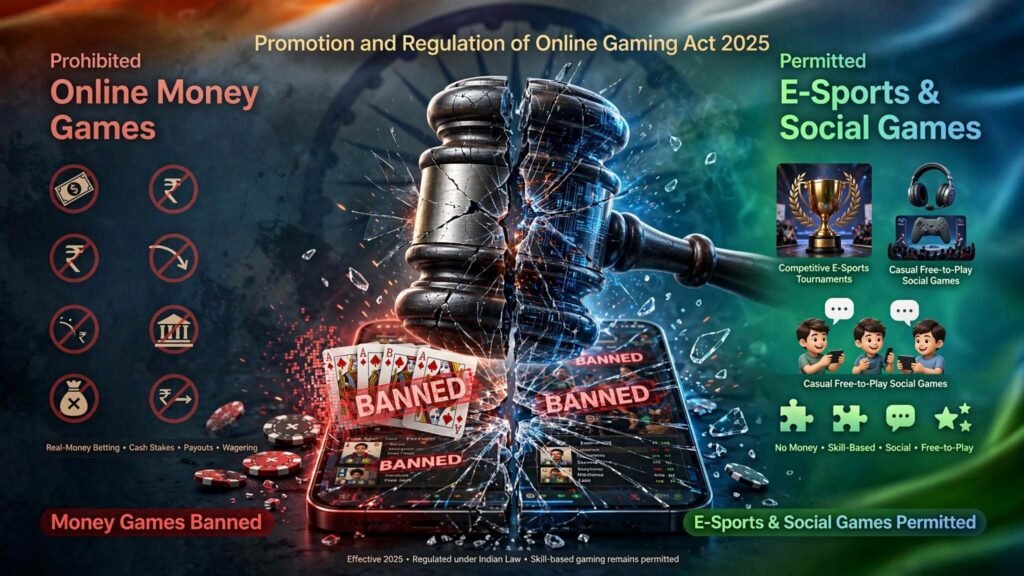
Parliament passed the Promotion and Regulation of Online Gaming Act in a hurry during the monsoon session of 2025. It cleared the Lok Sabha on 20 August, the Rajya Sabha the next day, and received Presidential assent on 22 August 2025. The headline framing, that India “banned online gaming,” is wrong in a way that matters. What the Act bans is a specific category it calls online money games: any game where a user pays money or stakes something of value with an expectation of winning money or something of monetary value back. It does not ban online gaming as a category, and it goes out of its way to say so, carving out and actively promoting two other categories: e-sports, and what it calls online social games, meaning casual games played without real-money stakes.
The part that actually upended the industry isn’t the ban itself. It’s how the Act defines what’s banned. For nearly seventy years, Indian courts have drawn a line between games of skill and games of chance, treating games like rummy and, more recently, fantasy sports as constitutionally protected activity under Article 19(1)(g), the right to carry on a trade or profession, because skill-predominant games were never treated as gambling. The 2025 Act simply erases that distinction for anything involving money. It bans online money games “whether based on skill or chance or both,” which means poker, rummy, and fantasy sports platforms, all of which had spent a decade winning court cases on exactly the skill-versus-chance argument, got swept into the same prohibition as pure games of chance. That’s the collision this law created, and it’s also exactly why it’s currently sitting in front of the Supreme Court.
Skill Games vs. Chance Games: Why This Distinction Used to Matter
If you’ve read older coverage of Indian gaming law, you’ll have seen endless references to cases like State of Andhra Pradesh v. Satyanarayana and the Chamarbaugwala judgments, which established that a game isn’t gambling if skill substantially predominates over chance. That doctrine is why rummy platforms, poker rooms, and fantasy sports operators like Dream11 could operate openly for years, arguing, successfully, that what they offered wasn’t gambling at all. Industry built entire business models on that legal foundation, and investors poured billions into it on the strength of that precedent.
The 2025 Act doesn’t argue with that doctrine so much as sidestep it entirely. It defines “online money game” by reference to the presence of a stake and the expectation of monetary return, full stop, with no exception for the degree of skill involved. This is precisely the part being challenged in the Supreme Court right now: can Parliament simply legislate away a constitutional distinction the courts have treated as settled for decades? That question hasn’t been answered yet, and it’s the single most important open issue in Indian gaming law today.
What’s Actually Permitted: E-Sports and Social Gaming
The Act’s more constructive half gets far less attention than the ban, probably because “government bans industry” is a better headline than “government also builds a parallel regulatory track for a different industry.” But it does exactly that. E-sports, structured competitive gaming recognised under India’s broader sporting framework, is explicitly promoted, not just tolerated, with the Act encouraging infrastructure development and skill programmes in the sector. Online social games, the free-to-play or non-monetary casual games people play on their phones without any stake involved, are similarly permitted and registrable.
The practical distinction that matters for anyone building in this space is whether users pay in with an expectation of a monetary payout. A prize pool funded by a platform for a genuine skill-based competition, structured correctly and registered as e-sports, is a different animal under this law than a peer-to-peer real-money game where users wager against each other. Getting that classification wrong isn’t a minor compliance slip, it’s the difference between a legal business and a criminal offence carrying real jail time.
Online Gaming vs. Online Betting: A Distinction the Act Deliberately Collapses
One question I get constantly is how “online gaming” differs from “online betting” under this law, because older Indian regulation treated them as genuinely separate things, gambling and betting regulated mostly at the state level under colonial-era statutes like the Public Gambling Act of 1867, and online skill gaming operating in a separate, more protected legal space. The 2025 Act deliberately collapses that separation for anything involving a stake. It doesn’t matter whether you’d colloquially call something a “game” or a “bet,” if money goes in with an expectation of money coming out, it falls under the online money game prohibition. Traditional state betting and gambling statutes still exist alongside this central law, which is actually one of the Act’s messier aspects, since it doesn’t cleanly displace state legislation like Nagaland’s Prohibition of Gambling and Promotion and Regulation of Online Games of Skill Act or Sikkim’s Online Gaming Act, both of which licensed exactly the kind of skill-money games the new central law now prohibits. That overlap, a central prohibition sitting on top of surviving state licensing regimes, is one of the law’s genuine unresolved tensions and a federalism argument the challengers have specifically raised in the Supreme Court.
Penalties: What Operators, Advertisers, and Even Payment Processors Actually Face
The enforcement teeth here are significant, and worth understanding in specific numbers rather than vague warnings. Offering an online money game can attract imprisonment of up to three years and a fine of up to one crore rupees. Advertising a banned game, directly or indirectly, carries up to two years imprisonment and a fine of up to fifty lakh rupees. These offences are classified as cognisable and non-bailable, meaning police can arrest without a warrant and bail isn’t a given, which is an unusually harsh classification for what is, at its core, a business regulation statute. The law also reaches financial facilitation: banks and payment gateways processing transactions for online money games face liability too, which is exactly why, according to court filings in the pending Supreme Court case, banks and payment processors withdrew services from gaming platforms almost immediately after the Act was published, well before it was even formally notified or enforced.
The Act also applies extraterritorially. It covers online money gaming services offered from outside India to users within the country, which closes the obvious offshore-relocation loophole operators might otherwise have used, and gives the government a basis to block offshore platforms under Section 69A of the Information Technology Act, the same provision that’s already been used to block over 1,500 betting and gambling sites in recent years. If you’re assessing exposure for a platform with any India-facing user base regardless of where it’s incorporated, this extraterritorial reach is the detail to take most seriously.
The Regulatory Machinery: Who Actually Decides What Counts as a “Money Game”
The Act sets up a national regulatory body, generally referred to as the Online Gaming Authority, with the job of registering games, categorising them, and resolving the genuinely hard cases, hybrid games that mix skill and chance elements in ways that aren’t obviously one or the other. This classification function matters enormously in practice, because it’s this authority, not a court applying decades of skill-versus-chance case law, that now makes the first call on which side of the line your product sits. A tribunal with civil court powers handles disputes and grievances. If you’re building or operating in this space, registration with this authority and a clean categorisation of your product isn’t optional paperwork, it’s the thing standing between you and a criminal prosecution.
Why “Banned” and “In Force” Aren’t the Same Thing Here
This is the part most coverage gets genuinely confused about, and it’s worth being precise. The Act received Presidential assent in August 2025, but it sat unnotified for months afterward, meaning the formal legal machinery, the Authority, the rules, the registration process, hadn’t actually been switched on. Industry players argued in court filings that this created a strange kind of limbo they called de facto enforcement: banks and payment processors pulled back from the sector purely out of fear of future liability, even though the law hadn’t technically been brought into force yet, causing real economic damage before the government had even finished setting up the regulatory apparatus the Act itself required. The Promotion and Regulation of Online Gaming Rules, 2026 were eventually notified, and the framework came into substantive force around mid-2026, more than half a year after the Act was passed. If you’re reading an article or a compliance memo that treats the August 2025 date as when enforcement actually began, it’s working from an incomplete picture.
The Supreme Court Case: What’s Actually Still Undecided
Here’s the detail that changes how you should think about this entire law: the constitutional validity of the ban itself has not been decided. Multiple petitions, filed by gaming operators including Head Digital Works and Bagheera Carrom, challenged the Act in the Karnataka, Madhya Pradesh, and Delhi High Courts almost immediately after it passed, arguing it violates Article 14 (equality), Article 19(1)(g) (the right to carry on a trade), and that Parliament lacks the legislative competence to simply erase the skill-versus-chance distinction courts have treated as constitutionally significant for generations. On 8 September 2025, the Supreme Court exercised its power under Article 139A to transfer every pending and future challenge to itself, consolidating what would otherwise have been years of conflicting High Court rulings into a single proceeding.
That case has moved slowly. A hearing was deferred from December 2025 to January 2026 without the Court granting any interim relief to the industry, something counsel for operators described, memorably, as leaving the sector in a state of “civil death,” operating under a ban whose legality hadn’t even been tested, with no ability to pause the economic damage while the question was resolved. The matter has continued through 2026 before a bench led by Chief Justice Surya Kant. A related but distinct ruling came on 27 May 2026, when the Supreme Court in State of Tamil Nadu v. Junglee Games India Pvt. Ltd. upheld Tamil Nadu’s state-level ban on online real-money games and a retrospective GST demand against gaming companies, holding that prohibiting even skill-based betting can be constitutionally valid where an “overweening public interest” justifies it. That ruling matters as a strong signal of where the Court’s thinking may be headed, but it is not the final word on the central Act’s own constitutionality, that question remains open, before the larger bench, as of this writing.
What This Means If You’re Building or Running a Gaming Platform Right Now
If your product touches real-money stakes in any form, the only responsible starting point is to assume the ban is currently enforceable, regardless of the pending constitutional challenge, because that’s exactly the position courts have left operators in by declining interim relief. Practically, that means a hard look at whether your product can be restructured into a genuine e-sports or social gaming model with no stake-based payout, whether your current user base and revenue depend on exactly the monetised mechanics the Act targets, and whether your payment processing partners are still willing to carry the risk, since many have already walked away regardless of what the Supreme Court eventually decides. If you’re an advertiser or an influencer who’s previously promoted real-money gaming platforms, the two-year imprisonment exposure for advertising attaches to you too, not just the platform, so continuing or renewing those campaigns on the assumption the law will eventually be struck down is a real personal risk, not a business one you can simply absorb.
This sits in the same regulatory moment as the broader tightening we’ve seen across Indian tech law recently, the compressed takedown timelines and platform obligations under the IT Amendment Rules 2026 follow a similar pattern of government moving fast on enforcement while leaving platforms to work out compliance in real time. If you’re running a SaaS product or platform anywhere near this space, whether that’s payments infrastructure, an app store listing, or a publishing platform carrying advertising for gaming products, it’s worth getting a specific review of your exposure under the current framework rather than waiting for the Supreme Court to settle the bigger question, since the penalties here are criminal, not just financial, and they attach well before any final verdict arrives.
What Comes Next
Three things are worth watching. First, the Supreme Court’s eventual ruling on the Act’s constitutionality, which will either validate Parliament’s decision to erase the skill-versus-chance distinction for money games entirely, or find that distinction was constitutionally protected in a way Parliament couldn’t simply legislate around, a ruling that would likely force significant amendments to the Act regardless of which way it goes. Second, how the Online Gaming Authority actually handles the hybrid-game classification question in practice, since that’s where most of the genuine product-design disputes are likely to land once the dust settles. Third, whether the unresolved tension with state gambling and gaming statutes gets addressed through amendment or simply continues as an open federalism question that keeps generating litigation state by state. None of this is close to settled, and anyone telling you with total confidence exactly how this ends is guessing, same as the rest of us watching this closely.
Frequently Asked Questions About the Online Gaming Ban in India
1. Is online gaming completely banned in India?
No. The 2025 Act bans a specific category called “online money games,” meaning games played for stakes with an expectation of monetary return. E-sports and non-monetary online social games are explicitly permitted and promoted under the same law.
2. Does the ban apply to skill-based games like rummy and fantasy sports?
Yes. This is the central change the Act made: it eliminates the earlier legal distinction between games of skill and games of chance for anything involving money, meaning rummy, poker, and fantasy sports platforms involving real-money stakes are covered by the prohibition regardless of how much skill is involved.
3. Has the Supreme Court ruled the online gaming ban unconstitutional?
No. The constitutional challenge to the Act itself is still pending before a larger Supreme Court bench. A related May 2026 ruling upheld Tamil Nadu’s separate state-level ban and a GST demand, which signals the Court’s likely direction, but it is not a final decision on the central Act’s validity.
4. What are the penalties for offering an online money game in India?
Offering an online money game can attract imprisonment of up to three years and a fine of up to one crore rupees. Advertising such a game carries up to two years imprisonment and a fine of up to fifty lakh rupees, and these offences are classified as cognisable and non-bailable.
5. Can an offshore gaming platform avoid this law by not being based in India?
No. The Act applies extraterritorially to online money gaming services offered from outside India to users within the country, and the government can block such offshore platforms under Section 69A of the Information Technology Act.
6. What’s the difference between online gaming and online betting under the new law?
The 2025 Act largely collapses this distinction for money-based activity, treating any game where users stake money with an expectation of monetary return the same way, regardless of whether it would traditionally be called a “game” or a “bet.” State-level betting and gambling laws continue to exist alongside this central law, creating some unresolved overlap.
7. When did the online gaming ban actually come into force?
The Act received Presidential assent on 22 August 2025 but remained substantively unnotified for several months. The implementing Rules were notified in 2026, bringing the full regulatory framework into practical force roughly eight to nine months after the Act was passed, not immediately on assent.
8. Can influencers be penalised for promoting real-money gaming apps?
Yes. The Act’s advertising prohibition applies to anyone promoting a banned online money game, directly or indirectly, including influencers, carrying potential imprisonment of up to two years and a fine of up to fifty lakh rupees.
9. What happens to a startup that pivots from real-money gaming to e-sports?
It can continue operating, provided the revised model genuinely removes the stake-and-payout mechanics the Act targets and the game is properly registered and classified by the Online Gaming Authority. Classification matters enormously here, since a poorly restructured “e-sports” product that still functions as a money game doesn’t escape the prohibition just by renaming itself.
10. Do existing state licenses for real-money gaming still apply?
This remains legally unsettled. The Act doesn’t clearly address how it interacts with existing state-level licensing regimes, such as those in Nagaland and Sikkim that previously licensed skill-based real-money games, and this overlap is one of the specific issues raised in the pending Supreme Court challenge.
Conclusion
The online gaming ban in India isn’t really one clean story, it’s a law that bans a narrower category than its name suggests, built on a legal theory, that Parliament can simply override the skill-versus-chance distinction courts spent seventy years building, that hasn’t actually been tested to a final verdict yet. Operators, advertisers, and platforms are currently living with the practical consequences of a ban whose constitutionality remains genuinely open, which is an uncomfortable but accurate way to describe where things stand as of now. If you’re building anything in or adjacent to this space, the safest posture is compliance with the law as it currently stands, not a bet on how the Supreme Court eventually rules, because the penalties here are criminal and the Court has shown no inclination to pause enforcement while it decides.
If you need a clear read on where your specific product or platform sits under this framework, it’s worth getting a direct assessment of your gaming or gaming-adjacent compliance exposure rather than relying on how a competitor has classified a similar product, since the Online Gaming Authority’s classification decisions are still being worked out case by case.