
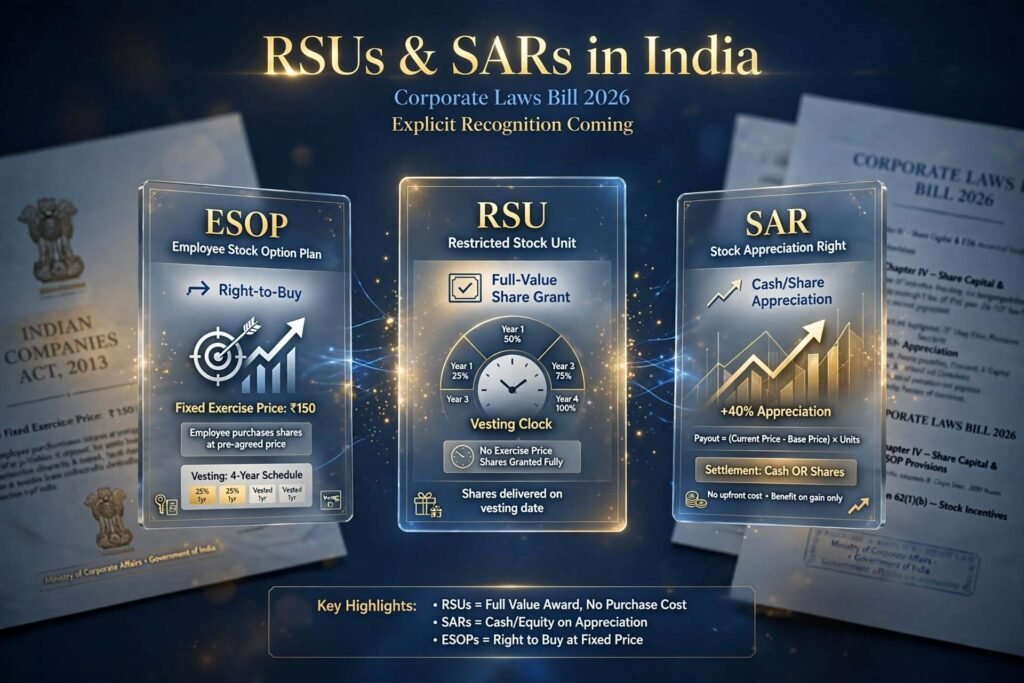
RSUs and SARs in India have been quietly doing a lot of work for years, even though the Companies Act only ever spoke clearly about one instrument: the employee stock option. A restricted stock unit is a promise of actual shares that arrive when a vesting condition is met. A stock appreciation right pays the employee the growth in the share’s value, usually in cash. Companies have offered both, but they’ve had to squeeze them into a framework built for options. The Corporate Laws (Amendment) Bill, 2026 is meant to fix that by recognising them directly. Before anything else, a word on the headline you may have seen: RSUs and SARs were not illegal before this Bill, and the Bill itself is not yet confirmed as law in anything I could verify. In this guide I’ll explain what’s changing, how RSUs, SARs and ESOPs differ, the tax problem the Bill doesn’t solve, and how a founder can use each instrument sensibly to hire senior people.
Where the Bill Stands
The Corporate Laws (Amendment) Bill, 2026 was introduced in the Lok Sabha on 23 March 2026 and seeks to amend both the Companies Act, 2013 and the LLP Act, 2008. The same day it was referred to a Joint Parliamentary Committee. According to PRS India’s tracker, the committee’s report was presented on 3 August 2026, and press coverage of that day says it recommended adopting the Bill with clause-wise modifications. I haven’t been able to confirm passage by both Houses or notification, so treat the provisions below as proposed until you’ve checked the current status. The practical point for founders is that the direction is clear, but your plan documents should not assume the final text.
What the Bill Actually Does
Today Section 62(1)(b) of the Companies Act lets a company issue shares to employees under an employee stock option scheme. The Bill proposes to widen that clause to include “other scheme linked to the value of the share capital of the company”, with matching changes to Section 42(2) on private placement and to Section 68 on buy-backs. Law-firm commentary reads this as bringing RSUs and SARs expressly inside the statute. It also lines up the Act with the SEBI share-based employee benefit regulations of 2021, which already recognised both instruments for listed companies.
Two caveats from the practitioner commentary are worth remembering. First, the Companies rules governing the detailed mechanics, such as eligibility, pricing and disclosures, will need updating, and until then RSUs are likely to keep operating within the ESOP framework. Second, the proposed Section 68 change extends buy-back restrictions to these schemes, which matters if you design a SAR with a share-settled component.
How RSUs, SARs and ESOPs Differ
Think of it as three different promises.
An ESOP gives the employee the right to buy shares at a fixed exercise price in the future. The employee profits only if the share price rises above that price, and has to find the cash to exercise.
An RSU is a grant of shares, usually for no purchase price or a nominal one, that vest over time. Because the employee isn’t paying anything, the instrument is worth something as long as the company is worth something. That’s why an RSU is often described as a full-value award.
A SAR pays the increase in value between a base price and the price at settlement. It can be settled in cash or in shares. In the cash-settled version, no shares are allotted at all.
The differences that matter to a founder are dilution, cash and risk. Share-settled ESOPs and RSUs dilute your cap table. A cash-settled SAR doesn’t, but it creates a future cash obligation, and a company that grows fast can find that bill uncomfortable. ESOPs carry the biggest upside leverage but can end up worthless if the company’s value falls below the exercise price. RSUs give a more certain, smaller-looking reward, which is why senior hires often prefer them.
A Quick, Illustrative Comparison
Take invented numbers. Suppose the fair market value at the relevant date is ₹500 a share.
- With 1,000 ESOP options at a ₹100 exercise price, the employee pays ₹1 lakh to exercise, and the ₹4 lakh difference between market value and exercise price is treated as salary for tax purposes.
- With 1,000 RSUs, there’s no exercise price, so the full ₹5 lakh value on vesting is the taxable perquisite, and the employee gets shares worth ₹5 lakh.
- With 1,000 cash-settled SARs at a ₹100 base price, the company pays ₹4 lakh in cash when the right is exercised or settled, which is taxed as salary.
These are illustrations of how the instruments behave, not tax calculations.
The Tax Trap the Bill Doesn’t Fix
This is the part I’d want every founder to read twice. The Bill changes company law and leaves income tax alone. Under the existing approach, an RSU that vests, or an ESOP that’s exercised, creates a tax charge in the employee’s hands at that moment, calculated on the value they received, even though a private-company employee usually can’t sell the shares and has no cash from the event. Practitioners call this the dry tax problem. Commentators on the Bill note that a 2021 amendment, which defers this tax for employees of DPIIT-recognised startups, applies only to those startups, so a company that isn’t recognised, or has outgrown the eligibility conditions, is exposed. Tax rules sit in the Income-tax Act, 2025 now, so confirm the current treatment with a tax adviser before you design the plan. If you’re building a recognised startup, our guide to Startup India registration covers the recognition conditions that determine whether the deferral is even available.
For founders this means designing around the tax event, not just the grant. Some options to discuss with your advisers:
- Double-trigger RSUs, where vesting needs both time served and a liquidity event such as an IPO or acquisition. This keeps the tax charge near the point where cash arrives. It’s a common technique, but check how it interacts with the tax rules and with employee expectations.
- Cash-settled SARs, which pay the cash that covers the tax.
- Company buy-backs or structured secondary sales that give employees liquidity, which the proposed Section 68 changes may make easier.
- A smaller, staged vesting pattern, so no single vesting date creates a huge tax bill.
Valuation Mechanics
Every one of these instruments depends on a defensible share value. You need one at grant (for pricing or the base price) and again at the tax events. For an unlisted company the valuation normally comes from a qualified professional such as a merchant banker or registered valuer, depending on the purpose, and the method has to be consistent and documented. One more reason to take it seriously: the commentary on the Bill points out that, with the expanded oversight proposed for auditors and valuation, sloppy numbers will be harder to defend. Keep the valuation report, the board approvals and the grant letters in one place, because investors and acquirers read them during due diligence. Our guide on DPDP compliance and VC due diligence shows how much investors now dig into the paperwork.
How to Use RSUs and SARs to Attract Senior Talent
I’ve seen founders treat equity as a one-size-fits-all offer, and it rarely works for senior hires. A seasoned VP of engineering or a CFO usually wants certainty, so a smaller RSU grant often lands better than a large pool of options that might be underwater. A SAR can suit a company that doesn’t want to dilute further but has the cash flow to pay, or an employee who doesn’t want to deal with owning shares in a private company. ESOPs remain sensible for early joiners who’ll accept risk for leverage.
Whichever instrument you choose, tie it into the rest of your documents. Vesting schedules, cliffs, acceleration, leaver treatment and forfeiture should line up with your employment agreements and shareholders’ agreement. Our guides on founder agreements and on bad leaver clauses and forfeiture of vested shares show how harshly leaver terms can bite once vesting is involved. And remember that existing rules limit who counts as an eligible employee, so founders and large shareholders may be excluded from some schemes; check the current position before you grant anything to yourself or a co-founder.
Why This Matters for the Delaware and Singapore Question
Part of the reason for the Bill is that many Indian startups set up foreign holding companies partly to incentivise employees from there, because the domestic framework was awkward. If RSUs and SARs become straightforward under Indian law, one of the practical arguments for staying abroad weakens. If you’re weighing that decision, our guide on reverse flipping explains the structuring and tax side of moving back. To discuss your own equity plan, you can reach out here.
What to Do Now
Don’t wait for the final text to tidy your house. Review your current plan and see whether it already uses RSU-like features under the ESOP framework. Check what your articles and shareholders’ agreement say about employee schemes. Talk to your tax adviser about the vesting tax problem. And when the Bill’s final form is notified, ask your counsel to compare it with your plan documents.
Frequently Asked Questions
1. Are RSUs and SARs legal in India right now?
Companies have offered them for years, often structured within the ESOP framework. The Corporate Laws (Amendment) Bill, 2026 would give them explicit recognition, but I could not confirm that the Bill has become law.
2. What does the Bill change?
It proposes to widen Section 62(1)(b) to cover other schemes linked to the value of a company’s share capital, with matching amendments to Sections 42(2) and 68, so RSUs and SARs sit alongside ESOPs.
3. What is the difference between an RSU and an ESOP?
An ESOP is a right to buy shares at a set price, while an RSU is a grant of shares, usually without a purchase price, that vests over time.
4. What is a SAR?
A stock appreciation right pays the increase in the share’s value over a base price, typically in cash, without the employee buying or being allotted shares.
5. Do SARs dilute founders?
Cash-settled SARs don’t issue shares, so they don’t dilute, but they create a future cash obligation. Share-settled SARs can dilute.
6. When is tax payable on RSUs?
Generally when the RSUs vest and shares are allotted, based on the value then, which is why employees can face a tax bill without receiving cash. DPIIT-recognised startups may be able to defer it under a 2021 provision; confirm the current rules with a tax adviser.
7. Does the Bill fix the tax problem?
No. It amends company law only, and commentators have pointed out that the income-tax treatment is untouched.
8. Which instrument is best for senior hires?
It depends. RSUs offer more certainty, ESOPs offer more leverage and risk, and SARs avoid dilution but need cash. Many companies mix them.
9. Do listed companies already have rules for this?
Yes. SEBI’s 2021 regulations on share-based employee benefits already recognise RSUs and SARs for listed companies.
10. What should a startup do before the Bill is final?
Review your plan and documents, confirm the tax treatment with an adviser, keep valuations and approvals well documented, and update the plan when the final law and rules are notified.
Conclusion
The Bill is a sensible tidy-up of something companies were already doing, and if it becomes law it should make RSUs and SARs easier to adopt with less legal awkwardness. But the instrument you choose matters less than the tax event around it, because an employee who owes tax on shares they can’t sell won’t feel rewarded. Design for the moment cash actually arrives, keep your valuation and paperwork clean, and treat the final text of the law as the thing to confirm, not assume.
This article is general information and not legal or tax advice for your specific plan.