
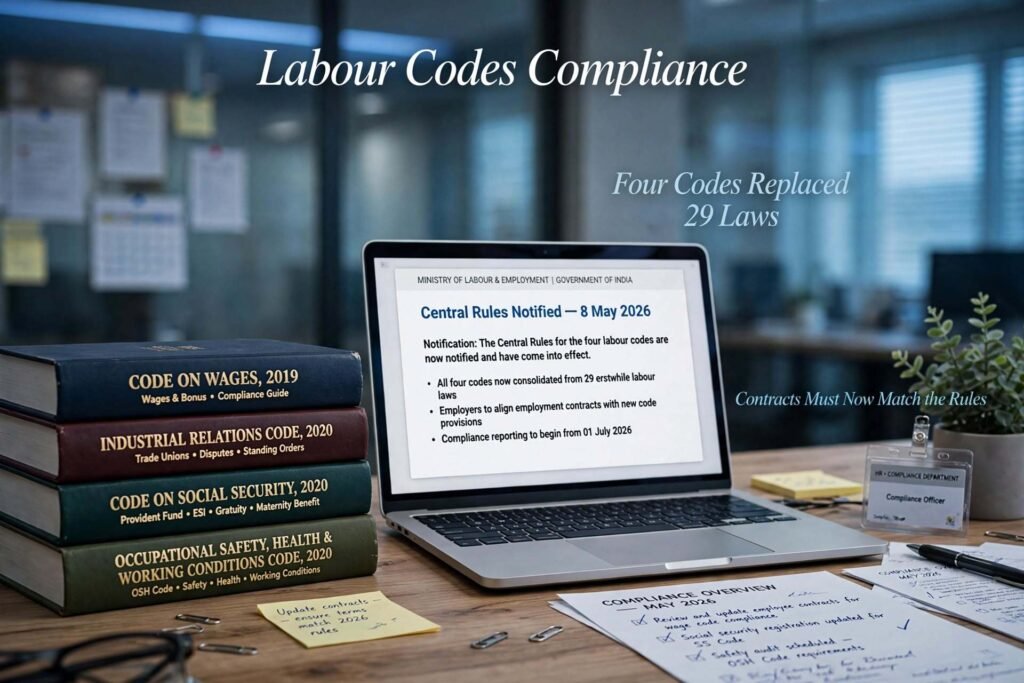
Labour codes compliance stopped being a “we’ll get to it” item once the Central Rules landed on 8 May 2026, because the rules are what turned four big statutes into forms, timelines and checklists that someone has to follow. The four codes, covering wages, industrial relations, social security and occupational safety, came into force on 21 November 2025 and replaced 29 central labour laws. For about six months employers worked from the statute alone and guessed at the mechanics. Now the guessing is over, and the employment contract is where most of the practical changes show up: how you define salary, how you describe fixed-term roles, what you promise on gratuity, and how fast you settle dues when someone leaves. In this guide I’ll go through what changed, what to put in your contracts and what to leave alone, written for founders and HR heads who need to act, not read a lecture on labour law.
The Timeline in Two Sentences
The four codes were brought into force on 21 November 2025. The Central Rules under the Code on Wages, the Industrial Relations Code and the Code on Social Security were notified on 8 May 2026, with the OSH Central Rules following on 8 or 9 May depending on the source. Because labour is a Concurrent List subject, each state also has to frame its own rules, and a tracker maintained by a labour-law publisher showed most states still at the draft stage in May. So if you employ people in several states, you’re tracking a moving target, and the central position is the one you can rely on today.
The Wage Definition: The Change That Touches Every Salary Slip
The biggest practical shift is the uniform definition of “wages”. The codes list what is excluded, such as house rent allowance, conveyance, overtime, the employer’s own provident fund contribution, gratuity and retrenchment compensation, and where those exclusions add up to more than 50% of total remuneration, the excess is added back to wages. Commentators are careful to say this doesn’t mean basic pay must be exactly 50% of CTC. It means that if you’ve been keeping the “basic” component low and loading the rest into allowances, a large part of it will now count as wages anyway.
Why does it matter? Because wages are the base for provident fund, gratuity and several other calculations. A simple, invented example: an employee on a ₹1 lakh monthly CTC with a basic of ₹40,000. If the add-back lifts wages to ₹50,000, gratuity under the standard formula of 15 days’ wages per year of service rises from roughly ₹23,000 to roughly ₹28,800 for each year of service. If you pay provident fund on actual wages and not on the statutory ceiling, the employer contribution base goes up as well, though the ceiling position should be checked with your payroll adviser. The take-home pay of the employee may fall slightly if the employee’s own contributions rise, which is the part employees notice first.
Contract Updates That Actually Matter
Here’s the part most readers came for. These are the areas where I’d expect your offer letters and employment agreements to need work.
1. Salary structure and the CTC annexure. Re-cut the salary breakup against the new wage definition, and say in the contract how wages are defined for PF, gratuity and bonus. If the new structure reduces someone’s take-home, don’t change it quietly. A variation to an existing contract generally needs the employee’s agreement, so explain it and get written acknowledgement.
2. A proper appointment letter. Commentary on the codes and the Ministry’s FAQs describe a written appointment letter as something every employee is entitled to, not a courtesy. Make sure yours states designation, date of joining, wage components, working hours, leave, notice terms and the place of work. If you’ve been relying on a one-page offer email, replace it.
3. Fixed-term employment, written carefully. The codes recognise fixed-term employment formally. The contract should state the term, any renewal mechanism, parity of benefits with permanent staff in similar roles, and how gratuity works. Gratuity for fixed-term employees is pro rata, and most sources, including the government’s own factsheet, say eligibility begins after one year of service, though a few commentaries read it differently, so confirm before you finalise wording. Commentary also points out that fixed-term employees don’t get notice pay or retrenchment compensation when the term simply ends, which should be spelled out in the contract. One caution from me: don’t treat rolling fixed-term contracts as a way to dodge gratuity. Rolling annual renewals for what is really permanent work is the kind of pattern that attracts scrutiny.
4. Exit and final settlement. The Code on Wages shortens the time for paying wages after an employee leaves or is removed. As I read it, the deadline is two working days, and several guides for employees say the same. Update your exit clause and your payroll process so that full and final isn’t a 45-day affair anymore. Where something is genuinely disputed, say how you’ll deal with it, such as paying the undisputed part on time.
5. Gratuity and leave wording. If your contract says gratuity is payable “as per the Payment of Gratuity Act, 1972”, that Act has been folded into the Code on Social Security. Update the reference, and refer to the wage definition the Code uses.
6. Standing orders and policies. Under the Industrial Relations Code, standing orders apply to establishments with 300 or more workers, up from 100 in many states earlier, and the central rules come with model standing orders. Check which regime your business falls under, and align your handbook with it.
7. Confidentiality, IP and restrictive covenants. The codes don’t change the basics here, and broad post-employment non-competes remain hard to enforce in India. Our guide on trade secret protection explains what actually holds up. It’s still a good moment to tidy those clauses while the contract is open.
Contractors and “Consultants”: Don’t Skip This
If part of your team is on consulting agreements, the expanded definitions and wider social security coverage make misclassification more expensive, not less. Read our guide on worker misclassification in India before you decide that a freelance label is safer than putting someone on a proper contract.
What Employees Should Check
If you’re on the other side of the table, read your appointment letter, compare your salary breakup with the wage definition, look at your fixed-term contract’s gratuity clause and keep a copy of any revised terms you sign. If you were on rolling short contracts for years, it’s worth asking where you stand on gratuity. And if you’re ever told your full and final will take weeks, remember that the law now expects it sooner.
Equity and Other Pay Components
If your pay package includes equity-linked elements, make sure the contract reflects them separately from the wage structure. Our guide to RSUs and SARs in India covers the instruments and the tax trap, and our piece on founder agreements shows how vesting and leaver terms interact with employment terms.
A Short Implementation Plan
Start with a payroll simulation, because the wage definition drives cost. Next, redraft the template appointment letter and the fixed-term template. Then roll out the changes in stages, with written explanations. Finally, set a calendar to check your states’ rules, since those will keep arriving. If you’d like a review of your templates, you can reach out here.
Frequently Asked Questions
1. When did the labour codes come into force?
The four labour codes came into force on 21 November 2025, replacing 29 central labour laws.
2. When were the Central Rules notified?
The Central Rules under the four codes were notified on 8 May 2026, with the OSH rules reported as 8 or 9 May depending on the source.
3. Do I need to change my employment contracts?
In most cases, yes. At the least, review the salary breakup, the appointment letter details, any fixed-term terms, gratuity references and the exit settlement clause.
4. What is the 50% wage rule?
If the excluded components of remuneration exceed 50% of total pay, the excess is added back to wages. It does not mean basic pay must be exactly 50% of CTC.
5. How does the wage definition affect gratuity and PF?
Wages are the base for these calculations, so a wider wage figure can increase gratuity and, depending on how you contribute, provident fund.
6. Are fixed-term employees entitled to gratuity?
Yes, pro rata, and most sources say eligibility begins after one year of service. Check the current wording with your adviser.
7. Can I use fixed-term contracts to avoid gratuity?
Repeated renewals for what is really permanent work are likely to draw scrutiny, so don’t rely on that approach.
8. How quickly must final dues be paid after an employee leaves?
As I read the Code on Wages, within two working days. Update your exit process accordingly.
9. Do state rules matter?
Yes. Labour is a Concurrent List subject, and states have to frame their own rules, many of which were still draft in mid-2026.
10. Are written appointment letters mandatory?
The Ministry’s FAQs and commentary treat a written appointment letter as an entitlement for employees, so issue one to every hire.
Conclusion
The codes won’t make or break your company, but sloppy contracts will cost you quietly, through a wrong wage base, a missing appointment letter or a late settlement. The Central Rules gave employers the forms and timelines, and the work now is to make your documents match. Do the payroll simulation first, redraft the templates second, and keep an eye on your states.
This article is general information, not legal advice. Check the current text of the codes, the Central Rules and your state’s rules before changing contracts.
Sources and further reading (exact URLs as returned by search; click-test before publishing):
- PIB factsheet on the Code on Social Security: https://www.pib.gov.in/FactsheetDetails.aspx?Id=150473®=3&lang=2
- Ministry of Labour FAQs, as reported by SCC Online: https://www.scconline.com/blog/post/2026/01/03/labour-ministry-issued-faqs-on-the-labour-codes/
- Cyril Amarchand Mangaldas, Guide to the Labour Codes (PDF): https://www.cyrilshroff.com/wp-content/uploads/2025/12/Guide-to-the-Labour-Codes.pdf
- Central and state rules tracker (LKS): https://employmentlaw.lkslaw.com/rules