
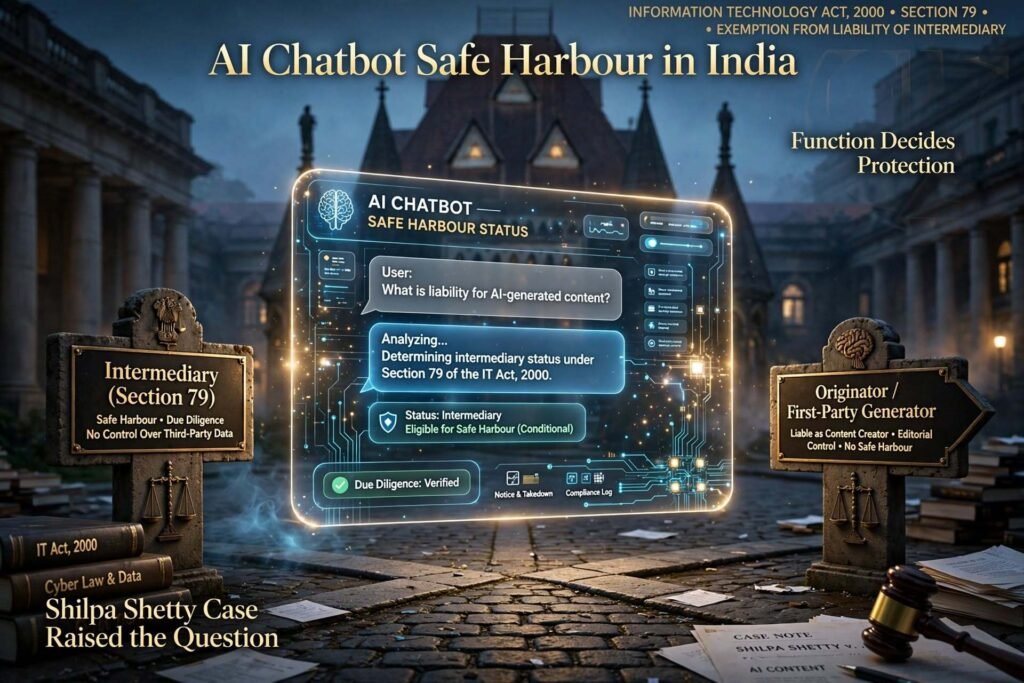
AI chatbot safe harbour stopped being a classroom debate in March 2026, when the Bombay High Court asked a blunt question during Shilpa Shetty Kundra’s personality rights suit: can a platform that produces a celebrity’s personality on demand, without her consent, hide behind intermediary protection under Section 79 of the IT Act? The bench did not answer it. It did something more useful for founders. It put the question on the record, at the exact moment the IT Rules 2026 amendment had pulled synthetically generated information (SGI) into the intermediary due diligence framework for the first time.
If you build or run a chatbot, a voice tool or any generative AI product in India, this guide is meant to save you a few expensive assumptions. It explains what safe harbour actually shields, why courts treat a passive host differently from an active generator, what the new rules demand, and how to place your own product on that spectrum. It also flags what nobody can promise you yet, because several of the answers are still being written. For the wider legal backdrop, our technology law section tracks the same developments.
Key Takeaways on AI Chatbot Safe Harbour for Founders
- Safe harbour turns on function, not on label. Intermediary status is decided by what the product does. The government told Parliament as much, and courts are following the same logic.
- A chatbot that composes its own replies looks, on the face of the statute, closer to an originator than to a neutral conduit. That is a reading, not a final ruling.
- The 2026 rules add duties (labelling, provenance metadata, preventive tools, 3-hour takedowns). They do not declare that every AI product is an intermediary.
- Even a genuine intermediary loses protection when it ignores its due diligence duties after notice.
- Impersonating a real person is the fastest route to an injunction, whatever your Section 79 position.
What the Bombay High Court Actually Asked in the Shilpa Shetty Case
Precision matters here, because headlines have run ahead of the order. The suit was filed against more than 30 platforms. One of them was an AI chatbot website accused of simulating Shetty’s personality for any user who wanted to chat with a version of her. Justice Sharmila Deshmukh observed that the site was still using the actor’s personality without permission, and asked, in substance, how an AI can create someone’s personality and make it available to the public without that person’s consent.
Counsel for Google, Tenor and the chatbot entity told the court that URLs flagged to them had been taken down. Shetty’s side disputed that, and the court let her file an application if links stayed live. Tenor argued that it is an intermediary GIF platform with no capacity for proactive monitoring, which is the classic passive-host defence. The chatbot company was directed to file a detailed reply, and that reply is where the safe harbour question for AI platforms gets tested.
Later, the Bombay High Court did protect Shetty’s name, image, voice, likeness and persona and ordered removal of infringing content. That is an interim personality rights outcome. I could not find a reported ruling that finally decides whether the chatbot company is an intermediary, so please treat the safe harbour point as open and check the latest order before relying on it. If the personality rights side of this is new to you, we have a separate explainer on personality rights in India and how courts protect face, voice and name without a statute.
Why the Question Cuts So Deep
A platform that hosts what users post gets safe harbour because it is carrying someone else’s words. A chatbot that speaks as a named person is producing the words itself. Commentators covering the hearing, including MediaNama, made the same point: content generated by the system is arguably first-party, not third-party, and Section 79 only speaks to third-party information. That is the whole fight in one sentence.
What Safe Harbour Under Section 79 Really Protects
Section 79 of the Information Technology Act, 2000 gives an intermediary conditional immunity for third-party information, data or communication links that it makes available or hosts. Section 2(1)(w) defines an intermediary as someone who, on behalf of another person, receives, stores or transmits an electronic record, or provides a service with respect to that record. Note the phrase “on behalf of another”. It is the textual hook for the entire AI debate.
The safe harbour is not automatic. Three conditions sit under Section 79(2):
- Your function is limited to providing access to a communication system.
- You do not initiate the transmission, select the receiver, or modify the information.
- You observe due diligence and follow the government’s guidelines, which today means the IT Rules 2021 as amended.
Section 79(3) then takes the shield away if you conspire, abet, aid or induce the unlawful act, or if you fail to act after getting actual knowledge. In Shreya Singhal v. Union of India (2015), the Supreme Court read “actual knowledge” to mean a court order or a government notification, not a private complaint. That is why Indian platforms, with safe harbour in hand, did not have to adjudicate every angry email. The 2026 amendment compresses timelines sharply, which we cover below, so it is worth reading the old position and the new one side by side.
What Safe Harbour Never Covered
- Your own content. The shield is for third-party information. Material you create is yours to defend.
- Court orders. Immunity from damages is not immunity from injunctions or takedown directions.
- Copyright and patent rights. Section 81 of the IT Act preserves rights under the Copyright Act and the Patents Act, so safe harbour is not a clean answer to an IP claim.
- Active participation. In Christian Louboutin v. Nakul Bajaj, the Delhi High Court recognised the active versus passive distinction and held that protection is for platforms acting as conduits.
Safe harbour is not a licence to ignore security and data duties. If your product sits on user data, read our note on cybersecurity as a legal requirement for founders, because a breach story and a safe harbour story tend to land in the same courtroom.
How the IT Rules 2026 Changed the Picture for AI Platforms
The Information Technology (Intermediary Guidelines and Digital Media Ethics Code) Amendment Rules, 2026 were notified on 10 February 2026 as G.S.R. 120(E) and came into force on 20 February 2026. They respond to deepfakes, impersonation and non-consensual intimate imagery, and they bring synthetically generated information inside the existing due diligence machinery.
The Definition of SGI
Rule 2(1)(wa) covers audio, visual or audio-visual information that is artificially created or altered in a way that appears real and depicts a person or event as indistinguishable from the real thing. Routine edits (cropping, colour correction, noise reduction), good-faith illustrative material such as training decks, and accessibility additions like captions or translations are carved out. Rule 2(1A) says references to “information” in the unlawful-act provisions include SGI.
What Intermediaries That Offer SGI Tools Must Do
Where a platform lets users create or modify synthetic content, Rule 3(1)(ca) requires it to warn users about the legal exposure, and the platform may remove content, suspend accounts and disclose the offending user’s identity to the victim. Rule 3(3) requires reasonable technical measures, including automated tools, to prevent SGI that involves child sexual abuse material or non-consensual intimate imagery, false documents or records, material on arms and explosives, or impersonation of a real person through voice, conduct or action that is likely to deceive. Lawful SGI must carry a prominent label and permanent metadata or a unique identifier, and the platform may not enable stripping of either.
Large social platforms carry more. Under Rule 4(1A), a significant social media intermediary must obtain a user declaration on whether content is synthetic and verify it with technical measures.
Faster Clocks
| Obligation | Earlier timeline | After the 2026 amendment |
|---|---|---|
| Takedown after actual knowledge (Rule 3(1)(d)) | 36 hours | 3 hours |
| Grievance Officer resolves a complaint (Rule 3(2)(a)(i)) | 15 days | 7 days |
| Complaints on prohibited content under Rule 3(1)(b) | 72 hours | 36 hours |
| Removal after complaint on intimate imagery (Rule 3(2)(b)) | 24 hours | 2 hours |
One comfort clause deserves attention. Rule 2(1B) says that removing or disabling access using reasonable technical measures, automated tools included, does not by itself breach the Section 79(2)(a) and (b) conditions. In plain terms, moderating AI output will not, on its own, make you “a modifier” who loses protection.
What the Rules Did Not Do
They did not define chatbots as intermediaries, and they did not amend Section 79. A law-firm commentary on the rules noted that the amendment preserves Section 79 as it stands while changing what counts as due diligence. That is the gap the Bombay bench noticed: duties were assigned to platforms offering SGI tools, yet the threshold question of who qualifies as an intermediary was left alone. Privacy-heavy products should also line up these duties with data minimisation under the DPDP Act, which our DPDP privacy policy compliance checklist walks through.
Passive Platform or Active Generator: How Courts Are Drawing the Line
No Indian court has issued a final, binding ruling that a generative AI platform is or is not an intermediary. What exists is a set of signals that point the same way.
The Calcutta High Court on ChatGPT
In IndiaMART Intermesh v. OpenAI (May 2026), the Calcutta High Court refused interim relief that would have forced ChatGPT to show IndiaMART links. On the side question of status, it said that ChatGPT’s ability to curate, synthesise and generate new content brings it closer to an originator than a passive intermediary, while calling the issue complicated and one needing technical evidence at trial. It also acknowledged the opposing argument that outputs depend on user prompts. Some headlines said the court “ruled” ChatGPT an originator. That overstates it. It was a prima facie observation in a case lost on other grounds, but it is the clearest judicial signal so far, and the court even suggested legislation may be needed, including a choice between function-specific and entity-specific liability.
The Government’s Position on Safe Harbour
In a written reply in the Lok Sabha, the Minister of State for Electronics and IT said that whether an AI system is an intermediary and gets Section 79 exemption depends on the nature of the service and the functions it performs. That is a function test. It matches academic commentary that safe harbour is a conditional immunity tied to specific activities rather than a status a company wears everywhere.
The Grok Episode
On 2 January 2026, MeitY issued a notice to X after explicit, non-consensual AI images linked to its Grok chatbot spread, warning that non-compliance could cost the platform its Section 79 immunity. X kept its protection for third-party posts. The chatbot’s own outputs sat in the grey zone, as one analysis by the Supreme Court Observer put it. Notice how the regulator separated the host from the generator.
The Louboutin Logic Applied to AI
The active/passive test asks whether you selected, modified or induced. A model that decides what to say is selecting and shaping every output, which is why many lawyers expect the Louboutin reasoning to travel badly for pure generators. Still, a counter-argument exists: the user writes the prompt, so the user “initiates” the content. Courts have not resolved which framing wins.
Misuse by fraudsters shows why the stakes are not abstract. Voice clones and fake officials are now part of cyber fraud, as we explain in our guide to the digital arrest scam and its legal remedies.
Where Does Your AI Chatbot Safe Harbour Claim Sit? A Practical Test
The table below is my working reading of how the signals above apply to common products. It is analysis, not settled law, and the facts of your system will move you up or down.
| Product type | Section 79 outlook | Reasoning |
|---|---|---|
| Hosting or messaging platform for user-posted content | Strongest | Third-party content, passive role, classic Section 79 territory |
| Tool the user directs closely (editing, translation, voice conversion of user’s own file) | Arguable | The user supplies the substance, though Rule 3(3) duties apply and heavy transformation weakens the argument |
| General-purpose answer chatbot | Contested | Composes new output; Calcutta High Court leaned toward originator at interim stage |
| Persona chatbot that imitates a real person | Weakest | The product itself produces the likeness; this is the Shilpa Shetty fact pattern |
| Your own brand’s support or sales bot | Assume none | You deploy it and speak through it; treat output as your statement |
Three questions help you place yourself. Who writes the substance of the output, you or your user? Do you train, tune or prompt the system to imitate identifiable people? Could a reasonable user believe the output comes from you? The more your answers point inward, the less the third-party logic of Section 79 helps.
The API Wrapper Problem
Many Indian startups sit on top of a foundation model. If the model provider is arguably the originator, are you a mere conduit to it? I would not bet your company on that. You choose the prompts, the persona, the interface and the audience, which makes you the deployer, and a court asked to allocate responsibility will see your product, not the vendor’s API. Protect yourself through contract: our guides on IP assignment agreements and on limitation of liability clauses explain the vendor-side terms worth negotiating.
What AI Chatbot Safe Harbour Will Not Cover Even If You Qualify
Suppose you are a real intermediary. You are still exposed in four places.
- Personality rights. India has no codified statute, so courts decide case by case. Celebrity suits over AI deepfakes and chatbots keep multiplying, including those by Preity Zinta and Shruti Haasan in the Bombay High Court during 2026, and each one lists AI platforms as defendants.
- Intellectual property. Section 81 keeps copyright and patent remedies alive.
- Post-notice failure. If you receive a valid order and sit on it, Section 79(3)(b) bites, and under Rule 7 of the 2021 Rules, failing due diligence ends your Section 79(1) protection.
- Criminal law. Content in categories like child abuse or intimate imagery brings reporting duties and penal exposure.
A 10-Step Safe Harbour Compliance Checklist for AI Founders
- Map each feature to either “hosts third-party content” or “generates content”, and write the map down.
- Treat generated output as first-party and do not rely on safe harbour for it, unless you can show the user authored its substance.
- Block real-person impersonation at prompt and output level. Allow named personas only with a written licence from the person.
- Label lawful SGI visibly, with audio prefixes for voice, and embed provenance metadata that users cannot strip.
- Run the 3-hour and 2-hour clocks: a monitored takedown inbox and an escalation path outside office hours.
- Name a Grievance Officer and meet the 7-day resolution window.
- Send the quarterly user notice required by Rule 3(1)(c), and add the SGI warning under Rule 3(1)(ca).
- Keep logs of detection tools, removals and response times. They are your evidence of due diligence.
- Update your Terms and Privacy Policy to match what the product actually does.
- Review vendor contracts for indemnity, data use and who bears takedown costs.
Not sure which of these applies to your stack? Reach out through our contact page and we can walk through it.
Contracts and Policies That Support Your Position
Documents will not create safe harbour for a chatbot. Section 79 is statutory, and no clause rewrites the safe harbour it grants. What good documents do is prove you told users the truth, set rules for misuse, and allocate risk with vendors and enterprise clients. Start with the difference between Terms of Service and a Privacy Policy, because the SGI notices belong in the first and the data handling in the second. If you are pitching AI features to enterprise customers, an NDA and a clean liability cap matter before the first demo, not after the first complaint. Early-stage teams can find more in our startup legal library.
Where AI Chatbot Safe Harbour Is Heading
Three safe harbour trends are visible. Courts are building AI liability case by case and treating safe harbour as conditional, with the Calcutta and Bombay High Courts both signalling that function matters. Reports suggest policymakers are reviewing whether AI companies should get the same protections as social media platforms, and a dedicated framework has been discussed alongside the long-pending Digital India Act. And the 2026 rules already turn labelling and provenance from nice-to-have features into conditions of compliance.
My view, and it is only a view, is that the safest assumption for a generative product is that you are responsible for what it says, while keeping Section 79 as a fallback for the third-party parts of your platform. Build for the harder standard now, and any safe harbour ruling in your favour becomes a bonus rather than a lifeline. For more on how these threads connect, browse the blog or read about the author.
Frequently Asked Questions on AI Chatbot Safe Harbour in India
1. Can an AI chatbot qualify as an intermediary under the IT Act?
It can claim safe harbour, but only for the parts of its service that really act on behalf of others and deal with third-party information. The government has said the answer depends on the nature of the service and its functions. A chatbot that writes its own replies is harder to fit, and the Calcutta High Court leaned that way at the interim stage in the IndiaMART case.
2. Did the Bombay High Court decide that an AI chatbot loses safe harbour in the Shilpa Shetty case?
No. The court questioned whether an AI platform simulating a celebrity without consent can claim intermediary protection, and asked the chatbot company to respond. It also protected Shetty’s personality rights on an interim basis. I found no final ruling on the safe harbour point itself.
3. What is synthetically generated information (SGI) under the IT Rules 2026?
SGI is audio, visual or audio-visual content artificially created or altered so that it appears real and could pass for a genuine person or event. Routine editing, good-faith illustrative material and accessibility features such as captions are excluded.
4. What does Rule 3(3) of the IT Rules require from AI platforms?
Platforms that facilitate SGI must use reasonable technical measures, including automated tools, to prevent unlawful categories such as child sexual abuse material, non-consensual intimate imagery, false records, weapons-related content and deceptive impersonation. Lawful SGI must be labelled prominently and carry permanent metadata or an identifier.
5. Does labelling AI content protect my chatbot’s safe harbour?
Labelling is a compliance duty, not a shield. It helps you show due diligence, and Rule 2(1B) clarifies that using technical tools to remove or disable content does not by itself breach Section 79(2). It does not turn first-party output into third-party content.
6. How fast must I take down unlawful content now?
Three hours after actual knowledge under Rule 3(1)(d), down from 36 hours. Complaints about intimate imagery must be actioned within two hours, and the Grievance Officer has seven days to resolve complaints, reduced from fifteen.
7. Can my Terms of Service or disclaimers give my chatbot safe harbour?
No. Safe harbour comes from the statute and depends on your conduct. Terms help by setting rules for users and supporting your due diligence record, but they cannot stand in for Section 79 protection.
8. I build on a third-party model API. Does the provider’s status protect me?
Not reliably, because safe harbour does not pass through an API. You choose the interface, prompts and audience, which makes you the deployer in most readings. Use contracts to push indemnities and cooperation duties upstream, and assume you carry the customer-facing risk.
9. Does AI chatbot safe harbour protect against personality rights and copyright claims?
Only partly. Courts continue to grant injunctions in personality rights suits, and Section 81 preserves copyright and patent remedies. Safe harbour is no answer if your own chatbot produces the infringing likeness or work.
10. Is there a dedicated AI law in India, and should I wait for one?
There is no standalone AI statute at the moment, and the government has treated generative AI under the existing IT Act and its rules. Do not wait for a new law to settle safe harbour. The 2026 rules already bind you, and courts are applying current law to AI disputes today.
Need Help With Your AI Chatbot Safe Harbour Position?
A short review of your architecture, user notices and vendor contracts can save you from learning the lesson through a notice. Talk to Advocate Parvez Ali about your product.
Sources
- MediaNama: Bombay HC and the Shilpa Shetty AI chatbot case
- Argus Partners: Overview of the IT Intermediary Amendment Rules, 2026
- Gazette copy of the 2026 Amendment Rules (G.S.R. 120(E))
- World Trademark Review: Calcutta High Court on IndiaMART v. OpenAI
- SCC Online blog: ChatGPT as intermediary or originator
- Outlook India: Government on generative AI and safe harbour
- Supreme Court Observer: Grok and intermediary liability
- Bar and Bench: Generative AI and intermediary liability
- Law School Policy Review: AI under India’s IT Rules and the limits of safe harbour
Last updated: 14 October 2026. This article is general information, not legal advice. Court proceedings in this area are moving quickly, so verify the current status of any case before relying on it.