
The first angel investment agreement a founder signs is usually the one they understand least — not because the amount is small, but because it’s often the first time a founder is negotiating against someone with genuinely more deal experience than they have. Angel rounds move fast, the excitement of the first real cheque is real, and it’s easy to sign whatever the investor’s lawyer sends over without fully grasping what each clause is actually doing to your cap table, your control, and your future fundraising flexibility.
This article walks through what an angel investment agreement actually is, the key terms every founder should understand before signing one, and a genuinely important update: angel tax, long one of the most feared provisions in Indian startup fundraising, has now been abolished — which changes part of this conversation from where it stood even a couple of years ago.
What Is an Angel Investment Agreement?
An angel investment agreement is the legal document (or set of documents) governing an early-stage investment made by an individual investor — typically a high-net-worth individual investing personal capital — into a startup, usually before institutional venture capital gets involved. Depending on the structure, this might take the form of a share subscription agreement, a convertible note, or increasingly, a CCPS-based (Compulsorily Convertible Preference Shares) structure, which I’ve covered in more depth in my article on SAFE Notes vs Convertible Notes.
Whatever the specific instrument, the underlying agreement needs to address the same core set of commercial and legal terms — which is where most of the real negotiation, and most founder mistakes, actually happen.
Key Terms Every Angel Investment Agreement Should Include
Valuation and Investment Amount
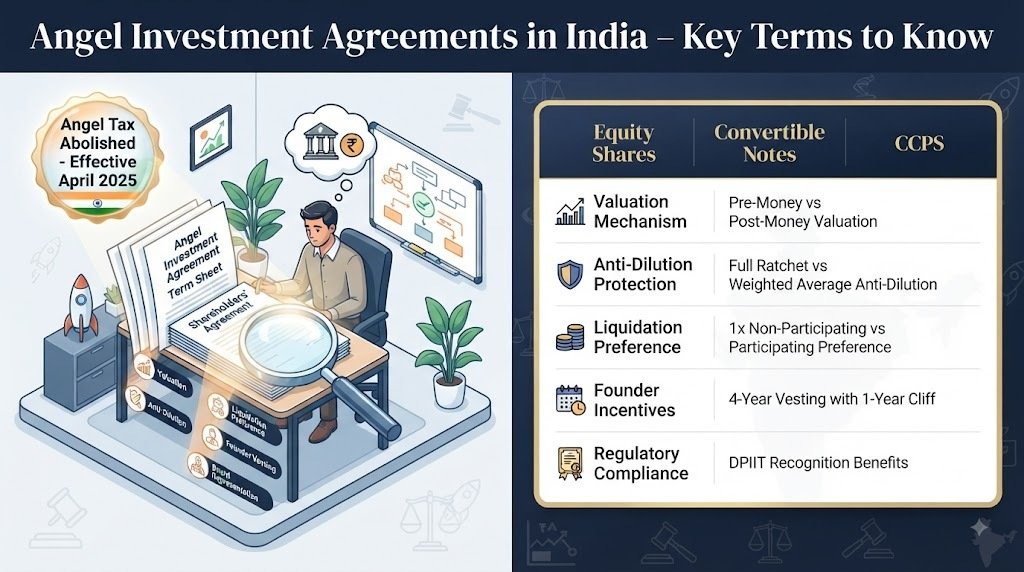
The agreement should clearly state the pre-money or post-money valuation being used, the total investment amount, and the resulting equity percentage or instrument being issued. Ambiguity here — particularly around whether a valuation is pre- or post-money — is one of the most common sources of later disputes and cap table confusion.
Instrument Type
Angel investments in India are typically structured as equity shares, convertible notes, or CCPS. Each carries different implications for control, conversion mechanics, and investor rights — an angel investment agreement should specify exactly which instrument is being used and why, rather than leaving the structure ambiguous.
Board Representation and Observer Rights
Angel investors sometimes negotiate a board seat or, more commonly at this stage, observer rights — the ability to attend board meetings without formal voting power. Founders should understand exactly what’s being granted here, since board composition affects control over major company decisions well beyond the investment itself.
Information and Inspection Rights
Most angel investment agreements include a right for the investor to receive periodic financial information and, in some cases, inspect company records. This is standard and reasonable within limits, but founders should ensure the scope is proportionate — unrestricted inspection rights can become genuinely burdensome as the company scales and takes on more investors.
Anti-Dilution Protection
Anti-dilution clauses protect the investor if the company later raises a down round — a subsequent round at a lower valuation than the angel invested at — by adjusting their effective ownership to partially compensate for the dilution. Founders should understand which anti-dilution formula is being used (full ratchet versus weighted average), since the two produce meaningfully different outcomes, and full ratchet protection is considerably more founder-unfriendly.
Liquidation Preference
A liquidation preference determines the order and amount investors receive before other shareholders in an exit or liquidation event. Common structures include 1x non-participating preference (the investor gets their investment back first, then shares in the remainder pro rata) versus participating preference (the investor gets their money back and participates in the remaining proceeds). This term matters more than founders often realise, because it directly affects how proceeds are actually split in an exit — including one that looks financially successful on paper.
Founder Vesting
Angel investors frequently require founders to be subject to a vesting schedule on their own equity, even for shares already held, to ensure founders remain committed and don’t walk away shortly after the round closes. I’ve written about how vesting schedules generally work — the standard four-year structure with a one-year cliff — in my piece on 50/50 Co-Founder Splits, and the same principles apply directly here.
Right of First Refusal and Tag-Along/Drag-Along Rights
A right of first refusal (ROFR) gives existing investors the option to purchase shares before a founder or other shareholder can sell to an outside party. Tag-along rights let minority shareholders join a sale if a majority shareholder sells; drag-along rights let a majority shareholder force minority shareholders to join a sale on the same terms. These terms significantly affect a founder’s future flexibility around transferring or selling equity, and deserve careful attention rather than being treated as routine boilerplate.
Exit Rights
The agreement should address how and when the angel investor expects to exit — through a company sale, a subsequent funding round, a buyback provision, or an IPO — and what rights they have if the company hasn’t provided a clear exit path within an agreed timeframe.
Representations, Warranties, and Confidentiality
Standard commercial protections — accurate representations about the company’s legal and financial status, and confidentiality obligations protecting both the company’s and investor’s sensitive information — round out a properly drafted angel investment agreement, similarly to the broader confidentiality principles I’ve discussed in Confidentiality Agreement vs NDA.
Angel Tax – Is It Still a Concern?
This is worth addressing directly, because it’s changed significantly and older articles on this topic are now genuinely out of date. Angel tax, levied under Section 56(2)(viib) of the Income Tax Act, 1961 on share premium exceeding a startup’s fair market value, was abolished for all classes of investors — resident and non-resident alike — effective 1 April 2025 (Financial Year 2025-26), through the Finance (No. 2) Act, 2024. Startups raising angel investment now, in FY 2025-26 and beyond, no longer need to navigate the angel tax exposure that shaped so much of Indian angel round structuring for over a decade.
That said, this abolition is prospective, not retrospective — startups with fund raises from before 1 April 2025 may still face pending assessments or notices under the old provision, and those legacy matters aren’t automatically resolved by the abolition. If your company raised angel investment in earlier financial years and has an open assessment, that’s still worth addressing on its own terms.
DPIIT Recognition and Why It Still Matters
Even with angel tax no longer a factor, DPIIT recognition under the Startup India programme remains genuinely valuable for other reasons — including eligibility for the Section 80-IAC tax holiday, intellectual property fee rebates, self-certification benefits under labour and environmental laws, and eligibility for schemes like the Startup India Seed Fund. Founders shouldn’t assume DPIIT recognition has become irrelevant just because the angel tax exemption it used to provide is no longer needed.
Angel Investment Agreement vs Term Sheet vs Shareholders’ Agreement
Founders often conflate these three documents, so it’s worth being precise: a term sheet is typically a preliminary, often non-binding summary of key commercial terms, negotiated before detailed legal documentation — a related concept to the distinction I’ve covered in MOU vs Contract, since term sheets raise the same “is this actually binding” questions depending on their drafting. The angel investment agreement itself is the detailed, legally binding document implementing those terms — covering the specific clauses discussed above. The shareholders’ agreement, if the company has one, governs the broader relationship between all shareholders going forward, and angel-specific rights are often carried into or referenced within it as the company raises subsequent rounds.
Common Mistakes Founders Make When Negotiating Angel Investment Agreements
I see the same handful of issues repeatedly among first-time founders:
- Not clarifying whether a valuation is pre-money or post-money before agreeing to it
- Accepting full ratchet anti-dilution protection without understanding how much more founder-unfriendly it is than weighted average
- Overlooking liquidation preference terms because they seem irrelevant until an actual exit happens
- Agreeing to founder vesting without negotiating reasonable terms around what happens on specific departure scenarios
- Treating the term sheet as a formality and only reading the detailed agreement carefully — by which point most terms are already effectively locked in
- Not involving a lawyer at the term sheet stage, when negotiating leverage is actually highest
Frequently Asked Questions
What is an angel investment agreement? It’s the legal document governing an early-stage investment from an individual investor into a startup, typically structured as equity shares, a convertible note, or CCPS, covering valuation, investor rights, and exit terms.
Is angel tax still applicable in India? No — angel tax under Section 56(2)(viib) was abolished for all investor classes effective 1 April 2025 (FY 2025-26). Legacy assessments for earlier years, however, aren’t automatically resolved by the abolition.
What’s the difference between a term sheet and an angel investment agreement? A term sheet is typically a preliminary summary of key terms, often non-binding; the angel investment agreement is the detailed, legally binding document that actually implements those terms.
What is liquidation preference and why does it matter? It determines the order and amount investors receive before other shareholders in an exit event — it can significantly affect how proceeds are actually distributed, even in a financially successful exit.
Does DPIIT recognition still matter without angel tax exemption? Yes — DPIIT recognition offers other benefits, including the Section 80-IAC tax holiday, IP fee rebates, and eligibility for government startup schemes, independent of the now-abolished angel tax exemption.
Should founders negotiate angel investment agreement terms, or just accept the investor’s draft? Founders should absolutely negotiate — particularly around anti-dilution structure, liquidation preference, and vesting terms, which have long-term consequences well beyond the initial round.
Final Takeaway
An angel investment agreement is rarely just about the cheque — it’s the document that sets the terms for how control, ownership, and future flexibility get shared between you and your earliest investor, often for years afterward. With angel tax now abolished, one major source of friction is gone, but the commercial terms — valuation, anti-dilution, liquidation preference, and vesting — matter just as much as they always did, and deserve the same careful negotiation.
Raising an angel round and want your investment agreement reviewed or negotiated properly? Get in touch and let’s make sure the terms actually work for you, not just for the investor’s side of the table.
This article is for general informational purposes and does not constitute legal or tax advice. Angel investment terms should be reviewed by a qualified lawyer based on your specific circumstances.