
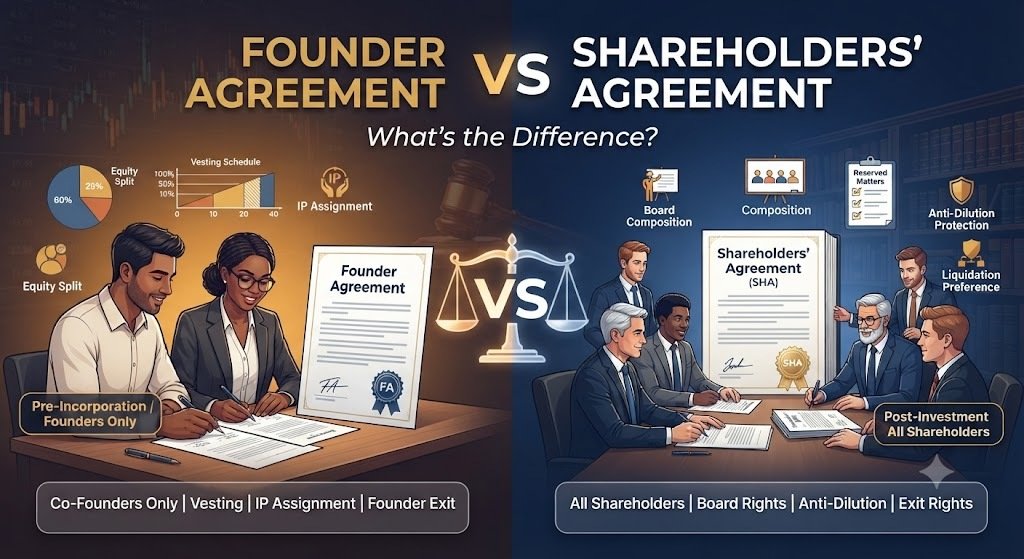
The Founder Agreement vs Shareholders’ Agreement question comes up almost every time a startup raises its first round of institutional funding, usually because the founders assumed the founder agreement they signed at incorporation already covered everything — and then an investor’s lawyer hands them a fifty-page Shareholders’ Agreement and asks why half its terms sound suspiciously familiar. They’re not the same document, they don’t do the same job, and — this is the part I most want founders to actually understand — one of them can be legally toothless against the company itself if it isn’t drafted with a specific, often-overlooked technicality in mind.
This article breaks down exactly how a founder agreement and a shareholders’ agreement differ, when each one actually applies, why they frequently overlap, and the specific enforceability trap — rooted in decades of Indian case law — that catches founders and even investors off guard.
What Is a Founder Agreement?
A founder agreement is the private contract between co-founders, typically signed before incorporation or before any shares are issued, governing the relationship between the founders specifically — equity split, vesting, roles and responsibilities, decision-making, IP assignment, and what happens if a founder exits. I’ve broken down the essential clauses in detail in Founder Agreement / Co-Founder Agreement in India, and covered the specific risks of an equal ownership structure in 50/50 Co-Founder Splits. It’s fundamentally a founders-only document — investors, employees, and other shareholders aren’t typically parties to it. Like any agreement, it still needs to satisfy the essential elements of a valid contract before its terms are enforceable between the founders who signed it.
What Is a Shareholders’ Agreement (SHA)?
A Shareholders’ Agreement is a broader contract that governs the relationship between all shareholders of the company — founders and investors alike — typically signed once external investment is raised. It’s binding as an ordinary contract under the Indian Contract Act, 1872, and covers share ownership, voting rights, board composition, reserved matters requiring investor consent, anti-dilution protections, exit rights, and information rights. Unlike a founder agreement, an SHA is drafted with investors’ interests specifically in mind, and often the company itself is a party to it, alongside the founders and shareholders. I’ve covered many of the specific terms investors negotiate into this document in Angel Investment Agreements in India.
Founder Agreement vs Shareholders’ Agreement: Key Differences
| Factor | Founder Agreement | Shareholders’ Agreement (SHA) |
|---|---|---|
| Parties | Co-founders only | All shareholders — founders and investors |
| Typical timing | Before incorporation or share issuance | At the time of an investment round |
| Primary purpose | Governs founder relationship, equity, roles | Governs company-wide governance and investor rights |
| Common clauses | Vesting, IP assignment, deadlock resolution, founder exit | Reserved matters, anti-dilution, liquidation preference, board rights |
| Company as a party? | Rarely | Often |
| Enforceability against the company | Contractual, between founders directly | Can be limited unless key terms are reflected in the AoA |
| Governing framework | Indian Contract Act, 1872 | Indian Contract Act, 1872, alongside the Companies Act, 2013 |
When Is Each Document Signed?
The founder agreement should ideally come first — before incorporation, or at the very latest, before any shares are issued — because unwinding an unfair equity split or adding vesting terms after shares are already allotted becomes a fresh negotiation rather than a founding decision. The Shareholders’ Agreement typically arrives later, at the point of the company’s first meaningful external investment round, when new parties — angel investors, or later, venture capital funds — need their own rights, protections, and governance terms formally documented.
Do You Need Both? Overlap and Redundancy
Yes, generally — and the overlap between them is intentional rather than a drafting mistake, which is exactly why the Founder Agreement vs Shareholders’ Agreement question isn’t really an either-or choice. Founder-specific terms like vesting, IP assignment, and founder exit provisions typically originate in the founder agreement, and are then carried forward into, or referenced by, the SHA once investors join the cap table, since investors have a direct interest in these same terms continuing to apply after their investment. A well-structured company doesn’t discard its founder agreement once an SHA is signed — the two documents should be drafted to work together, with the SHA generally taking precedence on matters involving the broader shareholder base, and the founder agreement continuing to govern founder-specific matters not otherwise addressed.
The Articles of Association Problem – Why Your SHA Might Not Be Enforceable
This is the section I’d want every founder and every early-stage investor to read carefully, because it’s a genuinely under-appreciated enforceability trap in Indian company law. A Shareholders’ Agreement is a private contract, while the Articles of Association (AoA) are the company’s public, statutory constitutional document, filed with the Registrar of Companies. Under Section 10 of the Companies Act, 2013, the AoA constitutes a binding statutory contract between the company and its members — and where an SHA’s provisions conflict with, or simply aren’t reflected in, the AoA, Indian courts have repeatedly held that the AoA prevails, and the unreflected SHA term can be unenforceable against the company itself, even though it remains a valid contractual obligation between the individuals who signed the SHA.
The V.B. Rangaraj Rule and How Courts Have Softened It
The foundational case here is V.B. Rangaraj v. V.B. Gopalakrishnan (1992), where the Supreme Court held that a share transfer restriction agreed between shareholders was not binding on the company because it wasn’t incorporated into the Articles of Association — even though the restriction itself didn’t violate any provision of company law. The Court’s reasoning was that restrictions on share transfer, to bind the company in its internal functioning, need constitutional embedding within the AoA itself, not merely a private agreement between the parties.
This position has been softened, but not entirely overruled, by later decisions. In Vodafone International Holdings v. Union of India, the Supreme Court took a somewhat more flexible view, treating an SHA as a private document binding the parties to it, provided its terms don’t contradict the AoA or the Companies Act. Cases like Messer Holdings Ltd. further nuanced this landscape. But High Courts have continued applying Rangaraj in specific contexts — for instance, the Delhi High Court in World Phone India Pvt. Ltd. v. WPI Group Inc. held that an affirmative voting right granted under an SHA was unenforceable precisely because it wasn’t reflected in the AoA. The practical, cautious position for founders and investors today: assume Rangaraj still applies to anything touching the company’s internal governance or share transfer restrictions, unless the specific term is properly incorporated into the Articles.
What Happens When a Founder Agreement and SHA Conflict?
Where a founder agreement and a later SHA address the same issue differently — say, a different vesting treatment or a different exit mechanism — this is where the Founder Agreement vs Shareholders’ Agreement relationship actually gets tested in practice: the SHA, being the more recent and typically more comprehensive document (and often the one the company itself signs), generally governs going forward for matters within its scope. This is exactly why founder agreements should be drafted with an eye toward the eventual SHA — vesting schedules, IP assignment, and exit terms structured consistently from the start reduce the risk of a genuine conflict requiring renegotiation once investors arrive, and both documents should ideally point to a consistent dispute resolution mechanism rather than leaving founders and investors litigating in different forums over overlapping terms. I’ve discussed how this same forward-looking discipline applies to structuring SAFE Notes vs Convertible Notes and other early instruments that eventually convert into the equity structure the SHA will ultimately govern.
Should Founder Agreement Terms Be Carried Into the SHA?
The Founder Agreement vs Shareholders’ Agreement question comes up almost every time a startup raises its first round of institutional funding, usually because the founders assumed the founder agreement they signed at incorporation already covered everything — and then an investor’s lawyer hands them a fifty-page Shareholders’ Agreement and asks why half its terms sound suspiciously familiar. They’re not the same document, they don’t do the same job, and — this is the part I most want founders to actually understand — one of them can be legally toothless against the company itself if it isn’t drafted with a specific, often-overlooked technicality in mind.
This article breaks down exactly how a founder agreement and a shareholders’ agreement differ, when each one actually applies, why they frequently overlap, and the specific enforceability trap — rooted in decades of Indian case law — that catches founders and even investors off guard.
What Is a Founder Agreement?
A founder agreement is the private contract between co-founders, typically signed before incorporation or before any shares are issued, governing the relationship between the founders specifically — equity split, vesting, roles and responsibilities, decision-making, IP assignment, and what happens if a founder exits. I’ve broken down the essential clauses in detail in Founder Agreement / Co-Founder Agreement in India, and covered the specific risks of an equal ownership structure in 50/50 Co-Founder Splits. Understanding this document properly is the first half of the Founder Agreement vs Shareholders’ Agreement comparison — it’s fundamentally a founders-only document — investors, employees, and other shareholders aren’t typically parties to it. Like any agreement, it still needs to satisfy the essential elements of a valid contract before its terms are enforceable between the founders who signed it.
What Is a Shareholders’ Agreement (SHA)?
A Shareholders’ Agreement is a broader contract that governs the relationship between all shareholders of the company — founders and investors alike — typically signed once external investment is raised. It’s binding as an ordinary contract under the Indian Contract Act, 1872, and covers share ownership, voting rights, board composition, reserved matters requiring investor consent, anti-dilution protections, exit rights, and information rights. Unlike a founder agreement, an SHA is drafted with investors’ interests specifically in mind, and often the company itself is a party to it, alongside the founders and shareholders. I’ve covered many of the specific terms investors negotiate into this document in Angel Investment Agreements in India. This is the second half of the Founder Agreement vs Shareholders’ Agreement comparison, and it’s worth being clear about how differently the two documents are actually built.
Founder Agreement vs Shareholders’ Agreement: Key Differences
Laid out side by side, the Founder Agreement vs Shareholders’ Agreement comparison looks like this:
| Factor | Founder Agreement | Shareholders’ Agreement (SHA) |
|---|---|---|
| Parties | Co-founders only | All shareholders — founders and investors |
| Typical timing | Before incorporation or share issuance | At the time of an investment round |
| Primary purpose | Governs founder relationship, equity, roles | Governs company-wide governance and investor rights |
| Common clauses | Vesting, IP assignment, deadlock resolution, founder exit | Reserved matters, anti-dilution, liquidation preference, board rights |
| Company as a party? | Rarely | Often |
| Enforceability against the company | Contractual, between founders directly | Can be limited unless key terms are reflected in the AoA |
| Governing framework | Indian Contract Act, 1872 | Indian Contract Act, 1872, alongside the Companies Act, 2013 |
When Is Each Document Signed?
The founder agreement should ideally come first — before incorporation, or at the very latest, before any shares are issued — because unwinding an unfair equity split or adding vesting terms after shares are already allotted becomes a fresh negotiation rather than a founding decision. The Shareholders’ Agreement typically arrives later, at the point of the company’s first meaningful external investment round, when new parties — angel investors, or later, venture capital funds — need their own rights, protections, and governance terms formally documented. Timing is one of the clearest ways to think about the Founder Agreement vs Shareholders’ Agreement relationship: one comes first, the other layers on top.
Do You Need Both? Overlap and Redundancy
Yes, generally — and the overlap between them is intentional rather than a drafting mistake, which is exactly why the Founder Agreement vs Shareholders’ Agreement question isn’t really an either-or choice. Founder-specific terms like vesting, IP assignment, and founder exit provisions typically originate in the founder agreement, and are then carried forward into, or referenced by, the SHA once investors join the cap table, since investors have a direct interest in these same terms continuing to apply after their investment. A well-structured company doesn’t discard its founder agreement once an SHA is signed — the two documents should be drafted to work together, with the SHA generally taking precedence on matters involving the broader shareholder base, and the founder agreement continuing to govern founder-specific matters not otherwise addressed.
The Articles of Association Problem – Why Your SHA Might Not Be Enforceable
This is the section I’d want every founder and every early-stage investor to read carefully, because it’s a genuinely under-appreciated enforceability trap in Indian company law, and it sits right at the heart of the Founder Agreement vs Shareholders’ Agreement discussion. A Shareholders’ Agreement is a private contract, while the Articles of Association (AoA) are the company’s public, statutory constitutional document, filed with the Registrar of Companies. Under Section 10 of the Companies Act, 2013, the AoA constitutes a binding statutory contract between the company and its members — and where an SHA’s provisions conflict with, or simply aren’t reflected in, the AoA, Indian courts have repeatedly held that the AoA prevails, and the unreflected SHA term can be unenforceable against the company itself, even though it remains a valid contractual obligation between the individuals who signed the SHA.
The V.B. Rangaraj Rule and How Courts Have Softened It
The foundational case here is V.B. Rangaraj v. V.B. Gopalakrishnan (1992), where the Supreme Court held that a share transfer restriction agreed between shareholders was not binding on the company because it wasn’t incorporated into the Articles of Association — even though the restriction itself didn’t violate any provision of company law. The Court’s reasoning was that restrictions on share transfer, to bind the company in its internal functioning, need constitutional embedding within the AoA itself, not merely a private agreement between the parties.
This position has been softened, but not entirely overruled, by later decisions. In Vodafone International Holdings v. Union of India, the Supreme Court took a somewhat more flexible view, treating an SHA as a private document binding the parties to it, provided its terms don’t contradict the AoA or the Companies Act. Cases like Messer Holdings Ltd. further nuanced this landscape. But High Courts have continued applying Rangaraj in specific contexts — for instance, the Delhi High Court in World Phone India Pvt. Ltd. v. WPI Group Inc. held that an affirmative voting right granted under an SHA was unenforceable precisely because it wasn’t reflected in the AoA. The practical, cautious position for founders and investors today: assume Rangaraj still applies to anything touching the company’s internal governance or share transfer restrictions, unless the specific term is properly incorporated into the Articles.
What Happens When a Founder Agreement and SHA Conflict?
Where a founder agreement and a later SHA address the same issue differently — say, a different vesting treatment or a different exit mechanism — this is where the Founder Agreement vs Shareholders’ Agreement relationship actually gets tested in practice: the SHA, being the more recent and typically more comprehensive document (and often the one the company itself signs), generally governs going forward for matters within its scope. This is exactly why founder agreements should be drafted with an eye toward the eventual SHA — vesting schedules, IP assignment, and exit terms structured consistently from the start reduce the risk of a genuine conflict requiring renegotiation once investors arrive, and both documents should ideally point to a consistent dispute resolution mechanism rather than leaving founders and investors litigating in different forums over overlapping terms. I’ve discussed how this same forward-looking discipline applies to structuring SAFE Notes vs Convertible Notes and other early instruments that eventually convert into the equity structure the SHA will ultimately govern.
Should Founder Agreement Terms Be Carried Into the SHA?
Generally, yes, for the terms that matter to investors — vesting schedules (since investors want continued founder commitment protected), IP assignment (since investors need clean IP ownership confirmed), and founder exit and non-solicitation terms (since investors have a direct interest in a departing founder not disrupting the business or its client relationships). This carry-forward process is really the practical answer to the Founder Agreement vs Shareholders’ Agreement question for most growing companies — not choosing one over the other, but sequencing them correctly. Reserved matters, board composition, anti-dilution, and liquidation preference are SHA-specific terms that generally have no equivalent in a founder agreement, since they concern the broader shareholder base rather than the founders’ internal relationship. This carrying-forward process is also the natural moment to ensure any share-transfer-restriction terms genuinely get incorporated into the AoA, closing the exact Rangaraj-style enforceability gap discussed above.
Common Founder Agreement vs Shareholders’ Agreement Mistakes
I see the same handful of Founder Agreement vs Shareholders’ Agreement mistakes repeatedly:
- Assuming the founder agreement automatically covers investor relationships once funding is raised, when a proper SHA is a distinct, additional requirement
- Signing an SHA with share transfer restrictions or affirmative voting rights that are never reflected in the AoA, creating exactly the Rangaraj-style enforceability gap discussed above
- Discarding the founder agreement once an SHA is signed, rather than ensuring the two documents remain consistent on founder-specific matters not addressed by the SHA
- Treating vesting or IP assignment terms as settled once, at incorporation, without confirming they’re properly carried forward and reflected consistently as the company raises subsequent rounds
- Not involving legal counsel in amending the Articles of Association alongside the SHA, assuming the private contract alone is sufficient protection against the company itself
Frequently Asked Questions
What is the main difference between a Founder Agreement and a Shareholders’ Agreement? The Founder Agreement vs Shareholders’ Agreement distinction comes down to scope and parties: a Founder Agreement governs the relationship between co-founders specifically, typically signed before incorporation; a Shareholders’ Agreement governs the relationship between all shareholders, including investors, typically signed at the time of an investment round.
Does a company need both a Founder Agreement and a Shareholders’ Agreement? Generally yes — founder-specific terms like vesting and IP assignment originate in the founder agreement and are typically carried forward into or referenced by the SHA once investors join the company.
Can a Shareholders’ Agreement override the Articles of Association? Generally no — under Section 10 of the Companies Act, 2013, the AoA constitutes a statutory contract that prevails over a private agreement where the two conflict, unless the SHA’s terms are properly incorporated into the AoA.
What did the V.B. Rangaraj case actually decide? The Supreme Court held that a share transfer restriction agreed between shareholders wasn’t binding on the company because it wasn’t incorporated into the Articles of Association, even though the restriction itself didn’t violate company law.
Has the V.B. Rangaraj rule been overruled? Not entirely — later decisions like Vodafone International Holdings have softened its application, but High Courts have continued applying it in specific contexts, particularly around share transfer restrictions and affirmative voting rights not reflected in the AoA.
Is a Founder Agreement legally binding even without being reflected in the Articles of Association? Yes, as between the founders who signed it — a founder agreement is enforceable as an ordinary contract between the parties. The Rangaraj-style enforceability concern specifically affects whether certain terms bind the company itself, not whether the agreement binds the signing founders.
Which document takes priority if a Founder Agreement and Shareholders’ Agreement conflict? Generally the SHA, for matters within its scope, since it’s typically the more recent, more comprehensive document and often includes the company as a signatory — though this depends on the specific terms and drafting of both documents.
Should share transfer restrictions be included in both the SHA and the Articles of Association? Yes — this is specifically recommended given the Rangaraj line of cases, since a restriction included only in the SHA risks being unenforceable against the company if it’s not also reflected in the Articles.
Can founders skip a Shareholders’ Agreement if they already have a solid Founder Agreement? Not once external investors are involved — investors specifically require an SHA to document their own rights, protections, and governance terms, which a founders-only agreement doesn’t cover.
Who is typically a party to a Shareholders’ Agreement, but not a Founder Agreement? Investors, and often the company itself, are typically parties to an SHA, whereas a founder agreement is generally limited to the co-founders alone.
Final Takeaway
The Founder Agreement vs Shareholders’ Agreement distinction isn’t just a matter of timing or scope — it’s a question of enforceability, particularly once share transfer restrictions or governance rights are involved. A founder agreement protects the relationship between co-founders from day one; a Shareholders’ Agreement protects the broader shareholder base once investors join — and neither one fully substitutes for the other. Getting the interplay right, including making sure key terms actually make their way into the Articles of Association, is what prevents a carefully negotiated right from turning out to be unenforceable against the company exactly when it matters most.
Structuring your founder and shareholder documents and want them to actually work together? Get in touch and let’s make sure your agreements — and your Articles of Association — are properly aligned. For the broader legal groundwork every founder needs, see my Business Contracts checklist, Pvt Ltd vs LLP vs OPC, and Contract Law Glossary.
This article is for general informational purposes and does not constitute legal advice. Founder and shareholder agreements should be tailored to your specific company and reviewed by a qualified lawyer.
Written by Advocate Parvez Ali.