
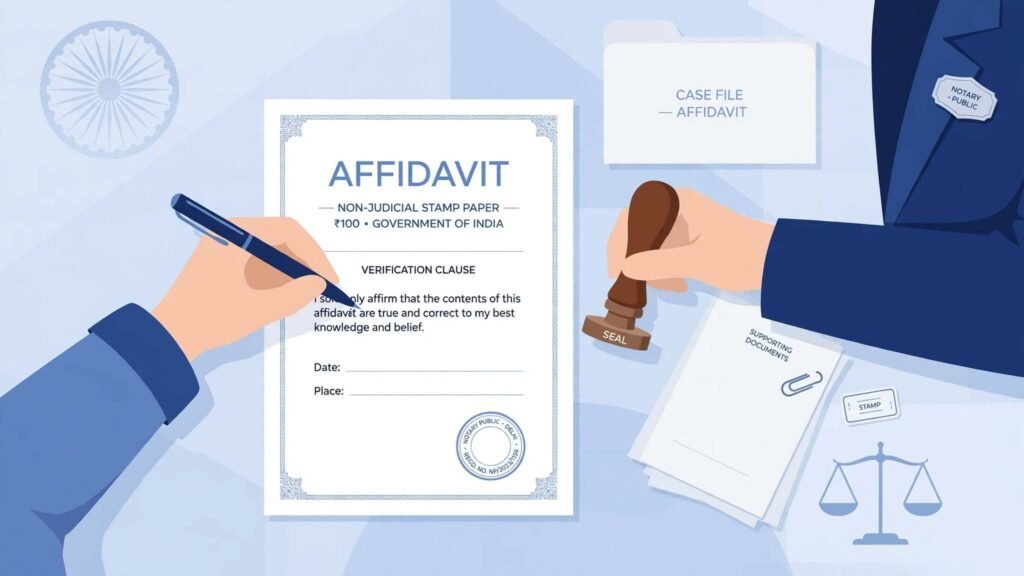
An affidavit is a written statement of facts that you sign and swear (or solemnly affirm) to be true before someone legally allowed to administer an oath, and the reason it matters is simple: once you sign it, you are answerable for every line.
Most people meet the affidavit at a bad moment. A college wants one for a gap year, a passport office asks for one to fix a name, a bank wants one for a lost cheque book, or a court registry sends back your petition because the supporting document is defective. They run to a typist outside the court, pay a hundred rupees, sign where the finger points, and never read what they swore to. That works until the statement turns out to be wrong, and then it is the deponent, not the typist, who has to explain it.
This guide explains what it is in Indian law, how it differs from similar papers (self-declaration, undertaking, affirmation), the common types, what a proper format looks like, how to get one stamped and notarised, what it costs, what happens if it is false, and what the courts have said lately. There is a sample you can adapt and ten FAQs at the end.
What is an affidavit?
An affidavit is a voluntary, written, first-person statement of facts, signed by the person making it (the deponent) and sworn before a notary public, oath commissioner, magistrate or other authorised person. The word comes from medieval Latin and means roughly “he has stated on oath”.
Three features separate it from an ordinary letter:
- It is sworn. The deponent takes an oath, or affirms, that the contents are true.
- It is attested. The person administering the oath signs and seals it, which proves that the deponent signed it and was identified.
- It carries a penalty. A knowingly false statement can be prosecuted as an offence, which is why courts and offices trust it more than a plain declaration.
Where the law sits:
- The Oaths Act, 1969 says who can administer oaths and affirmations. Under it, courts and persons specially authorised can administer them, and the Act also covers the forms of oath.
- Order 19 of the Code of Civil Procedure, 1908 governs sworn statements in civil courts. Rule 3 says it should ordinarily be confined to facts the deponent can prove from their own knowledge. For interlocutory applications, statements based on belief are allowed if the grounds of belief are stated.
- The Bharatiya Sakshya Adhiniyam, 2023, which replaced the Indian Evidence Act, 1872, deals with evidence. It is not ordinarily “evidence” at trial unless the court orders it or the law allows it, but it is routinely used for applications and many proceedings.
- The Notaries Act, 1952 governs notaries, and the Indian Stamp Act, 1899, with state schedules and rules, governs stamp duty.
- The Bharatiya Nyaya Sanhita, 2023 punishes false statements (more below).
Affidavit vs affirmation vs self-declaration vs undertaking
These four get confused constantly.
| Document | Sworn or solemnly affirmed? | Attested by an authority? | Typical use |
|---|---|---|---|
| Affidavit | Yes, oath or affirmation | Yes, notary, oath commissioner or magistrate | Courts, government forms, banks, universities |
| Affirmation | Solemn affirmation instead of an oath, same legal effect | Yes | For people who object to taking an oath |
| Self-declaration | No | Usually not, or only self-attested | Forms that only need your word |
| Undertaking | Not necessarily | Sometimes | A promise to do or not do something |
An affidavit states facts. An undertaking promises future conduct, and it can be sworn when you want the promise backed by an oath. A self-declaration is cheaper and quicker, but it does not carry the weight of an oath.
Some governments have reduced the demand for sworn papers. Uttar Pradesh, for instance, abolished the requirement of notarised papers for many state schemes back in 2014 and accepted self-declaration or self-attestation instead. So before you pay for a notarised document, ask the office, in writing if you can, whether a self-declaration will do. Many do not need one.
Types of affidavit
Each one is named after its purpose. The structure is the same; the facts change.
- Name change: states your old and new name and why; used with a gazette notification and for passports and bank records.
- Date of birth or age: corrects or confirms a birth date when records disagree.
- Address proof: states where you live; used for gas connections, SIM cards, school admissions.
- Income: states your annual income for scholarships, fee concessions or certificates.
- Gap year: explains a break in education.
- Marriage: used for registration of marriage or to state marital status.
- Lost documents: states a certificate, passport or share certificate was lost and not misused.
- Affidavit of support (sponsorship): a promise to support someone financially, often for visas.
- Relationship, legal heirs: states who the heirs are; used for transfers after death.
- Court filings: statements in support of petitions and applications, evidence-in-chief, counter statements, and statements of assets and income in matrimonial disputes.
- Business uses: founder or director declarations, indemnity statements and proof of no objection, such as an NOC from a landlord. If you are renting premises for a business, our guides on commercial lease agreements and rent agreement vs lease agreement explain the main documents.
What a proper affidavit contains
A well-made one is plain and organised. Courts dislike padding, and offices dislike ambiguity.
- Title. “AFFIDAVIT“, and where it is for a court, the case title and number.
- Deponent details. Full name, father’s or husband’s name, age, occupation and address. Identity must match your ID.
- Opening line. “I, [name], son/daughter/wife of [name], aged [age], resident of [address], do hereby solemnly affirm and state on oath as under:”
- Numbered paragraphs. One fact per paragraph, in short sentences. Do not mix facts with arguments.
- Verification clause. Usually: “I verify that the contents of paragraphs 1 to [n] are true and correct to the best of my knowledge and belief, and nothing material has been concealed therefrom.” Where some facts are from information, say which paragraphs are from knowledge and which from belief or records.
- Date and place.
- Signature of the deponent, signed in front of the notary.
- Attestation. Seal, signature, serial number, registration number and date of the notary or oath commissioner.
A few drafting habits make a real difference:
- State only what you personally know. “I was present when the document was signed” is knowledge. “I am told the document was signed” is information, and Order 19 expects you to say so.
- Avoid words like “always”, “never” and “all” unless they are literally true.
- Attach copies of any documents you mention and call them annexures. Number them.
- Do not leave blanks, and do not sign a blank or half-filled form.
- Check the spelling of names, because name mismatches are the most common reason offices reject one.
Sample affidavit format (general purpose)
AFFIDAVIT
I, [Full name], son/daughter/wife of [Name], aged [] years, occupation [], resident of [Address], do hereby solemnly affirm and declare as under:
- That I am a citizen of India and the deponent herein, and I am competent to swear this statement.
- That [state the first fact].
- That [state the second fact].
- That I am making this statement for the purpose of [state purpose] and for submission to [office or authority].
- That the documents annexed as Annexure A and B are true copies of the originals.
DEPONENT
VERIFICATION I, the deponent above named, verify that the contents of paragraphs 1 to 5 above are true and correct to my knowledge and belief and nothing material has been concealed therefrom. Verified at [place] on this [date].
DEPONENT
Sworn before me / identified by me [Notary name, seal, registration number, date]
Treat this as a skeleton. A name change needs your old name, new name, and a line that you are not changing it to avoid any legal liability. A court filing must follow the court’s own rules on format and number of copies.
How to make an affidavit step by step
- Confirm what is needed. Ask the office exactly what it wants: affidavit or self-declaration, what stamp value, whether notarised, how old it may be, and whether a format is prescribed.
- Draft it. Use your own facts. A downloaded template is a starting point, not a substitute for accuracy. For a legal matter such as a property dispute or a court filing, have a lawyer check it.
- Get stamp paper or an e-stamp. Stamp duty on it is a state matter and varies. As an illustration, one competitor guide lists values such as Rs. 10 in Delhi, Uttar Pradesh, West Bengal and Rajasthan, Rs. 20 in Karnataka and Tamil Nadu, and Rs. 100 in Maharashtra; I have not verified these, and they change, so check your state’s current schedule or e-stamp portal. In many states, if it runs to more than one page, only the first page needs the stamp paper.
- Print it, and do not sign yet. The notary must see you sign.
- Go to a notary or oath commissioner with a government photo ID and address proof. The notary checks your identity, confirms you understand the contents, administers the oath and watches you sign. Signing beforehand defeats the purpose.
- Notary records and attests. The notary enters it in a register with a serial number, signs, and affixes a seal.
- Submit it within the validity the office allows, and keep a copy and the original receipt. A few offices want it to be recent, say within three or six months, so do not make one too early.
Costs are usually modest: stamp paper value, a notary fee that in many places is Rs. 50 to Rs. 200 for a simple one (a competitor’s estimate, not a fixed rate), and any drafting charge. Court and legal-heir papers can cost more because of drafting time.
Is a notary always necessary?
No, and this is where plenty of money is wasted.
- Courts and some authorities require a sworn affidavit, which means an oath commissioner, notary or magistrate. Rules differ between courts.
- Many offices accept a self-declaration or self-attested document. Ask first.
- Stamp paper is not magic. It is a tax and a convenience, not what makes the statement true. Some authorities insist on it. Others do not.
- Notarisation and photo verification. The Allahabad High Court held in Biswajit Chowdhury v. Registrar General (2026, reported on LiveLaw as 2026 LiveLaw (AB) 507) that a writ petitioner’s affidavit can be notarised anywhere in India, and that nobody is compelled to appear at the court’s photo verification centre. The case was dismissed as unnecessary because the Registry already accepted notarised ones. I read this from a news report, not from the judgment; check it before relying on it.
Remote and e-notarisation exist in some places, but rules for them vary, and they are not accepted everywhere. If someone offers to “notarise” without seeing you, that is a warning sign.
Who can administer the oath
Not everyone with a stamp and a desk can swear you in. The usual authorities are:
- Notary public. Appointed under the Notaries Act, 1952, for a defined area. This is the most common route for forms submitted to offices, banks and colleges.
- Oath commissioner. Appointed by a High Court or state, usually attached to courts. Court filings in many places are sworn before one.
- Magistrate or the court itself. Used in court proceedings and some statutory settings.
- Indian consular officers abroad. For people living outside India who need a sworn statement for use here.
Before you sign, look at the register. A genuine notary writes your name and a serial number in it, and the seal carries a registration number. If none of that happens, you have paid for a rubber stamp, not an oath.
Using an affidavit abroad, or one from abroad
This catches NRIs and students more than anyone. A document sworn in India and meant for use overseas usually needs more than a notary’s seal. India is a party to the Hague Apostille Convention, so for use in member countries the notarised paper is typically attested by the competent state authority and then apostilled by the Ministry of External Affairs. For countries outside the Convention, a different legalisation chain applies. In the other direction, a statement sworn before a notary or consular officer abroad often needs an Apostille or consular attestation before an Indian court or office will accept it. Rules differ by office, so ask for the checklist in writing before you spend money on couriering papers.
How courts read these statements
Practice in court is stricter than at a passport office.
- Knowledge versus belief. Under Order 19, a court filing must separate what you know from what you believe. A paragraph that mixes the two invites a challenge.
- Verification. Pleadings under Order 6 Rule 15 also need verification, and a missing or vague one is a classic registry objection.
- Defects can often be cured. Courts usually allow a defective one to be corrected or refiled, but not when it hides a lie. Do not count on this.
- Cross-examination. If the other side asks, the deponent may be called to be cross-examined on what was sworn. People who signed without reading are exposed at this point.
- Annexures. Documents referred to must be attached and numbered, and the paragraph should say what each one proves.
In practice, the best protection is a short document with a few clear facts, each of which you could explain to a judge without looking at notes.
If the deponent cannot read, or is signing for someone else
A person who cannot read the language should have the contents read and explained, and the notary should record that this was done. Do not sign for another adult. If a person cannot attend because of illness or absence, the answer is not a friend swearing on their behalf; it may be a power of attorney for acts the law allows, or a statement made by the person themselves in another way. For a minor, a parent or guardian generally makes the statement and says so.
What happens if an affidavit is false?
A false statement on oath can create civil and criminal trouble.
- Section 216 of the BNS covers a person legally bound by an oath to speak the truth, who makes a false statement to a public servant or another person authorised to administer the oath. Per the text I read, the punishment is imprisonment up to three years, with fine.
- Section 229 of the BNS (giving or fabricating false evidence) applies to false evidence in a judicial proceeding, with imprisonment up to seven years and a fine, and a lighter tier for other cases. A secondary source I read gave fine amounts of Rs. 10,000 and Rs. 5,000, and another claim of a ten-year tier that I could not verify from the text. Read the statute for the current wording. Section 229 replaced the older IPC provision on false evidence.
- Court consequences. A court can disbelieve you, dismiss your case, impose costs, or direct prosecution. A single false line in a sworn statement can undermine everything else you said.
- Document consequences. Anything granted on the strength of a false statement (a certificate, a loan, an admission) can be cancelled.
The practical lesson: if you do not know something, do not swear to it. Say “I believe” and state the source, or leave it out.
Common mistakes
- Signing before reaching the notary.
- Swearing to facts you only heard about.
- Wrong or mismatched names, ages or addresses.
- Using the wrong stamp value, or using stamp paper bought long before.
- Missing verification clause, or a verification that does not match the paragraph numbers.
- Leaving blank spaces, or adding text after signing.
- Reusing an old one from a previous case and reusing it.
- Assuming notarisation makes a weak claim strong. It does not.
Sworn statements in business
Founders meet it more often than they expect: a director’s declaration for incorporation papers, an indemnity affidavit for a lost share certificate, a no-objection from a landlord or co-owner, a statement of net worth, or a regulatory filing. Where the statement is about authority to act for someone else, the right document may be a power of attorney rather than an affidavit; see our guide to power of attorney in India. For the basic terms behind these documents, our contract law glossary and the legal checklist for Indian startups are good starting points, and if a business deal needs ownership statements, our guide to partnership deed vs LLP agreement explains the structure.
For help with drafting or reviewing one, contact us or read more in the startup legal section.
Frequently asked questions
1. What is an affidavit in simple words?
An affidavit is a written statement of facts that you swear or affirm to be true before a notary, oath commissioner or magistrate. It is used as proof or support in courts, offices, banks and colleges. If it is false, you can be prosecuted for it.
2. What is the difference between an affidavit and a self-declaration?
An affidavit is sworn and attested by an authorised person, so it carries legal weight and penalties for falsehood. A self-declaration is just your signed statement, usually without an oath or attestation. Many offices accept a self-declaration, so ask before paying for one.
3. Is a notary necessary for an affidavit?
For a sworn one, yes, someone authorised to administer oaths must attest it, which can be a notary, oath commissioner or magistrate. But if the office only asks for a self-declaration, no notary is needed. Always check what the receiving authority requires.
4. Does an affidavit have to be on stamp paper?
Often, but not always. The requirement depends on the state, the authority and the purpose. Some places accept plain paper or a self-declaration, and some require a fixed value of non-judicial stamp paper or an e-stamp certificate. Check the current rule for your state and office.
5. How much does it cost to make an affidavit?
A simple one usually costs the stamp paper value plus a small notary fee, and drafting if you hire someone. In many places the total is a few hundred rupees, though the figure varies by state and the complexity of the matter. Court and legal-heir filings can cost more.
6. Can I write my own affidavit?
Yes. There is no law that says a lawyer must draft it. Write numbered paragraphs, include a verification clause, keep to facts you know, and sign before the notary. For a court case, a property dispute or anything with money or title involved, get a lawyer to check it.
7. What is the verification clause?
It is the closing statement in which you say which paragraphs are true to your knowledge and which to your belief or information, and that nothing material is hidden. It matters because it tells the court what you are personally vouching for.
8. What is the punishment for a false affidavit in India?
It can be prosecuted under the Bharatiya Nyaya Sanhita. Section 216, as I read it, provides up to three years and a fine for a false statement on oath to an authorised person, and Section 229 provides up to seven years and a fine for false evidence in a judicial proceeding. A court can also dismiss your case or impose costs.
9. How long is an affidavit valid?
There is no fixed legal life. Validity is set by the office or court you submit it to, and many ask for one made within the last three to six months. If circumstances change after you sign, make a fresh one.
10. Can an affidavit be made online or by e-stamp?
You can often buy an e-stamp certificate online, and some places allow e-notarisation or remote verification, but acceptance varies by authority and state. Confirm with the office you are submitting to, and be careful of services that notarise without checking your identity.
This article is general information, not legal advice. Stamp values, notary practice and format rules differ by state and authority, so check the current requirement or get advice before you swear an affidavit.