
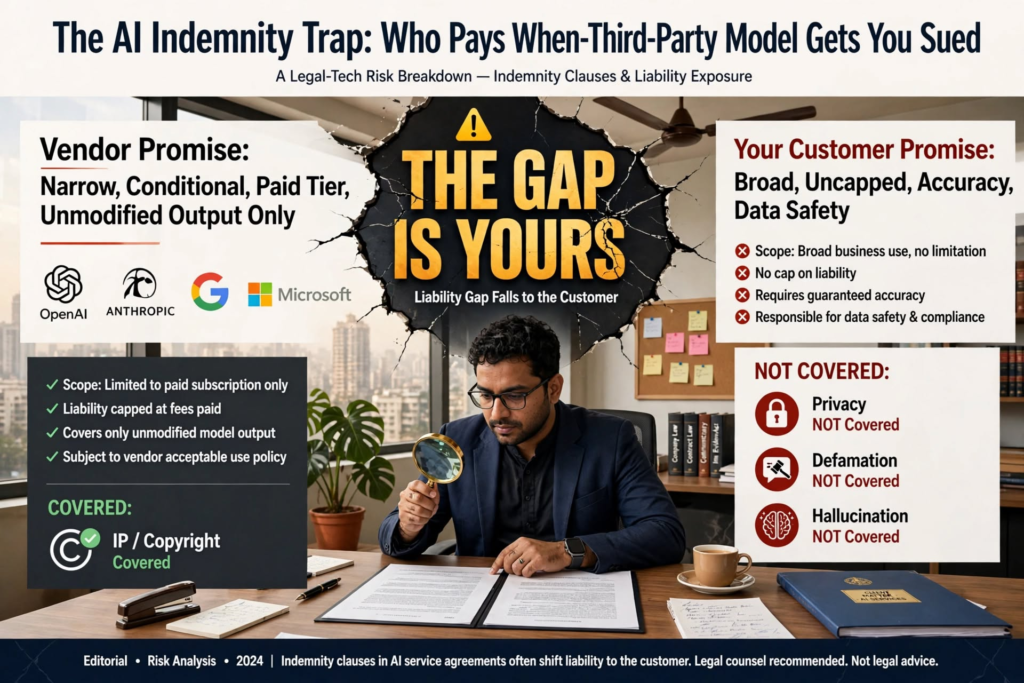
Most Indian companies building on OpenAI, Anthropic, Google or Microsoft models believe they’re covered. The vendor has an AI indemnity, the sales deck mentions it, and the founder moves on. Then a customer’s procurement team sends a contract that makes you promise far more than your vendor ever promised you, and the gap between those two documents is yours to fill. That gap is the AI indemnity trap. It isn’t a rare edge case. The vendor promise is usually narrow, conditional and tied to a paid tier, and the promise you hand downstream is usually broad. This guide walks through what vendor indemnities typically cover, the eight places where cover quietly stops, how Indian law treats indemnity, and the clauses I’d want in your own customer contracts. I’ve labelled what comes from vendor terms as reported by third parties, because I haven’t read every contract myself and neither should you rely on my summary alone. If you’re still working out your wider AI contract position, our piece on DPDP, ESG and EU AI Act contract clauses sits next to this one.
The Short Version
- A vendor AI indemnity, as reported, mainly cover third-party copyright claims over a model’s output, on paid or enterprise plans only.
- They generally don’t cover privacy complaints, defamation, wrong answers, bias or a product-defect claim.
- Modifying the output, combining it with other tools, switching off a safety feature or using a preview model can each end the cover.
- If you promise your customers an uncapped IP indemnity, you’ve probably promised more than your vendor gave you.
- The Delhi High Court’s July 2026 interim order in the ANI case helps AI developers on training, but it’s interim, and it doesn’t settle your contract exposure.
- The fix for the AI indemnity gap is mostly contract work: map your promises against theirs, cap what you can, and test the pipeline before a claim arrives.
What a Vendor AI Indemnity Actually Promises
An AI indemnity is a promise to cover someone’s loss. In the AI setting, the vendor promises to defend you, and pay covered costs, if a third party sues you saying the vendor’s model or its output infringes their rights. That sounds comprehensive. The detail is where it narrows.
According to a September 2026 summary by Serotonin Legal, indemnities of this kind are offered on business tiers, with the consumer plans getting none. The same summary reports that Anthropic’s covers claims over training data as well as output, and that the indemnity sits outside its 12-months-of-fees liability ceiling, which would make it the one uncapped indemnity of the group. Google’s, it says, applies to a published list of services and generally available models, and Microsoft’s covers Copilot products and Azure OpenAI, with Azure cover depending on required mitigations. A separate Sterne Kessler and Westlaw Today piece, dated 9 September 2026, makes a point I’d underline: indemnities tend to cover the vendor’s own training data and are much narrower for outputs, and they usually exclude what the customer supplies. Both are secondary sources reading vendor terms. Contracts change, so get the current version of whichever one you rely on.
Eight Places Your AI Indemnity Quietly Stops
1. The AI indemnity is about IP, and your risk isn’t
The AI indemnity these summaries describe is for copyright, and in some cases patent and trade secret, claims. It doesn’t extend to a privacy complaint, a defamation claim from someone your chatbot wrongly described, a product-defect suit, or a regulator’s penalty. Take a loan-assessment tool that makes up a reason for rejection, or a support bot that promises a refund your policy doesn’t allow. The customer’s loss there is real, and no vendor IP indemnity touches it. I’m drawing that conclusion from how these indemnities are scoped and not from a single case. If you want a reported example from outside India, Air Canada was held liable in 2024 for what its website chatbot told a customer, from my recollection of that tribunal decision, so check the details before you cite it. Our guide on chatbot safe harbour in India explains why you shouldn’t assume the IT Act’s intermediary protection saves you here.
2. “Unmodified output” is a narrow door for any AI indemnity
Several of the terms described in these summaries exclude output that’s modified, transformed or combined with other products. The Sterne Kessler piece flags that fine-tuning, retrieval-augmented generation, adapters, prompts, guardrails and wrappers may all count as modifications, and presents that as a question for counsel to check, not a confirmed exclusion for each vendor. Think about what that means for a real product. Almost nobody ships raw model output. You add your own data, filter it, reformat it, and chain it into a workflow. If any of that counts as modification, the exception can swallow the rule.
3. Safety features and what you knew
Cover is reported to depend on you leaving the vendor’s filters and citation features on, and on you not knowing, or having reason to know, that an output infringes. Microsoft is said to require mitigations such as a steering system prompt, and to expect you to demonstrate compliance when you make a claim. So the first thing a vendor’s lawyer will ask isn’t whether the output infringed. It’s whether you followed the instructions. Keep a record of your settings and your testing now, before anything goes wrong.
4. Tier and preview exclusions
One summary says consumer plans get no indemnity, and that the only indemnity in some consumer terms runs toward the vendor. It also reports that preview and beta models and services off the published list get no output cover. A team that prototypes on a personal login and ships the same pipeline into production is exposed without knowing it.
5. Exclusive remedy language
Anthropic’s terms are reported to make indemnification each party’s sole and exclusive remedy. That means if an exclusion applies and the indemnity doesn’t respond, you’ve got nothing else to fall back on against that vendor for the same claim. I’d check whether your vendor’s terms contain similar language before assuming you can still sue for breach.
6. Agents and autonomous actions
The Sterne Kessler summary reports that Google’s terms allocate responsibility for actions taken by AI agents to the customer. If your product lets a model act on its own, such as sending messages, booking, buying or editing records, the protected part of what you’re doing may be much smaller than the part you’re accountable for.
7. Partner and third-party models on someone else’s platform
A cloud or creative platform that hosts several vendors’ models doesn’t necessarily indemnify all of them equally. A secondary analysis of Adobe Firefly and Google Vertex AI, published 18 October 2026, reports that Adobe’s standard IP indemnity excludes partner models not trained by Adobe, with a separate supplemental coverage term effective 8 May 2026 for eligible partner models, and that Google’s indemnified-services list, as of an April 2026 snapshot, covers generally available versions only. The same author could not open OpenAI’s terms directly. The lesson is that “we use it through a big platform” isn’t an answer about your AI indemnity. You need to know which layer’s indemnity applies to which model. That analysis says nothing about Amazon Bedrock, so I can’t tell you what those terms say.
8. The stack mismatch between your AI indemnity and theirs
This is the one that costs people money. Your vendor negotiates with you. You negotiate with your customer. Your customer’s lawyers don’t care what your vendor promised, and they may ask for an uncapped indemnity against any third-party IP claim. The Sterne Kessler piece makes the same point: liability can arise at the integrator or end-user level while indemnities are negotiated upstream, and customers can take on indemnity duties to their own users that exceed what their provider covers. If you give your customer an AI indemnity bigger than the one you received, you’re the insurer for the difference.
| What you’ve promised your customer | What your vendor’s cover typically reaches | The gap |
|---|---|---|
| “Outputs won’t infringe anyone’s IP” | Third-party copyright claims over unmodified output, on a paid tier | Modified or combined output, preview models, claims you should’ve known about |
| “Your data won’t be misused or leaked” | Generally nothing | All of it: see our DPDP diligence guide |
| “The tool will give accurate answers” | Nothing | All of it |
| “We’ll indemnify you without a cap” | Depends on the vendor; one is reported as uncapped for its indemnity | Whatever the vendor’s cap doesn’t cover |
| “The agent will act within instructions” | Possibly allocated to you | Most of it |
How Indian Law Treats an AI Indemnity
The contract-law basics behind any AI indemnity are older than any AI product. Section 124 of the Indian Contract Act, 1872 defines a contract of indemnity as one where a party promises to save the other from loss caused by the promisor’s own conduct or by someone else’s. Section 125 gives the person indemnified the right to recover damages paid in a suit, costs reasonably incurred in defending it, and sums paid under a compromise. That’s my reading of the statute from memory, so check the text. In practice the contract governs. If your agreement says the vendor indemnifies you only for unmodified output on a paid tier, the court won’t read in more.
Three Indian-law points are worth keeping in front of you. First, a limit on liability in your downstream contract can hold up if it’s reasonable and clearly drafted, and an overbroad indemnity you signed will usually be enforced as written. Our article on limitation of liability clauses shows how a well-drafted cap changed an outcome. Second, you’ll often be dealing with a foreign vendor on its own paper, under foreign governing law and forum. A right on paper isn’t a right in practice if enforcing it means litigating abroad, so check governing law, forum and notice mechanics as carefully as the indemnity itself. Third, damages for breach still follow the general rules in the Act, including the requirement that loss be foreseeable, so an indemnity that fails doesn’t leave you without any claim, but the cap and exclusions in the main agreement will limit what you can recover.
What the Indian Courts Have, and Haven’t, Said About AI Liability
The ANI order: helpful, but interim
On 24 July 2026, Justice Amit Bansal of the Delhi High Court refused ANI an interim injunction against OpenAI. As reported, the court took the prima facie view that using ANI’s works to train the models falls within fair dealing under Section 52(1)(a)(i) of the Copyright Act, rejected the argument that “research” there must be non-commercial, and found that the responses at issue likely came from retrieval-augmented generation and weren’t substantial reproductions. It also held the suit maintainable in Delhi despite OpenAI’s US servers. The main suit continues on the merits, and I found no report of an appeal. SpicyIP’s account was written before the full order was available, and the two accounts I read give slightly different reasons for refusing the injunction, so read the judgment itself before relying on any of this.
What does that do for your AI indemnity risk? It lowers the temperature on training claims in India, for now. It does nothing for output claims in other countries, privacy claims, or a customer who contractually demands more than the law requires. A vendor facing less legal risk in India doesn’t automatically widen its indemnity.
The pending policy change
DPIIT’s working paper on generative AI and copyright proposes a hybrid statutory model: a mandatory blanket licence to train on lawfully accessed content, a statutory royalty set by a government-designated body, and a central organisation to collect and distribute it. It’s a proposal, it went out for public comment, and I found no enacted law. If something like it arrives, the cost of using models could change, and a contract that’s silent on who bears a royalty or licence fee would leave a gap. Add a change-in-law clause now. Our earlier pieces on copyright registration and IP assignment cover the ownership side of the output you produce.
Eight AI Indemnity Clauses for Your Own Customer Contracts
These AI indemnity clauses are drafting directions and not finished wording. The aim is to make what you promise match what you’ve actually got behind you.
1. Define “AI Output” separately. Don’t leave model-generated material inside your general IP warranty. A separate definition lets you give it different treatment.
2. Give a narrower IP indemnity for AI Output. Offer to defend claims that unmodified output, used as intended, infringes a third party’s rights, and exclude output the customer changes, combines or uses after notice of a problem. This mirrors what you’re likely to get upstream.
3. Pass through, don’t promise beyond. Say plainly that for third-party model claims your obligation is limited to what you recover from the model provider, plus an agreed amount. Customers will push back, so decide beforehand how far you can go.
4. Cap it separately. An AI-specific cap, below your general one and tied to fees or a fixed figure, keeps one claim from swallowing the business. Argue for it using the vendor’s own limits as your evidence.
5. Disclaim accuracy honestly. Say the system can produce errors and that the customer is responsible for human review where decisions affect people. Don’t let a marketing line like “accurate and reliable” become a warranty.
6. Keep the customer’s inputs and use in their lane. The customer warrants it has the right to give you the data it supplies and won’t ask the system to do something unlawful, and indemnifies you for that. Vendors take the same position with you.
7. Name the model and the right to change it. Identify the underlying provider, reserve the right to swap models, and say that a swap isn’t a breach. Without this, a vendor deprecating a model can put you in default to your customer.
8. Add a change-in-law and notice clause. Cover a new licensing regime, an adverse court ruling or a vendor changing its terms. Give both sides a way to renegotiate, and give yourself a short window to notify.
If you’re tempted to have an AI draft these for you, read can AI draft a contract first, and please have a lawyer review the result.
Upstream: Negotiating the AI Indemnity With Your Model Vendor
You may not have leverage with a large provider on the AI indemnity. If you’re spending enough, or you’re a platform customer with a negotiated agreement, try for these. Ask for a written list of the services and models the indemnity covers. Ask them to confirm in writing that your fine-tuning, retrieval layer and standard guardrails don’t count as disqualifying modification, since the sources flag that as an open question. Ask for the right to keep operating, or to be moved to a different model, if an injunction hits the one you use. And ask about the cap for the indemnity specifically, since only one vendor is described as uncapped in the summaries I read. If you can’t get any of that, it’s information: you now know the size of the gap and can price your own promises accordingly.
One thing I haven’t researched is insurance. Technology errors-and-omissions and cyber policies may or may not respond to AI claims, and I’d put the question to your broker directly, with your actual contract in hand.
A Practical Order of Work
- List every model and platform your product depends on, and the tier you’re on.
- Pull the current AI indemnity terms for each and note the covered services, the exclusions and the cap.
- Check that no production workload is running on a consumer account or a preview model.
- Write down how your pipeline modifies output, and ask whether that could count as a disqualifying change.
- Record your safety settings and keep a testing report on file.
- Compare your customer contracts with the vendor terms and mark every promise that goes further.
- Renegotiate the biggest gaps first: uncapped IP indemnities and accuracy warranties.
- Add the change-in-law and model-swap clauses to your template.
- Check governing law and forum in each vendor agreement.
- Re-run this list every six months, because vendor terms and Indian policy are both moving.
If you’re staring at a customer draft and a vendor agreement and can’t tell where the gap is, send both over through the contact page. For wider reading, see our startup legal checklist, the note on terms of service versus privacy policy and the technology law library. If your product generates faces or voices, deepfake law and personality rights add risks no IP indemnity addresses.
Frequently Asked Questions About AI Indemnity
1. What is an AI indemnity?
It’s a vendor’s promise to defend you, and cover specified costs, if a third party claims the vendor’s model or its output infringes their rights. In the terms described by the sources I read, it’s mostly about copyright and mostly for paid plans.
2. Does an AI indemnity cover hallucinations or wrong answers?
No, not in the terms described. These indemnities are scoped to third-party IP claims. A claim that your tool gave bad advice or defamed someone isn’t an IP claim, and you’d be handling it yourself.
3. Do I get an AI indemnity on a free or consumer plan?
According to one September 2026 summary, no. Business and enterprise tiers carry the indemnity, and some consumer terms only run in the vendor’s favour. Check your plan before shipping.
4. Can fine-tuning or retrieval add-ons void my AI indemnity?
Possibly. One law firm article flags that fine-tuning, retrieval-augmented generation, prompts, guardrails and wrappers could count as modifications under some terms, and presents it as a question to check. Ask your vendor to confirm in writing.
5. Who pays, beyond any AI indemnity, if I use a third-party model and a customer sues me?
You are, to your customer, under your own contract. Your vendor’s AI indemnity is a separate promise to you, and it may be narrower than what you promised downstream.
6. Should I give customers an uncapped AI indemnity for AI features?
I’d resist it. Unless your vendor gives you matching uncapped cover for the same claims, you’re covering the difference yourself. Offer a defined, capped indemnity for unmodified AI output.
7. What did the Delhi High Court decide in ANI v OpenAI?
On 24 July 2026 it refused an interim injunction and took the prima facie view that training use was fair dealing under Section 52(1)(a)(i). The suit continues on the merits, so treat it as an interim signal and not a final answer.
8. Will India introduce a licence or royalty for AI training?
DPIIT’s working paper proposes a mandatory blanket licence with statutory royalties. It’s a proposal. I found no enacted law, so add a change-in-law clause and watch for developments.
9. Is an AI indemnity enforceable against a foreign vendor?
It’s enforceable as a contract, but practical enforcement depends on governing law, forum and whether the vendor has assets or presence where you’d sue. Read those clauses as closely as the indemnity.
10. What’s the first thing I should do this week?
Compare your biggest customer contract with your main vendor’s terms and mark every promise you’ve made that the vendor hasn’t made to you. That list is the trap, in writing.
Built on Someone Else’s Model? Check Your AI Indemnity Gap Before a Claim Does
A comparison of your customer promises against your vendor’s AI indemnity takes less time than a dispute does. Talk to Advocate Parvez Ali, or read more about the author.