
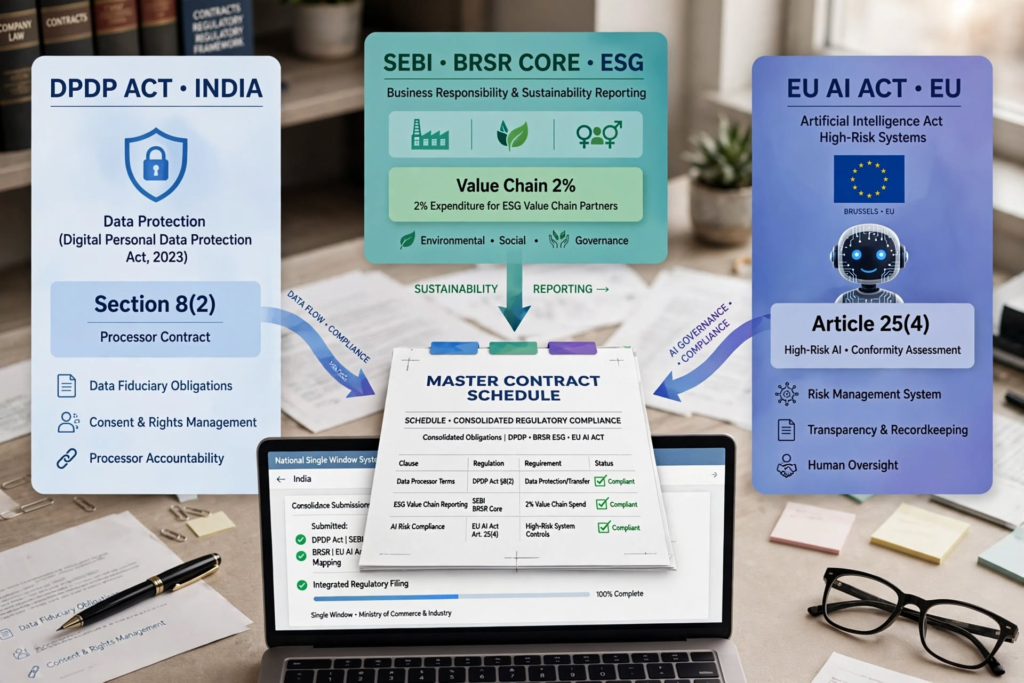
Sooner or later a large customer sends you a contract with three new attachments. One is a data processing addendum citing India’s privacy law. One is an ESG questionnaire that talks about “value chain” data. The third is an AI annex that mentions Brussels. If you sell software, outsourced services or components to bigger companies, this is already happening, and it’s why DPDP contract clauses can no longer be written in isolation. The Digital Personal Data Protection Rules, SEBI’s BRSR Core framework and the EU AI Act arrive from different regulators with different vocabularies, but they land on the same signature page. This guide shows what each regime really requires of a contract, where they overlap, where they collide, and how to build one reusable schedule so you aren’t renegotiating the same points three times. I’ve also marked the places where my sources disagree or where I’m reading the law myself. Our earlier pieces on DPDP compliance and investor due diligence and the DPDP privacy policy checklist cover the privacy basics, so I won’t repeat them here.
The Short Version
- With DPDP contract clauses, remember that under the Act the company that decides why data is used stays liable for what its vendors do, whatever the contract says. The contract is where you share the cost, not where you escape the duty.
- BRSR Core is a reporting rule for big listed companies. It doesn’t bind you directly, but if you’re a large supplier, their ESG data requests will reach your contract anyway.
- The EU AI Act can reach an Indian company whose AI output is used in the EU. For high-risk systems it expects a written agreement between the provider and whoever supplies parts of the system.
- Three timelines matter: DPDP’s main duties from May 2027, BRSR value-chain assurance from FY 2026-27, and the AI Act’s high-risk rules from December 2027.
- A single master schedule with a few regime-specific modules beats three separate addenda.
Why These Three Regimes Hit the Same Contract
DPDP contract clauses tend to come first in a negotiation, because they carry statutory penalties. It helps to see each regime as answering a different question. DPDP asks what happens to personal data once a vendor touches it. BRSR Core asks what a listed company can prove about the environmental and social footprint of its business, including the suppliers it buys from. The EU AI Act asks who is responsible when an AI system causes harm, and how responsibility is passed along a chain of builders and users. The same vendor can sit in all three answers at once.
| DPDP Act and Rules | BRSR Core | EU AI Act | |
|---|---|---|---|
| Who is bound | Data fiduciaries, and through them their processors | Top listed companies, which then ask suppliers for data | Providers and deployers, including some outside the EU |
| What it asks of your contract | Processor engaged under a valid contract with safeguards | Data collection, accuracy and verification rights | Written allocation of information and technical access for high-risk systems |
| Where the pressure comes from | Statute and penalties | Customer’s reporting and assurance needs | Statute and penalties |
| Key date | Core duties from 13 May 2027 | Value-chain assurance from FY 2026-27 | High-risk duties from 2 December 2027 |
DPDP Contract Clauses: What the Processor Contract Must Actually Do
The legal anchors behind DPDP contract clauses
Section 8(2) lets a data fiduciary use a processor only under a valid contract. Section 8(1) keeps the fiduciary responsible for compliance irrespective of any agreement to the contrary, and the fiduciary stays primarily liable for a processor’s failures. A contract can move commercial risk through indemnities. It can’t move the regulator’s penalty. The Rules add that the safeguards a fiduciary must maintain, such as encryption, obfuscation, masking or virtual tokens, apply to all personal data it holds, including data a processor handles, and that processor contracts must include provisions for those safeguards. I’m relying on law firm summaries for the detail here, so check the Gazette text for exact wording.
The dates, and a warning about rule numbers
The Rules were published on 14 November 2025. The Data Protection Board was set up straight away, the consent manager framework starts 13 November 2026, and the core duties, including notice, security safeguards, breach intimation, significant data fiduciary obligations and data principal rights, start 13 May 2027 according to JSA’s analysis. Treat that mapping as a summary, because different practice notes number the rules differently. One commentary placed cross-border transfers at Rule 14 and another at Rule 15, so I’d cite rules by topic in a contract and confirm numbering against the Gazette.
The three clocks inside DPDP contract clauses
Three timing rules drive most DPDP contract clauses. Breach: the fiduciary must tell the Board without delay and follow with a detailed report within 72 hours, and tell each affected person without delay. That leaves a vendor very little room. Practice guides commonly suggest requiring a processor to notify the fiduciary within 24 to 48 hours, which is a drafting norm and not a statutory number. Logs: fiduciaries must keep traffic data and processing logs for at least one year. Erasure: personal data must be erased once its purpose is served, and the Rules require 48 hours’ notice before an erasure deadline in the categories they cover. A processor that deletes on its own schedule can put its customer in breach.
On money, the Schedule to the Act sets penalties of up to ₹250 crore for failing to maintain reasonable security safeguards and up to ₹200 crore for failing to notify a breach. Those penalties land on the fiduciary, which is why customers push so hard on indemnities. If you’re on the vendor side, that’s where you’ll want to hold the line on caps in your DPDP contract clauses. Our article on limitation of liability clauses goes through how.
BRSR Core: What It Means for a Supplier Who Isn’t Listed
BRSR applies to the top 1,000 listed companies in India. BRSR Core is the audited subset, built around nine attributes: greenhouse gas footprint, water footprint, energy footprint, circularity and waste, employee wellbeing and safety, gender diversity, inclusive development, fairness towards customers and suppliers, and openness of business. One of my sources lists only eight of these and omits circularity, so the full list here is from my own reading of SEBI’s framework. Check it before you quote it to a client.
Assurance has been phased in by market capitalisation: top 150 in FY 2023-24, top 250 in FY 2024-25, top 500 in FY 2025-26 and top 1,000 in FY 2026-27, per Uniqus’s summary of SEBI’s framework. SEBI also changed the wording from “assurance” to “assessment or assurance” in December 2024, giving companies a choice.
The value chain: who gets asked, and why it’s mostly commercial pressure
This is the piece that reaches you. SEBI defined value-chain partners as upstream and downstream partners that each account for 2% or more of the company’s purchases or sales by value, and a company may limit its disclosure to partners covering 75% of its purchases and sales. KPMG’s note on the amendment says value-chain disclosures apply from FY 2025-26 and assessment or assurance of them from FY 2026-27, and two sources describe the value-chain reporting as voluntary after SEBI’s change. I couldn’t pull the SEBI circular of 28 March 2025 itself, so verify the current status against it.
If that reading is right, the law doesn’t compel your customer to collect your data, and it doesn’t compel you to give it. But a customer that has chosen to report will write the request into your contract, especially if you’re a large supplier that crosses the 2% line. So the compulsion is commercial and arrives through procurement, not through a statute. A contract is where you decide what you’ll share, how often, and who verifies it.
Where ESG data turns into personal data
This is the overlap I’d flag to every client. Several BRSR Core attributes, such as employee wellbeing and safety and gender diversity, can involve data about identifiable workers. Aggregated headcounts aren’t personal data. A spreadsheet of named employees with injury records is. Once a customer asks for the second kind, the ESG clause is also a DPDP clause, and it needs a lawful basis, a purpose limit and safeguards. Employment-related processing may fit one of the legitimate uses in Section 7, but whether it covers sharing worker data with a customer for the customer’s reporting is something I’d read cautiously and not assume. Keep ESG data requests at the aggregate level wherever you can.
The EU AI Act: When an Indian Vendor Is Pulled In
The Act applies to providers and deployers located outside the EU if the output of their AI system is used in the Union. An Indian company building a hiring tool, a credit model or a support bot for an EU customer can be in scope even with no office in Europe. I found no guidance aimed at Indian vendors, so this is my own reading of the Act’s text.
Where the dates stand now
The AI Omnibus was published in the Official Journal on 24 July 2026 as Regulation (EU) 2026/1744 and entered into force on 27 July 2026, per White & Case. It pushed the stand-alone high-risk obligations from 2 August 2026 to 2 December 2027, and the obligations for AI in regulated products to 2 August 2028. Most transparency duties under Article 50 still applied from 2 August 2026, with a grace period to 2 December 2026 for watermarking on systems already on the market. General-purpose AI model obligations have applied since 2 August 2025. The Omnibus also softened the AI literacy duty in Article 4: providers and deployers must now support literacy among their staff and no longer have to guarantee a particular level. A pre-publication summary I read described the delay as agreed but not yet in force, so you may still see older articles with the earlier dates.
The clause the Act itself asks for
For high-risk systems, Article 25(4) requires the provider and any third party supplying an AI system, tools, services, components or processes used in it to specify, by written agreement, the information, capabilities, technical access and other assistance the provider needs to meet its obligations. That’s the closest thing in any of the three regimes to a mandated clause. The exception is free and open-source components. Separately, Article 25(1) makes a company the provider if it puts its own name on a high-risk system or substantially modifies one, which matters for resellers and integrators. The Act lists penalties of up to €35 million or 7% of turnover for prohibited practices and up to €15 million or 3% for most other breaches, and I’d expect customers to price that into their indemnity asks.
The AI Omnibus summary I read doesn’t address value-chain contracts, so I can’t tell you whether the Commission’s promised model contractual terms have been issued. If a customer hands you template language claiming to be official, ask where it comes from. If you’re building anything with a chatbot interface, our pieces on AI chatbot safe harbour and the IT Rules amendments of 2026 cover the Indian side of AI output liability.
DPDP Contract Clauses and Their ESG and AI Companions: A Starting Library
These DPDP contract clauses and their ESG and AI companions are drafting starting points in plain language, not finished clauses. Adapt them to your facts and have counsel read them. I’ve grouped them by what they protect.
Core DPDP contract clauses that also serve the ESG and AI regimes
1. Roles and purpose. State who is the data fiduciary and who is the processor, list the data categories and say the processor acts only on documented instructions. Without this, nothing else holds together. Customers sometimes draft the vendor as a processor when the vendor actually decides how data is used for its own product improvement. If that’s you, you’re closer to a fiduciary, and the contract should say so.
2. Security standard. Tie your duty to “reasonable security safeguards” under the DPDP Act and list the controls you commit to: encryption, access control, monitoring, logging and resilience. Avoid promising “industry best practice” with no definition. It’s a promise you can’t prove you kept.
3. Incident notification. Pick a window you can actually meet and define “incident” so you aren’t notifying about every blocked login. Put one clock in the contract and make it run from the vendor’s awareness, since the customer’s 72-hour report to the Board depends on it. If you also sell high-risk AI into the EU, check whether serious-incident reporting under the AI Act sets a shorter window for your product.
4. Subprocessors. Allow them only with prior written approval, flow the same obligations down and keep a current list. Customers will ask for this under all three regimes.
5. Audit and verification. Give customers a right to review your controls and, for ESG data, the way you calculated it. Limit it: reasonable notice, once a year unless there’s an incident, during business hours and under confidentiality. Our NDA guide covers the confidentiality side.
6. Return and deletion. On termination, return or erase personal data on instruction, and confirm in writing. Align the timing with the fiduciary’s erasure duty and with the one-year log retention rule, so the two don’t contradict each other.
The DPDP contract clauses module
7. Data principal rights support. Commit to help the customer respond to access, correction and erasure requests within a stated number of days. Say who bears the cost of unusual volumes.
8. Cross-border transfers. The Act allows transfers except to countries the Government restricts by notification, per the summaries I read. Write that you’ll transfer personal data only to places the customer approves, and that you’ll tell the customer if a restriction is notified. The same clause should deal with the EU side if your data leaves Europe too.
The ESG module
9. Data scope and format. List the BRSR Core attributes you’ll report on, the period, the format and who owns the calculation method. If you estimate figures, say so and say how. A customer relying on your numbers in an assured report will want to know which are measured and which are spend-based estimates.
10. Accuracy and correction. A promise that data is “accurate” is risky. Promise that it’s prepared in good faith using a stated method, that you’ll correct material errors you discover, and that the customer’s remedy for an error is correction and not damages.
11. Personal data carve-out. State that ESG data will be delivered in aggregate form and that any request for named individuals will be handled under the DPDP module, not this one.
12. Use limits. The customer may use your data only for its own reporting and assurance. It may not publish supplier-level figures or share them with competitors without consent.
The AI module
13. Classification and responsibility. Say whether the system is, or is intended to be, high-risk, and who the provider and deployer are. If a customer wants to modify your system, state that it then takes on provider duties, mirroring Article 25.
14. Information and access. For high-risk systems, this is the Article 25(4) clause. List the documentation, technical access and assistance you’ll give, and the format and timing. Protect your trade secrets by stating what you’ll disclose and what stays on your side. Our guide to trade secrets for founders helps you decide where that line sits.
15. Transparency and human oversight. Say who tells end users they’re talking to an AI, who labels synthetic content, and who staffs the human oversight a high-risk deployment needs.
16. Training data and intended purpose. State what the system is designed to do and what it isn’t. A customer that deploys it for something else owns that risk. This matters for health products too; see our note on AI self-diagnosis.
Where DPDP Contract Clauses Collide With ESG and AI Terms
The hardest DPDP contract clauses to agree rarely come from any one regime. They come from the places where two clash. The first is audit: an ESG assurer wants to see your records, a DPDP customer wants to inspect your controls, and an AI customer wants technical access. Give one audit clause with one set of limits, covering all three, or you’ll end up with three sets of auditors. The second is incident clocks, as above. The third is liability: customers like to put all three regimes under one uncapped indemnity. Push for separate caps. Data breach and AI harm are different risks from ESG reporting errors, and insuring them as one lump is expensive. The fourth is confidentiality. A broad NDA can accidentally forbid you from giving the ESG figures or the AI documentation the same customer asks for in another clause, so add an express carve-out.
A Practical Order of Work
- List the customers who’ve sent a DPDP, ESG or AI request, and note which regime each cites.
- Decide your role under DPDP for each service: processor, fiduciary or both.
- Check whether any ESG data you hold is about identifiable people.
- Check whether any product’s output reaches the EU and whether it could be high-risk.
- Write the six core DPDP contract clauses once and attach the modules as schedules.
- Pick incident, audit and deletion terms you can actually deliver, before a customer picks them for you.
- Negotiate separate liability caps for data, AI and ESG.
- Diary the three dates: 13 May 2027, FY 2026-27 assurance, and 2 December 2027.
If a customer has already sent you a draft, I’m happy to read it with you. You can reach me through the contact page. For the wider contract hygiene, see the legal checklist for startups, our notes on cybersecurity legal requirements and the technology law library.
Frequently Asked Questions About DPDP Contract Clauses and ESG and AI Terms
1. Do I need DPDP contract clauses with every vendor that touches personal data?
Yes, if the vendor is a data processor. Section 8(2) of the DPDP Act allows processing on a fiduciary’s behalf only under a valid contract. The Rules add that the contract should include provisions for reasonable security safeguards.
2. Can DPDP contract clauses push all liability onto my vendor through an indemnity?
You can shift the money, not the responsibility. The fiduciary stays primarily liable to the regulator, and an indemnity only helps you recover from the vendor afterwards if the vendor can pay.
3. When do DPDP contract clauses start to matter in practice?
The Rules were published on 14 November 2025. The consent manager framework starts 13 November 2026, and the core duties, including security safeguards and breach intimation, start 13 May 2027 according to one law firm’s analysis. Check the Gazette for your specific rule.
4. Which DPDP contract clauses cover breach reporting, and how fast?
The fiduciary must inform the Board without delay and send a detailed report within 72 hours, and inform affected individuals without delay. Contracts commonly give processors 24 to 48 hours to notify the fiduciary, though that’s a drafting norm and not a legal number.
5. Does BRSR Core apply to my company if I’m not listed?
Not directly. It binds the top listed entities. But a listed customer that reports on its value chain may ask you for data, usually if you account for 2% or more of its purchases or sales.
6. Is value-chain ESG reporting mandatory?
The sources I reviewed describe it as voluntary, with disclosures from FY 2025-26 and assessment or assurance from FY 2026-27. I couldn’t read SEBI’s circular directly, so confirm against the 28 March 2025 circular before telling a customer you’re not obliged.
7. Can I refuse to share employee-level data in an ESG request?
You can and often should offer aggregates instead. Named employee data is personal data under the DPDP Act, and sharing it needs a lawful basis and safeguards. Offer aggregate figures first.
8. Does the EU AI Act apply to an Indian company?
It can, if the output of your AI system is used in the EU, even without an EU office. Whether your system is high-risk decides how heavy the obligations are.
9. What is the “written agreement” the AI Act asks for?
For high-risk systems, Article 25(4) requires the provider and a third-party supplier to set out in writing the information, technical access and assistance the provider needs for compliance. Free and open-source components are excepted.
10. Which AI Act dates apply now?
Under the AI Omnibus, in force from 27 July 2026, stand-alone high-risk duties start 2 December 2027 and regulated-product duties 2 August 2028. Most Article 50 transparency duties applied from 2 August 2026, and general-purpose AI model duties since 2 August 2025.
Need DPDP Contract Clauses That Work With Your ESG and AI Terms?
A single set of DPDP contract clauses with ESG and AI modules is cheaper to maintain than three, and easier to defend in a negotiation. Talk to Advocate Parvez Ali, or learn more about the author.
Sources
- JSA: DPDP Rules, November 2025
- BDO India: The DPDP Rules 2025
- King Stubb & Kasiva: Handling data shared with vendors under the DPDP Act
- Uniqus: Latest updates on the BRSR assurance framework
- KPMG: SEBI introduces key changes in BRSR reporting
- White & Case: EU AI Omnibus enters into force
- EUR-Lex: Regulation (EU) 2024/1689 (the AI Act), for Articles 2, 25 and 99, cited from my own reading
- Gibson Dunn: EU AI Act Omnibus agreement
Last updated: 20 October 2026. This is general information, not legal advice. The clauses above are drafting starting points. I couldn’t read SEBI’s 2025 circular or the Gazette text of the DPDP Rules directly, and the AI Act articles are cited from my own reading, so check all three before relying on any detail.