
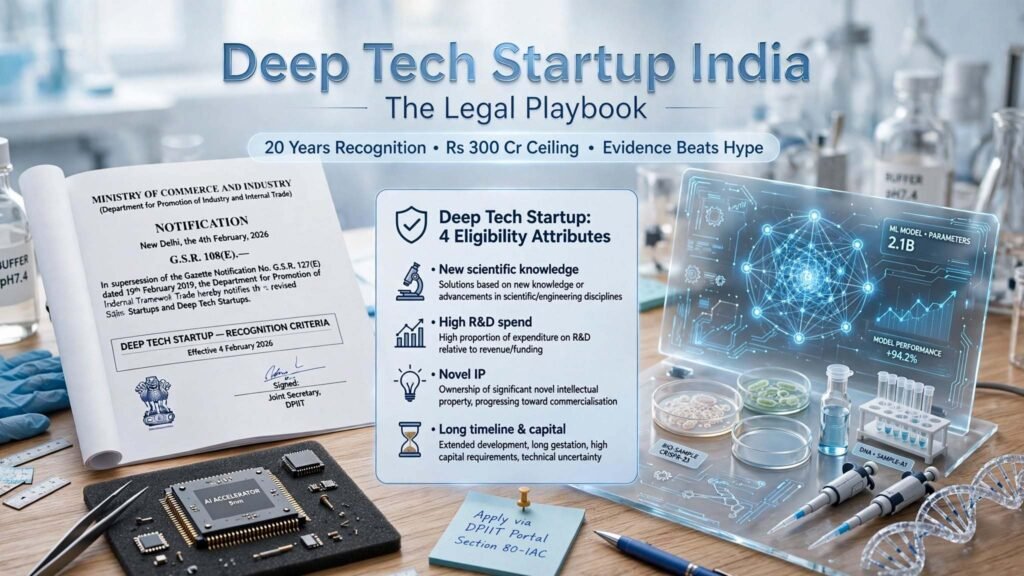
If you’re building chips, a new drug or a model that needs its own research lab, the Deep Tech Startup category in DPIIT’s February 2026 notification was written with you in mind. Notification G.S.R. 108(E) gives a qualifying company 20 years of recognition and a ₹300 crore turnover ceiling. An ordinary startup gets 10 years and ₹200 crore. That matters when your product might not reach a paying customer for eight years. What the notification doesn’t do is hand you a bigger tax holiday, or give you the label because you work in a fashionable sector. Most of what’s circulating online glosses over both points. This guide goes through how the category is actually defined, how to test yourself against it, where the spending and tax rules catch capital-heavy companies, and what to read before you accept government funding. If you haven’t seen the general rules yet, begin with our piece on DPIIT startup recognition in 2026, because this page assumes you’ve got the basics.
The Short Version
- The Deep Tech Startup label depends on four attributes of your business. It doesn’t depend on your industry.
- You have to clear the ordinary startup tests first, then the deep tech ones on top.
- DPIIT can give you plain startup status, deep tech status, or a rejection with reasons.
- The 20 years count from incorporation, not from your first sale.
- Recognition and the income-tax holiday are two different things. In everything I read, nothing stretches the tax window for deep tech.
- Several government schemes carry conditions of their own, some of which can collide with a foreign investor on your cap table.
What Counts as a Deep Tech Startup
You’ll see articles listing “AI, semiconductors, quantum and biotech” as though the notification named them. It doesn’t. Paragraph 1(n) describes a Deep Tech Startup through four attributes, and you need all four, on top of the general startup tests covering legal form, age, turnover, purpose and the rule against splitting up an older business.
The first is that you’re developing a solution based on new knowledge or advances in a scientific or engineering discipline, and that solution isn’t fully developed yet. The second is that a high share of your revenue or funding goes into R&D. The third is that you own, or are building, significant novel intellectual property and are taking steps to commercialise it. The fourth is that your path is long and expensive, with heavy infrastructure needs and real technical or scientific uncertainty about whether it will work.
Notice what’s missing. There’s no percentage for “high” and no definition of “significant”. Those details are left to a framework and guidelines from the Department, and the decision turns on the documents you submit. I looked for published scoring criteria and a separate application route for deep tech and found neither. Commentary describes one application with extra technical and R&D documentation, and says the Department may recognise you as a plain startup, as a Deep Tech Startup, or reject you and record why. So until DPIIT says more, every adjective in that definition is something you’ll have to prove with paper.
Why the sector lists mislead
The fields people quote come from commentary and from the language of government schemes. A company in one of those fields can fail the test. A company in a field nobody calls glamorous can pass. What matters is whether you’re doing new science or engineering with genuine technical risk and keeping the IP that comes out of it.
Would You Actually Pass? Four Typical Profiles
The notification gives no worked examples, so what follows is my own reading of how the four attributes apply to common founder profiles. Your facts will differ, and DPIIT may see it another way.
Semiconductors. A company with its own chip architecture or process technology, taped-out silicon, owned design IP and multi-year tape-out cycles looks like the textbook case. A company that integrates off-the-shelf chips onto a board, however clever the product, has a harder argument, because there’s little original science to point at.
AI. This is where I’d expect the arguments. Training new architectures or methods with a serious research budget and defensible IP is one thing. Wrapping someone else’s model in a prompt layer and a good interface is another, and the risk there is mostly market risk, not technical risk. A policy paper on India’s RDI Fund makes a similar point: being in AI or robotics doesn’t make a company a serious technology business, and fund managers have to judge IP defensibility, production feasibility and whether anyone will buy the thing. I’d assume DPIIT asks the same questions.
Biotech. A novel molecule or platform with preclinical data, patents filed and years to approval fits well. A contract services business, or a product that copies an approved formulation, doesn’t.
Advanced materials. New material or manufacturing method, lab results, pilot-scale plans: reasonable. Trading or processing materials that are already known: not likely.
Build the Evidence File Before You Apply
Applications for this category will be won or lost on documents, so start the file early. Here’s what I’d gather.
Start with your R&D ratio. Get your accountant to tag R&D spend separately and show it as a share of revenue and of funds raised, year by year. If it’s currently buried in general operating expenses, fix that now. Then IP proof: patent filings, invention disclosures, design records, lab notebooks, code repositories. Check that the company owns all of it, not a founder or a university. If that’s shaky, our guides on IP assignment agreements and patent filing in India will help you tidy it up.
Then write a short, plain account of what you don’t yet know and why it’s hard. Reviewers read a lot of hype, and specifics stand out. Add a milestone plan that shows the long timeline and the capital it needs: cleanroom time, tape-out fees, trials, pilot plants. And keep everything consistent. What you tell DPIIT should match your investor deck, your data room and your tax filings, because a certificate obtained on false information can be revoked.
The same documents help you decide what to patent and what to keep secret. For that, read our trade secrets guide and the Zetwerk-Ayr Energy case.
How the 20-Year Clock and the ₹300 Crore Ceiling Work
The age is counted from the date of incorporation or registration. A Deep Tech Startup stops being one when it completes 20 years, or when turnover in any previous financial year goes above ₹300 crore. That second test looks at every year since incorporation, so crossing the line once ends the status even if turnover later drops.
Three things catch deep tech companies out in particular. First, early incorporation uses up runway. If you incorporate a lab project in year one of research, the clock is already running while you have no product. I’m not suggesting you delay, since IP ownership and fundraising usually need a company, but know your end date and write it down.
Second, lumpy revenue. One guide I read says turnover follows Section 2(91) of the Companies Act, 2013. If so, a big upfront licensing fee or a large milestone payment landing in a single year could push you over ₹300 crore with no warning. Ask your chartered accountant how each revenue stream gets counted before you sign a major licence.
Third, a misunderstanding I’d like to clear up. A profitable company at ₹250 crore is no longer a regular startup (the ordinary ceiling is ₹200 crore), but it can still be a Deep Tech Startup if it meets the four attributes and has stayed under ₹300 crore. That’s the whole point of the higher ceiling.
The Tax Question Most Deep Tech Founders Get Wrong
Recognition is a status. The income-tax holiday is a separate deduction that needs a separate certificate from the Inter-Ministerial Board, applied for on Form 1. The sources I reviewed say recognised startups, deep tech ones included, can apply, but only private limited companies and LLPs qualify. Don’t assume a cooperative society gets it.
| Condition | What the sources say |
|---|---|
| Entity type | Private limited company or LLP |
| Incorporation window | On or after 1 April 2016 and before 1 April 2030 |
| Deduction | 100% of profits from the eligible business, for any three consecutive years within the first ten |
| Gateway | Inter-Ministerial Board certificate |
| Turnover limit | ₹100 crore in older guides. RSM India reports the Finance Act 2026 raised it to ₹300 crore from tax year 2026-27 |
What I think happens after year ten
Here’s the part I haven’t seen anyone say plainly. The deduction is claimed in three consecutive years within the first ten years from incorporation. I found no source saying the window stretches to 15 or 20 years for deep tech, and one guide I reviewed mentions no deep tech tax benefit at all. If that’s right, you can stay recognised until year 20 and still be unable to claim the Section 140 holiday after year ten. I wouldn’t build a financial model on the opposite assumption without reading the enacted text. Check it against the current Income-tax Act, 2025, and get your CA to confirm.
There’s a more practical problem too. Deep tech companies often lose money for years because the product isn’t ready. A deduction on profits is worth very little when there are no profits. For many of you the real value of recognition will be somewhere else entirely: access to schemes, government procurement and credibility with investors. And if you do claim the deduction, it generally means giving up the concessional corporate rate under Section 115BAA, a choice described as typically irreversible, so model both paths before deciding. Angel tax, by the way, is off the table: Section 56(2)(viib) was abolished from 1 April 2025.
Spending Rules When Your Business Is Capital-Heavy
The notification stops a recognised startup, deep tech included, from putting money into eight kinds of assets unless the investment is integral to its core business. They are residential property, non-residential property, loans and advances, capital contributions to other entities, shares and securities, high-value transport, jewellery and luxury assets, and any other speculative asset the Centre notifies. Our DPIIT recognition guide lists each exception. Deep tech companies run into these rules more often than app companies, and the reasons are easy to see.
Building or buying a lab, cleanroom or pilot plant looks like non-residential property, but it’s property you occupy for the business, which is within the exception. Keep board minutes that explain why you need it. A large round sitting in the bank for years is a harder one: shares and securities are allowed only where incidental to treasury operations, so adopt a board-approved treasury policy before you park anything. Funding an overseas subsidiary or joint venture, which is common when fab access or customers are abroad, counts as a capital contribution. It’s allowed when directly related to the business or its strategic objectives, so write down the link. Informal bridge loans between group companies or to a founder are restricted unless lending is part of your business. I’d avoid them or take advice first. And if your R&D really needs a test vehicle or an aircraft, keep usage logs to show it’s used in operations.
The notification doesn’t say what happens if you breach these rules, so don’t read silence as safety. It also puts no periodic filing duty on a recognised company, which means the first real check may come when you apply for a tax certificate or a government scheme.
Government Funding, and the Strings Attached
This is where the Deep Tech label meets real money, and where I’d slow down. I found no source saying Deep Tech recognition is a condition for these schemes or earns automatic access, so read each scheme’s own eligibility rules. What follows comes from press reports and government releases. Check the guidelines before you rely on any detail.
The RDI Scheme
The Research, Development and Innovation Scheme has ₹1 lakh crore over six years. It was approved on 1 July 2025 and launched on 3 November 2025, and it works through second-level fund managers such as TDB and BIRAC. Reported terms include interest of 3% to 4% for up to 15 years with no collateral or personal guarantee. The first cohort was 22 projects with ₹4,744 crore of R&D and ₹2,192 crore of support. Projects generally need to reach technology readiness level 4, and support can cover up to half of project cost, so you’ll need matching money.
Now the catch. Reported conditions include IP staying in India and control remaining with Indian citizens. If that’s accurate, it’s a direct clash with some cap tables. A foreign venture fund with a large stake, a group IP-holding company abroad, or an offshore parent can all raise questions. Read the guidelines against your shareholding before you apply, not after.
India Semiconductor Mission 2.0
ISM 2.0 has ₹1.25 lakh crore approved and shifts the focus towards chip and electronics design, with grants plus equity, and government money reportedly matching private investment stage by stage. The earlier Design Linked Incentive scheme committed ₹234 crore to 22 companies. Operational guidelines hadn’t been released at the time of reporting. Investors have raised worries about veto rights over fundraising, board appointments and acquisitions, and about unclear rules on IP licensing and overseas engagement. Any government equity comes with shareholder rights that will shape your next round, so our notes on term sheets and angel investment agreements are worth a read before you negotiate.
BioE3, Bio-RIDE and Biopharma SHAKTI
Bio-RIDE has ₹9,197 crore for R&D, entrepreneurship and biomanufacturing, and Biopharma SHAKTI has ₹10,000 crore over five years aimed at biologics. Check each programme’s eligibility. A 2026 policy paper notes there is still no dedicated biotech venture fund.
What Else Applies Beyond DPIIT, by Sector
Semiconductor founders
Your biggest legal exposure is usually contracts: EDA and foundry licences, third-party IP cores and the NDAs with partners. Be able to show a clean chain of ownership for every block of design you claim, and watch the shareholder rights in any government co-investment. Since the ISM 2.0 guidelines were still awaited, treat funding assumptions as provisional.
AI founders
Three regimes matter. The DPDP Rules were notified on 14 November 2025, with core obligations expected from around May 2027 according to one practice guide. The IT Rules amendment of 2026 brought synthetically generated information into the due diligence framework, with labelling and metadata duties for platforms that offer tools to create realistic synthetic media. And whether a generative AI product can claim intermediary safe harbour is unresolved: in IndiaMART v. OpenAI, the Calcutta High Court said at the interim stage that ChatGPT’s generative features bring it closer to an originator. We cover that in AI chatbot safe harbour in India. If your AI touches health, CDSCO’s medical device software guidance of 21 July 2026 may apply, as explained in our guide to AI self-diagnosis and digital health law. For privacy and investor diligence, see DPDP compliance and funding due diligence.
Biotech founders
Regulation is split across bodies. Work with genetically engineered organisms and recombinant DNA falls under the 1989 Rules made under the Environment (Protection) Act, 1986, with the Review Committee on Genetic Manipulation (RCGM), institutional biosafety committees and, for commercial release, the Genetic Engineering Appraisal Committee. A 2026 policy paper notes that regulatory functions are spread across FSSAI, GEAC, CDSCO and RCGM, so which approvals you need depends on what you make. One source reports that clinical trial licence timelines for new drugs were cut from 90 to 45 working days; confirm the current figure with CDSCO before you plan around it. Map your approvals on day one, because a delayed approval eats runway.
The Contracts You Shouldn’t Skimp On
A company that may live 20 years needs paperwork to match. Your founders’ agreement should carry vesting and a clean exit route: see our founders agreement template and the note on bad leaver clauses.
If your technology came out of a university or research lab, find out who owns the IP, what licence you hold and what rights the institution kept, and get it in writing before you raise money. Make sure every employee assigns work-related IP to the company, with sensible carve-outs for unrelated work. Deep tech hires often wait years for a payout, so look at ESOPs for startups early. Partners and foundries see your designs, so use tight NDAs; our NDA guide covers what to include. And because a failed deployment of a novel product is a real risk, cap your liability in customer contracts. The limitation of liability article shows how.
A 90-Day Checklist for Deep Tech Recognition
- Write down your incorporation date, and the dates your 20 years and your ten tax years end.
- Test yourself against the four attributes in writing, with evidence for each.
- Separate R&D in your books and track the ratio to revenue and funding.
- Confirm the company owns its IP and fix any gaps with assignments.
- Prepare the technical file and the plain-language note on uncertainty.
- Apply through the NSWS portal and keep a copy of everything you submit. Commentary on the portal says the Ministry charges no fee for the certificates.
- Decide your tax route, and confirm the Section 140 turnover limit with your CA.
- Adopt a treasury policy and a short note on why each large asset is integral to the business.
- Map your sector approvals (CDSCO, biosafety, data, IT rules) with dates.
- Read the guidelines of any scheme you plan to use against your cap table and IP structure.
- Review your contracts for IP, confidentiality and liability.
- Set a six-monthly review, because DPIIT’s guidelines, the schemes and the tax text are all still moving.
If you’d like a second pair of eyes on your application file or your IP structure, reach me through the contact page. For the wider paperwork, see our legal checklist for Indian startups and the startup legal library.
What Nobody Has Answered Yet
Four things are still open. DPIIT hasn’t published, in anything I could find, the yardsticks for “high” R&D spend and “significant” IP. The tax window for deep tech beyond year ten isn’t addressed in the sources I reviewed. The consequence of breaching the fund-use rules isn’t stated. And several scheme conditions are known only from press reports. Plan on the cautious reading of each, and watch for DPIIT guidelines and portal instructions as they appear.
Frequently Asked Questions About the Deep Tech Startup Category
1. What is a Deep Tech Startup under the 2026 DPIIT notification?
It’s a startup that passes the general startup tests and shows four attributes: new scientific or engineering knowledge, a high share of spend on R&D, significant novel IP being commercialised, and long timelines with high capital needs and technical uncertainty. DPIIT assesses this under its own framework.
2. How long does Deep Tech Startup recognition last?
Up to 20 years from incorporation or registration, compared with 10 for an ordinary startup. It ends sooner if turnover goes above ₹300 crore in any year.
3. Is my semiconductor, AI or biotech company automatically a Deep Tech Startup?
No. The notification doesn’t define the category by sector. You need to show the four attributes with documents, and DPIIT can recognise you as a regular startup or reject the application.
4. What is the turnover limit for a Deep Tech Startup?
₹300 crore, checked against every financial year since incorporation. Cross it once and the status ends, which is why a single large licensing fee deserves a second look.
5. Do Deep Tech Startups get a longer income-tax holiday?
I found no source saying so. The deduction covers three consecutive years within the first ten, and only for private limited companies and LLPs holding an Inter-Ministerial Board certificate. Check the current text of Section 140 and speak to your CA.
6. Can a Deep Tech Startup claim Section 80-IAC after year ten?
On the sources I reviewed, probably not, since the claim window sits inside the first ten years. That’s my reading and not settled guidance, so verify it before relying on it.
7. Are there limits on how a Deep Tech Startup can spend its money?
Yes. The same eight restricted categories apply, including property, loans, shares and luxury assets, unless the investment is integral to your core business. A lab or plant used for the business sits within the exception, but treasury investments need a clear policy.
8. Do government deep tech schemes require Deep Tech recognition?
I found no source linking the two. Each scheme, such as the RDI Scheme, sets its own conditions. Reported terms include matching funding and requirements on Indian IP and control, so read the guidelines first.
9. What documents do I need for a Deep Tech application?
A certificate of incorporation, a description of your business and innovation, and technical and R&D documentation that shows the four attributes. I couldn’t find a detailed checklist published by DPIIT.
10. Can Deep Tech recognition be revoked?
The notification lets the Board revoke a certificate obtained on false information, and a revoked certificate is treated as never issued. Recognition also lapses automatically at 20 years or when you cross the turnover ceiling.
Building Something Hard? Get the Paperwork Right Early
A short review of your application file, IP chain and funding conditions can save you months later. Talk to Advocate Parvez Ali, or read about the author.