
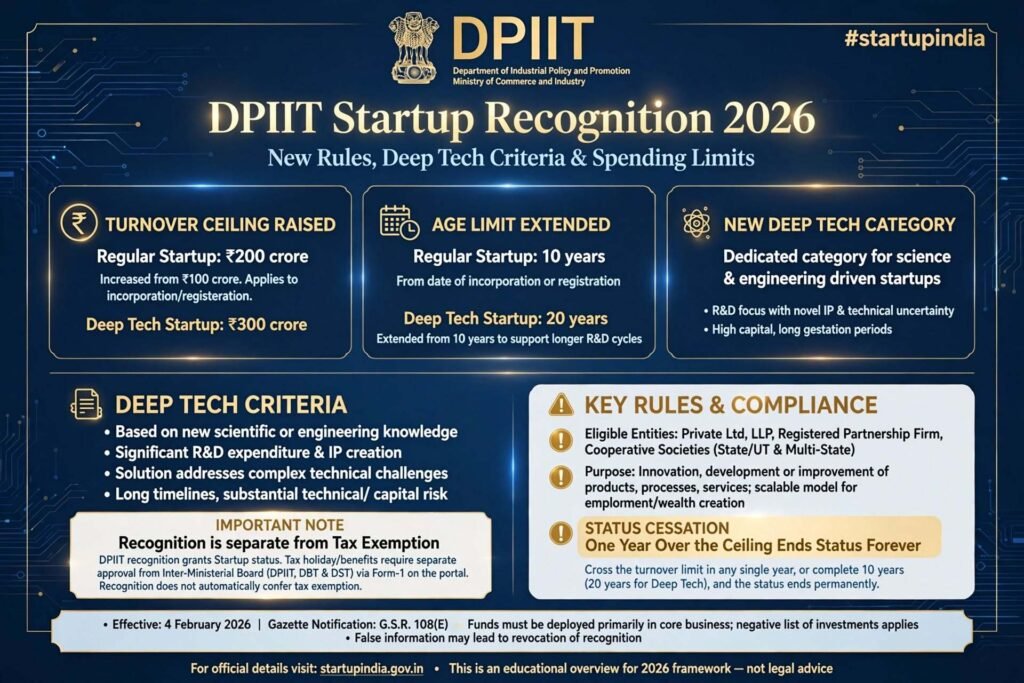
DPIIT startup recognition now runs on a rewritten rulebook. Notification G.S.R. 108(E), dated 4 February 2026, doubled the turnover ceiling from ₹100 crore to ₹200 crore, kept the ten-year age limit, created a Deep Tech Startup category with twenty years and a ₹300 crore ceiling, and, for the first time in this form, told recognised startups where they may not put their money. If you hold a recognition certificate, or plan to apply, the question is no longer only “do I qualify?” but “will I still qualify next year, and is my treasury policy safe?” This guide goes through the eligibility tests, the Deep Tech criteria, why recognition is not an income-tax exemption, and the spending rules that can quietly cause trouble. I have read the notification text itself, not only the commentary, and I flag the places where the two disagree. For the basics of applying, see our Startup India registration guide.
Key Takeaways on DPIIT Startup Recognition in 2026
- The ceiling is ₹200 crore, and it is measured over your whole life. The test is turnover “in any financial year since incorporation”. One year above the line ends the status, even if turnover later falls.
- Ten years is a hard stop for an ordinary startup. Deep Tech gets twenty.
- Recognition and tax exemption are separate things. The tax deduction needs a second certificate from the Inter-Ministerial Board.
- There are eight restricted investment categories, from residential property to jewellery, each with an exception for assets integral to your business.
- The notification’s revocation clause is narrower than the headlines. It deals with certificates obtained on false information. Read the section on breach below before you assume anything.
What Changed in DPIIT Startup Recognition Since the 2019 Framework
The notification that governs DPIIT startup recognition, G.S.R. 108(E), supersedes the 2019 notification, G.S.R. 127(E) of 19 February 2019, and takes effect from the date it was published in the Gazette. The headline differences are these.
| Feature | 2019 framework | 2026 notification |
|---|---|---|
| Turnover ceiling | ₹100 crore | ₹200 crore (₹300 crore for Deep Tech) |
| Age limit | 10 years | 10 years (20 years for Deep Tech) |
| Eligible entities | Private limited company, partnership firm, LLP | Same, plus multi-state and state cooperative societies |
| Deep Tech category | None | Defined, with its own attributes and ceilings |
| Fund deployment | Investment restrictions tied to the angel tax exemption | Standalone restrictions during the recognition period |
| Angel tax references | Present | Removed, since Section 56(2)(viib) was abolished from 1 April 2025 |
One commentary says the investment restrictions earlier applied for seven years and now run for the whole recognition period. I could not confirm the old duration from the notification text alone, so treat that detail as secondary. The rest of the table comes from the 2026 text and a law firm’s comparison.
The Five Eligibility Tests for DPIIT Startup Recognition
Paragraph 1(a) of the notification sets out what qualifies. All five must hold together.
- Form. Incorporated or registered in India as a private limited company, partnership firm, LLP, or a multi-state or state cooperative society.
- Age. Within ten years of the date of incorporation or registration.
- Turnover. Not above ₹200 crore in any financial year since incorporation.
- Purpose. Working towards innovation, development or improvement of products, processes or services, or running a scalable model with high potential for employment or wealth creation.
- Origin. Not formed by splitting up or reconstructing an existing business.
The fifth test catches founders who hive off a profitable division into a “new” company to claim startup benefits. If you are choosing a structure, our comparison of partnership vs LLP vs private limited matters here, because only some structures can later claim the tax deduction, as explained below.
How DPIIT Startup Recognition Ends on Its Own
The Explanation to paragraph 1 is blunt about how DPIIT startup recognition lapses. A startup ceases to be a startup on completing ten years from incorporation or registration, or if its turnover for any previous year exceeds ₹200 crore. A Deep Tech Startup ceases on completing twenty years, or if turnover for any previous year exceeds ₹300 crore. No one has to revoke anything; the status simply lapses.
| Scenario | Result |
|---|---|
| Company incorporated in January 2017, turnover always under ₹200 crore | Status ends around January 2027, when ten years complete |
| Company aged four years, turnover ₹210 crore in one year, ₹150 crore the next | Status ended in the year it crossed ₹200 crore; the dip does not restore it |
| Company aged twelve years that meets the Deep Tech attributes and is recognised as Deep Tech | Can remain a startup up to twenty years, subject to the ₹300 crore ceiling |
That one-way turnover rule is the most useful thing about DPIIT startup recognition for a fast-growing company. If you are heading towards ₹200 crore, plan for the day the recognition lapses and for what you will lose with it.
Deep Tech Startup Recognition: What Counts and What You Need to Show
Paragraph 1(n) defines a Deep Tech Startup by attributes, not by sector. You must meet the general startup tests plus all four of these.
- Developing a solution based on new knowledge or advances in one or more scientific or engineering disciplines, not yet fully developed or still in development.
- A high share of R&D expenditure relative to revenue or funding.
- Owning, or creating, significant novel intellectual property and taking steps to commercialise it.
- Long development timelines, high capital and infrastructure needs, and substantial technical or scientific uncertainty.
The notification sets no numerical R&D threshold and leaves assessment to a framework and guidelines the Department issues, based on documents you submit. Terms like “high share” and “significant novel IP” are undefined, which is the biggest practical gap. Commentary mentions AI, biotech, quantum computing, advanced materials and space technology as typical fields, but that is illustration, not a legal list.
Building Your Deep Tech Evidence File
This part is my suggestion, not a rule. Because the test is attribute-based, an application lives or dies on documents. Keep a dated record of R&D spend as a percentage of revenue and funding, patent filings and invention disclosures, technical roadmaps and test results, and a clear explanation of why the technical risk is real. Our guides on patent filing in India, IP assignment agreements and trade secret protection cover how to make sure the company, not a founder, owns the IP you will point to.
DPIIT Startup Recognition Is Not a Tax Exemption
This is the misunderstanding about DPIIT startup recognition I see most. A DPIIT certificate says you are a startup. It does not, by itself, reduce your tax. The income-tax benefit is a separate deduction, and it needs a separate approval.
| Layer | Who grants it | What it gives you |
|---|---|---|
| DPIIT recognition | DPIIT | Startup status and access to the Startup India programme |
| Eligible-business certificate | Inter-Ministerial Board (IMB), applied for under paragraph 3 and Form 1 | The gateway to the income-tax deduction |
| Income-tax deduction | Claimed in your return | 100% of profits and gains from the eligible business for any three consecutive years out of the first ten |
The Section 80-IAC and Section 140 Conditions
From 1 April 2026 the Income-tax Act, 2025 replaces the 1961 Act, and the notification itself notes that references to Section 80-IAC are read accordingly. Commentary maps the startup deduction to Section 140, with an earlier claim for 2025-26 still made under Section 80-IAC. The conditions reported across several guides are:
- Only a private limited company or an LLP can claim. Partnership firms, cooperatives, OPCs and sole proprietorships cannot.
- Incorporation on or after 1 April 2016 and before 1 April 2030.
- An IMB certificate of eligible business.
- Not formed by splitting up or reconstructing an existing business.
- The deduction covers profits from the eligible business, not interest, capital gains or dividends.
There is one disagreement you must resolve before relying on any article. Older guides say annual turnover must not exceed ₹100 crore for the year of claim. RSM India’s newsflash on the Finance Act 2026 says the turnover threshold under Section 140 was raised from ₹100 crore to ₹300 crore, effective from 1 April 2026 and applying from tax year 2026-27. The source does not explain how that ₹300 crore figure relates to the ₹200 crore recognition ceiling, and several guides still show ₹100 crore. Read Section 140 as enacted, or ask your chartered accountant, before you model your tax.
Two Practical Warnings on the Tax Holiday
- Few recognised startups have the second certificate. One commentary puts DPIIT-recognised startups at about 207,000 against about 3,700 IMB approvals. That figure is unverified, but the gap is real enough that you should not budget a tax holiday just because you hold a recognition number.
- Claiming the deduction usually means giving up the concessional corporate tax regime under Section 115BAA, and that choice is described as typically irreversible. Model both routes against your expected profits.
Angel tax is no longer part of this story. The sources I reviewed say Section 56(2)(viib) was abolished from 1 April 2025 for all companies, though historical notices can linger for rounds closed earlier. If you are raising money, our guides on angel investment agreements, term sheet basics and ESOPs for startups are the next reads.
The New Spending Rules Under DPIIT Startup Recognition: Where You Cannot Park Money
Paragraph 4 says a startup must deploy its funds mainly for core business, innovation, research, scaling or operational needs. Paragraph 5 then lists what a recognised startup, Deep Tech included, may not invest in during the recognition period, unless the investment is integral to its core business.
| # | Restricted category | Exception in the text |
|---|---|---|
| 1 | Residential building or appurtenant land | Used for your own business, or held as stock-in-trade |
| 2 | Non-residential land or building | Occupied for business, or held as stock-in-trade in the ordinary course |
| 3 | Loans and advances | Lending is a substantial part of the business, or advances are in the ordinary course |
| 4 | Capital contributions to other entities | Directly related to the business or strategic objectives |
| 5 | Shares and securities | Incidental to treasury operations, or part of the core business |
| 6 | High-value motor vehicles, aircraft, yachts and other transport | Used for operations, leasing or hiring, or held as stock-in-trade |
| 7 | Jewellery or other luxury assets | Held as stock-in-trade in the ordinary course |
| 8 | Any other speculative or non-productive asset or activity notified by the Centre | Integral to core operations |
How I Would Read Common Situations
These are my readings of the spending rules, not settled guidance, and the notification gives no worked examples. Run them past your accountant.
| Situation | Likely reading |
|---|---|
| Buying the floor your team works from | Likely fine; non-residential property occupied for business |
| Buying a flat as a store of value | Likely caught by category 1 |
| A company car or van used for deliveries | Likely fine as used for operations |
| A high-value car for a founder’s personal use | Risky under category 6 |
| Investing idle cash in listed shares | Risky unless incidental to treasury operations; get a written treasury policy |
| A loan to a group company or a director | Risky under category 3 unless lending is part of the business |
| A strategic stake in a supplier or customer | May fit category 4 if directly related to your business; document the reason |
| Funding an ESOP trust through a loan | Unsettled; some commentators flag it, so take advice |
Bank deposits are not on the list, but I would still keep a short board-approved treasury note explaining how surplus cash is held and why. If you raise venture money, investors will ask how you spend it, and our legal checklist for Indian startups before raising a first round covers the paperwork that goes with it.
Can You Lose DPIIT Startup Recognition for Breaking the Rules?
The honest answer is that it is unclear, and the sources do not agree. Here is what the text says.
- Paragraph 6. If a certificate or approval under paragraph 3, meaning the Board’s tax-related certificate, was obtained on false information, the Board may revoke it, and a revoked certificate is treated as never issued. The notification does not restate this for DPIIT recognition itself.
- Paragraph 5. It sets the investment restrictions but, as far as I can see, attaches no stated penalty or procedure to a breach.
- Reporting. The notification contains no periodic filing requirement for recognised startups. Its filing mechanics are the recognition application and the Form 1 certificate application.
- Paragraph 7. The Central Government may relax or modify conditions for classes of startups or for individual cases in special circumstances.
At least one commentary says DPIIT may revoke recognition or tax approval for misrepresentation or non-compliance with prescribed conditions. News coverage of the notification has said much the same. I could not find that wording in the notification text I reviewed, so I would not tell a client either “you cannot lose recognition for overspending” or “you will certainly lose it”. What I would say is that a false statement is the clearest route to losing a certificate, with real tax consequences, because a revoked tax certificate is treated as if it never existed and deductions claimed on it can be exposed for all the years involved. Treat the investment restrictions on DPIIT startup recognition as binding anyway. A regulator who finds a breach has several levers, and “the rule did not say what would happen” is a poor defence.
What Existing Holders of DPIIT Startup Recognition Should Do Now
The notification contains no separate transition clause for entities holding DPIIT startup recognition under the 2019 framework. It took effect on publication and supersedes the earlier notification. One commentator reads this to mean existing startups need not re-apply and that companies near the old ₹100 crore ceiling keep recognition under the higher limit, but that is the commentator’s reading, not the text. Check your status and expiry date on the Startup India portal, and keep a copy of the certificate.
If You Are a Cooperative
Cooperatives can now seek recognition, but they cannot claim the Section 80-IAC and Section 140 deduction, which is limited to private limited companies and LLPs.
A Founder’s Checklist for Keeping DPIIT Startup Recognition
- Write down your incorporation date and the date your ten years (or twenty, if Deep Tech) end. Put it in the company calendar.
- Track turnover against ₹200 crore every year, and against ₹300 crore if you are Deep Tech. Remember that one year above the line is permanent.
- Check which certificate you hold beyond your DPIIT startup recognition number. Recognition, the IMB certificate and the tax claim are three different things.
- Decide early on the tax route, the Section 140 deduction or the concessional regime, and model both.
- Confirm the turnover limit for Section 140 with your CA, given the ₹100 crore versus ₹300 crore discrepancy.
- Adopt a treasury and investment policy that tracks the eight categories, approved by the board and reviewed each year.
- Keep a file on “integral to core business” for any property, vehicle or investment you hold that falls near the list.
- Never sign an application with unverified statements. Check every figure and claim before filing.
- If you aim at Deep Tech, assemble the R&D, IP and technical-risk evidence before you apply.
- Get the paper right: founder agreements, IP assignments and shareholder terms. See our founders agreement template.
If you would like a second pair of eyes on your treasury policy or your recognition position, you can reach me through the contact page. More material for early-stage companies sits in the startup legal library, and if you are still choosing a registration route, see our MSME registration guide as well.
Open Questions on DPIIT Startup Recognition Worth Watching
Three gaps in the DPIIT startup recognition rules stand out. The Deep Tech guidelines are still to be spelt out, so the numbers behind “high” and “significant” are unknown. The consequences of breaching the investment restrictions are not stated. And the turnover cap for the tax deduction is reported differently by different sources. Expect clarifications, FAQs or portal instructions over time, and expect some founders to test the edges. I would plan on the conservative reading of each, because DPIIT startup recognition is cheap to keep and expensive to lose.
Frequently Asked Questions About DPIIT Startup Recognition
1. What are the 2026 DPIIT startup recognition rules?
They are set out in G.S.R. 108(E) of 4 February 2026. A startup must be a private limited company, partnership, LLP or cooperative society, within ten years of incorporation, with turnover never above ₹200 crore, working on innovation or a scalable model, and not formed by splitting up an existing business.
2. What is the turnover limit for DPIIT startup recognition now?
₹200 crore for a startup and ₹300 crore for a Deep Tech Startup, measured across every financial year since incorporation. It was ₹100 crore under the 2019 framework.
3. What is a Deep Tech Startup?
One with solutions based on new scientific or engineering knowledge, a high share of R&D spending, significant novel IP being commercialised, and long timelines with high technical uncertainty. It gets up to twenty years and a ₹300 crore ceiling, assessed under DPIIT’s framework.
4. Does DPIIT startup recognition give me an income-tax exemption?
No. The deduction needs a separate Inter-Ministerial Board certificate and a claim in your return. Recognition alone does not reduce tax.
5. Who can claim the 100% profit deduction?
A private limited company or LLP with an IMB certificate, incorporated on or after 1 April 2016 and before 1 April 2030, claiming for any three consecutive years within the first ten. It is not available to partnerships or cooperatives.
6. Is the turnover limit for the tax deduction ₹100 crore or ₹300 crore?
Sources differ. Older guides say ₹100 crore. RSM India reports the Finance Act 2026 raised it to ₹300 crore from tax year 2026-27. Confirm with the text of Section 140 or your CA.
7. What can a recognised startup not invest in?
Residential property, non-residential property, loans, capital contributions to other entities, shares and securities, high-value vehicles, jewellery and luxury assets, and other assets the Centre notifies. Each has an exception where the asset is integral to the core business.
8. Can DPIIT revoke my DPIIT startup recognition?
The notification text I reviewed lets the Board revoke a paragraph 3 certificate obtained on false information. Some commentary says recognition can be revoked for non-compliance too, but I could not find that wording in the text. Treat misstatements and the investment rules as serious.
9. Do existing holders of DPIIT startup recognition have to re-apply?
The notification has no transition clause. A commentator reads it as requiring no re-application, but that is not in the text. Check your status and expiry date on the Startup India portal.
10. Is angel tax still a concern for startups?
Sources say Section 56(2)(viib) was abolished from 1 April 2025, so new rounds are not caught, although notices on earlier rounds may still arise. Check your own history with a tax professional.
Not Sure Your DPIIT Startup Recognition Still Holds?
A short review of your incorporation date, turnover history, certificates and treasury policy will tell you where you stand. Talk to Advocate Parvez Ali, or read about the author.