
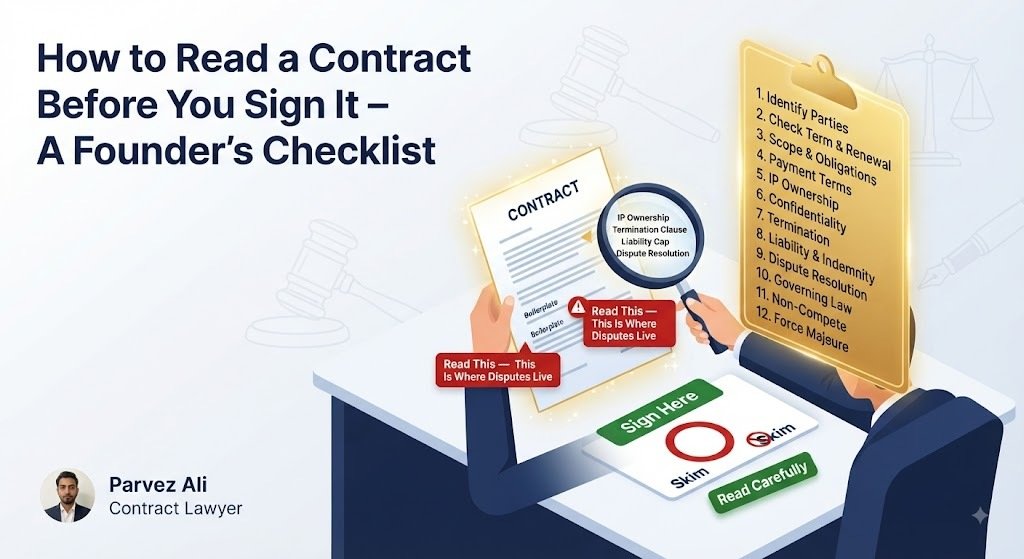
Most founders never learn how to properly read a contract — they learn how to scroll to the signature line. I don’t say that as a criticism; nobody teaches this in business school, and contracts are deliberately written in a register that discourages careful reading. But the gap between skimming a contract and actually reading one is exactly where founders lose leverage, agree to terms they didn’t mean to, and discover clauses they never noticed only once a dispute forces them to reread the document properly for the first time.
This is the checklist I’d want every founder to run through before they read a contract for the final time and sign it — not a substitute for legal review on high-stakes agreements, but the discipline that catches most problems before they ever need to become someone else’s job to fix.
Why Most Founders Read Contracts Wrong
The typical founder reading pattern looks like this: skim the first page for the parties and the deal amount, skip straight to anything in bold or highlighted, and treat everything else as boilerplate not worth the time. The problem is that “boilerplate” is exactly where the clauses that actually matter in a dispute tend to live — termination, liability, dispute resolution, IP ownership. This is exactly the gap between skimming and genuinely learning to read a contract properly: these sections feel unimportant precisely because you rarely need them, right up until the one time you desperately do.
Step 1: Identify the Parties Correctly
Before anything else, confirm exactly who you’re contracting with — the correct legal entity name, not a trading name or a shortened version someone used in email. If you’re signing with “XYZ Technologies Pvt Ltd” but the contract lists “XYZ Tech,” that’s worth clarifying before signing, since enforcing an agreement against the wrong legal entity can become a genuine problem later.
Step 2: Check the Effective Date and Term
Confirm when the agreement actually starts, how long it runs, and whether it renews automatically or requires active renewal. This sounds obvious, but I’ve seen founders assume a contract had ended, only to discover an auto-renewal clause had quietly extended it for another full term.
Step 3: Read a Contract’s Scope and Obligations Carefully
Read the scope of work or deliverables section slowly, and ask yourself whether it actually matches what you discussed verbally or over email. Vague scope language — “reasonable efforts,” “as needed,” “ongoing support” — feels harmless until a dispute over what was actually promised, which is exactly the kind of ambiguity I’ve flagged repeatedly across the clauses covered in my Business Contracts checklist for founders.
Step 4: Check Payment Terms Closely
Confirm the exact amount, currency, payment schedule, and what happens if a payment is late — interest, penalties, or a right to suspend performance. If the contract references milestones or deliverables tied to payment, make sure those are specific enough that both sides would agree, without dispute, on when a milestone has actually been met.
Step 5: Look for IP Ownership Clauses
This is one of the clauses founders most commonly skim past, and one of the most consequential to get wrong. Confirm who owns work product created under the agreement — code, designs, content — and whether IP is assigned to you outright or merely licensed. I’ve written specifically about why this clause deserves careful attention in both Founder Agreements and Employment Contract vs Freelance Agreement, since the default ownership assumption differs significantly between the two relationships.
Step 6: Check Confidentiality Obligations
Look for what information is covered, how long the obligation lasts (including after the relationship ends), and whether it’s mutual or one-directional. I’ve broken down exactly what to look for — including the difference between an NDA and an embedded confidentiality clause — in Confidentiality Agreement vs NDA.
Step 7: Read the Termination Clause
This is genuinely one of the most important sections in any contract, and one of the most commonly skipped. Confirm how either party can end the agreement, what notice is required, and what happens to outstanding obligations — payments owed, work in progress, confidentiality — once it ends. For employment-specific agreements, I’ve covered exactly what’s enforceable around notice periods in Notice Period Clauses – What’s Actually Enforceable in India.
Step 8: Check Liability and Indemnity Clauses
Look for any cap on liability — a maximum amount either party is responsible for if something goes wrong — and any indemnity clause requiring you to compensate the other party for specific losses. These clauses can quietly shift significant financial risk onto you if they’re one-sided, and they’re exactly the kind of provision that reads like harmless boilerplate until you’re the one actually invoking, or defending against, it.
Step 9: Look at Dispute Resolution – Jurisdiction and Arbitration
Check whether disputes go to arbitration or court litigation, and if arbitration, whether the seat, number of arbitrators, and appointment mechanism are actually specified — a poorly drafted arbitration clause can create a fight over the dispute resolution process itself, before your actual dispute is even addressed, as I’ve covered in Arbitration Clause Drafting. Separately, check the jurisdiction clause — which specific courts would hear a dispute — since this is a genuinely distinct question from governing law, explained fully in Jurisdiction Clauses in Contracts.
Step 10: Check Governing Law
Confirm which jurisdiction’s law governs the contract’s interpretation. For most domestic Indian agreements this will simply be Indian law, but it’s worth confirming explicitly rather than assuming, particularly for any cross-border relationship.
Step 11: Look for Non-Compete or Non-Solicitation Restrictions
If the contract restricts you from working with competitors or soliciting clients or employees after the relationship ends, read this section closely — many such clauses are actually far less enforceable than they appear on paper, which I’ve explained in detail in What Makes a Non-Compete Clause Enforceable in India? Don’t assume a restrictive clause is automatically binding just because you signed it, but also don’t assume it’s automatically void — the actual enforceability depends on exactly how it’s drafted.
Step 12: Check for Force Majeure and Auto-Renewal Provisions
Confirm whether the contract has a force majeure clause covering events beyond either party’s control, and whether it’s specific enough to actually protect you — a poorly drafted one can offer far less protection than founders assume, as I’ve covered in Force Majeure Clauses – Do They Actually Protect You?. Also double-check auto-renewal terms here again specifically — this is worth confirming twice, because it’s one of the most commonly missed provisions in contracts founders later regret signing.
Red Flags That Should Make You Pause Before Signing
A few patterns should slow you down while you read a contract, regardless of how much time pressure you’re under to sign:
- Blank spaces or “TBD” placeholders left unresolved in key terms like payment amount or deadlines
- One-sided indemnity or liability clauses that protect only the other party
- Vague, undefined terms doing a lot of work — “reasonable,” “material,” “as agreed” without further clarification
- No clear termination path, or termination rights that only favour the other party
- Restrictive covenants that seem unusually broad, in duration, geography, or scope
- Pressure to sign immediately, without time to actually read or seek review — legitimate counterparties rarely object to a reasonable review period
When Should You Get a Lawyer to Review It?
Not every contract needs a lawyer’s eyes before you sign — routine, low-value agreements you clearly understand don’t necessarily justify the cost and delay. But I’d genuinely recommend a proper review for anything involving significant money, equity, IP ownership, an ongoing multi-year commitment, or unusually complex clauses you don’t fully understand — the same threshold I’ve laid out in more detail in my Business Contracts guide. If you’re ever unsure whether a specific clause matters, that uncertainty is itself a reasonable signal to get it checked, rather than a reason to assume it’s fine.
Frequently Asked Questions
What’s the most important thing to check before signing a contract? There isn’t one single most important clause — but if you read a contract properly, termination, IP ownership, liability, and dispute resolution are the sections most commonly skipped that cause the most damage when something goes wrong.
Should I read every clause of a contract, even the boilerplate? Yes — “boilerplate” sections like termination, liability, and dispute resolution are exactly where the clauses that matter most in a dispute tend to live, precisely because they’re rarely read carefully.
Is it normal to ask for time before signing a contract? Yes, and a legitimate counterparty generally won’t object to a reasonable review period. Pressure to sign immediately without time to actually read a contract is itself a red flag worth taking seriously.
Do I need a lawyer to review every contract I sign? Not necessarily — routine, low-value agreements you clearly understand may not need one. Significant money, equity, IP, long-term commitments, or unusually complex clauses generally warrant a proper review.
What should I check first when I read a contract? Start with the parties (correct legal entity names), the term and renewal structure, and the scope of obligations — these set the foundation for understanding everything else in the agreement.
How do I know if a clause is one-sided or unfair? Compare what obligations, protections, and remedies each party actually has under the same type of clause — if one side carries all the risk or all the restrictions with none of the corresponding protection, that’s worth negotiating or reviewing further.
Are verbal promises outside the contract still binding? Generally no, if the contract includes an “entire agreement” clause, which most do — meaning only the written terms govern, regardless of what was discussed or promised verbally beforehand.
Final Takeaway
Learning to properly read a contract isn’t about becoming a lawyer yourself — it’s about knowing which sections deserve careful attention and which questions to ask before you sign. Run through this checklist on your next agreement, and you’ll likely catch something you would have otherwise skimmed past. For anything that raises a genuine question you can’t answer yourself, that’s exactly the point where a proper review earns its cost.
Have a contract you’d like reviewed before you sign it? Get in touch and let’s go through it together, clause by clause. For a plain-language reference to the terms you’ll run into along the way, see my Contract Law Glossary.
This article is for general informational purposes and does not constitute legal advice. Contract review should be tailored to your specific agreement by a qualified lawyer.