
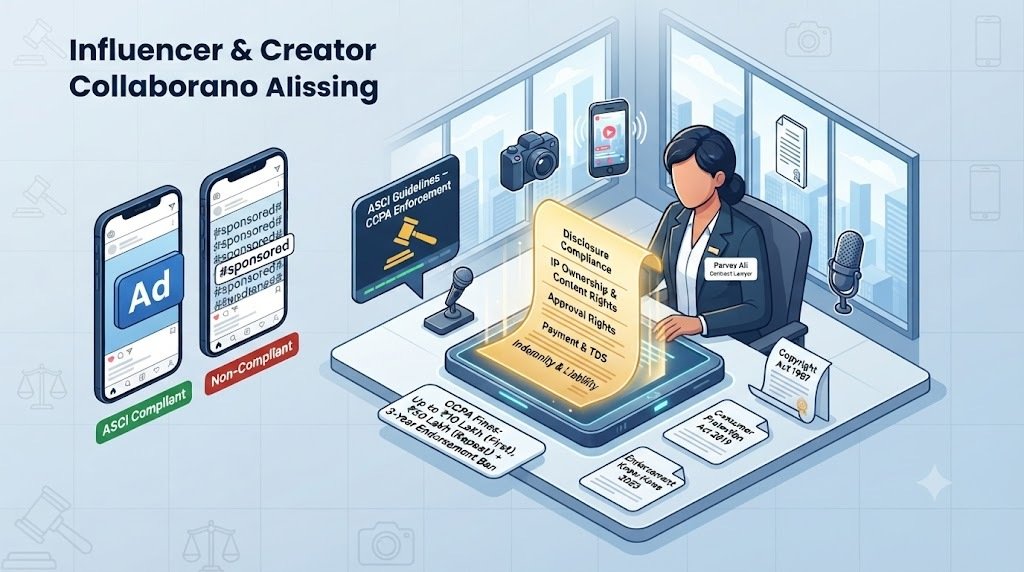
I’ve reviewed a lot of one-page influencer collaboration agreement documents that read more like a friendly DM thread than a contract — “3 reels, ₹50,000, tag us please” — from brands and creators who both genuinely believed that was enough. It rarely is anymore. India’s influencer marketing industry was estimated at roughly ₹1,275 crore in 2023 and is projected to keep growing sharply, and regulators have caught up fast: the Advertising Standards Council of India (ASCI) processed 1,409 influencer violations through November 2025 alone, with 94% involving disclosure failures, and the Central Consumer Protection Authority (CCPA) can now fine violators up to ₹50 lakh and ban them from endorsements for up to three years. A collaboration agreement that doesn’t address disclosure, content ownership, and claim substantiation isn’t just incomplete — it’s leaving both the brand and the creator personally exposed to regulatory action that didn’t really exist as a serious risk even three years ago.
This article covers what a properly drafted influencer collaboration agreement actually needs — the clauses I most consistently see missing, and the regulatory framework now sitting directly underneath this entire industry.
What Is an Influencer Collaboration Agreement?
An influencer collaboration agreement is a contract between a brand (or its agency) and a content creator, governing a paid, gifted, or barter-based promotional arrangement — sponsored posts, product reviews, brand ambassadorships, or affiliate partnerships. It should define exactly what content is being produced, what the creator is being compensated with, who owns the resulting content, and — increasingly non-negotiably — how the mandatory disclosure and endorsement compliance obligations under Indian law get satisfied. It’s also worth confirming the relationship is genuinely structured as an independent engagement rather than something resembling employment, a distinction I’ve covered in Independent Contractor Misclassification in India.
The Regulatory Backdrop – ASCI Guidelines, CCPA, and the Consumer Protection Act
This is the part most older influencer agreement templates simply don’t reflect, because the framework is genuinely recent. In January 2023, the Department of Consumer Affairs released “Endorsement Know-Hows” — official guidelines for celebrities, influencers, and even virtual influencers, requiring disclosure of any “material connection” with a brand, aligned with the Consumer Protection Act, 2019. Separately, ASCI’s Guidelines for Influencer Advertising in Digital Media, first issued in 2021 and updated in August 2023 with additional sector-specific rules for health, finance, and nutrition, set out the detailed mechanics of how that disclosure actually needs to look and function.
Critically, this isn’t merely self-regulatory guidance anymore — the CCPA backs these obligations with real legal teeth. Under the Consumer Protection Act, the CCPA can impose fines of up to ₹10 lakh for a first violation and ₹50 lakh for subsequent violations, and can prohibit an endorser from making endorsements for up to one year on a first offence, extending to three years for repeat violations. This is precisely why a modern influencer collaboration agreement needs to build compliance directly into its terms, rather than assuming it’s the platform’s or the influencer’s problem alone to solve.
Mandatory Disclosure Requirements Influencers and Brands Must Build In
Every collaboration agreement should explicitly require the creator to disclose the commercial relationship, and specify exactly how. Under the ASCI Guidelines and the 2023 Endorsement Know-Hows:
- Approved disclosure labels include “Ad,” “Sponsored,” “Collaboration,” “Partnership,” or “Paid Partnership” — vague phrasing like “thanks to XYZ for this” is explicitly insufficient
- Disclosure must be prominent and upfront — not buried in a cluster of hashtags, not hidden behind a “see more” link, and not relying solely on a platform’s built-in disclosure tool (Instagram’s “Paid Partnership” tag alone is not automatically treated as sufficient)
- Placement varies by format: for images, the label must be superimposed directly over the visual; for video under 15 seconds, it must remain visible for at least 3 seconds; for videos over 2 minutes, it must stay visible for the entire relevant section; for live streams, it must be displayed and repeated continuously throughout
- Barter and gifted collaborations require disclosure too — disclosure is triggered by “anything of value,” not just direct cash payment, meaning a free product sent for review still needs the same disclosure treatment
- Virtual influencers must separately disclose that the audience isn’t interacting with a real human being
A properly drafted influencer collaboration agreement should specify these requirements as express contractual obligations on the creator, not just a general “comply with applicable law” clause — because the specific format, placement, and duration requirements are exactly where most violations actually happen.
IP and Content Ownership – The Clause Most Agreements Get Wrong
This is genuinely the clause I see missing, or badly drafted, most often. By default, under the Copyright Act, 1957, the creator owns the content they produce — the brand doesn’t automatically acquire rights to reuse it just because it paid for the collaboration. I’ve covered this default-ownership principle in more depth in Copyright vs Trademark vs Patent, and the same logic applies directly here: if a brand wants to repost the content, run it as a paid advertisement, or use it across other channels, the agreement needs an explicit copyright licence granting those specific usage rights — it doesn’t happen automatically just because the brand commissioned and paid for the post. This is a similar principle to the one underlying Brand Licensing Agreements, where a licence has to be granted expressly rather than assumed.
Content Usage Rights – Organic vs Paid Amplification
Even where a licence exists, agreements frequently fail to distinguish between different usage scenarios that carry meaningfully different value:
- Organic usage — the content staying on the creator’s own channel, in its original form
- Brand repost rights — the brand resharing the same content on its own organic channels
- Paid amplification / whitelisting — the brand running the creator’s content as a paid advertisement, often under the brand’s own handle or using the creator’s likeness in ad targeting, which typically commands separately negotiated compensation
- Usage duration — whether the licence is perpetual or time-limited, and what happens to previously licensed content once the collaboration ends
Brands that assume a flat fee automatically covers indefinite, unlimited paid amplification rights are usually wrong, and this exact gap is one of the most commonly disputed terms once an agreement’s silence gets tested.
Exclusivity and Non-Compete for Creators
Brands frequently want a creator to avoid promoting competing products for a defined period, but this needs the same careful drafting discipline I’ve written about generally in What Makes a Non-Compete Clause Enforceable in India? — an unreasonably broad or lengthy exclusivity clause risks the same Section 27 enforceability problems that apply to any other restraint on someone’s ability to work. A properly scoped clause should specify the exact competing category, a reasonable duration, and ideally compensate the creator specifically for the exclusivity being granted, rather than treating it as an unpaid extra tucked into the main fee.
Approval Rights and Creative Control
Agreements should clearly specify whether the brand has a right to review and approve content before it’s posted, how many revision rounds are included, and what the timeline is for approval — silence here routinely causes disputes when a brand wants last-minute changes and a creator has already scheduled the post. It’s also worth building in the due diligence obligation ASCI itself imposes on influencers — creators are expected to independently verify that claims made in the content are substantiated, not simply post whatever script the brand provides, especially for health, finance, or nutrition-related claims, where ASCI’s own reporting found that over 70% of flagged content in one recent period involved unsubstantiated or exaggerated claims. Where a brand shares unreleased product details or campaign strategy ahead of a launch, a proper confidentiality clause should sit alongside the approval terms too.
Payment Terms – Cash, Barter, and TDS
Payment terms should specify the exact amount, payment schedule (often tied to content approval or posting confirmation), and whether compensation is cash, product/barter, or a hybrid. For cash payments, TDS obligations apply — brands paying creators for professional services generally need to deduct TDS under the applicable provision, similar to the payment structuring considerations I’ve covered in Employment Contract vs Freelance Agreement, since influencers are functionally independent contractors for tax purposes, not employees.
Due Diligence and Claim Substantiation Obligations
Beyond disclosure, both the ASCI Guidelines and the Consumer Protection Act place a due diligence obligation directly on the endorser — an influencer can be held individually accountable for promoting false or unsubstantiated claims, not just the brand. This principle was reinforced judicially in Marico Ltd. and echoes the Supreme Court’s reasoning in Common Cause v. Union of India (2018), which cautioned that endorsers shouldn’t promote products without verifying accuracy, particularly where health or safety is involved. A well-drafted agreement should require the creator to request supporting evidence for any specific claims the brand wants included, and should avoid requiring the creator to make absolute, unqualified claims (“clinically proven,” “100% safe,” “guaranteed results”) that ASCI has specifically flagged as risky without solid scientific backing.
Liability and Indemnity – Who’s on the Hook If a Claim Is False?
This is where the agreement needs to allocate risk explicitly, rather than leaving it to be sorted out after a CCPA notice arrives. If a brand supplies false or misleading claims and the influencer promotes them in good faith, both parties can face regulatory exposure — the influencer for endorser liability, and the brand for the underlying misleading advertisement. A properly drafted influencer collaboration agreement should include a mutual indemnity structure: the brand indemnifying the creator for claims the brand itself provided and represented as accurate, and the creator indemnifying the brand for their own independent statements or disclosure failures within their control.
Termination and Content Takedown
Agreements should specify what happens if either party wants to end the relationship early — including whether previously posted content must be taken down, whether partial payment is owed for partially completed deliverables, and what happens if a creator becomes embroiled in controversy that could reflect on the brand (commonly handled through a morality or reputation clause). ASCI also requires influencers to retain records of their endorsements for six years, which is worth reflecting in the agreement’s record-keeping obligations on the creator’s side.
What’s Often Missing – A Quick Audit
Pulling this together, here’s what I most consistently find missing from an influencer collaboration agreement brought to me for review:
- No explicit disclosure requirement specifying the exact label, placement, and duration under ASCI’s rules — not just a generic “comply with law” clause
- No copyright licence clause, leaving content ownership and reuse rights completely unaddressed
- No distinction between organic and paid amplification usage, causing disputes the moment a brand wants to run the content as an ad
- No due diligence or claim substantiation obligation on the creator’s side, despite the creator carrying independent legal liability for false claims
- No indemnity allocation for who bears responsibility if a specific claim later turns out to be false or unsubstantiated
- No record-retention requirement, despite ASCI’s six-year documentation expectation
- Barter/gifted collaborations treated as informal, without the same disclosure and contractual rigor applied to paid deals, despite carrying identical regulatory obligations
Frequently Asked Questions
Do influencers need to disclose gifted or barter collaborations, not just paid ones? Yes — disclosure is triggered by receiving “anything of value,” including free products, discounts, or trips, not just direct cash payment.
Who owns the content an influencer creates for a brand collaboration? By default, the creator owns the content under the Copyright Act, 1957. The brand needs an explicit licence in the agreement to reuse, repost, or run the content as a paid advertisement.
Can an influencer be personally fined for a misleading endorsement? Yes — the CCPA can impose fines directly on influencers (up to ₹10 lakh for a first violation, ₹50 lakh for repeat violations) and can ban them from endorsements for up to three years.
What disclosure labels are acceptable under ASCI’s guidelines? Approved labels include “Ad,” “Sponsored,” “Collaboration,” “Partnership,” and “Paid Partnership.” Vague or creative alternatives, and disclosures buried in hashtags, aren’t considered sufficient.
Is using a platform’s built-in “Paid Partnership” tag enough to satisfy disclosure requirements? Not necessarily — ASCI guidelines clarify that relying solely on a platform’s disclosure tool may not be sufficient; a separate, clear disclosure is generally still required.
Can a brand require an influencer not to promote competing products? Yes, through an exclusivity clause, but it needs to be reasonably scoped in duration and category to avoid the same enforceability issues that apply to overly broad non-compete clauses generally.
Is TDS applicable on influencer payments? Generally yes — brands paying creators for promotional services typically need to deduct TDS, similar to payments made to any independent contractor providing professional services.
What happens if an influencer promotes a false claim provided by the brand? Both parties can face exposure — the influencer for endorser liability under the due diligence obligation, and the brand for the underlying misleading advertisement — which is exactly why indemnity allocation matters in the agreement.
How long must influencers retain records of their sponsored content? ASCI’s guidelines require influencers to maintain records of their endorsements for six years.
Are ASCI guidelines legally binding, or just self-regulatory? While ASCI itself is a self-regulatory body, its guidelines are now directly reinforced by the Consumer Protection Act and enforced by the CCPA, which has statutory power to impose real fines and endorsement bans — meaning the practical consequences carry genuine legal weight.
Final Takeaway
An influencer collaboration agreement written before 2023 — or copied from a template that hasn’t caught up since — is very likely missing the disclosure specificity, content licensing clarity, and liability allocation that this industry now genuinely requires. With ASCI actively monitoring and the CCPA backing enforcement with real financial penalties, both brands and creators have direct, personal exposure that a one-page deliverables list simply doesn’t address. Build compliance into the contract itself, rather than assuming it’s someone else’s responsibility to get right.
Structuring an influencer or creator partnership and want the agreement to actually hold up? Get in touch and let’s make sure disclosure, IP, and liability are properly allocated before you sign. For the broader documentation discipline every growing brand needs, see my Business Contracts checklist, Contract Law Glossary, and How to Read a Contract Before You Sign It.
This article is for general informational purposes and does not constitute legal advice. Influencer collaboration agreements should be tailored to your specific arrangement and reviewed by a qualified lawyer.
Written by Parvez Ali.