
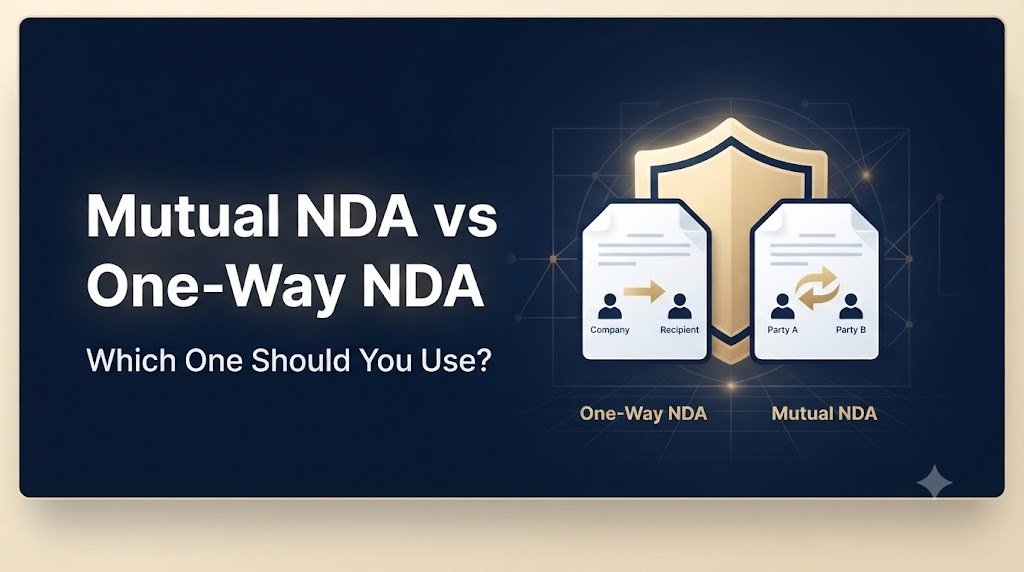
Mutual NDA vs one-way NDA is a question I get asked in nearly every NDA conversation I have with clients, and it’s usually followed by “does it actually matter, or can I just use whichever template I find first?” It genuinely matters. Picking the wrong type doesn’t just create awkward paperwork — it can leave you with confidentiality obligations you never meant to accept, or leave the other party with no real protection at all when they’re the one sharing something sensitive.
I’m Parvez Ali, a contract lawyer, and this guide breaks down exactly how a one-way NDA and a mutual NDA differ, which one fits which real-world situation, and the mistake I see founders make most often when they default to whichever version happens to be sitting in their downloads folder. By the end, the mutual NDA vs one-way NDA decision should take you under a minute to make correctly, for almost any situation you’re likely to face.
What Is an NDA? Quick Refresher
A non-disclosure agreement is a contract that protects confidential information shared between parties, creating a legal obligation not to disclose or misuse it. Before deciding between a mutual NDA and one-way NDA, it helps to understand the two roles every NDA involves:
- The disclosing party — the one sharing sensitive information
- The receiving party — the one receiving it, and taking on confidentiality obligations as a result
The entire mutual NDA vs one-way NDA question comes down to a single thing: how many parties are actually disclosing something confidential, and how many are only receiving? Get that answer right, and the correct NDA type follows naturally. This same disclosing-party/receiving-party framing is exactly what we build on in protecting confidential information when working with freelancers and contractors, where the one-way structure is the default for most engagements.
What Is a One-Way (Unilateral) NDA?
A one-way NDA, also called a unilateral NDA, protects information flowing in a single direction — one party discloses, the other party receives and agrees to keep it confidential. Only the receiving party takes on confidentiality obligations; the disclosing party has none, because they’re not sharing anything sensitive in return.
This is the more common NDA structure in practice, and it fits any situation where the information flow is genuinely one-sided — which, as it turns out, describes most real-world business relationships more often than people initially assume. In the broader mutual NDA vs one-way NDA decision, this is usually where founders should start by default, and only move to a mutual structure if the situation genuinely calls for it, a distinction we cover in more depth in types of contracts every business should know.
What Is a Mutual NDA?
A mutual NDA (sometimes called a bilateral NDA or two-way NDA) protects confidential information flowing in both directions — both parties are disclosing something sensitive, and both take on matching confidentiality obligations toward each other.
This structure fits situations where genuine two-way disclosure is actually happening — not just situations where it feels more “fair” or professional to make both sides sign something equivalent. That distinction matters more than it sounds, and it’s exactly where I see people default to the wrong choice in the mutual NDA vs one-way NDA decision — the same “match the paperwork to the actual relationship, not to what feels formal” principle we emphasize throughout our guide on protecting a startup idea before incorporation.
Mutual NDA vs One-Way NDA: Key Differences
| Factor | One-Way NDA | Mutual NDA |
|---|---|---|
| Who discloses information | One party only | Both parties |
| Who has confidentiality obligations | Receiving party only | Both parties |
| Best fit | Hiring freelancers, pitching to a single buyer, sharing a business plan with a contractor | Partnership talks, joint ventures, vendor relationships with two-way technical exchange |
| Complexity | Simpler, fewer negotiated terms | Slightly more complex, since both sides’ obligations need defining |
| Common risk if used incorrectly | Under-protects a genuinely two-way exchange | Creates confidentiality obligations on your side you didn’t need to accept |
This table is the fastest way to settle the mutual NDA vs one-way NDA question for most situations — if you can clearly place your scenario in one column, you have your answer. For freelancer- and contractor-specific scenarios in particular, our freelance/consultant agreement clauses guide goes deeper into how the NDA sits alongside the rest of the agreement.
When Should You Use a One-Way NDA?
Reach for a one-way NDA whenever you’re the only party actually disclosing anything sensitive:
- Sharing your business plan, product roadmap, or financials with a freelancer or contractor before they start work
- Pitching your idea to a potential investor who isn’t disclosing anything confidential of their own in that conversation
- Sharing internal company information with a new employee during onboarding
- Disclosing pricing or strategy details to a vendor who’s simply quoting you, without sharing anything sensitive back
This is the default choice for most freelancer and contractor engagements specifically — we cover exactly how this fits into the broader confidentiality picture in how to protect confidential information when working with freelancers and contractors, which walks through the full one-way NDA structure most businesses actually need day to day. If none of these scenarios quite match yours, it’s worth revisiting the mutual NDA vs one-way NDA comparison table above before drafting anything.
When Should You Use a Mutual NDA?
Reach for a mutual NDA when both sides are genuinely sharing something confidential:
- Exploring a partnership or joint venture, where each business is disclosing its own proprietary methods, client relationships, or technical details
- A vendor relationship involving two-way technical exchange — not just one side quoting a price, but both sides sharing meaningful proprietary information
- Merger or acquisition discussions, where both companies open their books to some degree during due diligence
- Co-founder discussions before formal incorporation, where each person may be bringing their own confidential prior work, contacts, or ideas to the table
If you’re at this pre-formation, co-founder stage specifically, our guide on how to legally protect a startup idea before incorporation covers exactly where an NDA — mutual or otherwise — fits into the broader sequence of protecting your idea before the company legally exists. Getting the mutual NDA vs one-way NDA choice right at this early stage sets the tone for how seriously the other side takes your paperwork going forward.
Common Scenarios and Which NDA Fits
A quick-reference walkthrough of the mutual NDA vs one-way NDA question across situations founders ask about most:
Hiring a freelancer or contractor: One-way NDA, almost always — you’re disclosing project details and business information; they’re typically not disclosing anything confidential back to you. This is one of the clearest, least-debatable calls in the entire mutual NDA vs one-way NDA decision tree. Our breakdown of freelance/consultant agreement clauses covers how this NDA sits alongside the broader service agreement.
Talking to investors: Usually one-way, though many investors decline to sign any NDA before a first meeting, viewing it as a red flag for investment-readiness. This is a genuine practical limitation worth knowing about ahead of time, not a reason to skip protecting your idea entirely.
Exploring a partnership or joint venture: Mutual NDA, since both businesses are typically disclosing proprietary information to evaluate the potential relationship.
Vendor or supplier relationship: Depends entirely on the information flow — a simple supply arrangement is usually one-way; a technical integration involving both companies’ proprietary systems typically calls for mutual.
Employee onboarding: One-way, since the employer is disclosing internal information the employee needs to do their job, without the employee disclosing anything confidential of their own in return.
Mistakes to Avoid When Choosing Between Mutual NDA and One-Way NDA
Getting the mutual NDA vs one-way NDA decision wrong usually comes down to one of these recurring mistakes:
- Defaulting to mutual “to be fair” or “to look more professional,” when the actual information flow is genuinely one-sided — this needlessly creates confidentiality obligations on your side that you never needed to accept
- Using a one-way NDA when the other party is also disclosing something sensitive, leaving their information genuinely unprotected and creating an imbalanced, easily-contested agreement
- Assuming the NDA type doesn’t matter as long as something is signed — the wrong structure can leave real gaps in protection or create obligations you didn’t intend
- Copying whichever template is easiest to find, without checking whether its structure actually matches your specific relationship — the same generic-template risk we flag across most of the agreements covered in types of contracts every business should know
Frequently Asked Questions
Is a mutual NDA always “safer” than a one-way NDA? No. A mutual NDA that doesn’t match the actual information flow can create unnecessary obligations on your side without adding any real protective value. “Safer” depends on matching the NDA structure to what’s actually being disclosed, not on which version sounds more comprehensive.
Can a one-way NDA be converted to a mutual NDA later? Yes, if the relationship evolves and both parties start disclosing confidential information to each other, the agreement can be amended, or a new mutual NDA can replace the original one-way version.
Do freelancers typically sign a one-way or mutual NDA? One-way, in the large majority of cases, since freelancers are usually receiving confidential project information rather than disclosing anything sensitive of their own.
What happens if I use the wrong type of NDA? At minimum, it creates ambiguity about who’s actually protected. In practice, using a one-way NDA when disclosure is genuinely mutual can leave one party’s confidential information completely unprotected, which defeats the purpose of having an NDA at all — which is exactly why the mutual NDA vs one-way NDA decision deserves a minute of real thought rather than defaulting to a random template.
Is a mutual NDA more expensive to draft than a one-way NDA? Not meaningfully — the core structure is similar, though a mutual NDA does require slightly more careful drafting to ensure both parties’ obligations are clearly and equally defined.
Do investors usually sign NDAs at all? Many don’t, particularly before a first meeting, since some investors view an NDA request as a signal of inexperience. This is worth knowing before you assume an NDA is always obtainable at the pitching stage — regardless of which side of the mutual NDA vs one-way NDA decision applies to your specific pitch, some investors simply won’t sign either version early on. If confidentiality is a genuine concern at that stage, our guide on protecting a startup idea before incorporation covers other protective steps that don’t depend on getting a signature first.
Final Thoughts
Mutual NDA vs one-way NDA ultimately comes down to one honest question: is information genuinely flowing both directions, or just one? Answer that correctly, and the right agreement follows without much further debate. Get the mutual NDA vs one-way NDA call wrong, and you either leave real information unprotected or accept obligations you never actually needed to take on.
If you’re not sure which structure fits your specific situation in the mutual NDA vs one-way NDA comparison — or want either version properly drafted rather than pulled from a generic template — get in touch directly, and I’ll help you get the right one in place before your next sensitive conversation, not after.
This article provides general legal information and does not constitute personalized legal advice. Consult a qualified contract lawyer regarding your specific situation before relying on any guidance here.