
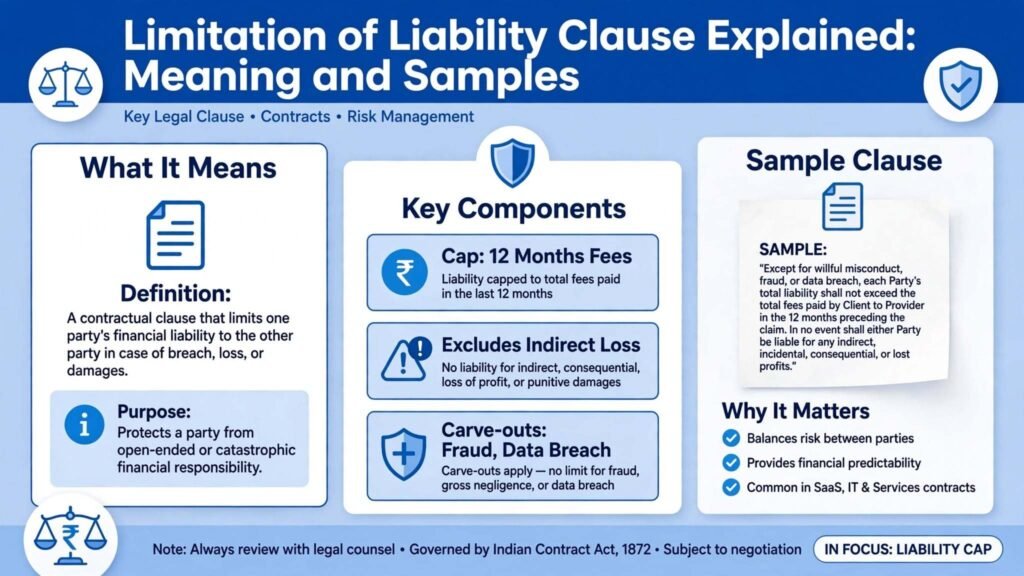
A limitation of liability clause decides, before anything goes wrong, how much the person who caused the damage will have to pay, and for a lot of contracts that number is a small fraction of the harm.
I want to start there because most people read a limitation of liability clause backwards. The vendor reads it as protection and the customer reads it as legal noise. Neither is quite right. It is a price tag on risk. If you are a software company charging ₹2 lakh a month and a bug wipes out a client’s data worth ₹5 crore, someone has to bear the gap, and the limitation of liability clause is where the contract says who. Get it wrong on the vendor side and one bad incident ends the company. Get it wrong on the customer side and you discover, after the incident, that the contract you signed values your loss at twelve months of fees.
This article explains what a limitation of liability clause is, how Indian law treats it (the answer is more nuanced than “courts enforce what you signed”), how it relates to indemnities and liquidated damages, what a working clause looks like with sample wording you can compare to your own, and what to negotiate from either side. I have also included a short worked example with numbers, because that is the part most explainers leave out.
What a limitation of liability clause is
It is a contract term that restricts what one party can be made to pay the other if something goes wrong. In practice a limitation of liability clause does one or more of three separate jobs, and Indian courts treat them differently:
- A cap. A ceiling on the total amount payable, such as “fees paid in the preceding twelve months” or “₹10 lakh”.
- An exclusion of types of loss. A list of things you cannot recover at all, typically indirect or consequential loss, loss of profit, loss of goodwill, loss of data.
- A complete bar on a particular claim. “The Customer shall have no claim against the Vendor for delay.” This is the most aggressive version and the one most open to challenge.
Many contracts use “exclusion clause”, “limitation clause”, “cap” and “waiver” loosely. Keep the three jobs in your head and you will read any of them correctly.
How it differs from an indemnity and from liquidated damages
People mix these up, including in term sheets, so here is the plain difference.
| What it does | Who benefits | |
|---|---|---|
| Limitation of liability clause | Puts a ceiling on, or removes categories of, what can be claimed | The party who might cause loss |
| Indemnity | Promises to cover specified losses, often third-party claims | The party who might suffer loss |
| Liquidated damages (Section 74) | Fixes the amount payable on a specific breach in advance | Both sides, because of certainty |
| Exclusive remedy clause | Says the stated remedy (say, a refund) is the only one | The party who might cause loss |
The two that collide are the first two. If a contract has an indemnity and a limitation of liability clause, the question that decides real money is whether the indemnity sits inside the cap or outside it. Silence is the worst answer, because Indian law has not settled it. We cover the indemnity side in our guide to the indemnification clause, and I would read the two together.
What Indian law says about a limitation of liability clause
There is no Indian statute dedicated to the limitation of liability clause. Enforceability comes from four provisions of the Indian Contract Act, 1872, and from case law that grew around penalties and exclusions.
- Section 73 is the default rule on damages: compensation for loss that arises naturally from the breach or that the parties knew was likely, but not remote or indirect loss. A limitation of liability clause modifies this default.
- Section 74 deals with stipulated sums payable on breach. A named sum is recoverable only to the extent of reasonable compensation, up to the sum stated (Fateh Chand v. Balkishan Dass, Supreme Court, 1963; Kailash Nath Associates v. DDA, Supreme Court, 2015). This matters if your cap is also a liquidated sum.
- Section 23 voids agreements whose object or consideration is opposed to public policy. This is the main route for attacking an exclusion.
- Section 28 voids terms that absolutely restrain a party from enforcing its rights in the ordinary tribunals, and terms that cut the limitation period. A clause that says “no claim can be brought against us” risks falling here.
Outside the Contract Act, the Consumer Protection Act, 2019 lets consumer fora treat unfair terms in consumer contracts as void (section 2(46) defines “unfair contract”), and sector laws and regulators can override what the contract says.
The working distinction: limiting a remedy versus abolishing it
Lawyers who track the case law, including commentators at Legal 500 and Cyril Amarchand Mangaldas, put it this way: courts are generally comfortable with a clause that limits a remedy (a cap, a carve-out for indirect loss) and much less comfortable with one that abolishes it (no damages at all for the other side’s default). That is the pattern in the decisions.
Where the cap was enforced
- In Seth Thawardas Pherumal v. Union of India (Supreme Court, 1955), an exclusion of liability for idle labour and damaged bricks was enforced against a contractor.
- In Bharathi Knitting Co. v. DHL Worldwide Express Courier ((1996) 4 SCC 704, Supreme Court), the Court held a customer to the liability cap printed in a signed consignment note, even though the customer did not appreciate its legal effect. The point to take from this: signing is usually enough.
- In 2024, the Delhi High Court enforced a clause excluding indirect, consequential and lost-profit losses (PLUS 91 Security Solutions v. NEC Corporation India, as reported by Legal 500). In a separate reported ruling the same year, a Delhi High Court Division Bench (Justices Vibhu Bakhru and Tara Vitasta Ganju) held that a tribunal cannot award damages the contract expressly excludes, treating such an award as patently illegal.
- In September 2026, reporting on Conso Feeds v. Alfa Laval (India) (Bombay High Court, Justice Sharmila Deshmukh) described how an arbitrator treated a refund of the plant price as a direct loss outside the cap, but capped the remaining heads of claim at the performance bank guarantee already encashed. The court refused to interfere under Section 34, saying the arbitrator’s reading of the clause was a plausible view. This is a useful case for drafting: the label “direct” or “consequential” decides whether you are inside the cap.
Where it was struck down or read down
- In Simplex Concrete Piles (India) Ltd. v. Union of India (Delhi High Court, 2010), a clause barring damages that the contractor would otherwise get under Sections 55 and 73 was held void under Section 23 as contrary to public policy. The decision has been criticised for treating a bar on delay damages the same way as an exclusion of an entire liability, but it remains cited.
- In Central Inland Water Transport Corporation v. Brojo Nath Ganguly (Supreme Court, 1986) and LIC v. Consumer Education and Research Centre (Supreme Court, 1995), the Court said unconscionable or unfair terms imposed by a dominant party on someone with no real choice can be void under Section 23. The doctrine is not usually applied between commercial parties of comparable bargaining power, but it explains why standard-form contracts get more scrutiny.
- In Simplex Infrastructure v. Siemens (Bombay High Court, 2015), on a prima facie view, wilful misconduct took the case outside the liability cap. I would treat the proposition as settled in practice: a cap does not protect fraud or deliberate wrongdoing, and well-drafted clauses say so.
Where the law is unsettled
The Supreme Court has not resolved the conflict between Ramnath International Construction v. Union of India (2007), which upheld an exclusion of damages for the contractor’s claim, and Asian Techs v. Union of India (2009), where the Court allowed damages in the face of a similar exclusion on the particular facts. Commentators point out that Asian Techs turned on waiver by conduct rather than on the doctrinal question. If you are an advocate arguing either side, you will find authority for your position, and that uncertainty is a reason to put your allocation in unambiguous words.
What a limitation of liability clause cannot do
Reading across the cases and commentary, a limitation of liability clause is vulnerable where:
- it purports to excuse fraud or wilful misconduct;
- it bars damages entirely rather than limiting them;
- it is buried in a standard form presented on a take-it-or-leave-it basis to a weaker party;
- it conflicts with a statute, for example consumer protection or a regulator’s mandatory duty;
- its wording is ambiguous (courts read exclusions strictly against the person relying on them);
- the other side never saw it.
Anatomy of a working limitation of liability clause
Here are the working parts. Missing any one of them in a limitation of liability clause tends to produce a dispute.
1. The cap
Common structures:
- Fees paid in the last 12 months (or 3, or 6). The default for services and software.
- Fees payable in the contract year. Better for the customer in early months.
- A fixed sum, such as ₹10 lakh.
- A multiple of fees, for example 2x annual fees for high-risk services.
- The value of the specific purchase order that caused the loss, common in supply contracts.
One problem the competitor articles I read did not mention: a cap of “fees paid in the preceding 12 months” is nearly zero in month two of a contract. If you are the customer, ask for “the greater of fees paid or payable in the first 12 months and ₹[fixed floor]”. If you are the vendor, accept it if you can price the risk.
2. What the cap applies to
Say whether it covers contract, tort (including negligence) and statutory liability, whether it is per claim or aggregate across the contract, and whether it applies per party. “Aggregate” is more favourable to the person giving the service, and “per claim” to the customer.
3. Excluded losses
The usual list is indirect loss, consequential loss, loss of profit, loss of revenue, loss of goodwill, loss of data, and business interruption. The trouble is that “indirect” and “consequential” are not precisely defined in Indian case law. In Conso Feeds v. Alfa Laval, the dispute was exactly whether a head of loss was direct or consequential. Define the terms in the contract or list the heads of loss you mean.
4. Carve-outs from the cap
Standard exclusions from the cap, in rough order of how often I see them accepted:
- fraud and wilful misconduct;
- death or personal injury caused by negligence;
- breach of confidentiality;
- infringement of intellectual property (often via the indemnity);
- data breach or breach of data protection obligations (often with a higher “super-cap” instead of unlimited liability);
- obligations to pay fees;
- liabilities that cannot lawfully be limited.
5. The super-cap
A super-cap is a higher ceiling for specified risks, such as 3x annual fees or a fixed ₹5 crore for data breach, so that serious risks are covered without exposing the supplier to unlimited loss. This is the compromise that makes most negotiations finish. With India’s data protection law in force, regulatory penalties and notification costs have become the reason this section gets argued over; our guides on DPDP contract clauses and DPDP compliance for investors set out how that risk is being allocated.
6. Interaction with indemnities and liquidated damages
Say expressly whether indemnities, liquidated damages and service credits are inside the cap, outside it, or subject to a separate cap. If service credits are the sole remedy for a service failure, say so; if they are not, say that too. Courts generally enforce the sole-remedy wording as written.
7. Mutuality and prominence
A mutual limitation of liability clause is easier to defend, because it is harder to call unfair when both sides are protected. Make it visible. Capital letters and a heading are not legally required, but where a standard form is used, drawing attention to the clause removes the argument that the other party never saw it.
8. Insurance alignment
A cap that is higher than your insurance is a promise you may not be able to keep. Match the cap to your professional indemnity, cyber and public liability cover, and ask the counterparty to show theirs.
Sample limitation of liability clauses
Sample 1: A basic limitation of liability clause (services)
“Subject to clause [carve-outs], each party’s total aggregate liability arising out of or in connection with this Agreement, whether in contract, tort (including negligence), breach of statutory duty or otherwise, shall not exceed the total fees paid and payable by the Customer under this Agreement in the twelve months immediately preceding the event giving rise to the claim. Neither party shall be liable to the other for any indirect or consequential loss, or for loss of profit, revenue, goodwill or anticipated savings, arising out of or in connection with this Agreement, whether or not foreseeable.”
It is mutual, covers contract and tort, and has both a cap and an exclusion. The weak spot is the twelve-month look-back, which can be near zero early in the engagement.
Sample 2: A SaaS limitation of liability clause with carve-outs and a super-cap
“Nothing in this Agreement limits or excludes liability for (a) fraud or wilful misconduct, (b) death or personal injury caused by negligence, or (c) any liability that cannot be limited under applicable law. The Vendor’s total aggregate liability for breach of its data protection and security obligations shall not exceed the greater of three times the annual fees and ₹[amount]. The Vendor’s total aggregate liability for all other claims shall not exceed the annual fees. Indemnities in clause [x] are subject to the cap in this clause.”
Customers should check the last sentence: here, the indemnity is inside the cap. A customer who wants unlimited IP indemnity has to change that. The vendor view: it is fair to cap IP indemnity at a multiple, not leave it open.
Sample 3: A customer-friendly limitation of liability clause
“The Supplier’s liability for loss of or damage to the Customer’s data, for breach of confidentiality, and for third-party intellectual property claims is unlimited. The Supplier’s liability for all other claims shall not exceed the greater of ₹[amount] and 150% of the total contract value. The exclusion of indirect and consequential loss does not apply to costs of data recovery, regulatory fines, notification costs and the reasonable cost of procuring replacement services, which the parties agree are direct losses.”
This does something I would encourage any customer to copy: it states which losses count as direct, which avoids the Conso Feeds type of argument.
Sample 4: A freelancer’s limitation of liability clause
“The Consultant’s total liability under this Agreement, whether in contract, tort or otherwise, shall not exceed the fees actually paid to the Consultant for the specific project giving rise to the claim. The Consultant is not liable for indirect or consequential loss or loss of profit.”
A freelancer without a cap can be sued for far more than a project fee. The same applies to agencies. Read this next to our guide on freelance agreement clauses. Clients will often push for a higher cap or insurance in return.
Sample 5: A website terms-of-service limitation of liability clause
“To the extent permitted by law, we are not liable for indirect or consequential loss arising from your use of the website. Nothing in these terms limits liability that cannot be limited by law, including liability under consumer protection law.”
The second sentence is not decoration. Consumer contracts face the unfair contract provisions of the Consumer Protection Act, 2019, so absolute exclusions in website terms are the ones that tend to fail. For how this fits with the rest of your site documents, see terms of service vs privacy policy.
A worked example of a limitation of liability clause with numbers
Take an Indian software company, Vendor, and a logistics business, Customer.
- Contract: ₹3 lakh a month. Annual fees ₹36 lakh.
- Clause: cap at fees paid in the preceding 12 months; exclusion of indirect and consequential loss; carve-outs for fraud and data breach, with a super-cap of 3x annual fees.
- Incident: in month 8, an outage causes the Customer to miss shipments. Direct costs (refunds, re-shipping, staff overtime): ₹18 lakh. Lost contracts and reputational damage: ₹2 crore.
What can the Customer recover?
- The ₹2 crore of lost contracts is likely excluded as indirect or consequential loss or loss of profit.
- The ₹18 lakh in direct costs is within the cap. Fees paid in the preceding 12 months are only eight months’ worth, ₹24 lakh, so the cap is ₹24 lakh and the claim fits.
- If the Customer had asked for “fees paid or payable in the contract year”, the cap would have been ₹36 lakh. Better, though not needed here.
- If the outage was caused by the Vendor’s data breach, the super-cap of ₹1.08 crore applies instead.
Now change one fact. If the outage happened in month 2, “fees paid” would be ₹6 lakh and the Customer’s ₹18 lakh direct claim would be cut by two-thirds. That is the point at which a customer wishes it had negotiated a floor.
Negotiation checklist for a limitation of liability clause
If you are the supplier or service provider:
- Insist on a cap in the limitation of liability clause and make it mutual.
- Exclude indirect and consequential loss and loss of profit, and define them.
- Keep carve-outs short and specific, and put a super-cap in place of unlimited liability wherever you can.
- State whether indemnities are inside the cap.
- Match the cap to your insurance.
- Make sure the clause is in the signed document, not only in linked terms the customer may say it never saw.
If you are the customer:
- Ask for a floor so the cap is not near zero early on.
- Ask for carve-outs for fraud, wilful misconduct, confidentiality, data breach and IP.
- List the losses you expect to be treated as direct: data recovery, regulatory fines, replacement cost.
- Check the exclusive remedy clauses. If service credits are your only remedy, understand the numbers.
- Ask what insurance the supplier has.
- Do not accept a one-way clause that protects only the supplier unless the price reflects it.
If you are a founder: list every contract where you are the supplier, and write down the maximum you could owe in each. If you cannot answer, your risk is unpriced. The legal checklist for Indian startups is a good place to start, the contract law glossary explains the vocabulary, and where a supply chain event is the risk, read our article on the force majeure clause alongside this one. If you would like a second opinion on a draft, contact us or browse the startup legal section.
Mistakes I see repeatedly in a limitation of liability clause
Copying a US or UK template. A limitation of liability clause written for English law assumes statute and case law (including a statute that regulates the reasonableness of exclusions) that India does not have in that form. In India, check the clause against Sections 23, 28, 73 and 74.
Assuming the cap in your limitation of liability clause applies to everything. Unless the contract says so, it may not cover indemnities or liquidated damages, and it will not cover fraud.
Relying on a clause the other side never saw. Linked terms and click-through terms are enforceable in principle, but you want a record that the counterparty accepted them.
Forgetting statutory liability. A regulator’s penalty, a duty under consumer law, or a safety obligation cannot be contracted away. A limitation of liability clause may govern what you can recover from your counterparty, not what the regulator can impose on you.
Treating the cap as the number you will actually pay. Legal fees, internal costs and reputation come on top.
Frequently asked questions
1. What is a limitation of liability clause in simple words?
A limitation of liability clause is a contract term that sets a ceiling on how much one party can be made to pay the other if something goes wrong, or removes certain types of loss from what can be claimed. Common examples are a cap equal to fees paid in the last twelve months and an exclusion of indirect or consequential loss.
2. Is a limitation of liability clause enforceable in India?
Generally yes, between commercial parties, when it limits liability rather than abolishing it. The Supreme Court enforced a liability cap in Bharathi Knitting v. DHL (1996). Clauses that bar damages entirely, excuse fraud or wilful misconduct, or are imposed through unfair standard forms are vulnerable under Section 23, Section 28 or consumer law.
3. What is the difference between a limitation of liability clause and an indemnity?
A limitation of liability clause protects the party who might cause loss by capping or excluding what can be claimed. An indemnity protects the party who might suffer loss by promising to cover specified losses. The practical question is whether the indemnity sits inside or outside the cap, which the contract should state.
4. Can a limitation of liability clause exclude fraud or gross negligence?
Not safely. Courts treat fraud and wilful misconduct as outside any cap, as in the Bombay High Court’s prima facie view in Simplex Infrastructure v. Siemens (2015). Gross negligence is less settled, so many contracts carve it out expressly. Death and personal injury from negligence are usually carved out as well.
5. What is a typical liability cap?
The most common cap in services and software is the fees paid or payable in the preceding twelve months. Others are a fixed sum, a multiple of annual fees, or the value of the purchase order. Higher caps or super-caps are used for data breach, confidentiality and IP. There is no legal standard; the number should reflect price and insurance.
6. Does a limitation of liability clause cover indemnity claims?
Only if the contract says so. Indian law has not settled whether a general cap applies to an indemnity, so state it. See our guide to the indemnification clause for how the two interact.
7. What does “indirect or consequential loss” mean?
It generally means loss that does not flow directly from the breach, such as lost contracts or reputational damage, as opposed to the direct costs of putting things right. Because the line is argued in every case (it was the issue in Conso Feeds v. Alfa Laval), define the terms or list the heads of loss in the contract.
8. Can an arbitrator ignore a limitation of liability clause?
Not safely. Delhi High Court rulings in 2024 treated an award of damages that the contract expressly excluded as patently illegal under Section 34 of the Arbitration and Conciliation Act, 1996, and the Bombay High Court’s Conso Feeds decision shows courts defer to an arbitrator’s reasonable reading of the clause, which can cut either way.
9. Does a limitation of liability clause apply to consumers?
It can, but consumer contracts face stricter scrutiny. Under the Consumer Protection Act, 2019, unfair terms in a consumer contract can be declared void, so absolute exclusions in website terms of service are risky. Use “to the extent permitted by law” and do not exclude liability that statute does not allow you to exclude.
10. Who benefits from a limitation of liability clause?
Usually the supplier or service provider, because it is the party more likely to cause loss. A customer benefits if the clause is mutual, if the cap is high enough to cover realistic loss, and if carve-outs exist for fraud, data breach and confidentiality. A well-negotiated limitation of liability clause is one both sides can price.
This article is general information, not legal advice. Contract terms and applicable law vary, so check your own draft or take advice before you sign.