
An indemnification clause is the part of a contract where one side promises to cover the other side’s losses if a specific thing goes wrong, and it is usually the single most expensive sentence in the document that nobody argued about.
I say that because of how contracts actually get signed. The commercial terms get negotiated for weeks. The indemnity sits near the end, in dense capitals, and the person reviewing it at 9 pm is thinking about whether the payment schedule works. Then, two years later, a customer’s lawyer relies on the indemnification clause and sends a notice saying “pursuant to clause 14.2, you are required to indemnify us”, and the number on it is five times the fee you were paid.
This article explains what an indemnification clause does under Indian law, how it differs from a damages claim and from a guarantee, what the clause looks like when it is badly drafted and when it is well drafted, and how to negotiate one from either side. There are real clause examples throughout, so you can compare them with the one sitting in your own contract.
What an indemnification clause means, in plain terms
To indemnify someone is to make them whole for a loss. The party giving the promise is the indemnifier. The party receiving it is the indemnified party (some contracts say indemnitee or indemnity holder; they all mean the same person).
A bare-bones indemnification clause looks like this:
“The Vendor shall indemnify and hold harmless the Customer against all losses, damages, costs and expenses (including reasonable legal fees) arising out of any third-party claim that the Services infringe that party’s intellectual property rights.”
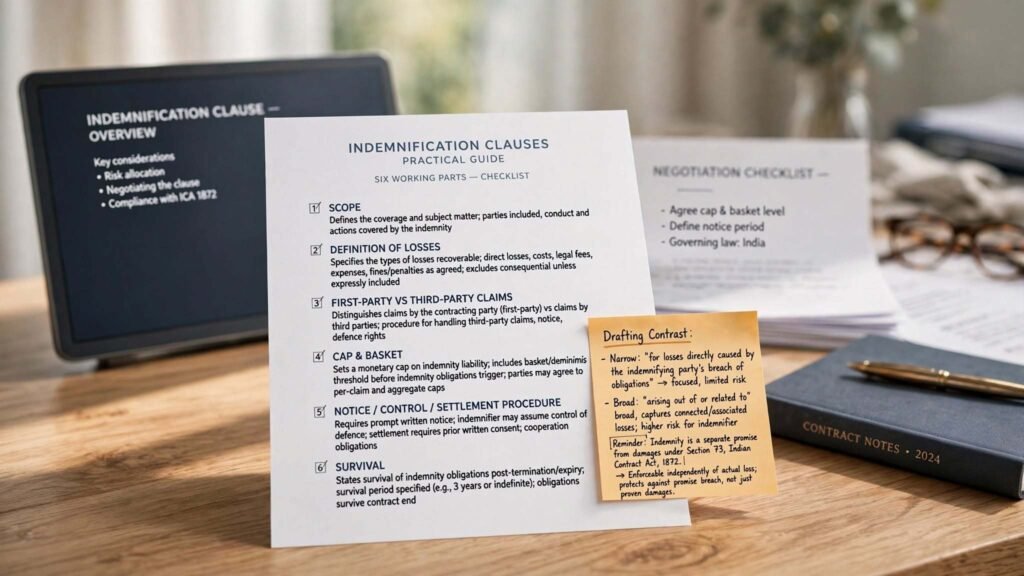
Break it into its working parts:
- Who pays: the Vendor.
- Who is protected: the Customer.
- What triggers it: a third party claiming the Services infringe their IP.
- What is covered: losses, damages, costs, legal fees.
Every indemnification clause you will ever read is a variation on these four. When one goes wrong, it is usually because one of the four was left vague, or because a fifth thing nobody wrote down (the cap, the notice procedure, who controls the defence) turned out to matter more.
“Hold harmless” appears next to “indemnify” in almost every clause. In practice, courts and lawyers treat the pair as doing the same job. The point of having both is belt and braces: indemnify means pay me back; hold harmless means do not let this land on me at all. If you are the party the indemnification clause protects, keep both words. If you are the one giving the promise, do not waste negotiating capital arguing about the difference.
What Indian law says: Sections 124 and 125
Indian statute law on indemnity is two sections long.
Section 124 of the Indian Contract Act, 1872, defines a contract of indemnity as a contract by which one party promises to save the other from loss caused to him by the conduct of the promisor himself, or by the conduct of any other person.
Section 125 says what the indemnity holder can recover from the promisor, and the conditions are the part people miss. The holder can claim:
- Damages he is compelled to pay in any suit on a matter covered by the indemnity.
- Costs he is compelled to pay in that suit, but only if bringing or defending it did not go against the promisor’s orders and he acted as would be prudent in the absence of any indemnity, or if the promisor authorised the suit.
- Sums paid under a compromise of the suit, if the compromise was not against the promisor’s orders and was prudent, or if the promisor authorised it.
Read that again, because it has teeth. If you are the indemnified party and you settle a third-party claim quietly, without telling the indemnifier, you may find the indemnifier declines to reimburse you because you did not follow its instructions or the settlement was not prudent. That is the statutory default. A good indemnification clause replaces the default with a procedure: notice within X days, indemnifier controls the defence, no settlement without consent, and consent not to be unreasonably withheld. We come back to this in the drafting section.
The statute is narrower than the clauses people write
Section 124 talks about loss caused by conduct, by the promisor or by another person. Commercial indemnities routinely cover things that are not anyone’s conduct: a change in law, a tax demand, a regulatory penalty, a defect in title, a warranty that turns out to be untrue.
Commentators have pointed out that this gap exists, and that Indian courts have dealt with it by treating the statute as not exhaustive. The Bombay High Court’s decision in Gajanan Moreshwar Parelkar v. Moreshwar Madan Mantri (1942) is the foundation. It held that the Contract Act’s definition does not cover the whole field, and that English equitable principles of indemnity continue to apply where they do not conflict with the Act. A Bar & Bench column by Sanjeev Gemawat calls this case the cornerstone of Indian indemnity law, and argues that the Supreme Court has not yet issued an authoritative restatement and that Sections 124 and 125 need updating for modern commercial practice. The practical consequence: a well-drafted express indemnification clause gets enforced as written, but how far courts will follow it into unusual territory (caps, remoteness, mitigation) is less settled than you would like.
An indemnity is a separate promise
The Supreme Court has described a contract of indemnity as an independent and separate contract in Deepak Bhandari v. Himachal Pradesh State Industrial Development Corporation (the sources I checked differ on the year, and I have seen both 2010 and 2014, so cite from the judgment itself). The point is that an indemnity is not just a remedy for breach of the main contract; it is its own obligation with its own triggers. This is why you can sometimes claim under an indemnity when you could not claim damages.
Indemnity versus damages: the difference that decides cases
Lawyers argue about this constantly, and not for sport. The answer changes how much you can recover.
| Damages for breach (Section 73) | Indemnity | |
|---|---|---|
| Trigger | The other side broke the contract | The event you named in the clause happened, whether or not anyone broke anything |
| Who caused the loss | The party in breach | Anyone, including a third party |
| Remoteness | Loss must be a natural result of the breach or foreseeable by both parties | The usual remoteness limits are argued not to apply in the same way, so consequential loss can be recovered unless the contract excludes it |
| Mitigation | Claimant must take reasonable steps to reduce loss | Indian law is unsettled on whether a duty to mitigate applies, so write it in |
| Timing | After the loss is suffered | Indian authority supports claiming once liability is absolute, even before you have paid |
| Proof of loss | Actual loss must be shown | Lower threshold, though there is no authoritative statement requiring or excusing proof of actual loss |
A caution on that table. Nishith Desai Associates’ note on this topic, which I found the most careful of the commentary, treats several of those points as inferences rather than settled law. I have presented them the way it did.
The timing point is worth a short explanation, since it is the most useful one for a client. In Gajanan Moreshwar, the court said the indemnity holder does not have to wait until he has actually paid. Once his liability has become absolute, the indemnifier can be compelled to cover it. The Privy Council took the same approach in Osman Jamal and Sons v. Gopal Purshottam, and the Bombay High Court discussed whether a holder can sue before any actual loss in Khetarpal Amarnath v. Madhukar Pictures (1956). If you are the indemnified party, this helps you; if you are the indemnifier, it means a claim can reach you before a court has decided anything about the underlying dispute.
On remoteness and caps, Fateh Chand v. Balkishan Dass (Supreme Court, 1963), which sits under Section 74, held that a penalty-type stipulation is enforceable only to the extent of reasonable compensation. How that applies to an uncapped or oversized indemnification clause is not clear. If it is oversized, an indemnifier may argue Section 74. An indemnified party will argue that an indemnity is not a liquidated damages clause at all. Neither side has a clean authority, and that uncertainty is itself a reason to put a sensible cap in writing instead of leaving a judge to find one.
Indemnity versus guarantee, in one paragraph
People mix these up, including in startup deal documents. An indemnity (Section 124) is a two-party promise to cover loss. A guarantee (Section 126) is a three-party arrangement: a creditor, a principal debtor and a surety who promises to perform if the debtor does not. The practical difference is that an indemnity is primary, because the indemnifier’s own promise is what you sue on. A surety’s liability is secondary, because it depends on the principal debtor defaulting. If you have signed as a personal guarantor on a company’s loan, you are not giving an indemnity, and our article on personal guarantor liability in insolvency explains why that matters.
The six working parts of an indemnification clause
Treat these as a checklist for any indemnification clause. When I review a contract, I look for each of these and note which one is missing.
1. Scope: what events are covered
This is where fights start. Compare:
Narrow: “…arising from the Vendor’s gross negligence or wilful misconduct.”
Medium: “…arising from any third-party claim that the Services infringe intellectual property rights.”
Broad: “…arising out of or related to the Services or this Agreement.”
The broad version is the one that hurts. “Arising out of or related to” has no fault qualifier, so it can cover a loss you did not cause. Commentary on drafting points out that courts read “arising out of” broadly, while “as a result of” is read more narrowly. If you are protected by the clause, prefer the broad words. If you are giving it, push for “to the extent caused by” so that your liability tracks your own fault.
2. What counts as a loss
Does “Losses” include legal fees, regulatory penalties, loss of profit, loss of data, the cost of fixing the problem, management time? A good indemnification clause defines Losses, and defines it inclusively (“Losses includes, without limitation…”) if you are the protected party. If you are the indemnifier, you want a closed list and an express exclusion for indirect and consequential loss.
3. First-party versus third-party claims
This catches founders out more than any other point. A third-party indemnity covers claims brought by someone outside the contract: a customer’s customer, a regulator, an IP owner. A direct-loss indemnity covers what one party suffers itself when the other party fails. Most vendor indemnities are third-party only, and that is what the protected party should check. If the indemnification clause only covers “third-party claims”, you cannot use it to recover your own direct loss. For that you go back to damages.
4. The cap and the basket
The cap is the ceiling on what the indemnifier pays under the indemnification clause. The basket (or deductible, or threshold) is the amount of loss that has to build up before any claim can be made. Examples:
- Cap at fees paid: “Total liability under this clause shall not exceed the fees paid in the twelve months before the claim.” Common in services and software.
- Super-cap: a higher ceiling for serious categories such as data breach or IP infringement, for example three times the annual fee.
- Uncapped carve-outs: fraud, wilful misconduct and sometimes IP infringement are commonly left outside any cap.
- Per-claim threshold: claims below ₹50,000 cannot be made, which screens out nuisance claims.
- Aggregate basket: the first ₹5 lakh of total loss is borne by the claimant; above that, the claimant can recover the whole amount (a “tipping” basket) or only the excess (a “true deductible”).
Whether the cap in a limitation-of-liability clause actually limits the indemnification clause is itself a question Indian law has not answered cleanly. The Bar & Bench column lists it among the open points. So say so in the contract: “The cap in clause 12 applies to this clause 14” or “does not apply”. Do not leave it to inference.
5. Procedure: notice, control and settlement
This is where Section 125 hides. A workable procedure covers:
- Notice within a fixed number of days of learning of the claim, with a rule that late notice only reduces recovery to the extent the indemnifier was actually prejudiced, so a one-day delay does not forfeit everything.
- Control of the defence by the indemnifier, with the right to choose counsel.
- No settlement admitting fault or imposing non-monetary obligations without the protected party’s consent.
- Cooperation by the protected party, at the indemnifier’s cost.
- Mitigation, which Indian law does not impose by default on an indemnity, so write it in.
- Payment within a fixed period of a claim being agreed or determined.
6. Survival and limitation
How long can a claim be made? In a services agreement, survival of the indemnity until the agreement ends plus the limitation period is common. In an acquisition, representations often survive for a fixed term (a typical range is 18 to 36 months, longer for tax and title) and fundamental warranties survive longer. The Nishith Desai note gives three years after closing as an example of a survival period for breaches of representations. Be explicit about whether the contractual period replaces or sits alongside the statutory limitation period, and about when time starts. Commentators flag when limitation begins for an indemnity claim as an open question, which is another reason to write the answer in.
Indemnification clause examples you can compare against your own
Example 1: SaaS and IT services (the one-way vendor indemnification clause)
“Vendor shall defend the Customer against any third-party claim alleging that the Services, as provided by Vendor, infringe an Indian or foreign patent, copyright, trademark or trade secret, and shall pay all damages and costs finally awarded or agreed in settlement. Vendor has no obligation for claims arising from (a) Customer’s modifications, (b) combination with items not supplied by Vendor, or (c) use contrary to the documentation. If the Services become subject to such a claim, Vendor may procure the right to continue use, modify the Services so they are non-infringing, or terminate the affected Services and refund prepaid fees.”
Why it works: it is limited to third-party IP claims, it has fair exclusions for things the customer did, and it gives the vendor a way out through repair or refund. If you sell software, this is the indemnification clause you want to be offering. If you buy software, check whether open-source components are excluded, because that is a common gap.
Example 2: A broad indemnification clause that should make you pause
“Contractor shall indemnify the Company against all losses of any kind arising out of or related to the Contractor’s engagement.”
Nothing in this indemnification clause limits it to the contractor’s own conduct. A loss the company suffers because its own director gave bad instructions is, on a literal reading, covered. There is no cap, no definition of loss and no procedure. I see this in consulting and freelance agreements all the time, and the freelancer rarely notices. Our guide to freelance agreement clauses covers how to push back.
Example 3: A balanced, mutual indemnification clause
“Each party (the ‘Indemnifying Party’) shall indemnify the other against third-party claims to the extent arising from (a) the Indemnifying Party’s breach of confidentiality, (b) its infringement of third-party intellectual property rights by materials it supplied, or (c) its gross negligence or wilful misconduct. The Indemnifying Party’s liability under this clause is capped at the greater of ₹[amount] and fees paid in the preceding twelve months, except for fraud and wilful misconduct, which are uncapped. The Indemnified Party shall give written notice within 15 days of becoming aware of a claim; late notice relieves the Indemnifying Party only to the extent of actual prejudice. The Indemnifying Party controls the defence but shall not settle any claim in a way that admits fault on the Indemnified Party’s behalf without its consent, which shall not be unreasonably withheld.”
This indemnification clause has all six working parts. “To the extent arising from” ties liability to fault. The cap is defined and has carve-outs. There is a fair procedure.
Example 4: Acquisition or investment (warranty indemnification clause)
“The Promoters shall, jointly and severally, indemnify the Investor and the Company against all Losses arising from (a) any breach of the Warranties, (b) any tax liability relating to periods before Closing, and (c) any claim in respect of title to the Shares. Claims under (a) must be notified within 24 months of Closing, other than Fundamental Warranties and tax claims, which may be notified within the applicable statutory limitation period plus 90 days. The aggregate liability of the Promoters under (a) shall not exceed [x]% of the Investment Amount.”
Indian deal documents usually give investors an indemnification clause of this kind, because a bare breach of warranty claim leaves them to prove loss and foreseeability. “Jointly and severally” is the phrase to read slowly: it lets the investor pursue any one promoter for the whole amount. If you are a founder, negotiate several (not joint) liability and a cap tied to what each person received. For the share forfeiture mechanics that sit next to this, see our piece on the bad leaver clause.
Example 5: A data protection indemnification clause
“Processor shall indemnify Controller against penalties, third-party claims and notification costs to the extent caused by Processor’s breach of the data protection obligations in this Agreement.”
This is a modern indemnification clause that older templates lack. With India’s data protection law in force, who bears the cost of a breach is a question every vendor contract now has to answer. See our guides on DPDP contract clauses and DPDP compliance in due diligence. On the related question of liability for third-party AI models, read our article on the AI indemnity trap.
Mistakes I see most often
Signing a one-way indemnification clause because the other side is bigger. A mutual indemnification clause is not always available, but a one-way indemnification clause with no cap almost never needs to be accepted as written. Ask for a cap. The worst they can say is no.
Assuming the cap in the liability clause covers the indemnification clause. Check whether the contract says so. Many say the opposite, listing indemnities as exclusions from the cap. If it is silent, you are in the unsettled area described earlier.
Forgetting the insurance link. An indemnification clause is only as good as the indemnifier’s ability to pay. A promise of ₹5 crore from a company with ₹20 lakh in the bank is a promise to pay ₹20 lakh. If the exposure is real, ask for matching insurance and make sure the policy actually covers contractual liability. For directors and officers, note that the Companies Act, 2013 limits a company’s ability to indemnify its own officers against their negligence or breach of duty, while allowing it to buy insurance (the provision is in Section 197, which I mention so you can check it, not so you can rely on my summary).
Using an indemnification clause for something illegal. An indemnity cannot be used to shift the consequences of a deliberate unlawful act or fraud. A promise to cover loss from the promisee’s own fraud or crime is open to attack as opposed to public policy, and a sensible indemnification clause carves fraud and wilful misconduct out expressly.
Ignoring cross-border payments. If the indemnifier is Indian and the beneficiary abroad, payments out of India raise FEMA questions. One commentator argues that indemnity payments are current account transactions and can be remitted, but notes banks often seek RBI clarification in practice. Plan for the paperwork.
Skipping stamp duty on the indemnification clause. Stamp duty rules are state-specific, and one commentary says an indemnity can attract its own duty in addition to the main agreement. Check the stamping of both the agreement and any separate indemnity bond with a local lawyer. An unstamped instrument is a real obstacle at the enforcement stage.
A negotiation checklist for either side
If you are the party being protected:
- Use “indemnify and hold harmless”, and define Losses inclusively, with legal fees.
- Prefer “arising out of” to “as a result of”.
- Make payment triggered by written notice of a claim, not only by final judgment.
- Keep fraud, wilful misconduct, IP infringement and data breach outside or above any cap.
- Insist on a defence procedure that you can live with and a short, fixed payment deadline.
- Ask for evidence of insurance.
If you are giving the indemnity:
- Limit scope to your own fault (“to the extent caused by”).
- Close the definition of Losses and exclude indirect and consequential loss.
- Set a cap, a per-claim threshold and a survival period.
- Add a duty to mitigate and exclude losses already covered by insurance, so there is no double recovery.
- Reserve the right to control the defence and settlement.
- Get the exclusions in writing: modifications by the other party, misuse, combination with other products, and the other party’s own negligence.
If you are a founder: before you sign anything with a customer, an investor or a landlord, find every instance of the word “indemnify” and write down what the maximum exposure is. If you cannot answer, the contract is not ready. Our legal checklist for Indian startups puts this in the context of everything else that needs checking, and the contract law glossary explains the terms used here. If you want a second pair of eyes on a specific draft, contact us or browse the startup legal section.
Frequently asked questions
1. What is an indemnification clause in simple words?
An indemnification clause is a promise in a contract that one party will cover the other party’s losses if a specified event happens, such as a third party suing over intellectual property infringement. It names who pays, who is protected, what triggers the promise and what losses are covered. It is a separate promise from the main performance obligations.
2. What does Section 124 of the Indian Contract Act say?
Section 124 defines a contract of indemnity as one where a party promises to save the other from loss caused by the promisor’s own conduct or the conduct of any other person. Courts, starting with the Bombay High Court in Gajanan Moreshwar Parelkar (1942), have treated the section as not exhaustive, so a commercial indemnification clause that goes beyond human conduct is still enforced.
3. What can an indemnified party recover under Section 125?
Damages it is compelled to pay in a suit on a covered matter, costs it is compelled to pay in that suit (subject to conditions about the promisor’s orders and prudence), and sums paid under a compromise (again subject to conditions). The conditions on costs and compromise are why a clause should set out a notice and consent procedure.
4. What is the difference between indemnity and damages?
Damages compensate for loss caused by a breach, subject to the remoteness and mitigation rules in Section 73. An indemnity is a separate promise that can cover losses caused by third parties and events that are not breaches, and commentary suggests it is not hemmed in by the same remoteness rules. Indian authority is not settled on every point, so draft the exclusions you want.
5. Can I claim indemnity before I have suffered an actual loss?
Indian authority points that way. In Gajanan Moreshwar the Bombay High Court said the holder need not wait until he has paid, and can call on the indemnifier once his liability is absolute. The Privy Council took a similar approach in Osman Jamal. In practice, state the trigger in the indemnification clause: payment on written notice of a claim, not only after judgment.
6. What is the difference between an indemnity and a guarantee?
An indemnity under Section 124 is a two-party promise to cover loss, and you sue the indemnifier on its own promise. A guarantee under Section 126 involves three parties, and the surety’s liability is secondary to the principal debtor’s default. Guarantees raise different issues, such as discharge of the surety.
7. Should an indemnification clause have a cap?
Almost always, yes. A cap makes the risk priceable and insurable. Typical structures are a cap at fees paid in the previous twelve months, a higher super-cap for data breach or IP claims, and uncapped carve-outs for fraud and wilful misconduct. State expressly whether the general limitation-of-liability cap applies to the indemnity, since Indian law has not clearly answered that.
8. What is a mutual indemnity?
A mutual indemnity means each party indemnifies the other for the losses caused by its own specified failures, such as confidentiality breaches, IP infringement by materials it supplied or gross negligence. It is fairer than a one-way clause when both sides bring risk to the deal, and is the usual position between businesses of equal bargaining power.
9. Is an indemnification clause enforceable if it is very broad?
Often, yes, if it is clear and the parties are commercial entities. But overbroad indemnities can be challenged for ambiguity, as penal under Section 74 where they work like a fixed sum, or as against public policy where they cover fraud or illegality. A narrower, capped indemnification clause is easier to enforce and cheaper to defend.
10. How long does an indemnity claim last?
It depends on the indemnification clause and the law. A contract can set a survival period, such as 18 to 36 months for warranty claims in an acquisition, and longer for tax or title. The statutory limitation period still applies, and when time begins to run for an indemnity claim is an open question, so state the start date and the notice deadline in the contract.
This article is general information, not legal advice. Check your own contract and the current law, or get advice before you sign.