
The same non-compete clause that a London employer can sometimes enforce will be void in California, unpaid and therefore dead in Germany, banned in Ontario for most staff, and not worth the paper in India once the job has ended.
That one sentence is the whole subject. There is no global rule. What exists is three broad camps, and a visible drift from the permissive camp toward the restrictive one. If you employ people in more than one country, hire remotely, or are about to sign a contract written for a different jurisdiction, you need to know which camp each person sits in. This guide goes through the main ones as they stand in late 2026, flags where law is still moving, and ends with what to put in the contract when a non-compete clause will not carry the weight.
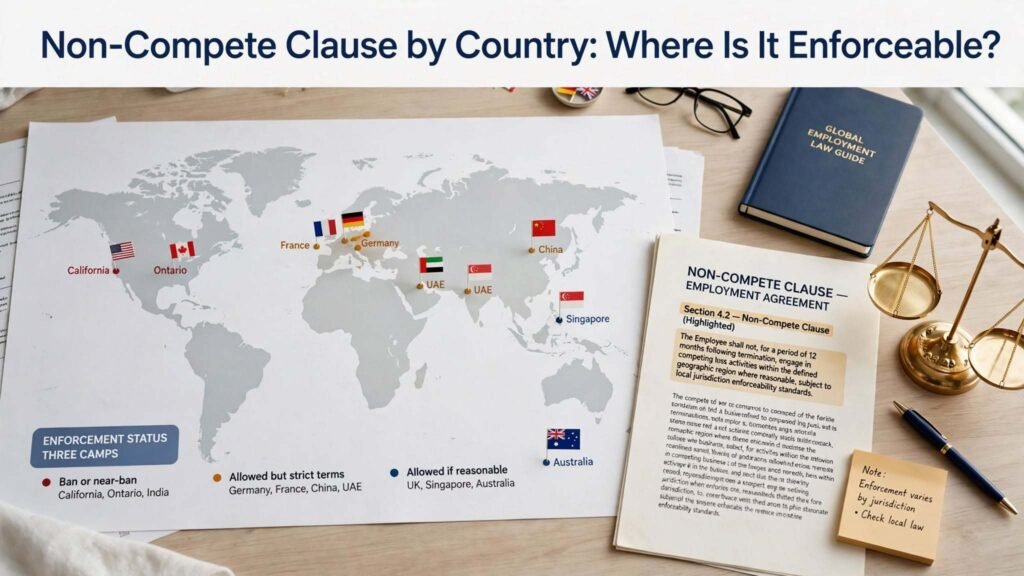
The three camps
| Camp | What it means | Examples |
|---|---|---|
| Ban or near-ban | A non-compete clause is void for most or all workers | California, North Dakota, Oklahoma, Minnesota; Ontario (with exceptions); Mexico and Colombia (prohibited, but with little sanction) |
| Allowed, but only on strict terms | Must be justified, time-limited and usually paid | Germany, France, Belgium, Poland, Sweden, China, the UAE, and the Netherlands (reform pending) |
| Allowed if reasonable | Courts ask whether the restraint protects a legitimate interest and goes no further | England and Wales, Singapore, Australia (until the 2027 change), New Zealand, Israel |
The OECD’s 2026 Employment Outlook, which looked at the way these clauses are regulated across member countries, put the common-law group (the UK, Australia, New Zealand, Israel) at the least restrictive end of the range. It also found that in a 15-country employer survey, a non-compete clause covered about one in five private-sector employees, and more employers said they were using these clauses more than five years ago than said they were using them less. In worker surveys, around 5% said a non-compete had stopped them changing jobs and about 3% said it had stopped them starting a business.
So the clauses are widespread, the legal tide is running against them, and many employers have not noticed. Country by country, then.
United States: no federal ban, a state-by-state patchwork
The headline everyone remembers is the Federal Trade Commission’s 2024 rule banning most employment non-competes. It never took effect. A federal court blocked it in August 2024 in Ryan LLC v. FTC, the FTC appealed, and in September 2025 the FTC dropped the appeal and stopped defending the rule. On 4 September 2025 it had opened a public inquiry into non-compete practices, and it says it will pursue targeted investigations and cases rather than a blanket rule.
That leaves the states, and the states disagree.
- Near-total bans: California, North Dakota, Oklahoma and Minnesota. In California, the statute (Business and Professions Code, Section 16600 and the 2024 follow-up laws) goes further than most: it is aimed at voiding a non-compete clause even if signed elsewhere, where the worker is based in California.
- Wage-threshold bans: the OECD counts around eleven states that ban the clause for workers below a pay level or outside senior roles.
- Pro-employer drift: Florida and Kansas, according to a February 2026 review by a global law firm, are moving the other way.
- Pending change: New York has had a bill (S4641A) that would bar the clause for lower-paid workers and health-related professionals. I could not confirm it had been signed, so check the current status before relying on it.
For a US employer the practical rule is to start from the worker’s state, not the company’s. A Delaware governing-law clause will not save a non-compete clause against a worker living in Sacramento.
United Kingdom: still reasonableness, with reform on the table
English law has no ban. A non-compete clause is unenforceable unless it goes no further than necessary to protect a legitimate business interest, typically trade secrets or a genuine connection with clients. Courts weigh duration, geography and the seniority of the worker, and a non-compete clause that tries to stop a junior employee from working anywhere in the trade is likely to fail.
The government is looking at changing that. A working paper published on 26 November 2025 asked for responses by 18 February 2026. It floated five options: a statutory cap on length (a three-month cap was the example, with one, six and twelve months as alternatives); caps that vary with employer size; a complete ban; a ban below a salary threshold; and a combination of a salary threshold plus a three-month cap above it. It also asked whether the cost of litigating puts workers off from challenging clauses. The paper estimated around five million UK workers are covered by these clauses.
In the material I found, no legislation had been enacted. If you advise UK staff, check where this has got to before you sign anything, because some of the options (a three-month cap, say) would turn a typical twelve-month clause into a dead letter.
European Union: allowed, but you pay for it
Continental Europe took a different route from both the US and the UK. Rather than asking only whether the restraint is reasonable, many countries ask whether the employer is paying for the loss of the worker’s freedom.
- Germany: the commercial code requires a post-employment restriction to be in writing, to protect a legitimate business interest, to last no more than two years, and to be paid. The compensation floor is half of the worker’s last contractual earnings. A restriction with no promised compensation is, in practice, not binding.
- France: courts require that the restriction be limited in time and space, protect a legitimate interest, take account of the job the worker actually did, and come with financial compensation.
- Belgium, Austria and Luxembourg: partial bans for lower-paid workers or those outside senior roles, per the OECD.
- Netherlands: tight rules already apply to fixed-term contracts. A bill for permanent contracts would require a written justification, a maximum of twelve months, and compensation of at least half the salary for every month the employer chooses to enforce. Entry into force was expected in late 2026 or early 2027, and existing clauses would be capped at twelve months. Check the current status.
- Poland and Sweden: permitted only under strict statutory conditions, often with minimum pay.
The practical lesson: in much of the EU, the cost of a non-compete clause shows up in the budget. Employers who drop in a UK-style non-compete clause with no pay find they have bought nothing.
Canada: Ontario bans it, the federal government is looking at executives only
Ontario prohibits non-competes in employment agreements, with exceptions for the sale of a business and for executives. The rest of Canada still leans on court reasonableness, which is notoriously unfriendly to broad clauses. At federal level, a proposal would limit the clause to executives in federally regulated sectors such as banking, telecoms and transport.
If you hire in Toronto, a clause that works in your New York template can be both void and a source of penalty exposure, since Ontario is one of the few places that penalises employers for using invalid clauses. According to the OECD, Spain and some US states are the others.
Australia: a ban is coming for most workers
Australia currently applies a reasonableness test, but the federal government has announced a ban on the non-compete clause for workers earning below the high-income threshold, which was AU$183,100 at the time of reporting and is adjusted each 1 July. Consultation is complete and the change is expected from 2027. That means most employees, apart from top earners, will fall outside any enforceable clause. If you are drafting for Australian staff now, assume the ban is coming and plan the alternatives.
Singapore: courts today, guidelines tomorrow
Singapore currently asks the familiar question: is there a legitimate proprietary interest to protect, and is the restraint no wider than needed? The tripartite partners (the Ministry of Manpower, the labour congress and the employers’ federation) are preparing guidelines on restrictive covenants. They will not be legally binding, but courts are expected to treat them as persuasive, and commentators expect enforceability to narrow, including for executives.
The Middle East: the UAE
The UAE’s Federal Decree-Law No. 33 of 2021 on employment relations allows a non-compete clause in writing if it is limited in time, place and type of work and protects the employer’s legitimate interests. My reading is that the maximum is two years. As with any Gulf jurisdiction, check the free-zone position (DIFC and ADGM have their own employment laws) before assuming the federal rule applies.
China: pay or it does not bind
On 4 September 2025, China’s Ministry of Human Resources and Social Security issued practical guidance on enforcing non-competes. The headline points: the employer must first identify what its trade secrets are and who has access to them; a non-compete clause is prohibited for workers who have no access to trade secrets; scope, duration and geography must be limited; and compensation must be paid during the restricted period, with rules on how to calculate and pay it. The statutory cap under the Labour Contract Law is two years.
India: void after the job, valid during it
India sits in the ban camp, but by a different route. Section 27 of the Indian Contract Act, 1872 voids any agreement that restrains a lawful profession, trade or business, with a single exception for the seller of goodwill. The Supreme Court held in Superintendence Company of India v. Krishan Murgai and Percept D’Mark v. Zaheer Khan that post-termination restraints fall within the section. In June 2025 the Delhi High Court applied the rule to a three-year post-employment non-compete clause in Varun Tyagi v. Daffodil Software. Restraints while the contract runs are generally valid, and partnership law has its own provisions. We have a separate, detailed guide: Non-Compete Agreement in India: Is It Enforceable?
What the countries have in common
Strip away the differences and a few patterns repeat in every country’s treatment of the non-compete clause.
The sale-of-business exception is almost universal. Whether the clause is struck down for employees in California, Ontario or India, courts in all three accept that a seller who is paid for goodwill can agree not to compete with the buyer for a reasonable period and area. If you are a founder selling a company or an investor buying one, you are on much safer ground than an employer using the same wording on an engineer.
Seniority and pay change the answer. Wage thresholds (US states, Austria, Belgium, Australia, Ontario) and senior-executive carve-outs are the preferred policy tool. A non-compete clause for the CEO is a different animal from the same clause for a support engineer.
Confidentiality is the survivor. Every system on this list protects real trade secrets even where the non-compete clause fails. India’s Delhi High Court distinguished cases involving proprietary information from bare job bans; China expressly ties the clause to trade secrets; the UK protects legitimate interests; the EU pays for the restraint because it recognises that a worker who cannot work for a competitor is losing something.
Courts are suspicious of clauses that look like penalties. A clause that forfeits all your equity if you compete will face the same attack as a ban on competing.
Cross-border problems nobody warns you about
Choice of law is not a cure. Employers often write the contract under their home law and hope. Courts in California, Ontario, Germany and India are likely to apply local public policy to a local worker regardless. The more your worker lives and works in one country, the less your governing-law clause helps.
Remote hires carry the law of where they sit. A US company hiring a contractor in Berlin cannot assume a US-style non-compete clause will be treated the same way. If the person is really an employee, labour protections follow the person. Our article on worker misclassification shows how this plays out when “consultants” are treated as employees.
An unenforceable non-compete clause can still hurt you. Some jurisdictions penalise employers for using invalid clauses (Ontario, Spain, and some US states). Others treat a clause as bad faith. And a lopsided clause damages hiring: good candidates read it.
Foreign courts do not always enforce foreign judgments. Even a favourable injunction on a non-compete clause in one country may not be recognised where the worker actually lives. Plan for enforcement where the worker is, not where the contract was signed.
Equity and share-based pay raise the stakes. Founders and early hires often hold shares or options. A non-compete clause that forfeits unvested equity on leaving is usually easier to defend than a ban on working, but it has to be built carefully. See our guides on the bad leaver clause and ESOPs for startups.
What to use when a non-compete clause will not hold
The strongest contracts spread protection across several tools, so the loss of one does not leave a gap.
- A tight confidentiality clause. Define confidential information by category, give examples, and make clear it survives termination. Pair it with real access controls. Our pieces on trade secrets law for founders and the Zetwerk and Ayr Energy dispute show what courts want to see.
- IP assignment. Everything created in the job belongs to the company, in writing, for employees and contractors alike. The freelance agreement clauses guide covers contractors.
- A narrow non-solicit. Clients the worker actually handled, staff the worker managed, a short period. Its enforceability varies by country, and a non-solicit that is really a disguised ban gets treated like one.
- Garden leave. A long notice period during which the person is paid but kept away from work and systems. Generally safer than a post-exit restraint because the employment is still alive.
- Paid, time-limited non-competes where the law allows it. In Germany, France, China and the Netherlands (once reformed), paying is the price of admission. Budget for it.
- Training or sign-on repayment. Linked to genuine cost and declining over time.
- Retention design. Vesting schedules, deferred bonuses and a culture people do not want to leave do more than any clause.
A short drafting guide by role
If you are an employer with staff in several countries: keep one master contract for the shared terms (confidentiality, IP, non-solicit), and add a country schedule for the restraint. Do not use a single global non-compete clause. Review it each year, because the law is moving in at least seven jurisdictions at once.
If you are an employee asked to sign: read the clause for three things: when it starts, how long it lasts, and whether you are paid. A non-compete clause with no pay in Germany, or one that bites after your job ends in India or California, may not be worth fighting. Keep your confidentiality obligations in view either way, because those are the ones that tend to stick.
If you are a founder or investor: the sale of the business and the shareholders’ agreement are where a non-compete clause earns its keep. Document the link to goodwill and the price, keep the area and period proportionate, and back it up with vesting and leaver provisions. For setting up the rest of your paperwork, use our legal checklist for Indian startups as a starting point, and for vocabulary the contract law glossary.
If you want a second opinion on a cross-border contract, get in touch or browse our startup legal resources.
Frequently asked questions
1. Is a non-compete clause enforceable everywhere?
No. A non-compete clause is banned or void for most workers in California, North Dakota, Oklahoma, Minnesota and Ontario, void after employment in India, paid-or-void in Germany, and judged case by case in England, Singapore and (until 2027) Australia. The answer depends on where the worker is based and what they earn.
2. What happened to the FTC’s non-compete ban in the United States?
It never took effect. A federal court blocked the 2024 rule in August 2024. The FTC appealed, then dropped the appeal in September 2025. Enforceability is now mostly a state-law question, and the FTC says it will pursue targeted cases and investigations instead of a blanket rule.
3. Can a UK employer still use a non-compete clause?
Yes, if it protects a legitimate business interest and goes no further than necessary. But the government consulted in late 2025 and early 2026 on capping the length (a three-month cap was one example), banning it below a salary level, or banning it altogether. I found no enacted change, so check current law before drafting.
4. Do I have to pay for a non-compete clause?
In many civil-law countries, yes. Germany requires at least half of the worker’s last earnings for the restricted period, France requires compensation, China requires it, and the Netherlands has proposed at least half the salary for each month the employer enforces. Common-law countries such as the UK and Australia generally treat taking the job as enough consideration.
5. Does a governing-law clause fix a non-compete clause for foreign workers?
Rarely. A worker based in California, Ontario, Germany or India will usually be protected by local public policy whatever the contract says. California’s laws are drafted to apply to California-based workers even if the contract was signed elsewhere.
6. What is the difference between a non-compete clause and a non-solicit?
A non-compete clause stops you working for a competitor. A non-solicit stops you approaching the former employer’s clients or staff. Non-solicits are generally easier to defend if narrow, but they are not safe everywhere, and courts treat a broad non-solicit like a disguised non-compete.
7. Is a non-compete clause enforceable in India?
Not after employment ends. Section 27 of the Indian Contract Act voids post-termination restraints, apart from the sale-of-goodwill exception. A clause that operates during employment is generally valid. See our India guide.
8. Is a non-compete clause allowed when someone sells a business?
Almost everywhere, yes. The sale-of-business exception is one of the few points of agreement across systems: a seller paid for goodwill can agree not to compete for a reasonable period and area. The limits must fit the business, and the link to the price should be documented.
9. Can I enforce a non-compete clause against a remote contractor in another country?
It is hard. The law of the contractor’s country may void the clause, a court there may not recognise your judgment, and if the contractor is really an employee, local labour rules apply. Use confidentiality, IP assignment and a narrow non-solicit instead, and get local advice for anything high-value.
10. What replaces a non-compete clause where it is banned?
Confidentiality and trade secret obligations, IP assignment, garden leave during notice, narrow non-solicits, training repayment and equity vesting. In countries that allow paid non-competes (Germany, France, China), you can pay for the restriction instead.
This article is general information, not legal advice. Laws in several of these countries are changing, so confirm the current position in the relevant jurisdiction before relying on it.