
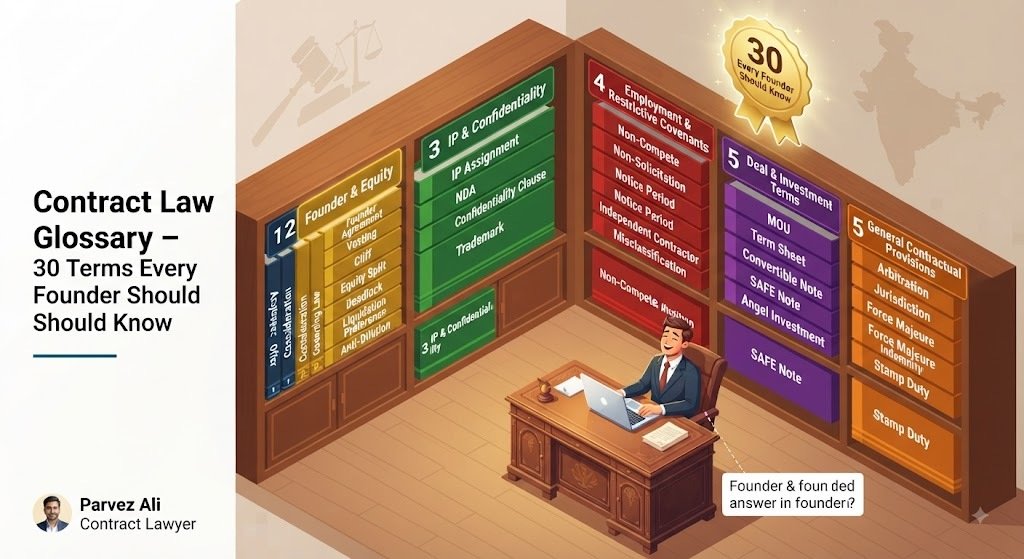
I built this contract law glossary because I kept explaining the same 30 terms to founders, over and over, across completely different conversations — a founder negotiating an angel round asking what “liquidation preference” actually means, another staring at an employment contract wondering what a “cliff period” does to their equity, another reading a vendor agreement and genuinely unsure whether “indemnity” was something to worry about. None of these terms are complicated once someone explains them plainly. Most legal writing just doesn’t bother to.
This contract law glossary is meant to be the page you bookmark and come back to — thirty terms every founder runs into eventually, defined in plain language, grouped by where you’ll actually encounter them, with links to the deeper articles on this site where a term deserves more than a two-sentence explanation.
Contract Formation Terms
Every contract law glossary has to start here — the basic building blocks that make any agreement legally enforceable in the first place.
Offer
An offer is a clear proposal by one party, communicated to another, expressing willingness to enter into an agreement on specific terms, capable of being accepted to form a binding contract.
Acceptance
Acceptance is the unqualified agreement to the exact terms of an offer. Under Indian contract law, acceptance must mirror the offer precisely — a modified response is treated as a counter-offer, not an acceptance.
Consideration
Consideration is something of value exchanged between parties to a contract — payment, a promise, goods, or services — that the Indian Contract Act, 1872 requires for an agreement to be legally enforceable, alongside offer, acceptance, capacity, and lawful object.
Governing Law
Governing law is the body of law that determines how a contract’s terms are interpreted and enforced. It’s frequently confused with jurisdiction, which is a separate concept entirely — I’ve covered exactly why in Jurisdiction Clauses in Contracts – Why “Governing Law” Isn’t Enough.
Founder & Equity Terms
The founder and equity section of this contract law glossary covers the terms that shape how ownership and control actually work between co-founders.
Founder Agreement
A founder agreement is the foundational contract between co-founders covering equity ownership, roles, decision-making, and exit terms — ideally signed before incorporation. I’ve broken down the essential clauses in Founder Agreement / Co-Founder Agreement in India.
Vesting
Vesting means equity is earned progressively over time, rather than owned outright from day one. The standard structure in India, as elsewhere, is four years with a one-year cliff — covered in depth in my article on 50/50 Co-Founder Splits.
Cliff Period
A cliff period is an initial stretch — commonly one year — during which no equity vests at all. If a founder or employee leaves before the cliff, they leave with nothing, which discourages very early departures.
Equity Split
An equity split is how ownership is divided among founders. It’s rarely just arithmetic — my 50/50 Co-Founder Split piece covers when an equal split works and when it creates real deadlock risk down the line.
Deadlock
A deadlock occurs when co-founders or shareholders with equal voting power can’t agree on a decision requiring joint approval, and neither side has the votes to break the tie. Well-drafted founder agreements address this in advance through a defined deadlock resolution process.
Liquidation Preference
Liquidation preference determines the order and amount investors receive before other shareholders in an exit or liquidation event — a term that matters enormously in an angel or venture round, covered in more detail in Angel Investment Agreements in India.
Anti-Dilution
Anti-dilution protection adjusts an investor’s effective ownership if the company later raises a down round at a lower valuation, partially compensating them for the resulting dilution — another term explained further in the same Angel Investment Agreements piece.
IP & Confidentiality Terms
This part of the contract law glossary covers protecting what you’ve actually built and what you’ve been trusted with.
IP Assignment
IP assignment is the clause ensuring intellectual property created for a company — by founders, employees, or contractors — actually belongs to the company, rather than remaining with the individual who created it. This is one of the clauses I consistently flag as non-negotiable, discussed further in Founder Agreement / Co-Founder Agreement in India.
NDA (Non-Disclosure Agreement)
An NDA is a contract restricting the disclosure of confidential information shared between parties, and can be mutual or one-way depending on the direction information actually flows. I’ve covered this distinction fully in Confidentiality Agreement vs NDA – Are They the Same Thing?
Confidentiality Clause
A confidentiality clause is the same underlying obligation as an NDA, but embedded within a broader contract — an employment agreement, a founder agreement, or a service contract — rather than existing as a standalone document.
Trademark
A trademark is a registered brand identifier — a name, logo, or other distinctive mark — protecting your business’s identity under the Trade Marks Act, 1999. I’ve written a full practical guide in Trademark Registration in India, and covered how it differs from copyright and patent protection in Copyright vs Trademark vs Patent.
Employment & Restrictive Covenant Terms
The employment section of this contract law glossary covers the terms that shape hiring, exits, and the limits on restricting someone after a relationship ends.
Non-Compete Clause
A non-compete clause restricts someone from working for a competitor after a relationship ends. In India, these are far less enforceable than most people assume, due to Section 27 of the Indian Contract Act — I’ve gone into this in full in What Makes a Non-Compete Clause Enforceable in India?
Non-Solicitation Clause
A non-solicitation clause restricts a departing employee or founder from actively poaching a company’s clients or employees. Unlike a non-compete, this is generally enforceable under Indian law, as covered in the same non-compete article.
Notice Period
A notice period is the advance warning either party must give before ending an employment relationship. What’s actually enforceable here surprises most people — I’ve broken it down fully in Notice Period Clauses – What’s Actually Enforceable in India.
Independent Contractor
An independent contractor is someone engaged for a defined scope of work, controlling how and when they perform it, rather than being integrated into a company as staff. The line between this and employment matters more than most founders realise — see Employment Contract vs Freelance Agreement.
Misclassification
Misclassification happens when a business treats a worker as a contractor while the relationship actually functions like employment — creating real statutory and tax liability. I’ve covered the risks in detail in Independent Contractor Misclassification in India.
Deal & Investment Terms
This section of the contract law glossary covers the documents and terms you’ll encounter raising money or exploring a deal before it’s fully formalised.
MOU (Memorandum of Understanding)
An MOU records intent between parties about a future arrangement, and isn’t automatically non-binding just because it’s labelled an MOU. I’ve explained exactly when courts treat one as enforceable in MOU vs Contract – Is a Memorandum of Understanding Legally Binding?
Term Sheet
A term sheet is a preliminary summary of key commercial terms, typically negotiated before detailed legal documentation — raising many of the same “is this binding” questions covered in my MOU vs Contract piece.
Convertible Note
A convertible note is a debt instrument that converts into equity at a future funding round, rather than requiring an immediate valuation. It’s a formally recognised instrument under Indian law for DPIIT-recognised startups — full details in SAFE Notes vs Convertible Notes.
SAFE Note
A SAFE (Simple Agreement for Future Equity) is a US-originated instrument giving investors future equity without debt, interest, or a maturity date. It carries genuine regulatory risk if used unmodified in India — covered fully in SAFE Notes vs Convertible Notes – What Indian Startups Should Know.
Angel Investment
Angel investment is early-stage capital from an individual investor, typically before institutional venture capital gets involved. The key terms to negotiate are covered in Angel Investment Agreements in India.
Dispute Resolution & Risk Terms
The final section of this contract law glossary covers what happens when something goes wrong — how disputes get resolved and how risk gets allocated.
Arbitration Clause
An arbitration clause routes disputes to private, binding arbitration instead of court litigation. Getting the drafting right — seat, number of arbitrators, scope — matters enormously, as I’ve covered in Arbitration Clause Drafting – What Every Indian Contract Should Include.
Jurisdiction Clause
A jurisdiction clause specifies which courts have authority to hear disputes — a distinct question from governing law, explained fully in Jurisdiction Clauses in Contracts.
Force Majeure
A force majeure clause excuses performance when an extraordinary event beyond a party’s control makes it impossible — but only if drafted properly. I’ve covered what actually protects you (and what doesn’t) in Force Majeure Clauses – Do They Actually Protect You?
Indemnity
Indemnity is a contractual promise by one party to compensate the other for specified losses, damages, or liabilities arising from defined events — a clause worth understanding in detail before agreeing to it, since it can shift significant financial risk onto whoever accepts it.
Stamp Duty
Stamp duty is a state-level tax on certain legal documents, and skipping it doesn’t void your agreement — it makes it inadmissible in court until the deficiency is cured. I’ve covered exactly what happens if you skip it, including a 2023 Supreme Court ruling on arbitration clauses, in Stamp Duty on Agreements in India.
Frequently Asked Questions
What is the difference between an NDA and a confidentiality clause? They serve the same function — an NDA is typically a standalone document, while a confidentiality clause is the same obligation embedded within a broader agreement, like an employment or founder contract.
Is a non-compete clause enforceable in India? Generally not for post-employment restrictions, due to Section 27 of the Indian Contract Act. Non-solicitation clauses are usually a more enforceable alternative.
What’s the difference between a convertible note and a SAFE note? A convertible note is formally recognised under Indian law for DPIIT-registered startups; a standard US-form SAFE carries genuine regulatory risk in India and isn’t independently recognised under the Companies Act or FEMA.
Do I need to register an NDA or confidentiality agreement in India? No — NDAs and confidentiality agreements are ordinary contracts and don’t require registration to be enforceable, unlike certain property or high-value instruments that attract stamp duty.
What happens if a contract doesn’t specify a jurisdiction clause? The forum becomes open to argument based on factors like where the defendant is located or where the contract was performed, which can trigger a preliminary dispute before the actual issue is addressed.
Is a term sheet legally binding? It depends on its actual content and wording, not its label — the same substance-over-form principle covered in this glossary’s MOU entry applies directly to term sheets too.
What is the difference between vesting and a cliff period? Vesting is the overall schedule over which equity is earned; the cliff is the initial period — commonly one year — before any vesting begins at all.
Does stamp duty make an unstamped agreement void? No — it becomes inadmissible as evidence in court until the deficient duty and any penalty are paid, but the underlying agreement itself isn’t automatically void.
What’s the difference between a trademark and a copyright? A trademark protects brand identifiers like names and logos; copyright protects original creative expression like code, writing, or design. Both are covered separately under different Indian legislation.
Can a founder agreement include a non-compete clause for departing co-founders? It can be included, but faces the same Section 27 enforceability limits as an employment non-compete. Confidentiality, IP assignment, and non-solicitation terms generally offer more reliable protection.
What’s the difference between arbitration and litigation? Arbitration is a private, typically faster dispute resolution process before a chosen arbitrator; litigation is public court proceedings before an assigned judge, with a full appellate process available — a distinction worth remembering from this contract law glossary whenever you’re negotiating a dispute resolution clause.
Final Takeaway
This contract law glossary is meant to be a living reference, not something you read once and forget — the kind of page worth bookmarking for the next time a term shows up in a contract you’re about to sign. If a definition here raises more questions than it answers, that usually means the underlying clause deserves a proper review before you rely on it.
Reviewing a contract and want to understand exactly what a specific term means for your situation? Get in touch and let’s walk through it together.
This glossary is for general informational purposes and does not constitute legal advice. Specific contract terms should be reviewed against your own facts by a qualified lawyer.
© Malik Times. Written by Advocate Parvez Ali.