
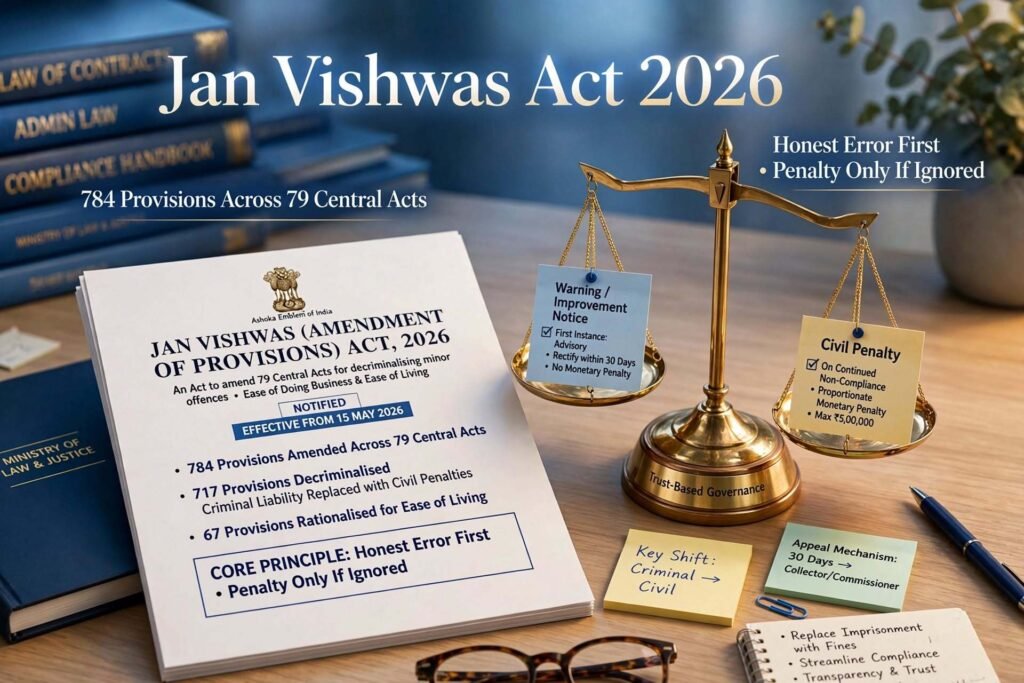
The Jan Vishwas Act 2026 is India’s second big attempt to stop treating small business mistakes like crimes. It amends 784 provisions across 79 Central Acts, replaces jail terms with civil penalties for many minor procedural offences, and, in a handful of laws, makes the regulator send a warning or an improvement notice before any money changes hands. For an MSME owner or a startup founder reading the Jan Vishwas Act 2026 for the first time, that is the heart of trust-based governance: the state assumes you made an honest error first, and punishes you only if you ignore the correction or the lapse was never honest. This guide explains what that means on the ground, which lapses are decriminalised, how graded enforcement works, and where real penalties remain.
A quick note on the name. Many articles still call this a “Bill”. It was introduced in the Lok Sabha on 27 March 2026, passed by both Houses by 2 April 2026, and the Gazette version carries the heading Act No. 8 of 2026 (assent dated 7 April 2026, as shown in a gazette tracker, so check it against the official e-Gazette PDF). That is why this page says Jan Vishwas Act and not Jan Vishwas Bill. If you run a registered MSME unit, our MSME registration guide is a useful companion to this one.
Key Takeaways on the Jan Vishwas Act 2026 for Small Business Owners
- Not every lapse is decriminalised. 717 provisions lose their criminal edge and 67 are ease-of-living changes. Fraud, adulteration and tampering still draw strict action.
- The Jan Vishwas Act 2026 is staged. Section 1(2) lets the Centre bring different parts into force on different notified dates, so a headline change may not apply to you yet.
- A warning under graded enforcement is a deadline, not a pardon. Ignore an improvement notice, or repeat the lapse, and the penalty ladder begins.
- Paperwork wins MSME compliance disputes. Keep a dated record of every notice and your reply.
- “No jail” does not mean “no compliance”. Penalties are civil, but they still cost money and they rise.
What the Jan Vishwas Act 2026 Actually Is
Think of the Jan Vishwas Act 2026 as an omnibus clean-up. Instead of reforming each law in its own bill, Parliament amended dozens of laws at once to remove outdated criminal clauses. The Press Information Bureau puts the numbers at 79 Acts, 23 Ministries and 784 provisions, of which 717 are proposed for decriminalisation and 67 aim at ease of living. PRS Legislative Research counts 80 Acts, so you will see both figures in the press; the gap is a matter of how amending Acts are counted, and I would quote 79 when citing the PIB.
How We Got Here
| Step | What happened |
|---|---|
| Jan Vishwas Act, 2023 | Amended 42 Central Acts and decriminalised 183 provisions, mostly by swapping imprisonment for fines |
| Jan Vishwas Bill, 2025 | Introduced 18 August 2025 for 16 Acts and 355 provisions, then sent to a Select Committee |
| Select Committee | Held 49 sittings, reported on 13 March 2026, and urged a much wider sweep |
| 2025 Bill withdrawn | Pulled on 17 March 2026 so a broader bill could replace it |
| 2026 Bill | Introduced 27 March, passed by the Lok Sabha on 1 April and the Rajya Sabha on 2 April 2026 |
| Commencement | By Gazette notification, with different dates possible for different Acts in the Schedule |
The Jan Vishwas reform is part of a wider push to make compliance lighter. If you are also tracking how other rules are changing, see our notes on labour codes compliance and employment contract updates and the IT Amendment Rules 2026 compliance guide.
Trust-Based Governance Under the Jan Vishwas Act 2026, in Plain Words
The phrase sounds like a slogan, so here is what it does in practice. For decades, Indian regulatory statutes bundled every breach, from a missing register to deliberate fraud, under the same threat of prosecution. An inspector could walk into a small shop, find an unstamped weighing scale or a late return, and the owner faced a criminal case for what was, in truth, an administrative slip. Business groups argued that this created fear and invited rent-seeking.
Trust-based governance flips the default, and the Jan Vishwas Act 2026 is the clearest example so far. A first, non-harmful, procedural default is treated as a mistake to be corrected. Penalties are meant to match the harm, and criminal law is kept for conduct that cheats or endangers people. Commentary on the Legal Metrology change describes it as a move from a purely punitive approach to a trust-based framework that reserves coercive enforcement for fraud, repeat violations and tampering. FISME, which represents small enterprises, welcomed the reform for reducing the compliance burden and the fear among entrepreneurs.
Two caveats from me. First, “trust” is conditional. The state trusts you once, in the specific laws that have a warning stage. Second, the officer’s judgment now matters more than ever, because someone has to decide what counts as a minor lapse. That is where good records help you most.
Which Offences the Jan Vishwas Act 2026 Decriminalises or Softens
The Jan Vishwas Act 2026 works through several mechanisms. Some offences are omitted entirely. Some keep a fine but lose imprisonment. Some move from a criminal court to an adjudicating officer who imposes a civil penalty. And in a few Acts, a warning comes first. The examples below come from the PIB release and PRS summary.
| Law | Earlier position | Position under the Act |
|---|---|---|
| Drugs and Cosmetics Act, 1940 (cosmetics) | Up to one year’s imprisonment and/or fine up to ₹20,000 | Civil penalty of ₹1 lakh or three times the value of confiscated cosmetics, whichever is higher |
| Drugs and Cosmetics Act (AYUSH drug storage disclosure) | Up to six months’ imprisonment | Higher monetary penalty instead |
| MMDR Act, 1957 | Up to two years’ imprisonment for contravening rules | Penalty up to ₹50 lakh |
| Clinical Establishments Act, 2010 | Imprisonment for minor deficiencies | Civil penalty up to ₹10,000 |
| Private Security Agencies Act, 2005 | Fine up to ₹25,000 for not displaying a licence | Offence removed |
| Copyright Act, 1957 | Up to one year for a false entry in the Register of Copyrights | Offence removed |
| Delhi Municipal Corporation Act, 1957 | Criminal treatment of hawking without licence and obstruction | Civil penalties for minor civic offences |
| National Highways Act, 1956 | Up to five years’ imprisonment for making a highway impassable | Civil penalty of ₹10 lakh to ₹1 crore |
You will notice something. Decriminalisation does not always mean a smaller bill. The MMDR and highways examples carry big money penalties. The reform removes the jail threat for procedural failures while leaving the financial sting intact, which is why I would never describe it to a client as “relief from penalties”. It is relief from prosecution.
Ease-of-Living Changes
Sixty-seven provisions are not about business at all. They include a 30-day grace period during which an expired driving licence stays valid and a longer window for accident victims to approach the Claims Tribunal under the Motor Vehicles Act, plus property tax changes in New Delhi. They matter to your drivers and delivery staff more than to your balance sheet.
How Graded Enforcement Works Under the Jan Vishwas Act 2026
Graded enforcement is the most practical part of the Jan Vishwas Act 2026 for a small business. It means a regulator cannot jump straight to a penalty for certain first-time lapses. The steps differ by law, and the PIB release gives these examples:
| Act | Step 1 | Step 2 | Step 3 |
|---|---|---|---|
| Apprentices Act, 1961 | Advisory for the first contravention | Warning for the second | Monetary penalty for repeats |
| Legal Metrology Act, 2009 | Improvement notice for the first lapse | Civil penalty for a second | Criminal fine for later offences (per PRS) |
| Central Silk Board Act, 1948 | Warning for the first contravention | Monetary penalty for repeats | None |
| Tea Act, 1953 | Warning for the first contravention | Penalty only for later violations | None |
| APEDA Act, 1985 | Warning for procedural lapses such as late returns | Penalty if repeated | None |
The Legal Metrology Improvement Notice in Detail
If you make, pack, import, repair or sell weighing or packaged goods, this part of the Jan Vishwas Act 2026 may touch you first. A Legal Metrology Officer can issue an improvement notice for specified first-time procedural or regulatory lapses. The sections listed in one analysis include 25, 27, 28, 29, 31, 32, 34, 35, 36(1), 38, 39, 41(1), 41(2), 45, 46 and 47, covering things like non-standard weights, missing model approval, failure to produce documents, false returns and operating without registration. If you fix the problem within the time allowed, penal proceedings may be avoided. The catch: published summaries I reviewed do not state the compliance period in days, and the exact period is “prescribed”. Read the rules and your own notice for the number. Tampering with a registration certificate is treated seriously, even though one article lists section 47 among the covered lapses, so do not assume it gets a warning.
The Penalty Clock Keeps Ticking
Under the Act, fines and penalties rise by 10 percent of the minimum amount every three years, unless the parent law has its own revision method. Adjudicating officers hold inquiries and impose penalties, and appeals go to appellate authorities. Plan for that. A penalty that looks manageable today is indexed upward.
What Still Carries Real Penalties After the Jan Vishwas Act 2026
The government says serious violations will continue to attract appropriate penalties, but the PIB release does not list which offences stay criminal. Independent commentary points to the same families of conduct. Treat the list below as my reading of those sources, not an official schedule.
- Fraud and deliberate deception. A false return made knowingly is a different animal from a late one.
- Adulteration and spurious products, in food and drugs especially.
- Harm to people or the environment. Public safety violations remain serious.
- Tampering, including with registration certificates under the Legal Metrology law.
- Repeat offending and ignoring a notice. Once the correction window passes unused, the ladder moves up.
One more point that people skip. The Jan Vishwas Act 2026 covers only the Central laws it names. It does not rewrite every compliance duty a small company faces. For contracts, employment and data rules, the old obligations apply as before. For example, a cheque dishonour is still handled through its own legal route, which we explain in our cheque bounce notice guide, and unpaid invoices follow the process in our piece on what to do when a client refuses to pay. I did not find GST among the Acts discussed in the coverage I reviewed, so check the Schedule before assuming a tax lapse gets warning-first treatment.
What the Jan Vishwas Act 2026 Means for Different Types of Business
Manufacturers and Traders
The Legal Metrology change, the Drugs and Cosmetics revisions and the removal of some licence-display offences are the ones to study. If you sell cosmetics or pack goods for sale, a first administrative slip is now a correction opportunity rather than a prosecution. Repeats are not.
Startups and Founders
Most startups are not selling weighing scales, so the direct effect is smaller than the press suggests. The real value is the signal: regulators are being pushed toward proportionate action. Still, founders with hardware, food, health or cosmetics products should map their licences now. Our legal checklist for Indian startups and Startup India registration guide are good places to start, and the broader startup legal library covers the contracts that sit beside regulatory compliance.
Exporters and Small Sector Units
The PIB release specifically mentions benefits for small sericulture businesses under the Silk Board Act, small coir exporters, and exporters under the APEDA Act, where a warning-and-penalty sequence now applies to procedural lapses.
Employers
The Apprentices Act now has a three-stage ladder, which helps firms that engage apprentices. Wider employment compliance is a separate matter. Worker status disputes, for instance, are explained in our guide to worker misclassification in India, and workplace duties are covered in the POSH Act compliance guide for employers.
A Practical MSME Compliance Playbook for the Jan Vishwas Act 2026
- List every licence, registration and return your business holds, and tie each to its governing Act.
- Check each Act against the Schedule of the Jan Vishwas Act 2026 and the notification list. If it is not notified yet, the old rules still apply.
- Assign one person to open government mail, email and portal alerts, every working day. A notice you miss is a deadline you miss.
- Log the date you receive any notice and note the compliance period in the notice itself.
- Reply in writing, attach proof of the fix, and keep the acknowledgement.
- Do not cure the same lapse twice. A repeat is what moves you from warning to penalty.
- Separate honest errors from anything that looks like misstatement. If the facts are unclear, get advice before replying.
- Update your vendor and customer contracts so that compliance duties and notice-handling are allocated clearly. Our NDA guide and limitation of liability article help here.
- Budget for the 10 percent upward revision in any penalty exposure, since amounts rise every three years.
- Review once a quarter. The Jan Vishwas Act 2026 is staged, and rules are still being written.
If you would like a second pair of eyes on a notice or on your compliance map, you can reach me through the contact page.
Criticisms and Open Questions Around the Jan Vishwas Act 2026
It would be dishonest to present the Jan Vishwas Act 2026 as pure good news. Three concerns come up repeatedly in commentary. Deterrence is the first: if a penalty is small, a large firm may treat it as a cost of doing business. Discretion is the second: whether an officer calls a lapse minor or serious will vary, and uneven enforcement could replace one kind of uncertainty with another. Delegation is the third: a lot of the detail, including compliance periods and penalty schedules, depends on rules not yet written. An analysis from India Policy Hub also notes that a flat 10 percent increase may affect small and large firms differently, and questions whether stated appeal timelines will hold in practice. I would add a fourth, which is about information. Most small owners will learn of these changes from a WhatsApp forward, and the Act does not require any outreach.
Where Jan Vishwas Reform Goes Next
Several states have passed their own Jan Vishwas Acts in 2026, including Andhra Pradesh, Bihar and Delhi, which suggests that decriminalisation is moving from a Central pilot into a standing policy habit. Whether a further Central round follows has not been announced, and I would treat articles forecasting one as speculation. If your business sits in a state with its own version, read that Act as well, because state laws govern many shops, establishments and local licences. Related technology compliance, such as data protection duties, runs on a separate track; see our DPDP compliance and funding due diligence piece and the technology law section for how those rules interact.
Frequently Asked Questions About the Jan Vishwas Act 2026
1. What is the Jan Vishwas Act 2026?
The Jan Vishwas Act 2026 is an omnibus law that amends 784 provisions across 79 Central Acts administered by 23 Ministries. It decriminalises 717 provisions and makes 67 ease-of-living changes. The Bill was introduced on 27 March 2026 and passed by both Houses by 2 April 2026.
2. Is it a Bill or an Act now?
The Gazette text shows the Jan Vishwas law as Act No. 8 of 2026, with assent dated 7 April 2026. Many news pieces still say Bill because they were written at the passage stage. Verify against the official e-Gazette copy.
3. Is the Act already in force?
Section 1(2) says it comes into force on dates the Central Government notifies, and different dates may be set for different Acts. Some changes, such as the Legal Metrology improvement notice, have been reported as introduced, but check the notification for each law you rely on.
4. What does trust-based governance mean for my business?
It means regulators should presume an honest mistake for a first, non-harmful procedural lapse and ask you to correct it, instead of prosecuting. It applies only in the laws that actually carry a warning or notice stage, and it ends if you ignore the notice or repeat the lapse.
5. Which minor offences are decriminalised?
Examples include removal of the Copyright Act offence for a false entry in the register, removal of the licence-display offence under the Private Security Agencies Act, and conversion of several imprisonment clauses into civil penalties under the Drugs and Cosmetics Act, MMDR Act and Clinical Establishments Act.
6. How does an improvement notice work?
For specified first-time lapses under the Legal Metrology Act, an officer identifies the deficiency and gives you time to fix it. If you comply, penal proceedings may be avoided. If you ignore it or repeat the lapse, penalties follow. The exact period is prescribed, so read your notice.
7. Do MSMEs still pay anything if the offence is decriminalised?
Often yes, because decriminalisation under the Jan Vishwas Act 2026 removes imprisonment and prosecution for the covered offence, but a civil penalty may still apply, and in some laws it is large. Fines also rise by 10 percent of the minimum every three years.
8. What still counts as a serious offence?
The government has said serious violations keep appropriate penalties but has not published a single list. Commentary points to fraud, adulteration, spurious drugs, environmental harm, public-safety breaches and tampering with registration certificates.
9. Does this change GST or income tax compliance?
Not on the evidence I reviewed. The coverage focuses on the Acts named in the PIB release and PRS summary, and I did not find GST among them. Check the Schedule of the Act and tax department notifications before assuming any warning-first treatment applies to tax returns.
10. Are directors and partners still personally liable?
Some commentary suggests reduced personal exposure for honest technical lapses, but liability depends on each Act’s own provisions, and fraud still carries risk. Do not treat a general summary as a shield. Ask for advice on the specific law involved.
Need Help Reading a Notice or Mapping Your Compliance?
A short review of your licences, past notices and contracts can show what the Jan Vishwas Act 2026 changes for your MSME or startup and what it does not. Talk to Advocate Parvez Ali, or learn more about the author.
Sources
- PIB: Jan Vishwas (Amendment of Provisions) Bill, 2026
- PRS Legislative Research: Bill track and summary
- Gazette Tracker: Jan Vishwas (Amendment of Provisions) Act, 2026 (Act No. 8 of 2026)
- All India Radio: Bill removes criminal penalties for minor procedural lapses
- All India Radio: Improvement notice mechanism under the Legal Metrology Act
- IndiaLaw: Improvement notice under the Jan Vishwas Act 2026
- Mondaq: Trust-based governance in Legal Metrology
- India Policy Hub: Jan Vishwas Bill 2026 explained
- iPleaders: Jan Vishwas Act 2026
Last updated: 15 October 2026. This article is general information, not legal advice. Commencement dates, rules and notifications are still emerging, so confirm the current status of each provision before relying on it.