
On 21 November 2025 the Centre brought all four Labour Codes into force. Among much else, the Code on Social Security defined gig work, platform work and aggregators for the first time, and the government’s own summary promised social security for “all workers”. Central rules followed in May 2026, and states are still catching up.
Most commentary stopped at the new definitions and skipped reclassification. The question I would put to a founder is simpler. How many people in your business are called consultants, advisors or “associates”, paid a fixed amount every month, working your hours, on your systems, for the past two years, with no PF, no ESI and no gratuity?
If the answer is more than zero, you have a consultant reclassified as an employee problem waiting for a trigger. A resignation, a dispute over dues, a funding round, or an EPFO or ESIC inquiry can set it off. The Codes did not invent the reclassification risk. Courts have looked past labels for decades. What the Codes did is write social security coverage into the statute in plain words, and that makes the cost of getting it wrong easier to prove and harder to argue with.
This guide covers how courts decide the question, what the Codes changed, what reclassification costs in rupees, how to tell a genuine consultant from one who will be reclassified, and what to do this quarter.
What changed on 21 November 2025, and what did not
Here is what the official summary and the law-firm alerts agree on:
- The four Codes (Wages, Industrial Relations, Social Security, and Occupational Safety, Health and Working Conditions) replaced 29 central labour laws.
- “Gig work”, “platform work” and “aggregators” were defined for the first time. Aggregators contribute a share of annual turnover, in the range of 1 to 2%, capped at 5% of what they pay or owe to gig and platform workers. One alert says aggregators must register their gig and platform workers on a portal within 45 days.
- Appointment letters are mandatory for all workers.
- Fixed-term employees get parity with permanent staff, with gratuity after one year instead of five.
- One definition of wages now applies across the Codes, with the “50% rule”: if allowances and other exclusions exceed half of total remuneration, the excess is added back.
- Transitional provisions keep proceedings under the old laws alive, and states must notify their own rules before the framework works everywhere.
What did not change is the reclassification test, meaning who counts as an employee. No Code replaced the case law. The Code on Social Security defines an employee as a person employed on wages in an establishment, directly or through a contractor, for skilled, unskilled, managerial, clerical or any other work, “whether the terms of such employment are express or implied”. That last phrase is the statute telling you that what the paper says is not the end of the inquiry.
The label has never decided a reclassification case
Indian courts ask what the relationship actually looks like, and reclassification follows from the answer. The same handful of decisions keep returning.
| Test | Source | What it asks |
|---|---|---|
| Control | Dharangadhara Chemical Works v. State of Saurashtra (1957) | Does the hirer control not just what is done but how it is done |
| Organisation or integration | Silver Jubilee Tailoring House v. Chief Inspector (1974) | Is the person part of the core business, or an outsider doing a side job |
| Multifactor | Workmen of Nilgiri Cooperative Marketing Society v. State of Tamil Nadu (2004) | Weigh selection, wages, dismissal, tools, risk of loss, chance of profit and integration together |
| Contract of service vs contract for service | Sushilaben Indravadan Gandhi v. New India Assurance (2021) | Look at the whole relationship and not one factor |
| Refined multifactor | General Manager, U.P. Cooperative Bank v. Achchey Lal (Supreme Court, September 2025) | Is there a “sufficient degree of control”, and who holds real economic and administrative power |
The 2025 decision is worth reading closely because it went the hirer’s way. A bank had let its employees form a cooperative society to run a canteen, and gave it infrastructure and a wage subsidy. The society appointed, paid, supervised and dismissed the canteen workers. The Supreme Court said subsidies and infrastructure do not by themselves create employment, and that the bank lacked complete administrative control. So the tests cut both ways, and reclassification is never automatic. A genuine independent intermediary who really hires, pays and supervises is a legitimate shield. A label on a contract between you and a person you actually manage is not.
Why the Labour Codes raise the stakes of reclassification
Four reasons, in rough order of how much I would worry about each.
1. The statute now speaks of coverage, not just categories. The government’s own release says all workers will get PF, ESIC, insurance and other social security benefits. An inspector reading that language is less likely to accept “we treat them as consultants” at face value.
2. The gig and platform label will not rescue you. The Code describes a gig worker and a platform worker as someone working outside a traditional employer-employee relationship. If your consultant sits in your office, takes your instructions and works only for you, the relationship is the traditional kind. You cannot move them into the new gig category by renaming them.
3. Appointment letters are mandatory. An engagement with no appointment letter, but with a fixed monthly payment, a company email and a reporting manager, now reads as a documentation gap in addition to a reclassification dispute.
4. The penalty provisions are real. According to a law-firm summary of the Code, failing to deposit the employees’ share of contributions that you deducted can attract a fine of ₹1 lakh and imprisonment of one to three years, and non-payment of any contribution can attract a fine of ₹50,000 with two to six months’ imprisonment, with higher penalties for repeat offences. Gratuity non-payment carries its own penalty. Read the Code text for your facts, because these ranges come from a summary.
Two more details matter for timing. That same summary reports a five-year limit on starting an inquiry into PF or ESI dues, and a two-year window to complete one. Do not treat that as a safe harbour until you have checked the section, because the old PF law and the transition provisions create room for argument. Also, one FAQ on the notification reads it as repealing the ESI and Gratuity Acts while the EPF Act continues for now, so check which law your matter falls under.
The reclassification red flag scorecard
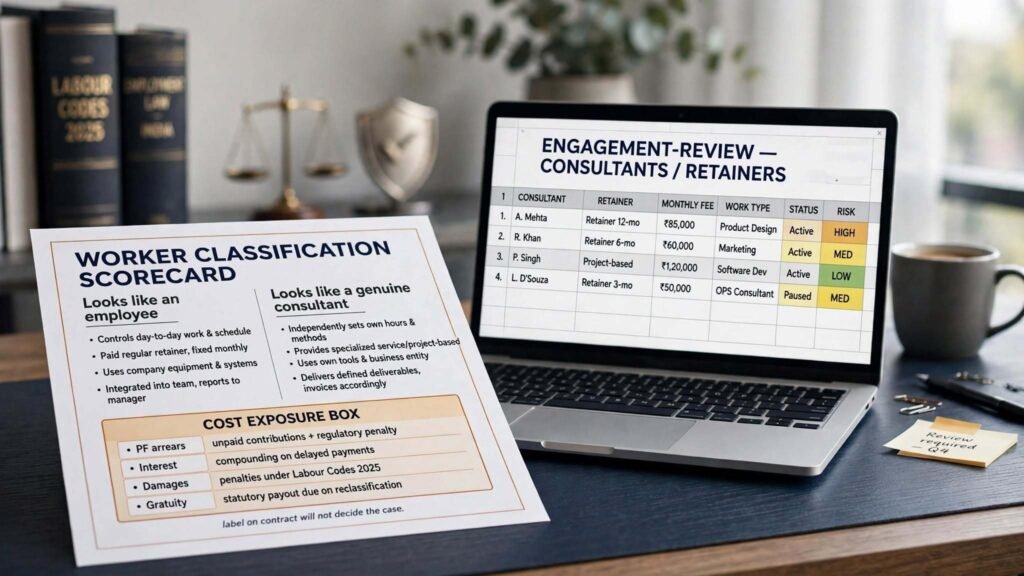
No court counts boxes, and no single factor decides the case. But if you recognise most of these in an engagement, the contract’s title is not going to save it.
| Factor | Looks like an employee | Looks like a genuine consultant |
|---|---|---|
| Control | You set working hours, daily tasks and the method | You define the outcome, they decide how and when |
| Integration | Core product or operations work, on your org chart, in your team meetings | A defined project outside your core business |
| Exclusivity | Works only for you, or you restrict other clients | Serves several clients |
| Tools | Your laptop, your email domain, your software seats | Their own equipment and systems |
| Payment | The same amount every month, regardless of output | Fees per deliverable or milestone, invoiced |
| Duration | Open-ended, renewed again and again for years | Defined scope and term |
| Substitution | Must do the work personally | Can send a qualified substitute |
| Risk | No chance of loss or profit | Bears cost overruns, can earn more by being efficient |
| Exit | Needs your permission to leave, or is “terminated” with notice and a final settlement | Contract ends on delivery or on agreed notice |
| Benefits | Leave, holidays, appraisals, ESOPs, company events | None of these |
If you find yourself explaining why the consultant “is basically part of the team”, you have already answered the question.
What reclassification costs
When a consultant is reclassified as an employee, the bill has several parts.
- PF. The employer’s share and the employee’s share, for every month in the engagement. In practice the employer ends up funding both, because recovering the employee’s share from someone you called a consultant is unrealistic.
- Interest and damages. Under the EPF Act, interest under Section 7Q runs at 12% a year, and damages under Section 14B can reach up to 100% of the arrears. An older slab ran from 5% to 25% a year by length of delay, and one guide reports a change in 2024, so confirm the current rate.
- ESI. Employer and employee contributions for eligible wages, with interest and damages.
- Gratuity. Fifteen days’ wages for each completed year after five years of service, and now pro rata after one year for fixed-term employees. It is calculated on Code wages, not on whatever bucket you called “basic”.
- Leave, bonus and notice. Accrued leave, statutory bonus where it applies, and notice or retrenchment entitlements if the relationship ended.
- Tax. Payments may be recharacterised as salary, which affects withholding.
- Commercial fallout. An unresolved classification issue shows up in diligence, delays a round and gives an investor a reason to negotiate price. Our legal checklist for Indian startups lists what investors tend to ask for.
A worked example of reclassification cost
Take one engineer engaged as a consultant for 36 months. I will use simple, stated assumptions, and your numbers will differ.
| Item | Assumption | Result |
|---|---|---|
| PF principal, ceiling ₹15,000 | 12% employer + 12% employee = ₹3,600 a month × 36 | ₹1,29,600 |
| PF principal, ceiling ₹25,000 | ₹6,000 a month × 36 (Cabinet approved the higher ceiling in September 2026, so confirm the effective date) | ₹2,16,000 |
| Interest at 12% (older ceiling) | Average delay of about 18 months | About ₹23,000 |
| Damages (older ceiling) | Up to the amount of arrears | Up to ₹1,29,600 |
| PF total, worst case, older ceiling | Principal + interest + maximum damages | About ₹2.8 lakh |
| Gratuity after five years | Code wages of ₹40,000 a month, ÷ 26 days × 15 days × 5 years | About ₹1.15 lakh |
That is one reclassified person and PF only, leaving out ESI, leave and legal costs. Multiply by ten consultants on the same pattern and the number is no longer a rounding error. If your team contributes on higher pay than the ceiling, scale up.
Common defences against reclassification, and why they fail
“Our agreement says independent contractor.” It is evidence of intention, not proof of reality, and reclassification looks at the reality. Courts ask what happened in practice.
“They send invoices.” An invoice helps when the invoice reflects a real business. A monthly invoice for the same fixed sum, for full-time work, prepared by the person only because you asked for one, adds little.
“They are on a retainer.” A retainer is fine for access to expertise. A retainer that buys 40 hours a week of supervised work is a salary with a different name.
“We use a staffing agency.” That can be valid, but the Codes restrict contract labour in core activities, with limited exceptions, and the principal employer carries obligations under the contract labour rules. A sham intermediary does not insulate you.
“We call them gig workers.” See above. The definition requires work outside a traditional employer-employee relationship, and reclassification looks through the gig label too.
“They want it this way.” Possibly true, and often true of consultants who prefer a higher take-home. Statutory contributions are not something the parties can waive by agreement.
What a consultant relationship that survives reclassification looks like
The structure that holds up has real features, not just clever drafting.
- A defined scope and a defined deliverable. A statement of work, milestones and acceptance criteria.
- Fees tied to output. Milestone or deliverable-based invoicing, not a fixed monthly sum for open-ended presence.
- No control over method or hours. You review results, you do not manage the day.
- Their own tools. Not your laptop, and not a permanent email address on your domain unless a narrow project need requires it.
- Freedom to work for others. With only a confidentiality and conflict-of-interest limit.
- A right to substitute. Subject to your approval for security and quality.
- A fixed term. Renewed by a new statement of work, not by default.
- Business reality. A registered business or professional practice, with its own GST registration where required, and its own invoices.
Our guide to freelance agreement clauses walks through the contract side, and the contract law glossary explains terms like indemnity and IP assignment in plain language. Confidentiality does not make someone an employee, and you will still want it. Our pieces on trade secret protection in India explain why.
Equity is a reclassification flag too. Granting ESOPs is built around employment, as the ESOP legal and tax guide explains, and the new RSU and SAR framework under the Corporate Laws Bill matters if you want a cleaner way to reward people who are not on payroll.
What to do this quarter to cut reclassification risk
- Make a list. Everyone paid on a consultancy, retainer, freelance or “associate” basis. Include tenure, monthly amount, hours, tools and who manages them.
- Score each person against the table above for reclassification risk. Start with the ones who have been with you longest, because arrears grow with time.
- Sort into three groups by reclassification risk. People who are really employees. People who are genuine consultants with a weak contract. People who are somewhere in between.
- Convert the real employees. Issue an appointment letter, set wages under the Code definition, start PF, ESI and gratuity accrual, and put leave and holiday policy in writing. Conversion stops new reclassification exposure. It does not erase old exposure.
- Get advice on the past period before you decide anything. The options include prospective correction, negotiated settlement and voluntary payment. Which is right depends on the facts, the limitation question and the state of any inquiry. Do not backdate documents and do not delete records.
- Re-paper the genuine consultants. Statement of work, milestone fees, substitution rights, defined term, and tools clause.
- Put a gate on future hiring. Nobody joins on a consultancy basis without an HR and legal review against the scorecard, and a six-monthly review of anyone who has stayed. That keeps reclassification risk from quietly rebuilding.
- Cover the other statutes. A consultant who is truly independent is still covered by some protections. The POSH compliance guide for employers explains how workplace obligations reach people who are not on your payroll, and you will want to confirm how that applies to each of your arrangements.
If you have already received an EPFO or ESIC notice, or a former consultant has raised a reclassification claim, stop reading general guides and get a lawyer on the file, because the first reply you send often shapes everything after it.
If you are the consultant
Keep your invoices, your contract and a record of how the work is actually run. If you want the independence a consultancy gives you, use it: serve other clients, work with your own tools, and invoice for deliverables. If you want the protections of employment, say so before a dispute, and not after. Our guide for freelancers on recovering unpaid fees covers the payment side.
What to watch next
- State rules under the Codes, which determine how things work on the ground in your state.
- Notification of the aggregator contribution and the gig-worker schemes.
- The effective date and impact of the PF wage ceiling increase.
- Any clarification on how PF and the Code on Social Security fit together during the transition.
- The first reclassification inspections and inquiries under the new framework.
If you want your consultancy agreements, offer letters or contractor onboarding checked, you can reach out here. We also cover related changes in our guides on what to change in your employment contracts after the Labour Codes and on worker misclassification in India.
Frequently asked questions
1. Can a consultancy agreement stop reclassification as an employee?
No. Courts look at how the relationship works in practice, using the control, integration and multifactor tests. A contract that calls someone a consultant is evidence of what the parties intended, but control, exclusivity, fixed pay and integration into your core business can outweigh it. The Code on Social Security also defines an employee by reference to express or implied terms.
2. What tests do Indian courts use to separate an employee from a consultant?
Mainly the control test (Dharangadhara Chemical Works, 1957), the organisation or integration test (Silver Jubilee Tailoring House, 1974) and the multifactor test (Nilgiri Cooperative Marketing Society, 2004), applied together. The Supreme Court’s September 2025 decision in Achchey Lal refined the approach, asking for a “sufficient degree of control” and looking at who holds real administrative and economic power.
3. Did the Labour Codes change the test?
Not directly. The test is still judge-made. What changed is the statutory backdrop: social security coverage for all workers, mandatory appointment letters, a unified wages definition, parity for fixed-term employees, and defined gig and platform categories. These make reclassification easier to spot and costlier to defend.
4. What will I owe if a consultant is reclassified as an employee?
Back PF for the full period, usually both shares, plus interest and damages; ESI contributions with interest; gratuity once the service threshold is met; accrued leave and bonus where applicable; and possible penalties under the Code. You may also face tax consequences and trouble in investor diligence.
5. How far back can authorities go?
It depends on the law that applies to your matter. A law-firm summary of the Code on Social Security reports a five-year limit on starting an inquiry into PF or ESI dues. Earlier practice under the EPF Act has been argued differently, and transition provisions preserve ongoing proceedings. Get advice on the specific position before relying on any limit.
6. Are gig and platform workers employees under the Code?
They are a separate category. The Code describes them as working outside a traditional employer-employee relationship, with aggregators contributing to a social security fund. That does not help a person who is really your full-time, controlled worker, because the relationship is the traditional kind.
7. Is a monthly retainer for a freelancer safe?
It can be, if the retainer buys access to expertise and outputs and not supervised full-time work. The risk rises when the amount is identical every month, the hours are fixed, the person uses your tools and email, and the engagement has run for years without a defined scope.
8. Does invoicing through a GST-registered business protect me?
It helps, because it points to an independent business. It is not decisive. If the business is a shell created for one client, and the work is controlled and integrated, courts and authorities can look past it.
9. Should I use fixed-term employment instead of consultants?
Often yes, for defined-duration roles that you actually manage. Fixed-term employees now get parity with permanent staff, with gratuity after one year. That costs more than a consultancy, but it is a defensible structure, and the cost is known and budgetable.
10. What is the first step against reclassification risk?
List everyone engaged on a non-employee basis, with tenure, pay pattern, hours, tools and manager. Score them against the scorecard in this guide, start with the longest-serving, and get advice on both the conversion and the past period before you change anything.
This article is general information, not legal advice. Statutory rates, ceilings and limits are changing, and several figures here come from secondary summaries of the Codes and reported announcements. Confirm the current position, and your own facts, with a qualified employment lawyer or chartered accountant before acting.
Sources: PIB, Government makes the four Labour Codes effective; EY alert, New Labour Codes effective 21 November 2025; Cyril Amarchand Mangaldas, The Social Security Code; BDO, Final central rules notified under all four Labour Codes; LiveLaw, Supreme Court on tests for employer-employee relationship (Achchey Lal); JSA Prism, Employment; Goodreturns, Social Security Code FAQs; ClearTax, penalty on employers for delayed EPF contributions; Moneylife, EPFO wage ceiling raised to ₹25,000; Compliancecheck, Gig and platform workers.